Finding the best MIDI keyboards with weighted keys means balancing authentic piano response with the controls, connectivity, and size your setup requires. Some options prioritize hammer-action realism, while others offer a lighter semi-weighted feel and more hands-on production features.
Our lineup includes full-size 88-key instruments, compact controllers, and beginner-friendly digital pianos, so you can choose confidently for composing, practicing, performing, or learning.
Best 10 Midi Keyboards with Weighted Keys Picks for 2026
Best Studio Controller

- 88 semi-weighted velocity-sensitive keys
- USB-powered with production controls
- Includes bundled music software
Best For: Computer-based production and virtual instruments
Best Piano Feel
Yamaha P71 88-Key Digital Piano

- 88 weighted-action touch-sensitive keys
- Built-in speakers and 10 voices
- Includes sustain pedal and power supply
Best For: Piano practice and expressive standalone playing
Best DAW Workflow

- 49 semi-weighted keys and 16 expressive pads
- Broad DAW integration and USB-C connectivity
- Scale, chord, and arpeggiator tools
Best For: Hands-on electronic music production and performance
Best Beginner Bundle
KUMENG 88-Key Semi-Weighted Digital Piano
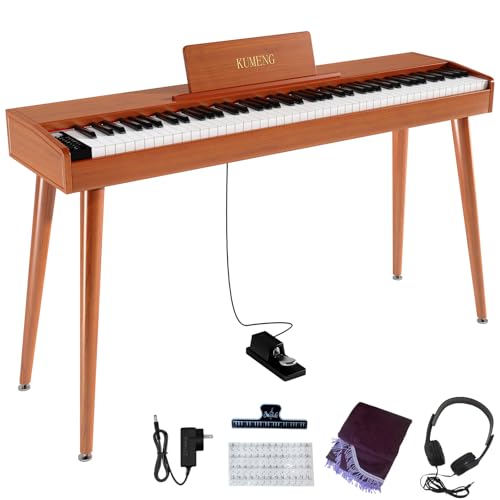
- 88 semi-weighted keys with 800 tones
- USB/MIDI and split-key functions
- Includes stand, pedal, and power adapter
Best For: Beginner home practice and versatile digital piano use
Versatile Controller

- 61 full-size semi-weighted velocity-sensitive keys
- Pitch/modulation wheels and DAW control buttons
- USB powered with bundled production software
Best For: Studio and stage players wanting a spacious 61-key controller
Full-Range Piano
88-Key Semi-Weighted Digital Piano

- 88 velocity-sensitive semi-weighted keys
- USB-MIDI plus wireless MIDI and audio
- 800 tones, 600 rhythms, and recording
Best For: Beginners wanting a full-size piano and MIDI setup
Compact Workstation

- 49 full-size velocity-sensitive synth-action keys
- Pitch/modulation wheels and DAW transport controls
- Compact USB-powered design with software bundle
Best For: Producers needing a portable, space-saving controller
Best Full-Size Option
AiJoy 88-Key Weighted Digital Piano

- Fully weighted hammer-action keys
- Wireless and USB-MIDI connectivity
- Triple pedal system included
Best For: Home piano practice and expressive playing
Best Compact Controller
Novation Launchkey Mini 37 MK4

- 37 mini synth-action keys
- 16 pads with polyphonic aftertouch
- Scale, chord, and arpeggiator modes
Best For: Portable DAW-based music production
Best Simple Pick
88-Key Semi-Weighted Digital Piano

- 88 semi-weighted keys
- Includes stand, case, headphones, and pedal
- USB-MIDI and MIDI support
Best For: First-time players wanting a complete setup
Best Studio Controller – M-Audio Keystation 88 MK3
For producers seeking midi keyboards with weighted keys, the M-Audio Keystation 88 MK3 offers a full-size 88-key layout with semi-weighted, velocity-sensitive keys. Its straightforward USB connection, essential performance controls, and bundled software make it a practical centerpiece for computer-based music production.
Best For: Home studios, producers who need an expansive keyboard range, and players controlling virtual instruments from a Mac, PC, or compatible iOS device.
Pros:
- 88 full-size semi-weighted, velocity-sensitive keys
- Includes pitch and modulation wheels, transport controls, and octave buttons
- USB plug-and-play operation with no separate power supply required
- Includes several music-production software titles
Cons:
- It is a controller rather than a standalone piano with built-in voices or speakers
- At 54.24 inches wide, it needs substantial desk or stand space
- The Apple to USB Camera Adapter for iOS use is sold separately
The Keystation 88 MK3 is a sensible choice when range and software control matter more than onboard sounds. Its semi-weighted action is useful for expressive MIDI parts, though players specifically wanting acoustic-piano-style hammer action may prefer a digital piano.
Best Piano Feel – Yamaha P71 88-Key Digital Piano
The Yamaha P71 is a strong option for shoppers comparing midi keyboards with weighted keys but wanting a more complete piano experience. Its 88 touch-sensitive weighted-action keys, built-in speakers, piano voices, and included sustain pedal support focused practice and expressive playing.
Best For: Beginners, piano learners, and players who want weighted action with built-in sounds and simple controls rather than an extensive DAW-control surface.
Pros:
- 88 weighted-action keys designed to replicate an acoustic piano feel
- Includes built-in speakers and 10 instrument voices
- Dual Mode can layer sounds such as piano and strings
- Sustain pedal and power supply are included
Cons:
- Its one-button design offers fewer hands-on production controls than a dedicated MIDI controller
- It is a full digital piano rather than a slim desktop keyboard
- The supplied notes do not list bundled recording software
The P71 is better suited to piano-first use than controller-heavy studio workflows. Choose it when authentic-feeling weighted action, onboard sound, and uncomplicated operation are higher priorities than pads, faders, and extensive DAW integration.
Best DAW Workflow – Novation Launchkey 49 MK4
The Novation Launchkey 49 MK4 combines semi-weighted keys with a broad set of performance and production controls. Among midi keyboards with weighted keys, it stands out for its 16 polyphonic-aftertouch pads, DAW integration, scale and chord modes, and compact 49-key format.
Best For: Producers and performers who want hands-on control over Ableton Live or other major DAWs, plus pads for clip launching, sequencing, and drumming.
Pros:
- 49 semi-weighted keys with pitch and modulation wheels
- 16 FSR pads support polyphonic aftertouch, sequencing, and clip launching
- Works with Ableton Live, Logic, Cubase, Reason, Reaper, FL Studio, and Ardour
- Scale, chord, and arpeggiator features support creative composition
Cons:
- Its 49-key range is smaller than an 88-key piano layout
- It is a USB MIDI controller without built-in speakers or standalone instrument voices listed
- Players seeking fully weighted hammer action may want a dedicated digital piano
The Launchkey 49 MK4 is the most workflow-focused option here. It balances a moderately sized semi-weighted keybed with extensive DAW and pad control, making it a better fit for production and live electronic performance than traditional piano practice.
Best Beginner Bundle – KUMENG 88-Key Semi-Weighted Digital Piano
This KUMENG digital piano offers an accessible entry point for shoppers seeking midi keyboards with weighted keys and built-in piano functionality. Its 88 semi-weighted keys, 800 tones, USB/MIDI connectivity, split function, recording controls, and included stand and pedal create a broad beginner-oriented package.
Best For: Beginners and home players who want a full-size digital piano with many sounds, learning-friendly controls, and connections for phones, tablets, or computers.
Pros:
- Full-size 88-key semi-weighted keyboard
- Offers 800 tones and 128-note polyphony
- Includes a piano stand, sheet music stand, pedal, and power adapter
- USB/MIDI connectivity supports computers, tablets, and compatible applications
Cons:
- Semi-weighted action may not feel like fully weighted acoustic-piano hammer action
- The supplied notes list a 3.5mm headphone jack but do not specify built-in speakers
- Its larger furniture-style design is less portable than a slim MIDI controller
The KUMENG is geared toward value and versatility for developing players. Its extensive tone selection and included accessories are useful for home learning, while USB/MIDI support keeps it compatible with computer-based music applications.
Versatile Controller – M-Audio Keystation 61 MK3
For musicians seeking midi keyboards with weighted keys, the M-AUDIO Keystation 61 MK3 offers 61 full-size, velocity-sensitive semi-weighted keys with a natural playing feel. Its USB plug-and-play setup, software controls, pitch and modulation wheels, and bundled production software make it a practical centerpiece for a computer-based studio.
Best For: Producers and players who want a spacious 61-key semi-weighted controller for studio, stage, or desk use.
Pros:
- 61 full-size semi-weighted, velocity-sensitive keys capture performance dynamics.
- Includes pitch and modulation wheels, volume fader, transport controls, octave buttons, and sustain-pedal input.
- USB-powered and compatible with Mac, Windows, and iOS devices with the appropriate adapter.
- Includes MPC Beats, Ableton Live Lite, AIR instruments, Touch Loops, and lesson access.
Cons:
- Requires a separate Apple to USB Camera Adapter for iOS compatibility.
- Its 61-key layout takes more desk space than compact controllers.
The Keystation 61 MK3 is a strong middle ground for players who want more range than a compact keyboard without moving to a full 88-key instrument. It is particularly appealing when bundled software and hands-on DAW controls matter.
Full-Range Piano – 88-Key Semi-Weighted Digital Piano
This 88-key digital piano suits shoppers comparing midi keyboards with weighted keys who also want built-in sounds and speakers. Its semi-weighted, velocity-sensitive action is paired with USB-MIDI, wireless MIDI and audio support, 800 tones, 600 rhythms, recording, and beginner-friendly practice features.
Best For: Beginners and all-level players who want a full-size digital piano that can also connect to computers, tablets, and music apps.
Pros:
- Full-size 88-key semi-weighted keyboard offers velocity sensitivity and quick rebound.
- Supports USB-MIDI, wireless MIDI, and wireless audio connectivity.
- Includes 800 tones, 600 rhythms, 80 demo songs, recording, layering, split, and transposition functions.
- Comes with a sustain pedal, music stand, and key stickers.
Cons:
- Its 51.6-inch width and 14.6-inch depth require substantial space.
- It is a digital piano with built-in functions rather than a streamlined controller-only keyboard.
Choose this model if authentic piano-style range and standalone practice features are as important as MIDI connectivity. The built-in speakers, headphone output, rhythms, and app connections give it broader home-use appeal than a basic MIDI controller.
Compact Workstation – M-Audio Keystation 49 MK3
The M-AUDIO Keystation 49 MK3 is a compact option for shoppers exploring midi keyboards with weighted keys, though its keys use synth action rather than true weighted action. It provides 49 full-size velocity-sensitive keys, essential DAW controls, pitch and modulation wheels, and USB plug-and-play operation in a desk-friendly format.
Best For: Home producers and performers who need full-size keys and expressive controls without the footprint of a 61- or 88-key instrument.
Pros:
- 49 full-size velocity-sensitive keys provide dynamic control in a compact layout.
- Includes volume, transport, directional, octave, pitch-wheel, and modulation controls.
- USB connection works with Mac, Windows, and compatible iOS setups without a separate power supply.
- Includes Ableton Live Lite, MPC Beats, AIR instruments, Touch Loops, and lesson resources.
Cons:
- Uses synth-action keys, so it does not provide a weighted or semi-weighted piano feel.
- iOS use requires an Apple to USB Camera Adapter sold separately.
The Keystation 49 MK3 is best viewed as a practical, portable controller rather than a weighted-key piano substitute. Its 49-key range and useful software controls make it a sensible choice for producers prioritizing workspace and portability.
Best Full-Size Option – AiJoy 88-Key Weighted Digital Piano
If you want midi keyboards with weighted keys that feel closer to an acoustic piano, the AiJoy offers a full 88-key layout with fully weighted hammer action. Its broad sound selection, wireless MIDI, and triple-pedal system make it suited to home practice and more expressive playing.
Best For: Beginners, home musicians, and players who want a furniture-style digital piano with piano-like key resistance.
Pros:
- 88 fully weighted hammer-action keys with responsive touch.
- Wireless MIDI and USB-MIDI support for apps and music creation.
- Triple pedal system includes sustain, soft, and sostenuto controls.
- Includes 128 voices, 128 rhythms, 64-note polyphony, and 80 demo songs.
Cons:
- At 44 pounds, it is less portable than compact MIDI controllers.
- Its full-size furniture-style design requires more floor space.
The AiJoy is the strongest choice here for traditional piano practice and weighted-key feel. Choose it if you value a complete digital piano setup over portability.
Best Compact Controller – Novation Launchkey Mini 37 MK4
The Novation Launchkey Mini 37 MK4 is a compact MIDI controller for producers who prioritize DAW control and hands-on music creation. It does not use weighted keys—instead, its 37 mini synth-action keys pair with performance-focused pads, sequencing tools, and deep software integration.
Best For: Bedroom producers, electronic musicians, and DAW users who need a portable controller with creative performance features.
Pros:
- Works with major DAWs including Ableton Live, Logic, Cubase, Reason, Reaper, FL Studio, and Ardour.
- Includes 16 responsive FSR pads with polyphonic aftertouch.
- Scale, chord, and arpeggiator modes support faster idea creation.
- Compact 2.1-pound design is easy to move between setups.
Cons:
- The 37 mini keys are synth-action rather than weighted.
- It is less suitable for traditional piano technique and realistic hammer-action practice.
Although it is not a weighted-key keyboard, the Launchkey is a practical alternative when portability, pads, and DAW workflow matter more than acoustic-piano feel.
Best Simple Pick – 88-Key Semi-Weighted Digital Piano
This 88-key digital piano is a beginner-friendly option for shoppers comparing midi keyboards with weighted keys on a budget. Its semi-weighted keys provide some piano-style resistance while remaining more responsive than fully weighted action, and the bundle includes accessories for getting started immediately.
Best For: Beginners and adults who want a complete starter package for practice, lessons, and basic MIDI recording.
Pros:
- Full 88-key layout with semi-weighted touch response.
- USB-MIDI and MIDI functions support phones, computers, and music apps.
- Bundle includes stand, carrying case, headphones, sustain pedal, music rest, and power adapter.
- Offers 1,000 timbres, 1,000 rhythms, 150 demo songs, and recording/playback.
Cons:
- Semi-weighted keys provide less resistance than fully weighted hammer action.
- The large accessory bundle may be less convenient for minimalist setups.
This package makes sense for beginners who want 88 keys and essential accessories without assembling a separate setup. Choose it when convenience and value outweigh the more realistic feel of fully weighted action.
How We Picked the Best Midi Keyboards with Weighted Keys
We compared these 10 options by focusing on the factors that matter most in everyday use: key count, action type, MIDI connectivity, included accessories, portability, and intended role. Because the list includes both dedicated USB MIDI controllers and digital pianos with MIDI functions, we considered whether each model is best suited to studio production, piano practice, live performance, or a first keyboard setup.
We also looked for practical value. A full-size weighted keyboard may provide the most convincing piano experience, but a 49- or 61-key controller can be easier to place and more useful for music production. Semi-weighted models can be a sensible compromise when budget and portability matter.
Quick Comparison
| Best For | Recommended Type | What to Prioritize |
|---|---|---|
| Traditional piano practice | 88-key hammer-action digital piano | Weighted action, sustain pedal, built-in sounds |
| DAW composition | USB MIDI controller | Software integration, controls, key range |
| Portable production | 37- or 49-key controller | Compact size, USB power, playable range |
| Beginner all-in-one setup | Digital piano keyboard | Included pedal, power supply, sounds, stand options |
Key Buying Factors for Midi Keyboards with Weighted Keys
Key Action and Feel
Fully weighted or hammer-action keys are the closest match to an acoustic piano and are usually preferable for classical technique, expressive playing, and regular practice. Semi-weighted keys feel lighter and may be faster for synth parts, but they do not provide the same resistance or dynamic response.
Key Count and Space
An 88-key model gives you the complete piano range without octave shifting. It is the strongest choice for serious piano work, but it needs substantial desk or stand space. Sixty-one keys suit broader arrangements, while 49 or 37 keys are easier to transport and often more practical for studio workflows.
Controller Features and Compatibility
Check whether you need only USB MIDI or also want knobs, pads, transport controls, MIDI DIN connections, or deep DAW integration. Confirm compatibility with your computer, tablet, or recording software before buying. A controller typically needs an external software instrument, while a digital piano may include onboard sounds.
Accessories and Setup
Included pedals, power supplies, music stands, and keyboard stands can materially affect total cost. Also consider sustain-pedal compatibility, headphone output, speakers, and whether the instrument can sit comfortably at the correct playing height.
Who Should Buy Which Midi Keyboards with Weighted Keys?
Choose an 88-key weighted or hammer-action model if realistic piano feel, full range, and technique development are your priorities. These are best for pianists, students, and players who want one instrument for practice and MIDI recording.
Choose a semi-weighted 88-key digital piano if you want a full range and a more accessible price, while accepting a less authentic acoustic-piano response.
Choose a 49- or 61-key controller if you primarily make music in a DAW and need a balance between playable range and desk space. These are especially useful for producers who value software controls over built-in sounds.
Choose a compact 37-key controller for mobile setups, small workspaces, and beat-making. It is the most convenient format, but octave changes are more likely when playing piano-style parts.