The best wireless in-ear monitor systems with earbuds help musicians hear a consistent mix without relying on floor wedges or running cables across the stage. The right setup can improve mobility, reduce stage clutter, and make rehearsals more focused.
These 10 systems cover practical options for solo performers, bands, worship teams, studios, and larger setups. Compare channel capacity, stereo support, operating range, battery life, and receiver design before choosing.
Best 10 Wireless in Ear Monitor Systems with Earbuds Picks for 2026
Best Low-Latency Pick

- Less than 5ms latency
- Six simultaneous channels
- Up to five hours of battery life
Best For: Individual performers and small teams needing compact, responsive monitoring
Best for Bands
Phenyx Pro PTM-33-4B UHF IEM System

- Four independent mono mixes
- Includes four receivers and earbuds
- UHF operation with IR syncing
Best For: Four-member bands, worship teams, and stage productions
Best Compact Setup
Xvive U4 Single-Transmitter Kit
- Over 90 feet of working range
- Less than 5ms latency
- Rechargeable five-hour battery
Best For: Solo performers and small-club personal monitoring
Best Battery Life
M6S Stereo Wireless IEM System

- Up to 10 hours of battery life
- Automatic transmitter-receiver pairing
- Mono/stereo switching
Best For: Performers needing long runtime and included in-ear headphones
Flexible UHF Monitoring

- Antenna diversity helps limit dead spots.
- Three inputs support flexible connections.
- Up to 262 feet of listed coverage.
Best For: Mono stage monitoring with adaptable UHF connectivity
Professional Stereo Control
Phenyx Pro PTM-10 Wireless IEM

- Stereo/mono modes support different monitoring needs.
- 89 tunable frequencies help manage interference.
- Includes earbuds and rack-mount accessories.
Best For: Stage and studio monitoring with stereo control
Portable Rechargeable Setup

- Charging case supports up to 30 hours of use.
- One transmitter supports multiple receivers.
- Auto-pairing and OTG support simplify setup.
Best For: Portable rehearsals and multi-performer monitoring
Best Metal UHF System

- Two receivers and earbuds included
- 100 selectable UHF frequencies
- Rugged metal transmitter for stage use
Best For: Bands, worship teams, and live performers needing two mono monitor feeds
Best Low-Latency Compact System

- Under 4.5ms mono latency
- Supports up to four receiver pairs
- Earbuds sold separately
Best For: Portable group monitoring and small-stage performances
Best Multi-Receiver Value
- Supports up to six receiver sets
- Stereo or mono transmission
- More than five hours of battery life
Best For: Bands and groups sharing one monitor transmitter
Best Low-Latency Pick – Xvive U4 Wireless IEM System
The Xvive U4 is a practical choice for shoppers seeking wireless in ear monitor systems with earbuds for rehearsals, studio work, and live performances. Its 2.4GHz connection delivers uncompressed audio with less than 5ms latency, while the metal construction and rechargeable batteries suit regular gigging.
Best For: Individual performers or small teams that need a compact, low-latency monitor system with flexible XLR or 1/4-inch input compatibility.
Pros:
- Less than 5ms latency with 24-bit/48kHz audio processing.
- Six channels can operate simultaneously without interference.
- Rechargeable batteries provide up to five hours of use.
- Includes a 1/4-inch adapter and supports balanced XLR or unbalanced TS input.
Cons:
- Battery life is limited to about five hours per charge.
- Mono monitoring rather than stereo monitoring.
- Earbuds are not included in the listed box contents.
The U4 balances simple setup, sturdy construction, and responsive performance. It is especially appealing when low latency matters more than extended battery life or stereo sound.
Best for Bands – Phenyx Pro PTM-33-4B UHF IEM System
The Phenyx Pro PTM-33-4B is designed for bands and teams comparing wireless in ear monitor systems with earbuds. Its integrated transmitter supports four independent monitoring mixes, and the package includes four receivers and four in-ear earphones for a ready-to-use group setup.
Best For: Four-member bands, worship teams, stage productions, and sound engineers who need multiple mono mixes from one rack-mountable system.
Pros:
- Provides four standalone mixes through four receiver channels.
- Includes four bodypack receivers and four in-ear earphones.
- Offers 4×25 UHF frequencies to help avoid interference.
- Supports IR syncing and includes a rackmount kit.
Cons:
- Mono monitoring only.
- Listed range depends on line of sight and can be reduced by walls, glass, or metal.
- Requires eight AA batteries for the receivers.
This is the strongest group-oriented option in the lineup. The four independent mixes and included earbuds reduce the need to assemble a multi-performer monitoring rig piece by piece.
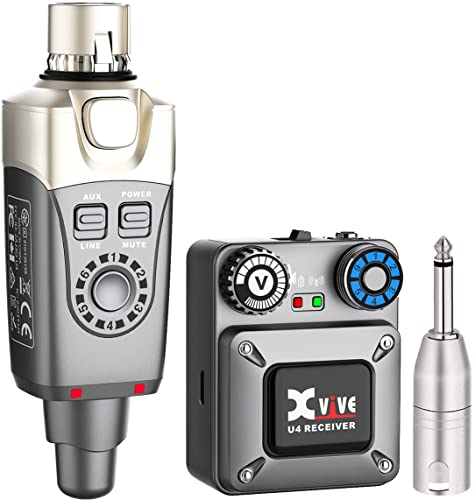
Best Compact Setup – Xvive U4 Single-Transmitter Kit
The Xvive U4 single-transmitter kit is a straightforward option for anyone shopping for wireless in ear monitor systems with earbuds for small venues, rehearsals, or personal stage monitoring. Its 2.4GHz wireless connection reaches over 90 feet and keeps latency below 5ms.
Best For: Solo performers and small-club users who want a compact transmitter-and-receiver kit with rechargeable power.
Pros:
- Provides more than 90 feet of working range.
- Less than 5ms latency helps minimize performance distraction.
- Six channels support simultaneous broadcasts.
- Rechargeable transmitter and receiver batteries last up to five hours.
Cons:
- The package includes only one receiver.
- Earbuds are not listed among the included items.
- It offers a shorter battery window than the M6S system.
With its small footprint and simple contents, this U4 kit is suited to personal monitoring rather than outfitting an entire band. The range and low latency make it a practical choice for compact performance setups.
Best Battery Life – M6S Stereo Wireless IEM System
The M6S stands out among wireless in ear monitor systems with earbuds for its stereo-capable design, automatic pairing, and extended battery rating. Its 2.4GHz connection uses 24-bit/48kHz processing, and one transmitter can pair with multiple receivers for church, stage, and rehearsal applications.
Best For: Performers who want included in-ear headphones, automatic pairing, stereo-or-mono operation, and up to 10 hours of battery life.
Pros:
- Offers a one-button mono/stereo input switch.
- Automatic pairing simplifies setup.
- Built-in rechargeable batteries provide up to 10 hours of use.
- Up to six units can work simultaneously with one transmitter.
Cons:
- The supplied notes do not specify a working range or latency figure.
- Only one receiver and one pair of in-ear headphones are included.
- Requires about three hours to charge.
The M6S is a flexible, long-running package for users who prioritize battery endurance and included earbuds. Its automatic pairing also makes it convenient when quick setup is important.
Flexible UHF Monitoring – SGPRO SG-40NA Mono IEM System
The SGPRO SG-40NA is a practical choice among wireless in ear monitor systems with earbuds for performers who need stable mono monitoring and flexible mixer connectivity. Its UHF transmission, antenna diversity, three inputs, and selectable power modes support setups requiring dependable reception across spaces up to 262 feet.
Best For: Live performers, worship teams, and small production setups needing mono monitoring with multiple input options.
Pros:
- Antenna diversity helps reduce dead spots and maintain clear reception.
- UHF operation includes 85 selectable frequencies for crowded RF environments.
- Three inputs, including XLR and 1/4-inch connections, support varied audio equipment.
- One transmitter can connect to multiple receivers, with coverage up to 262 feet.
Cons:
- This is a mono system rather than a stereo monitoring solution.
- The transmitter is corded electric, so it requires nearby power.
- The included receiver battery life is listed at approximately six hours.
Choose this model when reception stability and installation flexibility matter more than portability or stereo imaging. Its half-rack transmitter and LCD display also suit compact, organized rigs.
Professional Stereo Control – Phenyx Pro PTM-10 Wireless IEM
The Phenyx Pro PTM-10 stands out among wireless in ear monitor systems with earbuds for users who want stereo monitoring and detailed control. Its 900MHz band, 89 selectable frequencies, stereo/mono switching, EQ, balance, limiter, and rack-mountable metal transmitter make it suited to more demanding stage and studio systems.
Best For: Bands, worship teams, speakers, and studio users who need stereo monitoring with adjustable signal management.
Pros:
- True stereo and mono modes provide adaptable monitoring options.
- Selectable frequencies support up to five systems operating simultaneously.
- EQ, balance, limiter, PAD, and lock functions add useful control.
- Includes earbuds, carrying case, rack-mount kit, batteries, and hybrid XLR/6.3mm inputs.
Cons:
- Listed operating coverage is 160 feet, shorter than some longer-range systems.
- The system uses replaceable AA batteries in the bodypack rather than a stated rechargeable design.
- Its rack hardware and controls may be more equipment than casual users need.
This is a strong fit for professional-style installations where stereo clarity, interference management, and configuration controls are priorities. The included accessories also make it easier to move between venues.
Portable Rechargeable Setup – LEKATO MS-20 Wireless IEM
The LEKATO MS-20 is a compact option among wireless in ear monitor systems with earbuds, although its supplied package does not include earphones. It pairs one transmitter with two receivers, offers auto-pairing, OTG support, mono/stereo switching, and up to 30 hours of use with the charging case, making it convenient for rehearsals and mobile performances.
Best For: Bands, singers, instrumentalists, and rehearsal spaces that prioritize rechargeable portability and multiple receivers.
Pros:
- The charging case provides up to 30 hours of listed usage for the transmitter and two receivers.
- One transmitter can support up to 10 receiver pairs.
- Auto-pairing and OTG support simplify connections with USB-C devices.
- Low-noise, low-latency transmission offers 24-bit/48kHz audio within a listed 150-foot range.
Cons:
- Earphones are not included, so compatible earbuds must be supplied separately.
- Its 2.4GHz connection may be less suitable for especially crowded wireless environments.
- The listed 150-foot range is intended for open areas and may vary by venue.
Consider the MS-20 when quick setup, charging convenience, and shared monitoring are more important than a complete out-of-box earbud package. Its small clip-on receivers are particularly practical for rehearsals and gigs.
Best Metal UHF System – Phenyx Pro PTM-22
For performers who need wireless in ear monitor systems with earbuds included, the Phenyx Pro PTM-22 offers a sturdy UHF setup with two bodypack receivers and separate outputs. Its selectable frequencies and metal transmitter make it a practical choice for bands, worship teams, and live-event monitoring.
Best For: Bands, singers, church worship teams, studios, and live performers who need two wireless mono monitoring channels.
Pros:
- Includes two UHF bodypack receivers and two in-ear earbuds.
- Provides 100 selectable frequencies through its 2×50-channel design.
- Metal transmitter, LCD display, rackmount kit, and carry case support regular stage use.
Cons:
- Uses mono monitoring rather than stereo audio.
- Its transmitter-based setup is less compact than the clip-on 2.4GHz alternatives.
The PTM-22 is the more traditional stage-oriented option in this group. Choose it when durability, included earbuds, and frequency flexibility matter more than a compact rechargeable design.
Best Low-Latency Compact System – LEKATO MS-02
The LEKATO MS-02 is a compact option among wireless in ear monitor systems with earbuds, supporting mono or stereo transmission, automatic pairing, and a low-latency wireless connection. Note that earbuds are not included, so you will need compatible earphones to complete the setup.
Best For: Singers, small or medium stage groups, recording users, and church performers who value portability and multiple receivers.
Pros:
- Offers mono latency below 4.5ms and 24-bit/48kHz audio.
- One transmitter can support up to four receiver pairs.
- Provides 6–8 hours of operation, volume controls, status LEDs, and a one-key mute function.
Cons:
- Earbuds are not included in the package.
- The stated 100-foot range is specified for open areas.
With its rechargeable clip-on design and multi-receiver capability, the MS-02 suits performers who want a simple wireless workflow. It is especially appealing for groups sharing one monitor mix, provided you supply your own earbuds.
Best Multi-Receiver Value – LEKATO MS-1
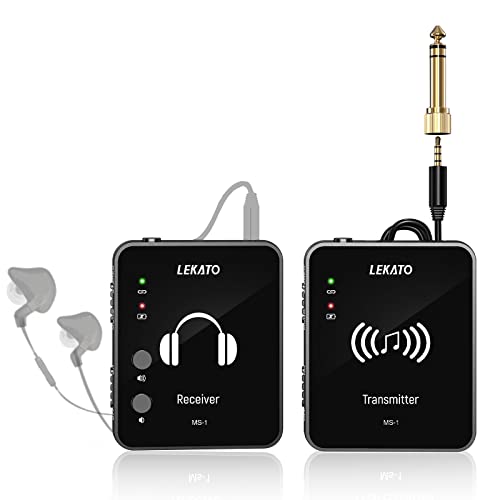
The LEKATO MS-1 is a flexible pick for wireless in ear monitor systems with earbuds when several performers need the same signal. It supports stereo or mono transmission, automatic pairing, and up to six receiver sets, though the supplied package does not list earbuds among its included components.
Best For: Small and medium bands, rehearsal rooms, churches, studios, and groups sharing one transmitter.
Pros:
- Supports up to six receiver sets with one transmitter.
- Provides stereo transmission plus a one-key mono/stereo switch.
- Offers under-12ms latency, 24-bit/48kHz transmission, and a 100-foot open-area range.
- Rechargeable battery provides more than five hours of use.
Cons:
- Earbuds are not listed as included, so separate in-ear earphones may be required.
- Battery life is shorter than the MS-02’s stated 6–8 hours.
The MS-1 stands out when one audio source must reach several performers. Its six-receiver capacity and stereo support make it a useful rehearsal or small-gig system, while its compact clip-on format keeps setup straightforward.
How We Picked the Best Wireless in Ear Monitor Systems with Earbuds
We focused on the features that matter most during rehearsals, performances, and monitoring applications: wireless stability, usable range, audio mode, channel flexibility, battery performance, receiver durability, setup simplicity, and value. We also considered whether each system is better suited to one performer, multiple musicians, or a rack-mounted professional rig.
Because included earbuds vary in fit and sound quality, they should be treated as part of the overall package rather than the only measure of performance. A system with a dependable transmitter and receiver can remain useful even if you later upgrade to higher-quality in-ear monitors.
Quick Comparison
| System type | Best for | Key advantage |
|---|---|---|
| Mono single-channel | Simple live monitoring | Easy setup and lower cost |
| Mono multi-channel | Bands and production teams | Multiple independent monitoring paths |
| Stereo | Detailed music mixes | More spacious, natural monitoring |
| One-to-many | Groups sharing a mix | Several receivers from one transmitter |
| Rack-mountable UHF | Fixed installations and stages | Organized, scalable deployment |
Key Buying Factors for Wireless In-Ear Monitor Systems with Earbuds
Mono or Stereo Audio
Mono is often sufficient for vocals, announcements, cues, and straightforward band mixes. Stereo is preferable when you need instrument separation, panning, or a more natural listening experience. Confirm that both the transmitter and receiver support the mode you want.
Frequency and Wireless Environment
UHF systems may offer useful range and selectable channels, while 2.4GHz systems are often convenient to pair and operate. Local interference, venue equipment, and regional regulations can affect performance, so selectable frequencies and scan-friendly controls are valuable for busy stages.
Range, Latency, and Reliability
Check the manufacturer’s stated range, but expect walls, people, antennas, and other wireless devices to reduce it. Low latency is particularly important for singers and instrumentalists because noticeable delay can make performing uncomfortable.
Battery and Receiver Design
Look for enough runtime for the entire show, plus charging indicators and practical spare-battery options. A lightweight beltpack with secure clips and accessible controls is easier to use than a receiver that is bulky or difficult to adjust mid-performance.
Inputs, Outputs, and Expansion
Verify connector compatibility with your mixer, audio interface, or stage box. If several musicians need separate mixes, choose a multi-channel system rather than assuming one transmitter can provide independent audio to every receiver.
Who Should Buy Which Wireless in Ear Monitor Systems with Earbuds?
Solo performers and small setups: Choose a straightforward mono or compact stereo system with simple pairing and a lightweight receiver.
Bands and worship teams: Prioritize multi-channel UHF systems or one-to-many designs, especially when several performers share a monitor mix.
Musicians who want a fuller mix: Select a stereo system with low latency and enough headroom for vocals, instruments, and backing tracks.
Studios and permanent stages: A rack-mountable system with selectable frequencies and robust bodypacks is usually the better long-term investment.