The best channel strips for vocals combine several recording essentials—preamp gain, compression, EQ, de-essing, gating, or limiting—in one streamlined signal path. That can help you capture a more controlled vocal before it reaches your interface or mixer.
This roundup covers versatile options for home studios, podcast setups, live rigs, and professional recording rooms, including tube, solid-state, rackmount, and 500 Series designs.
Best 10 Channel Strips for Vocals Picks for 2026
Versatile Vocal Control

- Mic preamp with four dedicated processing sections
- De-esser helps manage vocal sibilance
- 1U rack design with loop-out and LED metering
Best For: Home studios, streaming, and live vocal setups
Connected Tube Warmth

- Tube preamp designed for warmth and definition
- Compressor, expander, de-esser, and gate included
- USB and multiple digital-output formats
Best For: Digital recording setups needing tube vocal processing
Classic EQ Character

- Transformer-balanced Class A mic/line/DI preamp
- Up to 80 dB of gain
- Highpass filter and three-band EQ
Best For: Vocal chains prioritizing preamp tone and EQ
Tube Studio Flexibility

- Class A 12AX7 tube preamp with tube drive
- VCA compressor with automatic attack/release
- Flexible three-band EQ with parametric mid band
Best For: Studios wanting analog tube, compression, and EQ control
Transformer-Tone Vocal Front End

- Class A, one-channel microphone/line preamp
- Carnhill transformers and 3-band inductor EQ
- Highpass filter and switchable mic impedance
Best For: Analog vocal recording with hands-on preamp and EQ control
USB Vocal Recording Hub

- One-channel mic/line preamp with USB interface
- Compressor, gate/expander, and de-esser included
- USB support with up to 192 kHz sample rate
Best For: Computer-based vocal recording and podcasting
Analog Noise-Control Vocal Processor

- Analog noise gate and expander/gate processing
- Targets ambient and preamp-floor noise
- Requires placement after a mic preamp or line-level chain
Best For: Cleaning up noisy vocal and podcast signal chains
Premium Vocal Control

- Discrete preamp with Lundahl I/O transformers
- Compressor, Transient Designer, and tube saturation
- Mono format for focused vocal-chain processing
Best For: Dedicated vocal tracking chains needing broad tone and dynamics control
Compact SSL Workflow

- Three 500 Series channel-strip modules
- SSL mic preamp, EQ, and dynamics per module
- Standard 500 Series rack compatibility
Best For: Expandable studios needing multiple SSL-style tracking channels
Tube Vocal Shaping
dbx 676FX Tube Mic Preamp Channel Strip
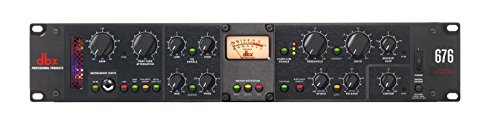
- 250-volt Class-A tube preamp
- Compressor, limiter, and sweepable-mid EQ
- XLR and 1/4-inch connectivity with side-chain insert
Best For: Vocal chains needing tube tone plus detailed EQ and dynamics control
Versatile Vocal Control – dbx 286s Channel Strip
The dbx 286s is a practical choice for channel strips for vocals when you want microphone preamplification plus several dedicated processing stages in one rack unit. Its compressor, de-esser, enhancer, and expander/gate provide useful tools for shaping speech, singing, and other single-channel sources.
Best For: Home studios, vocal recording, streaming, and live setups that need straightforward vocal dynamics and sibilance control.
Pros:
- Combines a mic preamp with compression, de-essing, enhancement, and expansion/gating.
- Dedicated de-esser helps reduce harsh high frequencies and sibilance.
- Rack-mountable 1U design includes status LEDs and a loop-out for additional processors.
Cons:
- Single-channel design limits use with stereo sources.
- Its wired, corded-electric format is intended for fixed studio or rack setups.
The 286s stands out for covering the core vocal-processing stages without requiring multiple separate units. It is especially appealing when ease of monitoring and a compact rack format matter more than digital connectivity.
Connected Tube Warmth – ART VoiceChannel
The ART VoiceChannel suits channel strips for vocals when you want tube-based preamp character alongside dynamics processing and flexible digital outputs. Its compressor, expander, de-esser, and gate provide a broad set of tools for recording a single vocal channel.
Best For: Recording systems that need tube preamp warmth, vocal dynamics control, and connections to USB or digital interfaces.
Pros:
- ART Tube Preamp design is intended to provide warmth and definition.
- Includes compressor, expander, de-esser, and gate for flexible processing.
- Offers USB, ADAT, AES/EBU, S/PDIF, and TOSLink digital connectivity.
Cons:
- Single-channel operation is less suited to stereo processing.
- Its extensive digital connectivity may be unnecessary for simpler analog-only setups.
With both analog vocal processing and multiple digital-output options, the VoiceChannel is a flexible centerpiece for a modern recording chain. It is a strong fit when integration options are as important as preamp tone.
Classic EQ Character – Neve 1073SPX
The Neve 1073SPX is aimed at buyers seeking a focused preamp-and-EQ solution among channel strips for vocals. Its transformer-balanced Class A circuitry, up to 80 dB of gain, highpass filter, polarity reverse, and three-band EQ provide a classic signal-shaping foundation.
Best For: Vocal recording chains where high-quality microphone preamplification and hands-on three-band EQ are the priority.
Pros:
- Transformer-balanced Class A circuitry delivers a dedicated preamp design.
- Provides up to 80 dB of gain for microphone sources.
- Includes highpass filtering, polarity reverse, and three-band EQ.
Cons:
- Does not list built-in compression, de-essing, or gating.
- Its feature set is more focused than an all-in-one vocal processor.
The 1073SPX is best understood as a premium preamp/EQ module rather than a complete vocal effects chain. Choose it when source tone and EQ control matter more than having every dynamics processor built in.
Tube Studio Flexibility – PreSonus StudioChannel
The PreSonus StudioChannel combines a high-voltage Class A tube preamp, VCA compressor, and three-band EQ, making it a versatile option among channel strips for vocals. It also includes practical recording controls such as phantom power, polarity reverse, a highpass filter, and a pad.
Best For: Project and professional studios shaping vocals with tube drive, flexible compression, and parametric EQ.
Pros:
- 12AX7 tube preamp offers gain and tube-drive control.
- VCA compressor includes automatic attack/release and selectable soft or hard knee.
- Three-band EQ provides a variable-Q mid band plus shelving or peak options for low and high bands.
Cons:
- Its 1U rack format requires a suitable rack or studio placement.
- Analog-focused design does not list digital or USB connectivity.
The StudioChannel offers substantial hands-on control for recording and tone shaping in one rugged rack unit. It is a sensible choice for users who want tube coloration and detailed compression/EQ options without relying on software processing.
Transformer-Tone Vocal Front End – 7603 XMod
The Chameleon Labs 7603 XMod is a focused choice among channel strips for vocals when you want a one-channel Class A microphone preamp with transformer-coupled character and hands-on tone shaping. Its 3-band inductor-based EQ and highpass filter provide practical front-end control before recording.
Best For: Vocalists and home-studio engineers who want a dedicated analog preamp with transformer inputs and outputs.
Pros:
- Carnhill input and output transformers for a dedicated analog signal path.
- 3-band inductor-based EQ and switchable microphone impedance.
- Built-in highpass filter, internal power supply, and XLR/6.35mm connectivity.
Cons:
- Provides one channel, so it is not designed for multichannel tracking.
- At 15.5 pounds, it is relatively substantial for a single-channel unit.
The 7603 XMod is best suited to users who prioritize analog preamp construction and direct EQ control over integrated USB recording or extensive dynamics processing.
USB Vocal Recording Hub – Ultravoice UV1
The Behringer Ultravoice UV1 combines a one-channel mic/line preamp with a USB audio interface, making it a practical option among channel strips for vocals in computer-based setups. Its listed processing includes compression, a gate, and an expander/de-esser for shaping a vocal before or during recording.
Best For: Home-studio vocalists and podcasters who want preamp processing and direct USB connectivity in one unit.
Pros:
- Combines a one-channel mic/line preamp and USB audio interface.
- Includes compressor, gate/expander, and de-esser processing.
- Supports USB connectivity and sample rates up to 192 kHz.
Cons:
- Only one channel is provided for recording.
- Compatibility is listed for Windows 10 and Mac OS X 10.4 or higher, so users should verify their system.
The UV1 stands out when workflow simplicity matters: it puts vocal-oriented dynamics and sibilance control alongside USB interfacing, reducing the need for separate front-end hardware.
Analog Noise-Control Vocal Processor – RO05
The Rodweil RO05 is a specialized add-on for channel strips for vocals, focused on reducing ambient and preamp-floor noise rather than providing a complete microphone preamp. Its fully analog noise gate and expander/gate should be placed after a mic preamp or in a line-level chain, using the included XLR-to-TRS cable.
Best For: Home-studio vocalists, podcasters, and stage users who need analog noise control after a suitable mic preamp.
Pros:
- Designed to reduce ambient background noise and preamp floor noise.
- Fully analog operation is specified for near-zero latency and no signal conversion.
- Compact 3.35 x 2.95 x 1.97-inch enclosure with included XLR-to-TRS cable.
Cons:
- It is not a standalone microphone preamp; a mic should not be connected directly.
- Its higher power consumption and slight power-off circuit echo are noted in the supplied information.
- Noise gating is its primary role, so it does not replace a full vocal channel strip.
The RO05 makes the most sense as a targeted cleanup device in an existing vocal chain. Correct placement after the preamp is essential, but its compact analog design may appeal to users seeking hardware noise control without a software subscription.
Premium Vocal Control – SPL Channel One MK3
The SPL Channel One MK3 is a feature-rich option for anyone comparing channel strips for vocals. Its discrete preamp, Lundahl input and output transformers, compressor, transient processing, and tube saturation provide several stages for shaping a mono vocal signal.
Best For: Vocal recording setups that need detailed tracking control, tonal coloration, and dynamics processing in one mono channel strip.
Pros:
- Combines a discrete preamp with Lundahl I/O transformers.
- Includes compressor and Transient Designer processing.
- Offers tube saturation for additional tonal shaping.
- Uses a stainless-steel construction.
Cons:
- Designed as a mono channel strip, so stereo sources require additional equipment.
- Its 16.78-pound weight and larger dimensions may require a sturdy installation space.
The Channel One MK3 stands out when you want multiple vocal-shaping tools before the signal reaches your interface. It is best suited to a dedicated studio chain where its extensive processing can be used during tracking.
Compact SSL Workflow – SSL SiX Channel 500 Series
This three-pack of SSL SiX Channel 500 Series modules is a practical choice for expanding a rack while building a vocal recording chain. Each module provides an SSL mic preamp, EQ, and dynamics processing in a standard 500 Series format.
Best For: Studios that want multiple SSL channel strips for vocals, additional rack channels, or flexible tracking and mixing setups.
Pros:
- Includes three SiX Channel 500 Series modules.
- Combines SSL mic preamp, EQ, and dynamics processing.
- Fits standard 500 Series rack enclosures.
- Suitable for tracking, mixing, and live use.
Cons:
- Requires a compatible 500 Series rack enclosure for installation.
- The three-module bundle may be more than needed for a single-vocal setup.
Choose this bundle if rack expandability and multiple channels matter as much as the processing itself. Its compact format makes it easier to integrate into an existing 500 Series system than a standalone rack unit.
Tube Vocal Shaping – dbx 676FX Tube Mic Preamp Channel Strip
The dbx 676FX is a versatile option among channel strips for vocals, pairing a 250-volt Class-A tube preamp with compression, limiting, and a 3-band parametric EQ. Its XLR and 1/4-inch connections also support integration with varied studio and live setups.
Best For: Vocalists and engineers who want selectable tube coloration, precise midrange EQ, and built-in dynamics control in a rackmount unit.
Pros:
- High-voltage Class-A tube preamp supports warm, clear, or dirty tones.
- Includes compressor/limiter processing and a side-chain insert.
- Provides 3-band parametric EQ with sweepable mids.
- Offers XLR and 1/4-inch connectivity plus a front-panel instrument input.
Cons:
- Its 2U rackmount format requires dedicated rack space.
- The tube-based design may be more processing capability than a simple vocal chain requires.
The 676FX is a strong fit when you want both tube character and detailed corrective control before recording. Its compressor, limiter, EQ, and side-chain insert make it adaptable for studio tracking or live vocal use.
How We Picked the Best Channel Strips for Vocals
We focused on the features that most directly affect vocal recording: preamp quality, available gain, noise performance, compression and EQ flexibility, de-essing or sibilance control, routing, connectivity, and ease of use. We also considered different workflows, from USB-equipped home-studio setups to dedicated analog front ends for rack or 500 Series systems.
Because vocalists and engineers have different priorities, this list includes both straightforward processors and more advanced channel strips. A unit with many controls is not automatically better; the right choice depends on your microphone, room, interface, and preferred recording workflow.
Quick Comparison
| Best For | Look For |
|---|---|
| Home recording | Low-noise preamp, useful compression, and simple connections |
| Podcasting and streaming | USB connectivity, de-essing, noise gating, and easy monitoring |
| Professional vocal tracking | High-quality preamp, musical EQ, detailed dynamics control, and reliable metering |
| Analog color | Tube circuitry, transformer character, or a selectable saturation stage |
| Compact studio expansion | 500 Series compatibility or a small rack footprint |
Key Buying Factors for Channel Strips for Vocals
Preamp Gain and Noise Performance
Make sure the preamp provides enough clean gain for your microphone. This is especially important with low-output dynamic and ribbon microphones. A quiet input stage matters when recording intimate vocals, spoken word, or heavily compressed tracks.
Compression and Dynamics Control
A compressor can smooth level changes and help a vocal sit consistently in a mix. Look for adjustable threshold, ratio, attack, release, and makeup gain when you want detailed control. A limiter or automatic-style compressor may be more convenient for live use, podcasting, or fast tracking.
EQ, De-Essing, and Tone Shaping
Vocal-friendly EQ should let you reduce muddiness, improve clarity, and add presence without making the track harsh. A dedicated de-esser is useful for controlling strong “s” and “sh” sounds, while an enhancer can add brightness or apparent detail when used carefully.
Connectivity and Workflow
Check whether the unit uses XLR, 1/4-inch, line-level, digital, USB, or 500 Series connections. Confirm that its output level matches your interface or mixer and that monitoring, insert, loop-out, or digital-output features fit your setup.
Tube Versus Solid-State Character
Tube designs may add warmth and harmonic coloration, while solid-state circuits often emphasize clarity, speed, and lower maintenance. Neither approach is universally superior; choose based on the sound you want and how much coloration your microphone and room already provide.
Who Should Buy Which Channel Strips for Vocals?
Choose a USB-equipped channel strip if you want a simple vocal, podcast, or streaming setup with fewer separate components. A compact analog preamp is a better fit if you already own an audio interface and want improved front-end tone or hands-on processing.
Tube models suit singers seeking added warmth and character, while transparent solid-state units are preferable when you want the microphone and performance to remain natural. For engineers who need precise shaping, prioritize full EQ and compressor controls over basic one-knob processing.
Finally, check rack, desktop, or 500 Series compatibility before buying. The best channel strip is the one that matches your signal chain, offers enough control for your recording style, and can remain useful as your studio grows.