Rackmount MIDI interfaces can streamline a studio packed with synthesizers, drum machines, controllers, and multichannel recording gear. The right choice depends on whether you need dedicated MIDI routing, full audio conversion, or both.
This roundup compares 10 options across professional rackmount audio interfaces, compact MIDI utilities, and flexible hybrid setups so you can match features, connectivity, and budget to your workflow.
Best 10 Rackmount Midi Interfaces Picks for 2026
High-Input Rackmount Workhorse
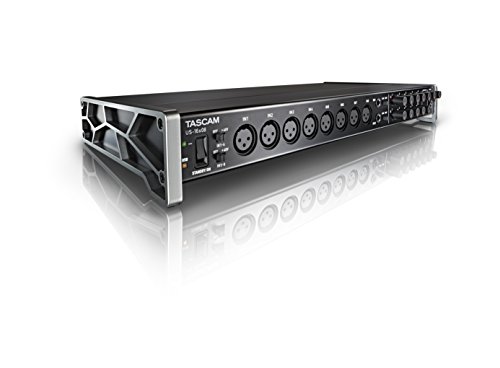
- 16 mic and line inputs over USB
- Eight preamps and eight balanced outputs
- DSP mixer with EQ and compression
Best For: Large recording sessions and drum tracking
Compact MIDI Distribution Hub

- Splits one MIDI input to four outputs
- Multi-voltage MIDI splitter design
- Lightweight hardware for keyboard rigs
Best For: Sending one MIDI source to multiple devices
Premium Rackmount Recording Platform
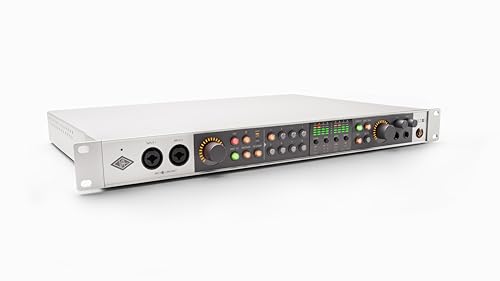
- Eight Vintage preamps and classic compressors
- 32-bit/192 kHz, 24x28 USB audio
- Supports cue mixes and multi-unit expansion
Best For: Professional recording and production studios
Advanced Standalone MIDI Router

- Three MIDI inputs and three MIDI outputs
- Router, filter, merge, split, and thru functions
- USB-C and standalone operation across major OS
Best For: Complex keyboard and synthesizer MIDI rigs
Studio Expansion Pick
Focusrite Scarlett 18i20 4th Gen

- Eight mic preamps plus extensive line and digital I/O
- Includes MIDI, ADAT, S/PDIF, and Word Clock
- Auto Gain, Clip Safe, and 192kHz conversion
Best For: Large home and project studio recording systems
Dedicated MIDI Routing Pick
Crumar GSi 5x5 Rackmount MIDI Interface

- Five MIDI inputs and five MIDI outputs
- 1U rackmountable design with rack ears
- USB-B 2.0 supports major desktop and mobile systems
Best For: Rack-mounted hardware MIDI routing
Flexible Hybrid Studio Pick
Arturia AudioFuse 16Rig Bundle

- 16 analog inputs and 12 outputs with dual ADAT
- MIDI In plus two MIDI Out/Thru connections
- Includes a condenser microphone and creative software
Best For: Hybrid MIDI and multichannel audio studios
Best MIDI Splitter
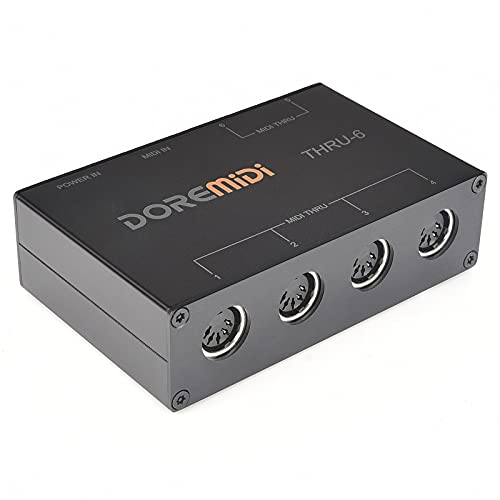
- One MIDI input feeds six outputs
- Supports standard 16-channel MIDI
- USB-powered, plug-and-play design
Best For: Distributing one controller's MIDI signal to multiple hardware devices
Best Rackmount Studio Interface
Clarett+ 8Pre Audio/MIDI Interface
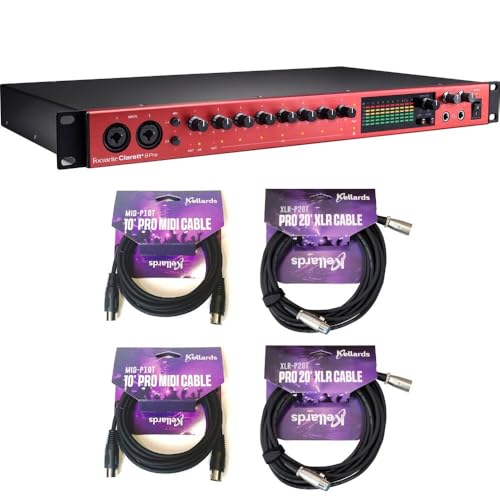
- Eight mic/line preamps with two Hi-Z inputs
- Includes MIDI, ADAT, S/PDIF, and word clock
- Offers 24-bit/192 kHz conversion
Best For: Project studios needing extensive audio, MIDI, and digital I/O
Best Compact MIDI Interface
Onyx Producer 2-2 Audio/MIDI Interface

- 2-in/2-out audio with MIDI I/O
- Two mic preamps with 48V phantom power
- Bus-powered USB and zero-latency monitoring
Best For: Solo musicians and mobile two-channel recording
High-Input Rackmount Workhorse – Tascam US-16×08
The Tascam US-16×08 is a practical choice for rackmount MIDI interfaces and recording setups that also need substantial audio I/O. It captures up to 16 mic and line inputs over USB, with eight microphone preamps, eight outputs, and onboard DSP mixing for low-latency monitoring.
Best For: Home studios, drum recording, and larger tracking sessions requiring many simultaneous inputs.
Pros:
- Offers 16 mic and line inputs, including eight Ultra-HDDA microphone preamps.
- Provides eight balanced line outputs for flexible monitoring and routing.
- Built-in DSP mixer includes four-band EQ and compression on each channel.
Cons:
- Its listed maximum sample rate is 96 kHz.
- The supplied warranty description is limited to 90 days of labor.
Choose the US-16×08 when input count and practical monitoring features matter more than compact size. Its rackmount-oriented format and broad analog connectivity make it well suited to a permanent studio setup.
Compact MIDI Distribution Hub – MIDI Solutions Quadra Thru
The MIDI Solutions Quadra Thru is a focused option for rackmount MIDI interfaces and hardware rigs that need to distribute one MIDI signal to several destinations. Its 1-in/4-out design functions as a straightforward multi-voltage MIDI splitter.
Best For: Keyboard and synthesizer setups that need one MIDI source routed to four outputs.
Pros:
- Splits one MIDI input into four MIDI outputs.
- Supports a broad range of operating systems and MIDI-capable software.
- Lightweight design weighs approximately 0.13 kg.
Cons:
- It provides MIDI distribution rather than audio recording inputs or outputs.
- The 1-in/4-out layout does not provide configurable multi-port routing.
This is a sensible add-on when your main requirement is reliable MIDI through distribution. It is less suitable if you need USB audio, MIDI merging, or advanced filtering in the same device.
Premium Rackmount Recording Platform – Universal Audio Volt 876
The Universal Audio Volt 876 combines rack-mount style hardware with extensive USB audio connectivity, making it a strong candidate for rackmount MIDI interfaces used in larger production systems. It includes eight Vintage preamps, classic-style compressors, 32-bit/192 kHz conversion, and support for Mac, PC, iPad, and iPhone.
Best For: Producers and studios seeking high-channel-count recording, onboard analog-style processing, and expansion options.
Pros:
- Provides eight Vintage preamps and classic compressor circuits.
- Supports 32-bit/192 kHz conversion with a 24×28 channel configuration.
- Offers UAD Console, two low-latency cue mixes, talkback, and system expansion up to three Volt 876 interfaces.
Cons:
- At 13.9 pounds, it is considerably heavier than compact MIDI-focused interfaces.
- Its feature set and recording focus may be more than needed for simple MIDI routing.
The Volt 876 is best viewed as a full recording centerpiece rather than a basic MIDI-only box. Its preamps, conversion, software integration, and expansion support make it a compelling choice for a growing rack-based studio.
Advanced Standalone MIDI Router – CME U6MIDI Pro
The CME U6MIDI Pro is a compact choice for rackmount MIDI interfaces when flexible routing is more important than audio recording. It provides three MIDI inputs and three outputs, USB-C connectivity, and standalone router, filter, merge, split, and thru functions.
Best For: Keyboard, synthesizer, digital piano, and electronic drum setups requiring precise MIDI routing and synchronization.
Pros:
- Works as both a USB MIDI interface and a standalone 3-in/3-out MIDI router.
- Supports MIDI channels and messages including clock, SysEx, MIDI timecode, and MPE.
- Offers close-to-zero latency, high-precision wired transmission, and broad OS compatibility.
Cons:
- It handles MIDI only and does not provide audio inputs or outputs.
- Advanced routing and filtering configuration requires the UxMIDI Tools software.
For a hardware-heavy MIDI rig, the U6MIDI Pro offers considerably more control than a basic thru box. Its compact size and standalone operation are useful when you need routing flexibility without leaving a computer connected.
Studio Expansion Pick – Focusrite Scarlett 18i20 4th Gen
For rackmount MIDI interfaces that also need serious audio I/O, the Focusrite Scarlett 18i20 4th Gen combines MIDI connectivity with eight mic preamps, line inputs, ADAT, S/PDIF, and Word Clock. Its USB-C connection, 24-bit/192kHz conversion, and 1U-style rackmount dimensions make it suited to larger studio setups.
Best For: Home and project studios recording multiple microphones, instruments, and MIDI hardware.
Pros:
- Broad connectivity includes MIDI I/O, dual ADAT, S/PDIF, and Word Clock.
- Eight mic preamps, two Hi-Z inputs, and eight line inputs support varied recording needs.
- Auto Gain, Clip Safe, Air modes, and included recording software streamline studio work.
Cons:
- Its extensive audio feature set may be more than a MIDI-focused setup requires.
- At 8 pounds, it is less portable than smaller interfaces.
The Scarlett 18i20 is the strongest all-around choice here when MIDI is only one part of a larger rack-based recording system. Choose it when expansion, microphone inputs, and synchronization connections matter as much as MIDI.
Dedicated MIDI Routing Pick – Crumar GSi 5×5 Rackmount MIDI Interface
The Crumar GSi 5×5 is a focused option among rackmount MIDI interfaces, providing five 5-pin DIN MIDI inputs and five MIDI outputs in a 1U rackmountable design. USB-B 2.0 connects it to computers running Windows, macOS, Linux, iOS, or Android.
Best For: Hardware-based MIDI studios that need multiple DIN connections in a rack-mounted unit.
Pros:
- Offers five MIDI inputs and five MIDI outputs for substantial hardware routing.
- Purpose-built for MIDI rather than combining MIDI with audio conversion.
- Rack ears support a clean 1U installation.
Cons:
- Does not provide audio inputs, outputs, or audio conversion.
- Uses USB-B 2.0 rather than USB-C.
For a MIDI-only rig, the 5×5 keeps the job straightforward and maximizes traditional DIN connectivity. It is a practical fit when rack organization and multiple hardware ports are more important than integrated recording features.
Flexible Hybrid Studio Pick – Arturia AudioFuse 16Rig Bundle
The Arturia AudioFuse 16Rig is a versatile choice for rackmount MIDI interfaces when you also need substantial analog and digital audio connectivity. It provides 16 TRS inputs, 12 outputs, dual ADAT, Wordclock, MIDI In, and two MIDI Out/Thru connections, plus USB-C and a compact rack-friendly chassis.
Best For: Hybrid studios combining MIDI instruments, analog hardware, ADAT expansion, and computer-based production.
Pros:
- Combines MIDI routing with 16 analog inputs, 12 outputs, dual ADAT, and Wordclock.
- Eight DC-coupled outputs support compatible external hardware workflows.
- 24-bit/192kHz conversion, a USB hub, and included AudioFuse software add flexibility.
Cons:
- The listed bundle includes a separate condenser microphone, which may not be needed by every buyer.
- Only one MIDI input is provided, compared with its two MIDI Out/Thru connections.
The AudioFuse 16Rig stands out for studios that want MIDI alongside extensive routing and expansion options. Its bundled microphone adds recording value, but buyers focused solely on rack MIDI distribution may prefer a dedicated MIDI interface.
Best MIDI Splitter – 6-Output MIDI Thru Box
This compact MIDI Thru-6 Box is a practical choice for rackmount MIDI interfaces setups that need to distribute one controller or synth’s MIDI signal to several devices. It provides one MIDI input and six 5-pin MIDI outputs, with plug-and-play USB power and support for standard MIDI commands across 16 channels.
Best For: Musicians who need to send the same MIDI data to up to six hardware devices.
Pros:
- Distributes one MIDI input to six outputs.
- Supports standard 16-channel MIDI communication.
- Requires no batteries and uses 5V DC USB power.
- Works with Windows, macOS, and Linux systems when USB connectivity is needed.
Cons:
- Provides MIDI signal routing rather than audio recording inputs or outputs.
- Requires an external 5V DC USB power source.
Choose this model when your priority is reliable MIDI distribution in a hardware-focused rig. Its six-output layout is especially useful for controlling multiple synths or other MIDI-compatible equipment from one source.
Best Rackmount Studio Interface – Clarett+ 8Pre Audio/MIDI Interface
The Focusrite Clarett+ 8Pre is a full-size rackmount MIDI interface and audio interface for bands, project studios, and producers. It combines eight mic/line preamps, MIDI I/O, USB-C or USB-A connectivity, and expansion connections including ADAT, S/PDIF, and word clock.
Best For: Project studios and producers needing multiple recording inputs plus MIDI and digital expansion.
Pros:
- Includes eight mic/line preamps, with two Hi-Z inputs.
- Provides MIDI, S/PDIF, ADAT I/O, and word-clock output.
- Supports up to 24-bit/192 kHz conversion.
- Offers two headphone outputs, two monitor outputs, and four line outputs.
Cons:
- Its broad feature set may be more than a small two-channel setup requires.
- USB uses the USB 2.0 protocol over USB-C.
For a rack-based studio that needs substantial I/O, the Clarett+ 8Pre is the most complete option in this selection. The internal power supply, phantom power, Air mode, and included connectivity make it well suited to a more permanent recording setup.
Best Compact MIDI Interface – Onyx Producer 2-2 Audio/MIDI Interface
Mackie Audio Interface, Onyx Producer 2X2 USB Audio Interface with MIDI (Onyx Producer 2-2)
Check Price On AmazonThe Mackie Onyx Producer 2-2 is a compact alternative for musicians comparing rackmount MIDI interfaces with smaller desktop units. It combines MIDI I/O with two 24-bit/192 kHz audio channels, two Onyx mic preamps, combo inputs, and bus-powered USB connectivity.
Best For: Solo musicians and mobile recordists who need two-channel audio recording with MIDI.
Pros:
- Provides 2-in/2-out audio with MIDI I/O.
- Includes two Onyx mic preamps and 48V phantom power.
- Combo inputs accept mic, line, and Hi-Z instrument sources.
- Offers zero-latency direct monitoring and USB bus power.
Cons:
- Only provides two audio inputs and two outputs.
- It is a desktop interface rather than a rackmount unit.
- The supplied warranty is one year.
The Onyx Producer 2-2 makes sense when portability and straightforward recording matter more than a large rack I/O count. Its MIDI connections and instrument-friendly inputs cover essential home-studio needs without requiring a separate power adapter.
How We Picked These Rackmount Midi Interfaces
We focused on connectivity, routing flexibility, recording capability, hardware compatibility, and practical studio value. The list includes full-size rackmount audio/MIDI interfaces as well as dedicated MIDI thru boxes and compact interfaces that suit smaller rigs. We also considered USB connectivity, MIDI input and output counts, audio channel capacity, expansion options such as ADAT, control software, and whether each product fits live, project-studio, or professional workflows.
Because “rackmount MIDI interface” can describe several types of equipment, check the product category carefully. Some models are complete audio interfaces with MIDI ports, while others are designed primarily to distribute or route MIDI data.
Quick Comparison
| Best For | What to Prioritize | Typical Product Type |
|---|---|---|
| Multitrack recording | Mic preamps, simultaneous inputs, low-latency drivers | Rackmount audio/MIDI interface |
| Hardware synthesizer control | Multiple MIDI ports, reliable timing, broad compatibility | Dedicated MIDI interface |
| Expanding a digital studio | USB-C, ADAT, flexible routing, high channel counts | Professional rack interface |
| Simple MIDI splitting | Thru outputs, plug-and-play operation, optocoupling | MIDI thru box |
Key Buying Factors for Rackmount Midi Interfaces
MIDI Inputs, Outputs, and Routing
Count the hardware devices you need to connect now, then allow room for expansion. Multiple independent outputs are more useful than a single MIDI out when you run several synthesizers or want separate routing paths. A dedicated thru box can distribute one controller or sequencer signal to several devices, but it may not provide computer integration or two-way communication.
Audio I/O and Preamps
If you record microphones, guitars, drums, or line-level hardware, evaluate input type and count rather than choosing on MIDI specifications alone. Combo inputs, phantom power, headphone outputs, and direct monitoring matter for tracking. ADAT support can add channels later when your studio grows.
Computer Connection and Software
USB-C is increasingly convenient, but confirm operating-system support and whether the interface uses a compatible USB mode. Stable drivers, low-latency monitoring, MIDI filtering, and routing software can make a bigger everyday difference than headline sample-rate figures.
Rack Compatibility and Workflow
Some products are true 19-inch rack units, while others use a rackmount-style chassis or require optional hardware. Check dimensions, power requirements, front-panel access, and cable clearance before installing the unit. A clear signal path and accessible MIDI ports can save considerable setup time.
Who Should Buy Which Rackmount Midi Interfaces?
Choose a full rackmount audio/MIDI interface if you need microphone preamps, multichannel recording, monitoring, and hardware MIDI in one central unit. These are the strongest choices for bands, drum recording, and growing studios.
Choose a dedicated MIDI interface or thru box if your main goal is controlling several external instruments from a computer, sequencer, or keyboard. They are simpler and often more efficient when you already own an audio interface.
Choose a higher-end expandable model if you expect to add preamps, ADAT-equipped converters, or more hardware over time. Extra I/O and routing flexibility can cost more initially but help avoid an early replacement.
Choose a compact two-channel interface for a small desktop setup, mobile recording, or a limited number of MIDI devices. It may be the best value when rack space and channel count are not priorities.