The best drum machines with speakers make it easier to practice, sketch rhythms, and create beats without setting up a full kit or connecting external gear. This roundup covers simple roll-up pads, portable rhythm boxes, finger drummers, and more advanced samplers.
Use the guide below to compare speaker-equipped options by portability, sound control, learning features, connectivity, and creative depth so you can choose the right machine for your setup and skill level.
Best 10 Drum Machines with Speakers Picks for 2026
Best Portable Kids’ Pick

- Nine pads with two pedals and starter sounds
- Built-in stereo speakers and headphone output
- Rechargeable, roll-up design with up to 10 hours of play
Best For: Kids, beginners, and portable practice
Best Compact Rhythm Box

- Sixteen velocity-sensitive pads
- 126 patterns and 14 user preset slots
- Built-in speaker with battery-powered portability
Best For: Pattern practice and portable finger drumming
Best Learning-Focused Option
Donner DED-20 Roll-Up Drum Pad

- 40 Melodics lessons plus demos and accompaniments
- 2.2W stereo speakers and headphone output
- MIDI and USB MIDI for computer connectivity
Best For: Beginner learning and quiet connected practice
Best for Beat Production
Roland AIRA Compact T-8 Beat Machine

- TR-808, TR-909, TR-606, and TB-303-inspired sounds
- 16-step sequencing with 64 user patterns
- Effects plus USB-C audio and MIDI connectivity
Best For: Electronic beat production and live jamming
Best Expressive Finger-Drumming Pick

- 18 expressive pads plus eight assignable RGB pads
- 48 kits and 50 user presets
- Built-in speaker, battery, and USB audio/MIDI
Best For: Finger drummers and mobile producers wanting customization
Best Simple Rhythm Companion

- 60 patterns and 120 fills
- Built-in 2-watt speaker
- 16 pads and optional footswitch control
Best For: Beginners and quick rhythm practice
Best Compact Pattern Starter

- 16 touch-sensitive finger pads
- 48 kits and 100 preset patterns
- USB-C or battery power with included foot pedal
Best For: Portable beat-making and basic finger drumming
Best Portable Synth Drum Machine

- Built-in speaker in a compact body
- 16-step sequencer with Active Step and Slice
- Six-part DSP engine for distinctive drum sounds
Best For: Portable electronic percussion and live pattern creation
Best DAW-Based Pad Controller

- 16 pads across three banks for 48 assignments
- Adds faders, knobs, and backlit controls
- Requires DAW software and has no standalone sound
Best For: Computer-based beat production and sample triggering
Best Sampling Drum Machine With Speaker
Teenage Engineering EP-133 K.O. II
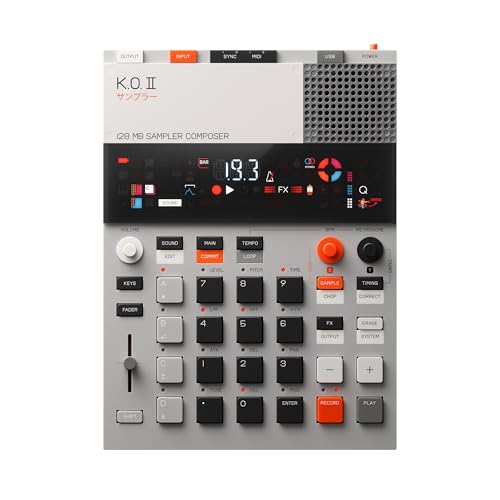
- Built-in speaker and microphone for portable sampling
- 128MB memory with 999 sample slots
- Sequencer, effects, MIDI, and battery operation
Best For: Mobile beat-making, sampling, and live performance
Best Portable Kids’ Pick – Sboet 9-Pad Roll-Up Drum Kit
If you want drum machines with speakers for beginner practice, the Sboet combines nine drum pads, two pedals, built-in stereo speakers, and a rechargeable battery in a roll-up design. It also includes recording, demo songs, rhythms, headphone output, and an AUX connection for flexible practice at home or on the go.
Best For: Kids, beginners, travel, and casual family music-making.
Pros:
- Nine pads, two pedals, seven timbres, 10 demo songs, and nine rhythms provide a broad starter setup.
- Built-in stereo speakers offer untethered play, while the headphone jack supports quieter practice.
- Rechargeable battery provides up to 10 hours of playtime per charge.
- Roll-up construction, recording, and AUX connectivity add portability and creative flexibility.
Cons:
- The miniature, toy-sized format may feel limited for advanced drummers.
- The 5V 2A power adapter is not included.
This is a practical entry-level choice when portability and built-in sound matter more than advanced programming. Its generous starter features and kid-friendly format make it particularly suitable for musical introductions and travel practice.
Best Compact Rhythm Box – Korg KR-11 Rhythm Machine
The Korg KR-11 is a compact option among drum machines with speakers, designed for quick practice and pattern creation. Its 16 velocity-sensitive pads, 126 built-in patterns, user presets, metronome, and battery operation make it useful for both finger drumming and rhythm development.
Best For: Musicians who want a small, pattern-focused practice and performance tool.
Pros:
- Sixteen velocity-sensitive pads allow more nuanced finger drumming.
- Includes 126 patterns across multiple genres and 14 user preset slots.
- Built-in speaker with Acoustage Bass technology supports portable playback.
- Metronome, headphone/line-out, and optional pedal support extend practice options.
Cons:
- Its rhythm-box design is less like a full electronic drum kit with separate drum pads and pedals.
- Optional AC power and pedal accessories are not described as included.
The KR-11 is a strong fit for players who value compact pattern access and expressive pad response. It offers more rhythm-programming depth than a basic toy-style pad while remaining easy to carry and battery powered.
Best Learning-Focused Option – Donner DED-20 Roll-Up Drum Pad
The Donner DED-20 is one of the more lesson-friendly drum machines with speakers, combining seven drum sets, stereo speakers, recording, quiet silicone pads, and included learning content. MIDI and USB MIDI connections also make it suitable for users who want to connect the pad to a computer for music production or games.
Best For: Beginners and families seeking lessons, quiet practice, and computer connectivity.
Pros:
- Includes 40 Melodics drum lessons, plus 12 demo songs and nine accompaniments.
- Two 2.2W stereo speakers provide built-in playback with nine volume levels.
- Soft silicone construction, headphone output, and roll-up storage support quieter practice.
- Standard MIDI and USB MIDI outputs enable computer and external-speaker connections.
Cons:
- The strike force is single and does not change with harder hits.
- Its seven-pad roll-up format is less extensive than a full electronic kit.
The DED-20 stands out when structured learning and connectivity are priorities. It offers a well-rounded starter package, though players looking for dynamic touch response should account for its fixed strike force.
Best for Beat Production – Roland AIRA Compact T-8 Beat Machine
The Roland AIRA Compact T-8 takes a different approach to drum machines with speakers: it is a portable rhythm and bass machine centered on classic TR drum sounds and TB-303 bass. Its 16-step sequencing, effects, pattern controls, and USB-C audio/MIDI make it better suited to beat production and performance than conventional roll-up drum pads.
Best For: Adults producing electronic beats, acid patterns, and portable live jams.
Pros:
- Includes TR-808, TR-909, and TR-606-style drums alongside TB-303 bass sounds.
- Sixteen-step sequencing supports up to 64 user patterns and 32 steps per pattern.
- Advanced controls include probability, sub step, last step, velocity, fills, and pattern shifts.
- Built-in delay, reverb, overdrive, and sidechain compression add sound-shaping options.
Cons:
- The supplied notes do not specify a built-in speaker, so it is not as self-contained for speaker playback as the other options.
- Its compact sequencing workflow may be less suitable for children seeking a traditional drum-pad layout.
The T-8 is the most production-oriented choice here, especially for electronic musicians who want authentic Roland-inspired sounds and hands-on sequencing. Choose it for beat creation and integration rather than a conventional standalone drum practice experience.
Best Expressive Finger-Drumming Pick – Yamaha FGDP-50
The Yamaha FGDP-50 is a versatile choice among drum machines with speakers, combining expressive finger-drumming pads, built-in sounds, and portable battery-powered operation. Its USB audio/MIDI connectivity also makes it suitable for mobile music-making or computer-based production.
Best For: Finger drummers, mobile producers, and performers who want deep sound customization and DAW connectivity.
Pros:
- 18 velocity-sensitive pads with aftertouch plus eight RGB-backlit assignable pads support expressive performances.
- Includes 48 drum kits and 50 user-preset slots for creating and saving custom kits.
- Built-in speaker, rechargeable battery, headphone output, and compact design support portable use.
- USB audio/MIDI and Rec’n’Share integration simplify recording and mobile workflows.
Cons:
- Its extensive features may be more than casual users need.
- The product is a finger drum pad rather than a traditional keyboard-style controller.
The FGDP-50 stands out when expressive control and flexibility matter most. It is a particularly strong fit for creators who want a standalone practice tool that can also connect to a broader recording setup.
Best Simple Rhythm Companion – Korg KR mini
The Korg KR mini is a straightforward option for shoppers seeking drum machines with speakers without a complicated setup. Select a rhythm, press play, or use the 16 pads for finger drumming and performance recording.
Best For: Beginners, casual practice, and musicians who want quick rhythm backing with minimal setup.
Pros:
- Simple controls make it easy to select patterns and start playing.
- Offers 60 rhythm patterns and 120 fills, with a Chain function for arranging complete songs.
- Built-in 2-watt speaker enables jamming without an additional monitor.
- Optional footswitch support allows hands-free fill, start, and stop control.
Cons:
- The supplied listing is an international version with no warranty.
- It has fewer customization-oriented features than more advanced drum pads.
The KR mini prioritizes immediacy over extensive sound design. Its pattern selection, chaining, built-in speaker, and optional foot control make it a practical rhythm tool for rehearsals and uncomplicated practice sessions.
Best Compact Pattern Starter – Medeli MR101S
The Medeli MR101S is a compact portable choice for shoppers comparing drum machines with speakers and hands-free control. It combines touch-sensitive finger pads with preset kits and patterns, while USB-C or battery power supports flexible placement.
Best For: Portable beat-making, basic finger drumming, and players who want included foot-pedal control.
Pros:
- Sixteen touch-sensitive finger pads provide direct hands-on beat control.
- Includes 48 drum kits and 100 preset drum patterns for varied starting points.
- USB-C or battery power supports use in different locations.
- Included foot pedal adds hands-free flexibility.
Cons:
- The supplied notes do not specify its speaker output or other audio connections.
- Its preset-focused feature set may offer less detail for users seeking extensive kit editing.
The MR101S is a sensible lightweight option when portability and ready-made patterns are the priority. Its touch pads and included pedal give it useful performance flexibility, while the compact size suits mobile setups.
Best Portable Synth Drum Machine – Korg Volca Drum
Korg Volca Drum Digital Percussion Synthesizer w/ 16-step Sequencer and Active Step
Check Price On AmazonThe Korg Volca Drum is a compact choice for shoppers seeking drum machines with speakers for portable beat-making. Its built-in speaker, 16-step sequencer, and six-part DSP synth engine make it suitable for creating patterns without a large setup.
Best For: Portable pattern creation, electronic drum sound design, and live or studio use.
Pros:
- Built-in speaker and compact design support on-the-go music creation.
- 16-step sequencing includes Active Step, Slice, Accent, and randomize functions.
- Six-part DSP synthesis and a waveguide resonator provide varied drum sounds.
- Choke settings help organize grouped percussion parts.
Cons:
- The 16-step workflow may be limiting for users seeking longer built-in arrangements.
- Its focus is synthesized percussion rather than broad sampling features.
The Volca Drum stands out when portability and hands-on sequencing matter most. It offers a focused set of rhythm-design tools and a built-in speaker in a small format.
Best DAW-Based Pad Controller – Donner STARRYPAD Beat Maker
The Donner STARRYPAD is a USB MIDI pad controller for shoppers comparing drum machines with speakers but who plan to make sounds through a computer or mobile device. It provides responsive pads and hands-on controls, but it does not produce sound by itself.
Best For: DAW-based beat production, triggering samples, and controlling virtual instruments.
Pros:
- Sixteen velocity-sensitive pads can switch across three banks for 48 assignable pads.
- Two faders, two knobs, and additional buttons provide hands-on software control.
- Backlit pads offer seven color options for visual organization.
- Includes MIDI connectivity, Melodics courses, and a Cubase LE software kit.
Cons:
- It needs DAW software or another compatible setup to produce sound.
- It has no built-in speaker for standalone playback.
- Connecting to an iPhone or iPad may require an Apple Lightning to USB adapter.
The STARRYPAD is better viewed as a controller than a self-contained drum machine. Choose it if you already use a DAW and want flexible pad triggering with extra faders and knobs.
Best Sampling Drum Machine With Speaker – Teenage Engineering EP-133 K.O. II
The teenage engineering EP-133 K.O. II combines sampling, drum programming, and sequencing in a portable unit with a built-in speaker. For shoppers seeking drum machines with speakers, it adds a built-in microphone, effects, battery power, and extensive pattern and sample features.
Best For: Portable sampling, beat sketching, live performance, and resampling found sounds.
Pros:
- Built-in speaker and microphone support quick, portable sampling and playback.
- 128MB memory, 999 sample slots, and line-in sampling provide substantial creative flexibility.
- Four groups with 99 patterns each support fast arrangement and variation.
- Includes master and punch-in effects, a multifunctional fader, and MIDI and sync connections.
Cons:
- It is more expensive and feature-rich than a basic standalone rhythm box.
- Its 10.24-inch square footprint is less compact than pocket-sized grooveboxes.
- Battery operation requires four AAA batteries.
The EP-133 K.O. II is a strong fit for creators who want a speaker-equipped sampler rather than a drum-only instrument. Its microphone, effects, pattern groups, and battery operation make it particularly versatile for mobile ideas and performance.
How We Picked These Drum Machines with Speakers
We selected products that offer an integrated speaker or self-contained playback experience, while covering a broad range of uses and budgets. The lineup includes beginner-friendly practice pads, compact rhythm machines, MIDI controllers, drum synthesizers, and sampler-based beat makers. We also considered portability, onboard sounds, sequencing features, power options, headphone connectivity, MIDI or USB support, and how quickly each product can produce a usable rhythm.
Because these devices serve different audiences, the most feature-rich model is not automatically the best choice. A child learning basic patterns may benefit more from guided lessons and simple controls, while a producer may prioritize sequencing, sampling, effects, and hands-on performance controls.
Quick Comparison
- Best for basic practice: Sboet Electronic Drum Set or Donner 7-Pad Electronic Drum Set.
- Best compact rhythm boxes: Korg KR-11, Korg KR mini, or Medeli MR101S.
- Best for finger drumming: Yamaha Finger Drum Pad.
- Best for portable beat making: Roland AIRA Compact T-8.
- Best for sound design: Korg Volca Drum.
- Best for MIDI-based production: Donner MIDI Pad Beat Maker.
- Best for sampling and performance: teenage engineering EP–133 K.O. II.
Key Buying Factors for Drum Machines with Speakers
Speaker and Headphone Flexibility
An integrated speaker is convenient for practice and quick playback, but check whether the device also includes a headphone output. Headphones are important for quiet practice, especially in shared homes. Speaker volume and clarity vary, so do not assume a built-in speaker will replace powered monitors.
Pads, Sounds, and Playing Feel
Drum pads differ in size, sensitivity, layout, and response. Larger multi-pad kits generally feel more natural for two-handed playing, while compact finger pads are easier to carry. Also check the available drum voices, kits, effects, and whether sounds can be edited or layered.
Sequencing and Creative Control
For simple accompaniment, preset rhythms may be enough. If you want to compose original beats, look for pattern memory, step sequencing, live recording, tempo control, fills, and song arrangement features. Samplers and synthesizers offer more flexibility but usually require more time to learn.
Connectivity and Power
USB MIDI, standard MIDI, and audio connections determine how easily a machine works with a computer, tablet, keyboard, or larger production setup. Battery power improves portability, while USB power can be more convenient at a desk. Confirm exactly which cables and accessories are included.
Who Should Buy Which Drum Machines with Speakers?
Choose a roll-up electronic drum set if you want an inexpensive, approachable practice solution for beginners or children. Pick a compact rhythm box if you mainly need backing patterns and quick tabletop operation. The Yamaha or Roland models suit mobile musicians who want expressive playing in a small format. Choose the Volca Drum, Donner MIDI pad controller, or EP–133 K.O. II if your priority is beat production and performance rather than straightforward practice. Before buying, match the control layout and learning curve to how you plan to use the instrument most often.