The best looper pedals for home studios make it easier to practice, sketch song ideas, build layered arrangements, and add rhythm without opening a computer. The right model depends on how much recording time, control, connectivity, and performance flexibility you need.
This roundup compares 10 options ranging from compact single-loop pedals to feature-rich units with drum patterns, multiple tracks, screens, and extended storage. Use the guide below to narrow the choices by workflow and budget.
Best 10 Looper Pedals for Home Studios Picks for 2026
Best Beginner-Friendly Looper

- 12 minutes of stereo recording
- Simple overdub, undo, and redo controls
- Visual 24-segment loop indicator
Best For: Beginners and straightforward home-studio looping
Best Minimalist Guitar Looper

- Five minutes of looping time
- Unlimited overdubs with undo/redo
- Analog-dry-through and true bypass
Best For: Guitarists wanting compact, transparent looping
Best Looper With Drum Machine

- 140 minutes across 14 save slots
- 121 drum grooves in 11 genres
- Import/export support via editor software
Best For: Layered performances with rhythms and stored loops
Best Value Looper With Tuner
LEKATO Guitar Looper With Tuner

- Nine loops and 40 minutes of recording
- USB WAV import/export
- Built-in tuner with uninterrupted switching
Best For: Guitarists needing looping, tuning, and USB transfers
Premium Studio Looper
Aeros Loop Studio Gold Edition
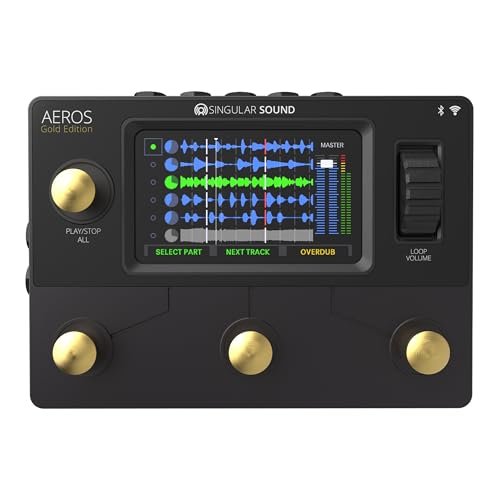
- Six song parts and six stereo tracks per song
- Up to 10 hours per song with extensive storage
- Touchscreen mixing, effects, and broad connectivity
Best For: Layered home-studio songwriting and loop-based production
Rhythm-Ready Looper

- Looper and drum machine in one compact pedal
- 100 slots with 300 minutes of storage
- Auto-record, DrumMatch, time stretch, and editor software
Best For: Beat-driven practice, songwriting, and home-studio arrangement
Simple Layering Looper

- Three loop slots with 90 minutes total recording
- Unlimited overdubs with undo and redo
- Bright status screen, auto-save, and true bypass
Best For: Beginner-friendly guitar practice and basic layered songwriting
Feature-Rich Studio Pick
FLAMMA FF20 Looper and Drum Machine

- 300 minutes of stereo recording in 100 slots
- 220 grooves across 11 drum styles
- Color screen, USB transfer, and headphone output
Best For: Home recording, silent practice, and layered solo arrangements
Simple Compact Pick

- 5 minutes of 24-bit uncompressed looping
- Unlimited overdubs with undo and redo
- Mini aluminum-alloy design with USB transfer
Best For: Simple guitar layering and portable home practice
Budget Rhythm Companion
LEKATO 2-in-1 Looper and Drum Machine
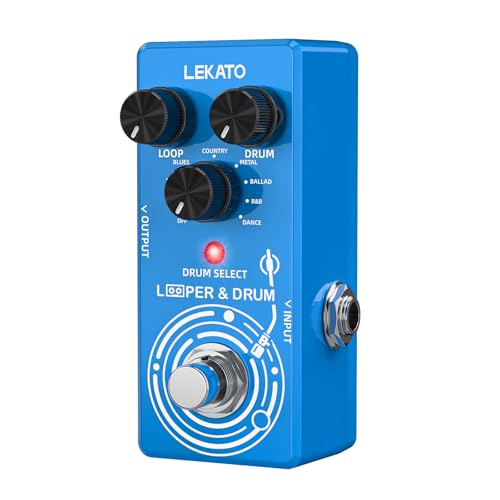
- 6 minutes of 24-bit looping with unlimited overdubs
- Eight grooves with real drum samples and tap tempo
- Independent loop and drum volume controls
Best For: Solo practice with compact drum-backed looping
Best Beginner-Friendly Looper – BOSS RC-1 Loop Station
For home studios needing straightforward looping, the BOSS RC-1 is a practical choice for guitar, bass, and keyboard players. It records up to 12 minutes in stereo and keeps a recorded phrase in memory after power-off.
Best For: Beginners and home musicians who want simple, reliable phrase looping.
Pros:
- User-friendly record, playback, overdub, undo, and redo controls.
- 12 minutes of stereo recording time.
- 24-segment loop indicator shows the current loop mode.
- Stereo inputs and outputs support flexible studio connections.
Cons:
- AC adapter is optional and sold separately.
- Single 9-volt battery provides approximately 4.5 hours of use.
The RC-1 focuses on uncomplicated operation rather than extensive editing or rhythm features, making it a solid entry point for looper pedals for home studios.
Best Minimalist Guitar Looper – TC Electronic DITTO Looper
The TC Electronic DITTO is a compact option for guitarists building layers in home studios. Its focused control set provides five minutes of looping, unlimited overdubs, and undo/redo functionality while preserving the dry signal through analog-dry-through.
Best For: Guitarists who want a small, transparent-sounding looper with uncomplicated controls.
Pros:
- Five minutes of loop time with unlimited overdubs.
- Undo and redo support for correcting layers.
- True bypass and analog-dry-through help preserve the dry signal.
- Compact, guitar-focused design.
Cons:
- 9V power supply is required but not included.
- Five minutes of loop time is less than several larger alternatives.
- Designed primarily with guitarists in mind.
With its transparent signal approach and limited control layout, the DITTO suits players who prioritize quick overdubbing over drum patterns, extensive storage, or advanced routing.
Best Looper With Drum Machine – MOOER Groove Loop X2
The MOOER Groove Loop X2 combines stereo looping and drum accompaniment for home studios that need more than basic phrase recording. It offers 14 save slots, up to 140 minutes of total stereo recording, and editor software for importing and exporting audio.
Best For: Home-studio musicians who want stored loops, built-in rhythms, and stereo routing.
Pros:
- Stores up to 140 minutes of stereo loops across 14 slots.
- Includes 121 drum grooves across 11 genres.
- Count-in, automatic, and normal recording modes support different workflows.
- Supports audio import/export and separate looper and drum outputs.
Cons:
- Its larger feature set may be more than beginners need.
- Requires a 9V DC, 300mA adapter.
- Editor software is needed for computer-based track management and file transfers.
Time stretch, tap tempo, and sync-focused functions make the Groove Loop X2 especially useful for practice arrangements and layered home-studio performances.
Best Value Looper With Tuner – LEKATO Guitar Looper With Tuner
The LEKATO Guitar Looper is a versatile pick for home studios that want generous storage, computer file transfer, and an integrated tuner. It provides nine loops, up to 40 minutes of total recording time, and lossless 48kHz/24-bit sampling.
Best For: Guitarists who want a looper, tuner, and USB workflow in one pedal.
Pros:
- Nine loops with up to 40 minutes of total recording time.
- Supports WAV import and export through USB.
- Built-in tuner can switch continuously without interrupting the phrase.
- Provides unlimited overdubbing with record, undo/redo, stop, and erase functions.
Cons:
- Its supplied power adapter is rated at 0.6A, so replacement adapters need compatible specifications.
- Loop operations use different foot commands on a single button, which may require practice.
- Single-knob control limits direct playback-volume adjustment to one control.
With USB transfer and a built-in tuner, the LEKATO combines several useful practice and recording tools in a compact format for computer-based home-studio workflows.
Premium Studio Looper – Aeros Loop Studio Gold Edition
Aeros Loop Studio Gold Edition - 6 Track, Stereo Looper Pedal | Touch Screen and Hands Free Mixing
Check Price On AmazonThe Aeros Loop Studio Gold Edition is a powerful choice among looper pedals for home studios, especially if you want to build complete arrangements rather than simple repeating phrases. It supports six song parts, six stereo tracks per song, unlimited overdubs, and extensive storage options.
Best For: Guitarists, vocalists, and multi-instrumentalists creating layered songs or loop-based productions.
Pros:
- Supports up to six song parts and six stereo tracks per song with unlimited overdubs.
- Offers up to 10 hours of recording per song and over 48 hours of loop storage with a 32GB SD card.
- Provides 32-bit floating-point audio, built-in effects, touchscreen mixing, and USB, Wi-Fi, Bluetooth, and MIDI connectivity.
Cons:
- The 32GB SD card is not included.
- Its larger 8.5-by-6.25-inch footprint and advanced feature set may be more than a beginner needs.
For a home studio, the Aeros stands out when flexible song structure, stereo recording, and hands-free mixing matter most. Its two-year warranty and broad connectivity also make it a strong long-term investment for more ambitious looping setups.
Rhythm-Ready Looper – MOOER GL100 Drum Looper
The MOOER GL100 combines looping and drum-machine functions in one compact unit, making it a practical pick among looper pedals for home studios. Its automatic recording, quantized alignment, drum matching, and editor software are designed to speed up practice, songwriting, and arrangement building.
Best For: Home-studio musicians who want guided rhythms, automatic timing assistance, and flexible loop management.
Pros:
- Includes 100 memory slots with 300 minutes of total storage.
- Provides 220 drum patterns across 11 styles, plus DrumMatch for automatic groove and BPM matching.
- Offers auto recording, count-in, quantized loop endings, time stretch, split drum output, and computer-based import/export.
Cons:
- The feature-rich touchscreen and dual-footswitch workflow may require a learning period.
- Its listed storage limit is three minutes per memory slot for recordings, while imported files can be up to 30 minutes per slot.
The GL100 is especially useful when a loop needs to sit against a beat without extensive manual timing work. Dedicated drum routing and MOOER Studio support give it a broader production role than a basic looper, while its compact design suits smaller setups.
Simple Layering Looper – Donner Triple Looper Pedal
The Donner Triple Looper is a straightforward option among looper pedals for home studios, offering three independent loop slots, unlimited overdubs, and a visual status screen. Its single-footswitch design keeps the core looping workflow accessible for practice, songwriting, and basic layered arrangements.
Best For: Beginners and guitarists who want simple, affordable loop storage for practice and songwriting.
Pros:
- Stores up to three independent loops, with 30 minutes per slot and 90 minutes total recording time.
- Supports unlimited overdubs plus undo and redo functions for layered parts.
- Includes a bright screen, auto-save, and true bypass for preserving the guitar signal when bypassed.
Cons:
- It has fewer loop slots and less advanced connectivity than the other options here.
- The product notes contain conflicting information about the included power adapter; verify the package contents before buying.
- The listed warranty is six months.
For a compact home-studio setup, the Donner focuses on the essentials without adding drum-machine or touchscreen-mixing features. It is a sensible fit if you mainly need a few saved song sections and uncomplicated overdubbing.
Feature-Rich Studio Pick – FLAMMA FF20 Looper and Drum Machine
For home studios needing more than basic looping, the FLAMMA FF20 combines a stereo looper, drum machine, extensive memory, and headphone monitoring. Its screen and USB file transfer make it a versatile choice among looper pedals for home studios, especially for building and saving layered ideas.
Best For: Home recording, silent practice, and solo guitarists who want built-in rhythms and substantial loop storage.
Pros:
- Stores up to 300 minutes of stereo loops across 100 memory slots.
- Includes 220 drum grooves across 11 styles, plus tap tempo.
- Offers a full-color display, time stretch, auto record, USB transfer, and headphone output.
Cons:
- Its larger feature set may be more than needed for simple one-loop practice.
- Requires a 9V, 300mA power source.
The FF20 stands out when workflow flexibility matters. Time stretch, auto record, one-shot mode, and headphone monitoring give home-studio users useful tools for developing arrangements without extra equipment.
Simple Compact Pick – LEKATO Looper Pedal
The LEKATO Guitar Looper is a compact option for musicians who want essential looping controls without a complex interface. With 5 minutes of recording, unlimited overdubs, and USB WAV file transfer, it fits straightforward practice and idea capture in home studios.
Best For: Guitarists who prefer a small, easy-to-use pedal for basic layering and portable practice.
Pros:
- Provides 5 minutes of uncompressed 24-bit looping.
- Supports unlimited overdubs plus undo and redo functions.
- Compact aluminum-alloy construction and USB import/export support.
Cons:
- Has fewer features than drum-machine or display-equipped loopers.
- Uses a single-knob design, so loop functions rely on foot commands.
This is a practical choice for buyers who value simplicity and small size. Its analog-dry-through design preserves the dry signal, while USB connectivity adds a convenient way to move WAV loops between the pedal and a computer.
Budget Rhythm Companion – LEKATO 2-in-1 Looper and Drum Machine
The LEKATO LP-02 combines looping and drum backing in a small pedal, making it a practical addition to a bedroom setup. It offers 6 minutes of high-fidelity recording, unlimited overdubs, independent volume controls, and USB import/export for home studios.
Best For: Solo players who want synchronized drum practice and a compact looper with low current draw.
Pros:
- Combines a 44.1kHz, 24-bit looper with an independent drum machine.
- Includes 8 drum grooves, real drum samples, and tap tempo.
- Features auto-save, unlimited overdubs, USB transfer, and separate loop/drum volume controls.
Cons:
- Drum synchronization supports only 4/4 time-signature phrases.
- Power adapter and cable are not included.
- Provides fewer recording minutes and drum styles than the FLAMMA FF20.
The LP-02 offers a focused way to add rhythmic support without a separate drum machine. Its buffer bypass and under-80mA current draw also suit compact pedalboards, provided you already have a compatible 9V center-negative power supply.
How We Picked the Best Looper Pedals for Home Studios
We compared these pedals by looking at the features that matter most in a home recording and practice setup: loop length, overdub and undo/redo capability, track or loop organization, rhythm functions, stereo support, bypass behavior, tuning, controls, display information, USB connectivity, and overall ease of use. A simple pedal can be the better choice if you mainly need hands-free practice, while a larger unit may suit songwriting, arrangement building, or live-style looping.
Specifications and feature names can vary by version, so confirm the manufacturer’s current details before buying, especially for power requirements, included accessories, and software or USB functions.
Quick Comparison
| Best For | What to Prioritize |
|---|---|
| Simple practice | One-button control, clear loop status, reliable footswitches |
| Songwriting | Long recording time, unlimited overdubs, undo/redo, memory slots |
| Rhythm-based practice | Built-in drum patterns, tap tempo, adjustable levels |
| Layered arrangements | Multiple tracks, stereo routing, independent track control |
| Compact pedalboards | Small footprint, low power draw, straightforward connections |
Key Buying Factors for Looper Pedals for Home Studios
Loop Time and Storage
Check both the maximum length of a single loop and the number of saved loops or memory locations. Short loop times are sufficient for riffs and exercises, but longer recording limits are more useful for full song sections. Storage matters if you want to keep ideas available between sessions.
Controls and Timing
Footswitch behavior affects how naturally you can record, stop, overdub, and undo while playing. Displays can make timing and selected memories easier to verify. Quantized or auto-start features may help beginners, while manual control can feel more immediate for experienced players.
Drums, Outputs, and Stereo Operation
Built-in drums are useful when you want a self-contained practice rig, but evaluate groove variety, tap tempo, and whether rhythm volume can be adjusted separately. Stereo inputs and outputs are important for stereo effects, keyboards, or wider home-studio routing; mono operation is often enough for a basic guitar setup.
Connectivity and Power
Look for USB when transferring loops, backing up ideas, or integrating with a computer is important. Confirm whether the pedal requires a standard 9V supply, the correct current rating, or a battery. Analog dry-through and true bypass can also matter when preserving your unprocessed signal in a pedalboard chain.
Who Should Buy Which Looper Pedals for Home Studios?
Choose a compact single-loop model if you want fast, uncomplicated practice and have no need for extensive song storage. Pick a pedal with drums if you want to rehearse without a separate backing track. Models with longer recording times and screens are better for building layered arrangements, saving multiple ideas, or working through complete sections. If your home studio includes stereo instruments or you expect to perform with loops, prioritize stereo routing and multiple independent tracks over the smallest footprint.