Choosing among guitar effects processors for home studios can be difficult when amp modeling, impulse responses, USB recording, MIDI, and monitoring features overlap. The right unit should fit your workflow as well as your tone goals.
This roundup compares 10 processors across beginner-friendly practice tools, compact modeling pedals, and more advanced studio-ready systems, so you can narrow the field by features that matter in your setup.
Best 10 Guitar Effects Processors for Home Studios Picks for 2026
Studio-to-Stage Workhorse

- 240+ effects and amp/cab models
- USB-C interface with re-amping
- Expression pedal, looper, and MIDI
Best For: Flexible home recording and live setups
Touchscreen Tone Lab

- 32 amp types and 170+ BOSS effects
- 15 assignable routing blocks
- Touchscreen and computer editing
Best For: Detailed preset building with BOSS sounds
Capture-and-Create Hub

- NAM support and Smart Amp Cloner
- 24-bit/96 kHz USB recording
- Guitar, vocal, looper, and drum tools
Best For: Guitar-and-vocal studios seeking deep modeling
Compact NAM Practice Rig
- 100+ effects with NAM and IR loading
- 2-in/2-out USB with re-amping
- Rechargeable battery and Bluetooth app control
Best For: Portable home recording and practice
Versatile Budget Pick

- 66 effects with eight modules
- 80 factory and 80 user patches
- 180-second looper and drum machine
Best For: Beginners building a flexible home practice or recording setup
Advanced Studio Hub

- 240+ effects and 140+ amp/cab models
- 6-in/4-out USB-C audio interface
- IR loading, looper, drums, and gig bag
Best For: Home studios needing recording, modeling, and live-performance flexibility
Compact Practice Favorite

- 71 effects and 13 amp models
- 68 rhythm patterns and 30-second looper
- Expression pedal with headphone and aux support
Best For: Portable practice, songwriting, and straightforward home-studio use
Feature-Loaded Pick

- 200 presets with 170 effects and 55 amp models
- MNRS amp/cab support with 20 slots each
- USB-C, OTG, looper, drums, and expression pedal
Best For: Home studios needing extensive modeling and practice features
Proven Budget Workhorse
- 151 effects and 55 MNRS amp models
- 26 user slots for third-party IR files
- Looper, drums, metronome, and USB-OTG recording
Best For: Portable home practice, streaming, and songwriting
Modern Modeling Choice

- 200+ effects with 48kHz HD modeling
- IR and NAM support with extensive file storage
- Rechargeable battery and 6-in/4-out USB interface
Best For: Flexible recording, streaming, and mobile studio setups
Studio-to-Stage Workhorse – Valeton GP-200
Valeton GP-200 Multi-Effects Processor for Guitar & Bass, Expression Pedal, MIDI, USB Interface
Check Price On AmazonFor guitar effects processors for home studios, the Valeton GP-200 is a versatile option that combines extensive modeling, flexible signal routing, and a built-in USB-C audio interface. Its balanced outputs, re-amping support, looper, drum patterns, and expression pedal make it suitable for both recording and practice.
Best For: Guitarists and bassists who want one unit for home recording, sound design, practice, and occasional stage use.
Pros:
- Includes more than 240 effects, amp and cab models, with up to 11 movable modules per patch.
- USB-C 6-in/4-out audio interface supports recording and re-amping.
- Built-in expression pedal, looper, drum patterns, MIDI, FX loop, and balanced XLR outputs.
- Offers 20 user IR slots and 256 patch locations.
Cons:
- Requires a power adapter and does not support battery operation.
- Its broad feature set may take time to learn.
The GP-200 is a strong all-around choice when a home studio setup needs recording connectivity as well as extensive live-control features. The color screen and footswitch templates help make its large feature set more manageable.
Touchscreen Tone Lab – BOSS GX-100
The BOSS GX-100 is a practical choice among guitar effects processors for home studios, pairing 32 amplifier types with more than 170 BOSS effects and a touchscreen interface. Its assignable routing and computer-editing support give players plenty of room to build and organize detailed presets.
Best For: Guitarists and bassists who prioritize BOSS effects, touchscreen control, and flexible preset routing.
Pros:
- Provides 32 amp types and more than 170 effects derived from the GT-1000.
- Uses 15 assignable blocks for flexible amp and effect routing.
- Supports onboard speaker types and WAV speaker IR loading.
- Includes an expression pedal with toe switch and assignable footswitches.
Cons:
- Optional Bluetooth hardware is required for mobile-device editing and streaming.
- Its extensive routing and assignment options may be more than beginners need.
With its color touchscreen, rugged metal chassis, and AIRD-based amp modeling, the GX-100 offers a streamlined way to create complex rigs. BOSS Tone Studio also supports computer editing and Liveset sharing on macOS and Windows.
Capture-and-Create Hub – HeadRush Core
The HeadRush Core stands out among guitar effects processors for home studios by combining guitar and vocal processing, amp cloning, Neural Amp Modeler support, and high-resolution USB recording. Its touchscreen, Wi-Fi access, and broad connectivity make it especially capable for musicians building a multi-purpose recording rig.
Best For: Guitarists who also record vocals and want amp capture, cloud-based tones, and integrated practice tools.
Pros:
- Supports native NAM files, TONE3000 access, and Smart Amp Cloner technology.
- Records through USB at up to 24-bit/96 kHz and includes Bluetooth audio reception.
- Combines guitar effects, vocal processing with Antares Auto-Tune, looper, and drum machine.
- Offers 350+ built-in IRs, Wi-Fi, MIDI, an FX loop, and multiple input/output formats.
Cons:
- Its 3.9 kg chassis is less portable than smaller multi-effects units.
- The extensive cloning, cloud, and vocal features may be unnecessary for a guitar-only setup.
The Core is a particularly complete studio centerpiece for players who want more than conventional effects and amp modeling. Gapless preset switching with delay and reverb spillover also supports smooth performance transitions.
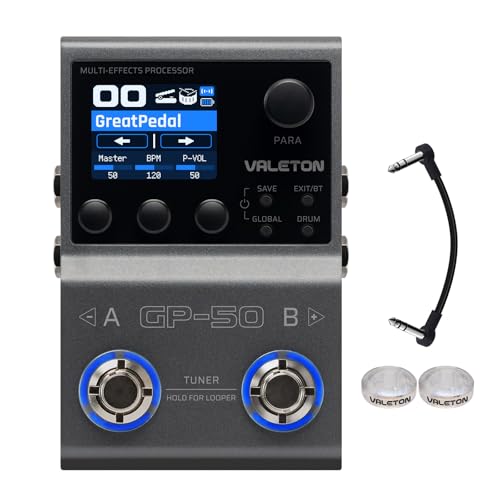
Compact NAM Practice Rig – Valeton GP-50
The Valeton GP-50 is a compact entry in the guitar effects processors for home studios category, combining HD effects with NAM and cabinet IR loading. Its 2-in/2-out USB audio connection, Bluetooth app control, rechargeable battery, and small metal enclosure make it convenient for desktop recording and mobile practice.
Best For: Guitarists and bassists who want portable modeling, NAM files, and simple USB recording in a compact unit.
Pros:
- Includes 100+ HD effects, nine simultaneous modules, NAM loading, and IR support.
- Stores up to 80 NAM files and 20 third-party cabinet IR files.
- Offers 2-in/2-out USB audio with re-amping and USB MIDI support.
- Supports Bluetooth app editing, a rechargeable battery, drum patterns, and headphone monitoring.
Cons:
- Its 1.77-inch screen and dual-footswitch layout provide less hands-on control than larger processors.
- It has fewer simultaneous modules than the GP-200.
The GP-50 is a sensible choice when desk space, portability, and wireless editing matter. It delivers useful studio connectivity and modern NAM support without the larger footprint of a full-size floor processor.
Versatile Budget Pick – MOOER GE100
The MOOER GE100 is a practical entry point for guitar effects processors for home studios, combining a broad effects library with amp-free monitoring, looping, and rhythm tools. Its 80 factory and 80 user patches make it easy to build and save a personal sound library.
Best For: Home recording beginners, practice setups, and players who want many tones without using an amp.
Pros:
- Includes 66 effect types across eight effect modules.
- Offers 80 preset patches and 80 user patches for tone storage.
- Provides a 180-second looper, 40 drum rhythms, tuner, and headphone output.
- Runs from a 9V adapter or four AA batteries.
Cons:
- Its feature set is more limited than higher-end processors with extensive amp modeling and USB audio connectivity.
- The supplied notes do not specify a USB recording interface.
The GE100 is a flexible, approachable choice when silent practice, basic home-studio sound shaping, and built-in songwriting tools matter more than advanced routing.
Advanced Studio Hub – Valeton GP-200
The Valeton GP-200 is one of the more complete guitar effects processors for home studios, pairing amp and cabinet modeling with an IR loader, flexible routing, and USB-C audio. It also includes performance-oriented controls and a protective gig bag.
Best For: Guitarists and bassists who want a central recording, rehearsal, and live-performance processor.
Pros:
- Includes over 240 effects, more than 140 amp and cabinet models, and supports up to 11 simultaneous modules.
- Provides 20 user cabinet IR slots and 256 patch slots, including 156 user slots.
- Functions as a 6-in/4-out USB audio interface with loopback and re-amping support.
- Includes a 180-second looper, 100 drum patterns, expression pedal, and 4.3-inch color display.
Cons:
- Its 2.37 kg metal chassis is less compact than simpler desktop or pedalboard options.
- The larger feature set may be more than a beginner needs for basic practice.
With broad modeling, USB recording, and extensive connectivity, the GP-200 is the strongest choice here for a home studio that may also need live-ready control and routing.
Compact Practice Favorite – Zoom G1X FOUR
The Zoom G1X FOUR is a compact option among guitar effects processors for home studios, offering 71 effects, amp models, rhythm patterns, and an expression pedal in a straightforward practice-focused unit. Headphone and auxiliary connections also support quieter sessions.
Best For: Guitarists who want an affordable, portable unit for practice, songwriting, and simple recording experiments.
Pros:
- Includes 71 effects and 13 amp models for clean and high-gain tones.
- Offers 68 rhythm patterns and a 30-second looper for practice and songwriting.
- Supports amp, headphone, and auxiliary connections for flexible monitoring.
- Includes an expression pedal and access to patch editing through Zoom Guitar Lab.
Cons:
- The 30-second looper is shorter than the 180-second loopers in the other listed processors.
- Its supplied notes do not indicate a multi-channel USB audio interface.
The G1X FOUR keeps the essentials accessible and portable, making it a sensible pick when practice features and a built-in expression pedal are more important than advanced studio routing.
Feature-Loaded Pick – MOOER GE150 Pro
The MOOER GE150 Pro is a versatile choice for guitar effects processors for home studios, combining extensive amp and cabinet modeling with convenient recording and practice tools. Its USB-C and OTG connectivity, headphone output, looper, drum machine, and expression pedal make it suitable for building tones, tracking ideas, and practicing without a large setup.
Best For: Home-studio guitarists who want broad tone-shaping options plus integrated looping, rhythms, and mobile recording.
Pros:
- Includes 200 factory presets, 55 amp models, 26 cabinet simulations, and support for MNRS samples.
- Offers 20 amp sample slots and 20 cabinet IR slots for expanded tone customization.
- Includes four multifunction footswitches, an expression pedal, an 80-second stereo looper, drum rhythms, and metronome modes.
- USB-C, OTG, AUX, and headphone connections support editing, recording, playback, and practice.
Cons:
- The standard GE150 Pro is corded rather than battery-powered.
- Its broad feature set may take time to learn for users seeking a simple effects unit.
For a home studio that also serves as a practice and jamming space, the GE150 Pro offers a particularly complete feature set. It is strongest when you want hands-on foot control and plenty of preset, modeling, and sample options in one compact processor.
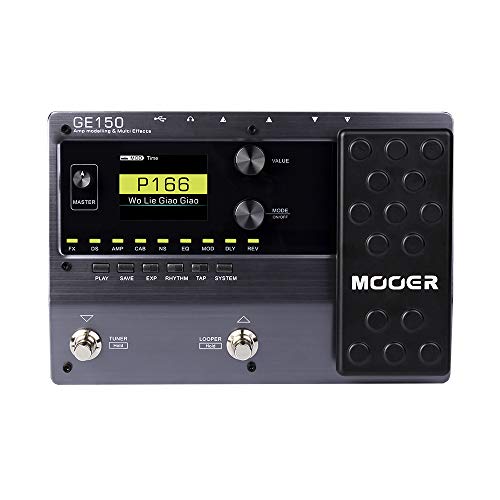
Proven Budget Workhorse – MOOER GE150
The MOOER GE150 is a compact option for guitar effects processors for home studios, offering a practical mix of amp modeling, effects, IR loading, and recording features. Its portable design and USB-OTG support also make it useful for guitarists who move between home practice, streaming, and quick idea capture.
Best For: Guitarists wanting a portable multi-effects unit with amp models, third-party IR support, and built-in practice tools.
Pros:
- Provides 151 effects and 55 MNRS-based amp models for varied genres and playing styles.
- Includes 26 user slots for loading third-party IR files.
- Built-in expression pedal, 80-second looper, 40 drum rhythms, and 10 metronome settings support practice and songwriting.
- USB-OTG enables smartphone recording, streaming, and sharing.
Cons:
- It has fewer effects and user-facing features than the newer GE150 Pro.
- The listed USB connection is Micro USB rather than USB-C.
The GE150 remains a sensible choice when portability and core modeling matter more than the newest connectivity or expanded sample support. Its combination of IR loading, rhythm tools, and mobile recording gives a home-studio setup plenty of creative flexibility.
Modern Modeling Choice – Valeton GP-150
The Valeton GP-150 is a modern contender among guitar effects processors for home studios, pairing more than 200 effects with HD modeling, IR and NAM support, and a rechargeable battery. Its USB audio interface, flexible routing, Bluetooth, MIDI, and mobile-device compatibility make it especially adaptable for recording and streaming workflows.
Best For: Home-studio users who want extensive digital modeling, rechargeable operation, and direct USB recording or streaming.
Pros:
- Offers more than 200 effects with 48kHz second-generation HD modeling.
- Supports third-party cabinet IRs and NAM files, with storage for 100 SnapTone files and 20 IR files.
- Built-in 3000mAh battery provides more than six hours of playtime and charges by USB-C or 9V DC.
- Functions as a 6-in/4-out USB audio interface and adds Bluetooth and MIDI support.
Cons:
- Its included rechargeable battery requires charging for mobile use.
- The product listing includes a one-year warranty, shorter than the two-year warranty listed for the MOOER GE150.
The GP-150 stands out for users who want a processor that can move easily from desktop recording to mobile practice. Its NAM compatibility, multi-channel USB interface, and rechargeable design give it a strong workflow advantage for contemporary home-studio setups.
How We Picked the Best Guitar Effects Processors for Home Studios
We focused on features that directly affect recording and practice at home: amp and cabinet modeling, impulse-response support, effects quality, routing flexibility, USB audio, preset access, editing, and headphone usability. We also considered value, portability, expression control, MIDI connectivity, and whether each processor can support a realistic signal chain without requiring additional hardware.
Because home studios vary widely, the list includes simple budget-friendly pedals alongside more capable processors with deeper routing, vocal support, NAM compatibility, and expanded preset capacity. Product specifications can vary by firmware version or retailer, so confirm current connectivity and included accessories before buying.
Quick Comparison
- Best for all-in-one studio control: Look for a processor with USB audio, an expression pedal, flexible routing, and multiple simultaneous effects modules.
- Best for realistic amp tones: Prioritize quality amp modeling, cabinet simulation, IR loading, and NAM support where available.
- Best for beginners: A straightforward interface, useful factory presets, built-in tuner, looper, and headphone output can shorten the learning curve.
- Best for compact setups: Smaller units with app control and USB connectivity are easier to place beside a desktop or portable recording rig.
Key Buying Factors for Guitar Effects Processors for Home Studios
USB Recording and Monitoring
USB audio can let you record directly into a computer without a separate guitar interface. Check whether the device supports stereo recording, reamping, low-latency monitoring, and the operating systems used by your DAW. A headphone output is equally important for late-night practice.
Modeling, IRs, and NAM
Amp models shape the core sound, while cabinet simulations and impulse responses help make that sound suitable for direct recording. NAM support can expand tone options, but confirm how profiles are loaded and managed. If you already own favorite IRs, verify file compatibility and available memory.
Editing, Routing, and Presets
Consider how quickly you can build a chain, move effects, save scenes, and make changes during recording. Touchscreens, desktop editors, mobile apps, MIDI, and ample preset storage can make advanced processors more practical, especially when switching between multiple projects.
Physical Controls and Expansion
Expression pedals, footswitches, tap tempo, and assignable controls improve hands-free operation. A looper is useful for practice, while balanced outputs, MIDI, and external control connections matter if the processor will become the center of a larger studio or live rig.
Who Should Buy Which Guitar Effects Processors for Home Studios?
Beginners and casual players should favor affordable units with clear menus, built-in expression control, and enough effects for practice and basic recording. Home recordists who want fewer cables should choose a model with USB audio, headphone monitoring, and dependable cabinet or IR options. Players building detailed preset libraries should prioritize deeper editing, MIDI, app control, and higher preset capacity.
Choose a compact processor if desk space and portability are priorities. Choose a more advanced unit if you need simultaneous effects, flexible signal routing, vocal or bass support, reamping, or integration with other studio hardware. Before purchasing, map out your actual signal chain and confirm that the processor provides every connection you expect to use.