In 2026, the USB-C audio interface market has transformed, offering powerful options for musicians, podcasters, and content creators alike. With impressive features like 24-bit/192kHz recording and low-latency monitoring, these interfaces cater to a range of needs. If you’re looking to enhance your audio quality without sacrificing portability or breaking the bank, you’ll want to know which models stand out this year. Let’s explore the top contenders and what makes them worth considering.
Focusrite Scarlett Solo 4th Gen USB Audio Interface

The Focusrite Scarlett Solo 4th Gen USB Audio Interface is perfect for guitarists, vocalists, and producers who want high-fidelity recordings without the hassle. With a dynamic range of 120dB and the same converters used in major studios, you’ll enjoy exceptional sound quality. The improved Air mode adds richness and presence to your vocals and guitars, ensuring your recordings stand out. Its plug-and-play functionality makes connecting your gear effortless, while the included software—Pro Tools Intro+, Ableton Live Lite, and Hitmaker Expansion—provides essential tools for recording, mixing, and mastering. It’s everything you need for professional-sounding music in one complete package.
Best For: The Focusrite Scarlett Solo 4th Gen USB Audio Interface is best for guitarists, vocalists, and producers seeking high-quality recordings in a user-friendly package.
Pros:
- High-fidelity sound quality with a dynamic range of 120dB, suitable for professional recordings.
- Improved Air mode enhances the tonal richness and presence of vocals and guitars.
- Comprehensive software bundle included, offering essential tools for recording, mixing, and mastering.
Cons:
- Limited input options, only featuring one microphone and one instrument input, which may not suffice for larger setups.
- No onboard effects processing, requiring reliance on external software for effects during recording.
- Potential latency issues if not configured properly, which can affect real-time monitoring.
MOTU M4 4×4 USB-C Audio Interface

For musicians and podcasters seeking a reliable and versatile audio interface, the MOTU M4 4×4 USB-C Audio Interface stands out with its impressive hardware monitoring feature. With two microphone preamps and a user-friendly LCD screen, you’ll enjoy seamless recording and playback. The loopback function makes live streaming easier, while its lightweight design (just 1 pound) guarantees portability. Compatible with Mac, PC, and iOS, the M4 is perfect for various setups. Plus, you get over 6 GB of free content to kickstart your projects. Rated 4.5 out of 5 stars, it’s a favorite among users for good reason.
Best For: Musicians and podcasters seeking a reliable and versatile audio interface for recording and live streaming.
Pros:
- High-quality audio: Features two microphone preamps for clear sound capture.
- User-friendly interface: LCD screen and hardware monitoring enhance usability.
- Portability: Lightweight design makes it easy to transport for on-the-go recording.
Cons:
- Requires batteries: Needs one specific type of battery to operate.
- Limited software compatibility: Only supports Performer Lite and Live Lite.
- Price adjustments: Users may need to report lower prices for competitive pricing.
Fender Quantum LT 2 USB-C Audio Interface for Music Production
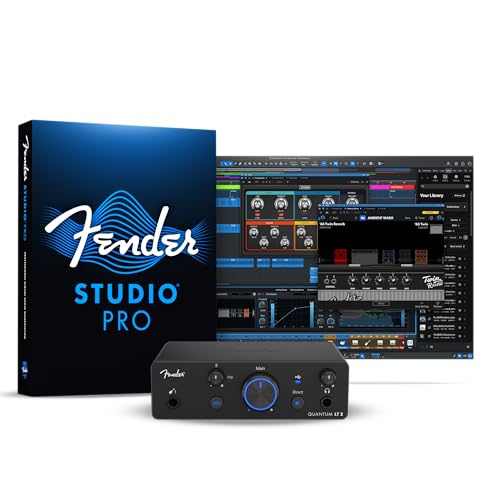
Looking for a compact and powerful solution for your music production needs? The Fender Quantum LT 2 USB-C Audio Interface delivers professional-quality recording in a sleek design. With custom low-latency drivers and high-quality converters, you’ll enjoy natural tracking. Its MAX-HD Mic Preamp offers 75 dB of clean gain, perfect for vocals and instruments, while the specially voiced instrument input enhances your guitar and bass tones. Flexible monitoring options include balanced TRS outputs and a high-power headphone amp. Plus, with easy software integration and broad compatibility across macOS and Windows, you’re set for a seamless recording experience.
Best For: Musicians, podcasters, and content creators looking for a compact and high-quality audio interface for professional recording.
Pros:
- Custom low-latency drivers provide a seamless recording experience.
- MAX-HD Mic Preamp offers 75 dB of clean gain, ideal for high-quality vocal and instrument recording.
- Flexible monitoring options with balanced TRS outputs and a high-power headphone amp enhance usability.
Cons:
- Limited to 2×2 inputs/outputs, which may not suit larger recording setups.
- Requires USB-C compatibility, which may be a limitation for users with older devices.
- 6-month trial of Fender Studio Pro may not be sufficient for long-term users looking for extended software access.
Shure MVX2U XLR-to-USB Interface with Headphone Jack

Shure’s MVX2U XLR-to-USB Interface stands out as an ideal choice for podcasters and musicians seeking high-quality audio without the hassle. With its universal microphone compatibility, you can connect dynamic mics like the SM7B or sensitive condensers, enjoying up to 60dB of clean gain and 48V phantom power. The built-in 3.5mm headphone jack allows for real-time monitoring, while zero-latency guarantees you hear exactly what your audience does. Its compact design and dual mounting options offer flexibility, making setup easy. Plus, the included USB-C cable works seamlessly with both Mac and Windows, enhancing your recording experience effortlessly.
Best For: Podcasters and musicians seeking high-quality audio recording with versatile microphone compatibility.
Pros:
- Universal compatibility with dynamic and condenser microphones, providing up to 60dB gain and 48V phantom power.
- Zero-latency monitoring through a built-in headphone jack, ensuring real-time audio feedback for users.
- Compact design with flexible mounting options, making it easy to set up in various recording environments.
Cons:
- Limited to USB connectivity, which may not suit users looking for other connection types.
- No onboard effects or processing, which might be a drawback for those seeking additional sound manipulation.
- Requires external power for phantom power usage, which may limit portability in certain situations.
Focusrite Scarlett 2i2 4th Gen USB Audio Interface

The Focusrite Scarlett 2i2 4th Gen USB Audio Interface is an ideal choice for musicians and content creators who demand professional-grade sound quality without the complexity of high-end gear. With a dynamic range of 120dB, it delivers studio-quality audio using the same converters found in major studios. You’ll love the Auto Gain feature that sets perfect levels for your mic or guitar, while Clip Safe technology guarantees your recordings stay clean. Plus, Air mode enhances your vocals and guitars with added presence. Bundled software like Pro Tools Intro+ allows you to record, mix, and master effortlessly, making it a complete audio solution.
Best For: Musicians and content creators seeking professional sound quality and user-friendly features for recording, streaming, and podcasting.
Pros:
- Studio-quality sound with a 120dB dynamic range, utilizing high-end converters.
- Auto Gain feature simplifies setting optimal levels for microphones or guitars.
- Comprehensive software bundle includes Pro Tools Intro+, Ableton Live Lite, and essential effects and instruments.
Cons:
- Limited inputs and outputs may not suit advanced users needing extensive connectivity.
- No MIDI connectivity, which could be a drawback for some musicians.
- Potential learning curve for beginners unfamiliar with audio interfaces and recording software.
Focusrite Scarlett Solo 3rd Gen USB Audio Interface

Designed specifically for guitarists, vocalists, podcasters, and producers, the Focusrite Scarlett Solo 3rd Gen USB Audio Interface delivers studio-quality sound in a compact package. You’ll enjoy high-performing mic pre-amps that enhance recording brightness, while the switchable Air mode adds clarity to your acoustic instruments. With two high-headroom instrument inputs, you can capture your guitar or bass without clipping or distortion. Experience up to 24-bit/192kHz recording quality, ensuring you retain all sonic details. Plus, low-noise balanced outputs guarantee clean audio playback, and the included software enhances your creative process. A three-year warranty backs your investment for peace of mind.
Best For: Guitarists, vocalists, podcasters, and producers looking for a compact audio interface that delivers studio-quality sound.
Pros:
- High-performing mic pre-amps enhance recording brightness and clarity.
- Supports up to 24-bit/192kHz recording quality for detailed sonic retention.
- Includes essential software for creative enhancements and a three-year warranty for peace of mind.
Cons:
- Limited to two inputs, which may not suffice for larger setups.
- No MIDI input/output, restricting connectivity with MIDI devices.
- Some users may find the bundled software limited compared to full versions.
M-AUDIO M-Track Duo HD Audio Interface

For those seeking a versatile and high-quality audio interface, the M-AUDIO M-Track Duo HD stands out with its impressive 24-bit/192kHz audio resolution. This 2-in/2-out USB-C interface is perfect for recording, streaming, and podcasting. You’ll appreciate the two combo inputs for microphones or instruments, along with a headphone output that offers independent level control. With switchable +48V phantom power and crystal preamps, it captures every nuance of sound with zero-latency monitoring. Plus, it comes with a thorough software bundle to enhance your creativity. Its compact design guarantees easy portability, making it a great choice for any setup.
Best For: The M-AUDIO M-Track Duo HD is best for musicians, podcasters, and content creators seeking a compact and high-quality audio interface for recording and streaming.
Pros:
- Supports high-resolution audio with 24-bit/192kHz capabilities for studio-quality sound.
- Versatile connectivity options with two combo inputs and headphone output with independent level control.
- Comprehensive software bundle included to enhance creative possibilities.
Cons:
- Limited to 2 inputs and outputs, which may not be sufficient for larger recording setups.
- USB-C only, which may require additional adapters for older devices.
- No onboard effects, meaning all processing must be done through software or external equipment.
PreSonus Studio 24c USB Audio Interface

With its exceptional 24-bit resolution and versatile sampling rates, the PreSonus Studio 24c USB Audio Interface is a perfect fit for budding musicians and seasoned producers alike. You’ll appreciate its 2×2 I/O configuration, featuring two XMAX-L mic preamps for high-quality recordings. Connect your studio monitors through the balanced ¼-inch TRS outputs, while the high-power headphone output guarantees you hear every detail. The mixer knob allows for low-latency monitoring, and the included Studio One 6 Artist Edition software makes recording a breeze. Plus, with USB-C connectivity, it’s compatible with most computers, enhancing your workflow effortlessly.
Best For: The PreSonus Studio 24c USB Audio Interface is best for budding musicians and seasoned producers looking for high-quality recordings with a compact and user-friendly setup.
Pros:
- High-quality sound: Offers 24-bit resolution and various sampling rates for professional audio fidelity.
- Flexible connectivity: Includes USB-C cables for easy compatibility with most computers.
- Comprehensive software: Comes with Studio One 6 Artist Edition for streamlined recording and production.
Cons:
- Limited I/O options: Only provides 2 inputs and 2 outputs, which may be restrictive for larger setups.
- No onboard effects: Lacks built-in effects or processing capabilities, requiring external solutions for sound enhancement.
- Basic MIDI functionality: MIDI In/Out may not meet the needs of users with more complex MIDI setups.
PreSonus Quantum ES 2 USB-C Audio Interface with Studio One Pro Software

The PreSonus Quantum ES 2 USB-C Audio Interface stands out as an exceptional choice for musicians and producers seeking high-quality sound and low-latency performance. With its custom low-latency driver, you’ll experience minimal audio delays during recording. The two MAX-HD mic preamps deliver +75 dB of gain, ensuring transparency and low noise. Collaborating with Fender engineers, this interface optimizes instrument input tailored for guitar and bass. Plus, it comes with a perpetual license for Studio One Pro, enhancing your recording capabilities. The user-friendly features, like the Auto Gain button and bright LED metering, make it easy to achieve professional results.
Best For: Musicians and producers looking for high-quality sound and low-latency recording solutions.
Pros:
- Exceptional low-latency performance thanks to the custom low-latency driver.
- High-quality sound with MAX-HD mic preamps providing +75 dB of gain.
- User-friendly features like Auto Gain and bright LED metering simplify the recording process.
Cons:
- May be overkill for casual users or those with minimal recording needs.
- Requires USB-C compatible devices for optimal connectivity.
- The included Studio One Pro software may have a learning curve for new users.
Fender Quantum LT 16 USB-C Audio Interface

Ideal for musicians and content creators seeking professional-grade audio, the Fender Quantum LT 16 USB-C Audio Interface delivers impressive features that elevate your sound quality. With 16-in, 8-out connectivity and eight MAX-HD mic preamps offering +75 dB gain, clarity is assured. You’ll enjoy the flexibility of standalone modes for live mixing or as an outboard mic preamp. Its low-latency performance guarantees precise monitoring, while the loopback feature is perfect for streaming and content creation. Seamless software control with Fender Studio Pro enhances your experience, giving you the tools to create high-quality audio effortlessly.
Best For: Musicians and content creators looking for a professional-grade audio interface with versatile functionality and high-quality sound.
Pros:
- Versatile connectivity with 16-in, 8-out options and multiple mic preamps for various recording needs.
- Standalone functionality allows for use in diverse environments without the need for a computer.
- Low-latency performance and high-quality converters ensure accurate monitoring during production.
Cons:
- Higher price point may not be suitable for beginners or those on a tight budget.
- Complexity of features may require a learning curve for new users.
- Limited portability due to the number of inputs and outputs, which may not be ideal for mobile setups.
Factors to Consider When Choosing USB C Audio Interfaces
When you’re picking a USB-C audio interface, several key factors can make a big difference in your sound quality. You’ll want to contemplate audio quality standards, input/output configuration, and software compatibility to guarantee it fits your needs. Don’t forget to check latency performance and build quality for a reliable and durable setup.
Audio Quality Standards
Choosing a USB-C audio interface means understanding key audio quality standards that impact your recordings. First, consider dynamic range; higher-end interfaces typically offer around 120dB, ensuring clear and detailed sound. Look for support for high-resolution audio formats, like 24-bit/192kHz, to capture a broader range of frequencies and nuances. Quality converters are essential, as they directly influence clarity and fidelity—professional interfaces often use converters found in major studios. Low-latency monitoring is vital too; it lets you hear your sound in real-time without delays. Finally, high-performance mic preamps can enhance audio quality, providing clean gain and minimizing noise for studio-level recordings. Prioritizing these factors will elevate your recording experience greatly.
Input/Output Configuration
Understanding input/output configuration is essential for selecting the right USB-C audio interface, as it directly impacts your recording capabilities. You’ll want to reflect on how many audio sources you need to record simultaneously; common setups include 2×2 or larger configurations like 16×8 for extensive projects. The type of inputs—XLR, TRS, or combo jacks—will determine compatibility with your microphones and instruments, enhancing versatility. Look for balanced outputs for studio monitors and headphone outputs with independent level control for precise monitoring. If you work with electronic instruments, MIDI I/O can greatly expand your production options. Finally, loopback functionality is a must-have for content creators, allowing you to route system audio into your recordings effortlessly.
Software Compatibility
Software compatibility plays an essential role in maximizing the potential of your USB-C audio interface. When choosing one, make sure it comes bundled with compatible recording software that meets your specific needs, like DAWs or effects plugins. Check if the interface supports popular software such as Pro Tools, Ableton Live, or Studio One; this can greatly enhance your workflow. Don’t forget to verify the operating system compatibility, ensuring it works seamlessly with macOS, Windows, or iOS devices. Look for interfaces that offer additional software bundles, including virtual instruments and mastering tools, for a richer recording experience. Finally, consider whether the interface allows remote monitoring or control through specific applications to streamline your recording and mixing process.
Latency Performance
When it comes to recording and monitoring in real-time, latency performance is an essential factor in selecting a USB-C audio interface. Low-latency drivers in high-quality models can achieve response times as low as 1-2 ms, which is vital for seamless performance. Look for interfaces with high-performance converters and mic preamps that process audio signals quickly and accurately, minimizing any noticeable delay. Many models offer zero-latency monitoring, letting you hear input signals directly without digital processing delays. The USB-C connection enhances data transfer rates, further improving latency. Additionally, some interfaces feature adjustable buffer sizes, allowing you to fine-tune latency during recording sessions while balancing CPU load for playback. This flexibility can greatly enhance your workflow.
Build Quality and Durability
Low-latency performance is important, but the build quality and durability of a USB-C audio interface can make all the difference in your recording experience. You’ll want to choose models with rugged enclosures and durable electronics, especially if you frequently transport your gear. Look for sturdy materials like stainless steel and reinforced plastics that resist wear and tear over time. High-quality connectors and cables help prevent signal degradation, ensuring reliable operation during your sessions. Additionally, interfaces that feature proper sealing against dust and moisture are ideal for various environments, whether you’re in a studio, at a live performance, or outdoors. Prioritizing durability means you’ll enjoy lasting performance from your audio interface for years to come.
Portability and Size
Portability and size are essential considerations for anyone looking to choose a USB-C audio interface, especially if you’re a musician or producer on the move. Compact designs typically weigh around 1 pound and easily fit into your laptop bag or backpack. Many manufacturers prioritize lightweight materials and rugged enclosures, ensuring durability without adding bulk. For instance, interfaces like the MOTU M4 and M-AUDIO M-Track Duo HD show how efficient use of space can integrate multiple inputs and outputs while staying portable. A small form factor not only enhances your mobility but also allows for seamless integration into home studios or on-the-go setups, giving you the freedom to record wherever inspiration strikes. Choose wisely for your active lifestyle!
Price and Value
Price plays a pivotal role in your choice of USB-C audio interfaces, as it directly reflects the features and audio quality you can expect. You’ll find prices ranging from about $100 for basic models to over $1,000 for high-end gear. When evaluating value, consider the included software bundles; professional recording software can save you money later. A higher dynamic range, often over 120dB in premium interfaces, enhances sound quality, too. Features like low-latency monitoring, built-in preamps, and extra connectivity options can justify a steeper price, making them ideal for serious musicians. Finally, don’t overlook customer reviews and ratings, as they can reveal user satisfaction and reliability, helping you make a well-informed decision.