A portable EV charger can turn a compatible outlet into a convenient charging point at home, work, or on the road. The right model depends on your vehicle, outlet type, charging speed, cable reach, and safety certifications.
We compared 10 portable EV chargers across Level 1 and Level 2 performance, plug compatibility, adjustability, portability, and everyday usability to help you choose with confidence.
Best 10 Portable Ev Chargers Picks for 2026
Best Travel Flexibility

- Level 1 and Level 2 capability
- NEMA 5-15 adapter included
- 20-foot cable and physical controls
Best For: Road trips, apartments, and backup charging
Best High-Output Value

- Up to 9.6kW at 40A
- Adjustable 8A–40A output
- 25-foot cable and delay timer
Best For: Fast home charging from a 240V NEMA 14-50 outlet
Best Rugged Portability

- Multiple outlet adapters included
- Rugged NEMA-4X aluminum enclosure
- 7A–40A adjustment and smart features
Best For: Frequent travelers needing durable, adaptable charging
Flexible Home-to-Road Charging
Toptoo 16A Portable EV Charger

- 110V-240V input with 16A, 3.5kW capability
- LCD monitoring plus adjustable current and delay settings
- Includes US plug adapter for household charging
Best For: J1772 owners seeking adjustable home and travel charging
High-Power Garage Charging
EVDANCE 40A Level 2 Portable Charger

- Up to 9.6kW at 240V with adjustable 10A-40A output
- 25-foot cable for flexible parking and garage placement
- IP66-rated design with display and multiple protections
Best For: Drivers with a NEMA 14-50 outlet seeking faster J1772 charging
Simple Overnight Charging
Lectron 15A Level 1 EV Charger

- Uses a standard 120V outlet at 15A and 1.65kW
- 16-foot cord supports flexible placement
- ETL/FCC certified with IP65 water and dust resistance
Best For: J1772 drivers needing uncomplicated household-outlet charging
Best Value 7kW Option
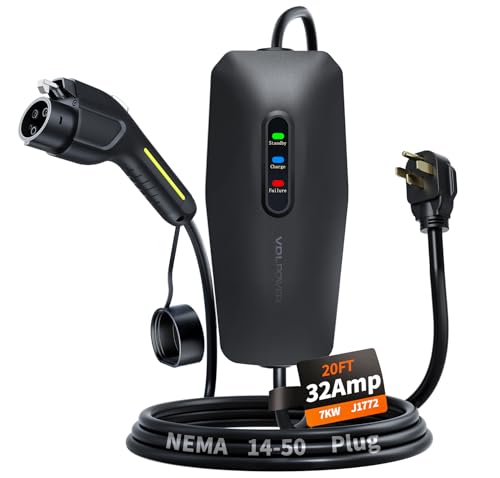
- 7kW output at 32A
- 20-foot charging cable
- IP65 control box with safety monitoring
Best For: J1772 EV owners with a 240V NEMA 14-50 outlet
Best High-Power Pick
Lectron 40A Portable EV Charger

- Up to 9.6kW at 40A
- ETL and FCC certified
- 16-foot cable and carrying case
Best For: J1772 drivers with a 240V NEMA 14-50 outlet
Best Flexible Outlet Choice

- Works with 120V or 240V outlets
- 25-foot charging cable
- Up to 3.68kW at 16A
Best For: J1772 drivers needing household-outlet flexibility
Best Wi-Fi Control – 32A Portable EV Charger
For drivers who want app-based scheduling and adjustable charging, this 32A unit is a versatile choice among portable EV chargers. Its J1772 connector, 25-foot cable, touch display, and NEMA 14-50 plug support convenient Level 2 home charging, provided your circuit and outlet are properly matched.
Best For: J1772 EV owners who want Wi-Fi monitoring, charging schedules, and a long reach for home use.
Pros:
- Adjustable 16A–32A charging for 20A–40A circuits.
- Wi-Fi app supports scheduling, charging history, cost tracking, and status notifications.
- 25-foot cable and NEMA Type 4 enclosure improve installation flexibility.
- Built-in display shows amperage, voltage, charging speed, and delay time.
Cons:
- Requires a suitable 240V NEMA 14-50 outlet for its fastest charging.
- Tesla and other NACS vehicles need a separate J1772-to-Tesla adapter.
- The optional 110V adapter is not included and provides much slower charging.
This charger stands out for combining app controls with manual operation and a long cable. Confirm your circuit capacity, outlet type, vehicle connector, and installation conditions before choosing it.
Best Travel Flexibility – bokman Dual-Level EV Charger
This bokman model is a practical pick for road trips, apartments, and camping because it supports both Level 1 and Level 2 charging. The included NEMA 5-15 adapter, adjustable current settings, tactile controls, and 20-foot cable make it one of the more adaptable portable EV chargers for changing outlets and charging conditions.
Best For: Travelers and apartment dwellers who need Level 1 backup charging plus faster Level 2 charging when a NEMA 6-20 outlet is available.
Pros:
- Supports Level 1 with the included NEMA 5-15 adapter and Level 2 through its NEMA 6-20 plug.
- Adjusts from 6A to 16A and includes a 1–12-hour delay timer.
- 20-foot cable offers useful reach in standard parking spaces.
- ETL certification, IP65 protection, and multiple safety safeguards support all-weather use.
Cons:
- 16A output is slower than 32A or 40A Level 2 chargers.
- Tesla vehicles require a separate J1772 adapter.
- Users must verify whether their outlet is NEMA 6-20 or NEMA 5-15.
Its main advantage is flexibility rather than maximum speed. Choose it when portability, simple physical controls, and access to both household and Level 2 outlets matter more than high-output home charging.
Best High-Output Value – 40A Portable EV Charger
With up to 40A and 9.6kW of Level 2 power, this charger is aimed at drivers who want faster home charging without giving up portability. Its NEMA 14-50 plug, 25-foot cable, adjustable current settings, and delay timer make it a straightforward option among portable EV chargers.
Best For: J1772 EV owners with a properly grounded 240V NEMA 14-50 outlet who want high-output charging and simple scheduling.
Pros:
- Delivers up to 40A and 9.6kW through a 240V connection.
- Five current settings from 8A to 40A accommodate different charging needs.
- 25-foot cable helps reach vehicles in garages and driveways.
- Built-in 1–12-hour delay timer can help schedule off-peak charging.
Cons:
- Designed for dry use and requires a properly grounded outlet.
- Tesla vehicles need a separately sold adapter.
- Its NEMA 14-50 plug requires a compatible 240V circuit.
This is a sensible choice when charging speed is the priority and your electrical setup can support 40A operation. The adjustable settings also make it easier to select a lower current when needed.
Best Rugged Portability – Grizzl-E Mini 40A Charger
The Grizzl-E Mini is built for drivers who want a durable, portable charging setup that can adapt to several outlet types. Its metal NEMA-4X enclosure, 7A–40A adjustment range, soft case, and included adapters give it broad utility for indoor and outdoor charging.
Best For: EV owners who travel between locations and need rugged construction, multiple circuit adapters, and adjustable current control.
Pros:
- Includes adapters for NEMA 5-15P, TT-30P, 14-30P, and 6-50P circuits.
- Adjustable amperage from 7A to 40A supports different electrical setups.
- Compact aluminum NEMA-4X enclosure is designed for indoor and outdoor conditions.
- Offers local smart features, built-in GFCI, safety protections, and power-outage recovery.
Cons:
- At 9.8 pounds, it is heavier than some compact portable chargers.
- Its J1772 connector requires an adapter for Tesla or other NACS vehicles.
- Smart features connect within range of the charger rather than through stated remote Wi-Fi access.
This model is especially compelling for frequent travel or homes with multiple outlet configurations. Its adapter set and rugged enclosure add versatility, while the adjustable output helps match each circuit safely.
Flexible Home-to-Road Charging – Toptoo 16A Portable EV Charger
For drivers who want adaptable portable EV chargers, the Toptoo 16A model supports 110V-240V input and includes both a standard US plug adapter and a J1772-compatible charging connector. Its control box adds charging-status visibility, adjustable current selection, and delayed-start settings for home or travel use.
Best For: J1772 EV owners who want one adjustable charger for household outlets, travel, and scheduled charging.
Pros:
- Supports 110V-240V input with 16A and 3.5kW capability.
- 1.8-inch LCD displays current, voltage, power, temperature, and charging status.
- Offers adjustable current, delayed start, and automatic shutoff when charging is complete.
- Includes a US-standard plug adapter for Level 1 household outlets.
Cons:
- Charging current must stay within the outlet’s rated capacity.
- The supplied notes do not specify a cable length or weather-resistance rating.
The Toptoo is a practical middle ground for buyers who need more control than a basic Level 1 unit but do not want to commit to a fixed high-power installation. Check your outlet, wiring, and vehicle compatibility before use.
High-Power Garage Charging – EVDANCE 40A Level 2 Portable Charger
Among portable EV chargers, the EVDANCE 40A model is designed for faster 240V charging and uses a NEMA 14-50 plug. It delivers up to 9.6kW, includes a 25-foot cable, and lets drivers select charging current from 10A to 40A for more flexible installation and use.
Best For: J1772 EV and hybrid owners with a compatible 240V NEMA 14-50 outlet who prioritize faster charging and extra cable reach.
Pros:
- Provides up to 40A and 9.6kW at 240V, with six selectable current levels.
- 25-foot cable helps reach vehicles in larger garages or parking spaces.
- 2.4-inch TFT display shows charging current, voltage, power, energy, time, and status.
- IP66 rating, broad operating-temperature range, and multiple built-in safety protections.
Cons:
- Requires a suitable 240V NEMA 14-50 outlet.
- Tesla vehicles require a J1772-to-Tesla adapter, which is not included.
- At 11.59 pounds, it is less lightweight than lower-power portable options.
This EVDANCE charger makes the most sense when your electrical setup can support its output and you want Level 2 speed without a permanently mounted unit. The long cable and included carry bag also make it easier to reposition or transport.
Simple Overnight Charging – Lectron 15A Level 1 EV Charger
The Lectron Level 1 is one of the simpler portable EV chargers for drivers who have access to a standard 120V outlet. Its NEMA 5-15 plug supplies 15A and 1.65kW, while the 16-foot cord provides useful reach for home, workplace, road-trip, and overnight charging.
Best For: J1772 EV owners who want a straightforward, ETL-certified charger for standard-outlet overnight charging.
Pros:
- Works with standard 120V outlets and provides 15A, 1.65kW charging.
- 16-foot extension cord supports more flexible vehicle positioning.
- ETL and FCC certified, with overvoltage, overcurrent, and short-circuit protection.
- IP65-rated construction provides dust and water resistance.
Cons:
- Level 1 output is slower than 240V Level 2 charging.
- Designed for J1772 vehicles rather than vehicles requiring a different connector.
If convenience and compatibility with an existing household outlet matter more than charging speed, the Lectron is a sensible entry-level choice. Its certification, protection features, and two-year warranty add reassurance for regular overnight use.
Best Value 7kW Option – Portable 32A EV Charger
For drivers comparing portable EV chargers for home use, travel, or a vacation rental, this VDLPOWERVP model offers 32A Level 2 charging through a NEMA 14-50 plug. Its 20-foot cable and portable design provide useful flexibility when the outlet is not close to the vehicle.
Best For: J1772 EV owners who want a portable 240V charger with a long cable and straightforward status indicators.
Pros:
- Delivers up to 7kW at 32A with a 220V/240V NEMA 14-50 connection.
- Includes a 20-foot charging cable for easier driveway or garage positioning.
- Control box provides monitoring plus lightning and leakage protection.
- IP65-rated control box and a one-year warranty add practical reassurance.
Cons:
- Requires a compatible 240V NEMA 14-50 outlet.
- Designed for SAE J1772 vehicles; connector compatibility should be confirmed before purchase.
With its combination of 7kW output, long cable, and portable construction, this is a practical choice for J1772 drivers who already have the required 14-50 outlet.
Best High-Power Pick – Lectron 40A Portable EV Charger
This Lectron model is one of the higher-output portable EV chargers in this lineup, providing up to 9.6kW at 40A from a 240V NEMA 14-50 outlet. Its 16-foot cable, carrying case, and certified safety features make it suitable for home or travel charging.
Best For: J1772 EV and plug-in hybrid owners seeking faster portable Level 2 charging from a properly rated 240V outlet.
Pros:
- Provides up to 9.6kW of charging power at 40A.
- Uses a standard NEMA 14-50 plug without requiring hardwiring.
- ETL and FCC certified, with overvoltage, overcurrent, and short-circuit protection.
- Includes a 16-foot cable, IP65 water and dust resistance, and a carrying case.
Cons:
- Requires a 240V NEMA 14-50 outlet and a vehicle that can accept its available charging rate.
- Uses a J1772 connector and is not natively compatible with Tesla vehicles without an adapter.
This is the strongest performance-oriented option here, provided your electrical setup supports 40A charging and your vehicle uses the J1772 standard.
Best Flexible Outlet Choice – EVDANCE Level 1/2 EV Charger
Among portable EV chargers, the EVDANCE Level 1/2 model stands out for its outlet flexibility. It can draw 12A from a standard 120V NEMA 5-15 connection or up to 16A from a 240V NEMA 6-20 outlet, while its 25-foot cable helps reach vehicles parked farther from the receptacle.
Best For: J1772 drivers who need one charger for standard household outlets and compatible 240V NEMA 6-20 connections.
Pros:
- Supports 120V Level 1 charging at 12A and 240V Level 2 charging at 16A.
- Includes a NEMA 6-20 plug and a 6-20-to-5-15 adapter.
- Extra-long 25-foot cable improves placement flexibility.
- ETL certified with IP66 housing, LED status information, and a carrying bag.
Cons:
- Its maximum 16A output and 3.68kW Level 2 rating are lower than the other chargers in this roundup.
- Not compatible with NEMA 14-50, 10-30, 14-30, or 6-50 outlets without a separately sold adapter.
- Some listed vehicles, including Tesla models, require an adapter or may be incompatible.
The ability to use common 120V power is its main advantage, making this a versatile backup and travel charger rather than a high-speed home-charging replacement.
How We Picked the Best Portable Ev Chargers
We focused on chargers that offer practical flexibility for EV and plug-in hybrid owners. Our selection includes Level 1 models for standard 120-volt outlets, Level 2 units for 240-volt circuits, and dual-voltage options that can adapt to different charging situations.
We also considered cable length, connector type, current settings, display or app controls, weather suitability, safety certification claims, and the convenience of carrying or storing each unit. Because installation requirements vary, we prioritized clear plug specifications and models suited to common J1772 vehicles.
Quick Comparison
| Type | Typical Use | What to Look For |
|---|---|---|
| Level 1 | Overnight charging from a household outlet | 120V compatibility, manageable cable, 12–16A output |
| Level 2 | Faster home or destination charging | 240V circuit, suitable plug, 32–40A output |
| Dual-voltage | Home and travel flexibility | Included adapters, adjustable current, clear outlet requirements |
Key Buying Factors for Portable Ev Chargers
Check Your Vehicle and Outlet
Most products in this roundup use a J1772 connector, but you should verify your vehicle’s charging port before buying. Then match the charger plug to your existing receptacle. A NEMA 14-50, NEMA 6-20, or standard 5-15 outlet requires the appropriate circuit and adapter; an adapter should never be used to exceed the outlet or wiring capacity.
Choose the Right Charging Level
Level 1 is slower but often requires no special electrical work. Level 2 can substantially reduce charging time, but a 240-volt circuit and suitable amperage are necessary. Higher advertised amperage does not automatically mean faster charging if your vehicle has a lower onboard AC charging limit.
Prioritize Reach and Controls
A 20- to 25-foot cable can make driveway positioning easier, while a shorter cable is typically easier to store. Adjustable current settings are useful when sharing a circuit or charging from different outlets. Displays and app controls can help monitor charging, timing, and power, but they are not essential for basic operation.
Review Safety and Installation Needs
Look for recognized safety certification, overcurrent and overtemperature protection, and a durable enclosure. Outdoor use also calls for weather resistance and careful storage of plugs and connectors. Have a qualified electrician confirm that your circuit, receptacle, breaker, and wiring can support the selected charger.
Who Should Buy Which Portable Ev Chargers?
- Choose a Level 1 model if you drive modest daily distances, have ample overnight charging time, or want the simplest setup.
- Choose a Level 2 charger if you need faster turnaround at home and already have, or plan to install, a compatible 240-volt circuit.
- Choose a dual-voltage charger if you travel frequently or want one unit that works with both household and higher-voltage outlets.
- Choose a longer-cable model if your outlet location limits where you can park.
- Choose adjustable or app-connected equipment if you want more control over charging schedules, current draw, or energy monitoring.