If you’re serious about podcasting, choosing the right audio interface is essential for achieving excellent sound quality. With so many options available, it can be overwhelming to find the one that suits your needs best. From user-friendly features to high-quality preamps, these interfaces can elevate your recordings considerably. Curious about which models stand out and why they might be the perfect fit for your podcasting journey? Let’s explore the leading contenders.
Focusrite Scarlett 2i2 4th Gen USB Audio Interface for Recording
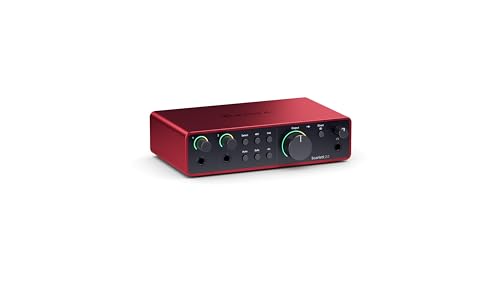
If you’re a podcaster looking for a reliable audio interface that delivers professional sound quality, the Focusrite Scarlett 2i2 4th Gen is an excellent choice. With its studio-quality sound and a dynamic range of 120dB, it utilizes advanced converters found in major studios. The Auto Gain feature automatically sets ideal levels for your mic or guitar, while Clip Safe technology prevents clipping during recording. Plus, the Air mode enhances your vocals and guitars, giving them richness. Bundled software like Pro Tools Intro+ and Ableton Live Lite guarantees you have all the tools needed to record, mix, and master your podcast seamlessly.
Best For: Podcasters and musicians seeking a reliable audio interface with professional sound quality and user-friendly features.
Pros:
- Studio-quality sound with a 120dB dynamic range for clear recordings.
- Auto Gain feature simplifies the process by automatically optimizing input levels.
- Comprehensive software bundle includes essential tools for recording, mixing, and mastering.
Cons:
- Limited connectivity options may not suit all recording setups.
- The interface may require additional setup time for beginners unfamiliar with audio gear.
- Some users may find the bundled software features overwhelming or unnecessary.
Focusrite Scarlett Solo 3rd Gen USB Audio Interface

The Focusrite Scarlett Solo 3rd Gen USB Audio Interface is perfect for solo podcasters and musicians who want to capture high-quality audio with ease. With high-performing mic preamps, your recordings will shine with brightness and clarity. The switchable Air mode enhances acoustic instruments, while two high-headroom inputs let you record guitars or bass without any distortion. Enjoy studio-quality recordings at up to 24-bit/192kHz, ensuring every detail is retained. Plus, low-noise balanced outputs provide clean playback, and the included software like Pro Tools Intro+ and Ableton Live Lite gives you essential tools for editing. A three-year warranty covers any manufacturing faults.
Best For: The Focusrite Scarlett Solo 3rd Gen USB Audio Interface is best for solo podcasters, musicians, and producers looking to achieve studio-quality recordings with ease and convenience.
Pros:
- High-performing mic preamps enhance recording brightness and clarity.
- Supports studio-quality recordings up to 24-bit/192kHz, capturing every detail.
- Includes essential software like Pro Tools Intro+ and Ableton Live Lite for effective editing.
Cons:
- Limited to two inputs, which may not be sufficient for larger recordings or collaborations.
- May require additional cables or accessories for optimal use not included in the package.
- Some users may find the setup process challenging if they are not familiar with audio interfaces.
M-AUDIO M-Track Solo USB Audio Interface for Recording and Streaming

For podcasters seeking an affordable yet high-quality solution, the M-AUDIO M-Track Solo USB Audio Interface stands out with its impressive 48kHz audio resolution. This interface features one combo XLR/Line input and one Line/Instrument input, perfect for recording vocals or instruments. You’ll appreciate the zero-latency monitoring with the USB/Direct switch, ensuring real-time audio feedback. The transparent Crystal Preamp enhances sound quality across all microphone types, including condensers. Plus, it comes with MPC Beats Software, giving you essential tools for music creation and editing. With its versatility and ease of use, the M-Track Solo is a great choice for your podcasting needs.
Best For: Podcasters and musicians seeking an affordable, high-quality audio interface for recording and streaming.
Pros:
- Versatile Inputs: Features one combo XLR/Line input and one Line/Instrument input for flexible recording options.
- Zero Latency Monitoring: The USB/Direct switch allows for real-time audio feedback during recordings.
- High-Quality Preamp: Equipped with a transparent Crystal Preamp that optimizes sound quality for all types of microphones.
Cons:
- Limited Inputs: Only one XLR/Line input may be restrictive for multi-person podcasts or complex setups.
- Basic Software Bundle: While it includes MPC Beats Software, additional software may be needed for more advanced production features.
- No MIDI Support: Lacks MIDI input/output capabilities, which could limit options for electronic musicians.
M-AUDIO M-Track Duo USB Audio Interface for Recording and Streaming
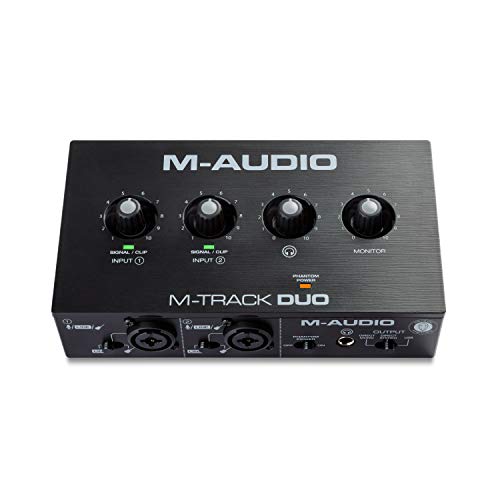
M-AUDIO M-Track Duo stands out as an excellent choice for podcasters seeking versatility and high-quality sound. This USB audio interface features dual XLR, line, and DI inputs, allowing you to connect various audio sources seamlessly. With 48kHz audio resolution and transparent Crystal Preamps, your recordings will sound crisp and professional. You’ll appreciate the two combo inputs with phantom power, perfect for capturing vocals or instruments. The 1/4 headphone output and stereo outputs provide flexible monitoring, while the USB/Direct switch guarantees zero latency. Plus, it includes MPC Beats Software for enhanced editing, making it a powerful tool for your podcasting needs.
Best For: Podcasters and streamers looking for a versatile and high-quality audio interface to capture professional sound.
Pros:
- High audio resolution at 48kHz ensures crisp and clear recordings.
- Dual combo inputs with phantom power allow for versatile connections of microphones and instruments.
- Zero latency monitoring feature provides real-time audio feedback for seamless recording.
Cons:
- Limited to two inputs, which may not suffice for larger podcaster setups.
- Lacks advanced features found in more expensive audio interfaces, such as MIDI connectivity.
- The included software may not meet the needs of professional-level music production.
Focusrite Scarlett Solo Studio 4th Gen USB Audio Interface Bundle

Ideal for aspiring podcasters, the Focusrite Scarlett Solo Studio 4th Gen USB Audio Interface Bundle offers studio-quality sound with a remarkable 120dB dynamic range. You’ll love the included CM25 MkIII condenser microphone and SH-450 headphones, perfect for capturing crisp vocals and rich instrument tones. With Focusrite’s renowned converters, your recordings will sound professional, whether you’re songwriting or podcasting. The Air mode boosts your audio, adding depth and presence. Plus, you get outstanding software like Pro Tools Intro+ and Ableton Live Lite, providing everything you need for recording, mixing, and mastering. This bundle is your all-in-one solution for high-quality sound.
Best For: Aspiring podcasters, songwriters, and musicians looking for an all-in-one solution for recording high-quality sound.
Pros:
- Studio-quality sound with a 120dB dynamic range, ensuring professional audio recordings.
- Includes essential components such as a condenser microphone and headphones for a complete recording experience.
- Comes with industry-leading software, offering tools for recording, mixing, and mastering.
Cons:
- May be overwhelming for complete beginners due to the range of included software and features.
- Limited to USB connectivity, which may not suit all setups or preferences.
- The bundled headphones may not meet the expectations of professional audio engineers or audiophiles.
MAONO Podcast Equipment Bundle: Audio Interface Mixer (MaonoCaster E2 Gen2)

The MAONO Podcast Equipment Bundle, featuring the E2 Gen2 audio interface mixer, is an excellent choice for podcasters seeking a versatile, all-in-one solution. With dual XLR inputs and high-quality preamps offering 60dB gain, you’ll achieve crystal-clear audio perfect for co-hosts. The customizable sound effect buttons add engagement, while noise reduction technology enhances your recordings. You can easily connect to computers and smartphones via USB-C or 3.5mm ports. The built-in battery provides up to 8 hours of use, ensuring you’re ready to podcast anytime. Plus, the plug-and-play functionality makes setup a breeze, so you can focus on your content.
Best For: Podcasters and streamers looking for a comprehensive audio interface mixer that delivers high-quality sound and versatile features.
Pros:
- High-quality preamps with 60dB gain ensure crystal-clear audio for professional recordings.
- Customizable sound effect buttons and pitch-changing effects enhance content engagement.
- Portable with a built-in battery providing up to 8 hours of use, perfect for on-the-go podcasting.
Cons:
- Limited to audio recording and mixing; does not support phone charging or power delivery.
- Some users may find the learning curve steep for maximizing all features.
- The eight sound effect buttons may be insufficient for those needing a wider variety of effects.
Arturia MiniFuse 2 Compact USB Audio & MIDI Interface
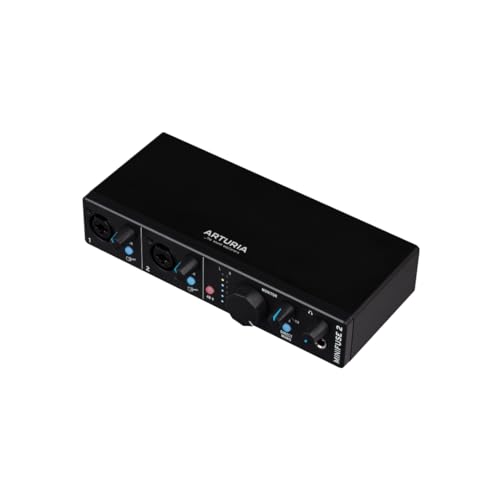
For podcasters seeking a reliable and versatile audio interface, the Arturia MiniFuse 2 stands out with its Loopback feature, allowing you to seamlessly capture voiceovers alongside in-app or in-game audio. This compact USB audio and MIDI interface is designed for quick and easy sound creation. With robust construction and a 5-year warranty, it promises durability. You’ll appreciate its high-quality audio, featuring 2 combo Mic/Inst/Line XLR inputs, balanced line outputs, and a headphone output. Plus, it comes bundled with beginner-friendly software like Ableton Live Lite and tutorials to kickstart your projects. Get ready to elevate your podcasting game!
Best For: Podcasters and content creators looking for a reliable, versatile audio interface for capturing high-quality sound.
Pros:
- High-quality audio with best-in-class specifications and Loopback feature for seamless voiceover and in-game audio capture.
- Robust construction and a 5-year warranty ensure long-lasting durability and value.
- Includes beginner-friendly software and tutorials, making it easy for new users to get started with music production.
Cons:
- The compact design may limit connectivity options for users needing more inputs/outputs.
- Some advanced users may find the bundled software insufficient for professional-level production.
- Limited USB hub power (250mA) may restrict the use of certain peripherals.
Wrugste USB Audio Interface Solo (24Bit/192kHz) for Computer Recording

Looking to elevate your podcasting game? The Wrugste USB Audio Interface Solo (24Bit/192kHz) is your answer. This plug-and-play device features +48V phantom power, perfect for professional condenser microphones. With combo input sockets, you can easily connect both mics and instruments. Enjoy studio-quality sound that enhances your recordings, whether you’re using a computer or streaming live. The interface also includes a 1/4-inch jack for real-time headphone monitoring, ensuring you catch every detail. Plus, it’s compatible with Mac and Windows 10, providing technical support and a two-year warranty. Upgrade your audio setup and impress your listeners!
Best For: This audio interface is best for podcasters and musicians looking for high-quality sound and easy connectivity for recording.
Pros:
- Professional Sound Quality: Delivers studio-grade audio for recordings, enhancing overall clarity and richness.
- Versatile Inputs: Combo input sockets allow for easy connection of both microphones and instruments.
- Real-Time Monitoring: 1/4-inch jack for headphone monitoring ensures accurate sound checks during recording.
Cons:
- No Included Software: The device is plug-and-play but does not come with any software, which may require additional setup.
- Driver Installation Needed for Some Users: Users with specific setups may need to install drivers via ASIO4ALL for optimal performance.
- Limited Compatibility: While it works with Mac and Windows 10 and above, users on older systems may face compatibility issues.
USB Audio Interface for PC Computer Recording Music

Whether you’re a budding podcaster or an aspiring musician, a USB audio interface brings professional recording quality right to your PC or Mac. With 24-bit/192kHz recording, you’ll capture every sonic detail. The zero-latency monitoring via the headphone jack guarantees you hear your performance in real-time. Featuring two XLR/Line combo inputs, it accommodates both microphones and instruments, while the HI-Z switch caters to high-impedance gear. Plus, it supports 48V phantom power for condenser mics. Plug and play functionality makes setup a breeze, so you can focus on creating great sound anywhere—be it at home, in a studio, or during live events.
Best For: Budding podcasters and aspiring musicians seeking professional recording quality on their PC or Mac.
Pros:
- High-quality 24-bit/192kHz recording captures every sonic detail.
- Zero-latency monitoring allows for real-time audio feedback during recording.
- Plug and play functionality makes it easy to set up without technical expertise.
Cons:
- Limited to two inputs, which may not suffice for larger recording setups.
- Requires phantom power for condenser microphones, which may not be included.
- Portability may be a concern for those needing a more rugged interface for outdoor use.
MAONO USB Audio Interface for PC (PS22 Lite Black)

The MAONO USB Audio Interface PS22 Lite Black is a fantastic choice for budding podcasters and streamers seeking high-quality sound without complex setups. With 24-bit/192kHz recording capabilities and a dynamic range of 106dB, it delivers impressive audio clarity. You can easily connect both condenser and dynamic microphones, thanks to its 56 dB preamp and 48V phantom power. The compact design makes it portable, while the included ProStudio Routing Software enhances your streaming experience. It’s compatible with Mac, Windows, and iPads, ensuring a seamless integration with your favorite DAW. Plus, the direct monitoring switch offers real-time feedback for perfect recordings.
Best For: The MAONO USB Audio Interface PS22 Lite Black is best for aspiring podcasters and streamers looking for a user-friendly solution to achieve high-quality audio recordings.
Pros:
- Compact and lightweight design makes it highly portable.
- Supports both condenser and dynamic microphones with professional-level features.
- Direct monitoring switch allows for real-time audio feedback during recordings.
Cons:
- Limited features for advanced users who require more complex setups.
- May require installation of specific drivers for optimal performance on different systems.
- The included software may have a learning curve for complete beginners.
Factors to Consider When Choosing Audio Interfaces for Podcasting
When you’re choosing an audio interface for podcasting, there are several key factors to keep in mind. You’ll want to take into account audio quality standards, input and output options, and monitoring capabilities to guarantee a smooth recording experience. Don’t forget about software compatibility and the portability of the device, as these can greatly impact your workflow.
Audio Quality Standards
Choosing the right audio interface for podcasting is vital to achieving high-quality sound, especially since various factors directly impact your recordings. First, look for interfaces that support at least 24-bit/192kHz recording quality to guarantee clarity and fidelity in your audio. A dynamic range of 106dB or higher is recommended, as it helps capture the full spectrum of sound without distortion. High-performance preamps will enhance the brightness of your vocals and instruments, making them stand out. Additionally, zero-latency monitoring is essential for real-time feedback while recording, allowing you to hear your voice without delays. Finally, don’t forget about phantom power; it’s necessary for using condenser microphones, which are often favored for their sensitivity in podcasting.
Input and Output Options
Versatility in input and output options is essential for any podcaster looking to create high-quality recordings. When choosing an audio interface, look for multiple combo XLR/line inputs. They allow for various microphone and instrument connections, making your setup more flexible. Verify it supports phantom power (48V) for condenser microphones, which can greatly enhance your sound quality. Dedicated instrument inputs are also a plus, as they capture high-impedance sources like guitars without distortion. Additionally, consider balanced outputs (TRS or XLR) for connecting to studio monitors or external audio equipment—this guarantees high-quality playback. By focusing on these factors, you’ll equip yourself for an exceptional podcasting experience that resonates with your audience.
Monitoring Capabilities
Effective monitoring capabilities are essential for ensuring high-quality audio in your podcast. Real-time audio monitoring allows you to hear your voice clearly during recording, which is vital for maintaining a natural flow in conversation. Look for audio interfaces with zero-latency monitoring features, so you won’t experience delays that can disrupt your performance. Many interfaces provide headphone outputs with independent volume control, letting you adjust your listening level without affecting others. Some models even include direct monitoring switches, making it easy to switch between monitored audio and mixed inputs. Finally, high-quality preamps can greatly reduce noise, delivering a cleaner monitoring experience that accurately reflects your recorded sound. Prioritize these features to enhance your podcasting quality.
Software Compatibility
When selecting an audio interface for your podcast, software compatibility is one of the top factors to take into account. Make certain the interface works seamlessly with your operating system, whether it’s Mac or Windows, to prevent installation headaches. Look for options that bundle popular Digital Audio Workstations (DAWs) like Pro Tools or Ableton Live, as these can enhance your podcasting experience with essential tools. Check for ASIO driver support for low-latency performance during recording sessions. It’s also beneficial to choose interfaces that come with dedicated software or plugins for audio processing, improving sound quality. Finally, verify the interface integrates well with other software tools you plan to use, like routing software or virtual channels for better audio management.
Portability and Size
How important is portability when choosing an audio interface for your podcast? If you plan to record on the go, compact designs are essential. Lightweight interfaces make it easy to transport your gear without adding strain during travel. Plus, those with a small footprint fit perfectly into limited workspace environments, like home offices or temporary setups. Many portable audio interfaces also come with plug-and-play functionality, allowing for quick setups without complicated installations. Consider battery-powered options as well, giving you the flexibility to record anywhere without needing a wall outlet. By prioritizing portability and size, you can guarantee your podcasting experience is both efficient and enjoyable, no matter where your recording adventures take you.
Preamp Quality
While you might focus on portability and ease of use, the quality of the preamps in your audio interface is equally important for achieving professional-sounding podcasts. High-performance preamps enhance clarity and brightness, ensuring your vocals and instruments sound engaging. Look for features like switchable air mode, which boosts presence in acoustic recordings. Aim for a gain range of at least 60dB to handle various microphone types, from dynamic to condenser, without adding noise or distortion. Transparent preamps play a key role in maintaining the integrity of your original sound, providing a clean representation of your audio. Remember, preamp quality greatly influences overall sound, impacting your listener’s experience and engagement, making it a essential consideration when selecting an audio interface.
User-Friendly Features
Choosing an audio interface that prioritizes user-friendly features can make all the difference in your podcasting experience. Look for plug-and-play functionality to simplify setup, letting you start recording without needing extensive technical knowledge. Zero-latency monitoring is essential; it allows you to hear your input in real-time, guaranteeing high-quality performance during recordings. User-friendly controls like dedicated gain knobs and direct monitoring switches make the interface more accessible, especially for beginners. A compact and lightweight design enhances portability, enabling you to easily record in various locations. Finally, verify compatibility with popular digital audio workstations (DAWs) so you can seamlessly integrate the interface into your existing workflow, allowing you to focus on creating great content.