When you’re in the studio, the quality of your cables can make or break your sound. Choosing the right balanced XLR cables is essential for achieving that pristine audio fidelity. With options like Mogami and Cable Matters leading the way, it’s worth exploring the various features that enhance noise rejection and durability. Let’s take a closer look at the top picks and what sets them apart for your studio needs.
Mogami Gold Studio 06 XLR to XLR Quad Conductor Patch Cable (6 feet)

If you’re a professional audio engineer or a dedicated musician, the Mogami Gold Studio 06 XLR to XLR Quad Conductor Patch Cable is an essential tool for achieving unparalleled sound quality. This 6-foot cable utilizes Mogami Neglex Quad technology to deliver crystal-clear audio with ultra-low noise. Its high-performance XLPE insulation enhances sonic clarity, while the 100% copper shield effectively rejects RF and EM interference, ensuring a pristine signal. Built with rugged connectors and gold-plated contacts, it’s designed for durability. With a lifetime warranty, you can rely on this cable for years, making it perfect for any studio or live setup.
Best For: Professional audio engineers and dedicated musicians seeking high-quality sound and durability in their audio cables.
Pros:
- Delivers crystal-clear audio with ultra-low noise using Mogami Neglex Quad technology.
- Exceptional durability with rugged connectors and gold-plated contacts, preventing corrosion.
- Lifetime warranty ensures long-term reliability and signal integrity.
Cons:
- May be more expensive than standard XLR cables on the market.
- Limited to a 6-foot length, which might not suit all setups.
- Requires careful handling to maintain its high-performance qualities.
Cable Matters 2-Pack Premium XLR to XLR Cables

For professionals seeking reliable and high-quality audio connections, the Cable Matters 2-Pack Premium XLR to XLR Cables stand out as an excellent choice. These 6-foot cables feature oxygen-free copper conductors, guaranteeing pristine sound quality for your microphones and recording equipment. The high-quality 3-pin XLR connectors deliver exceptional audio fidelity, while the balanced design and soft PVC jacket minimize interference. With two cables included, you’ll have spares for various setups. Plus, the copper braided shielding enhances noise cancellation, and the durable metal connectors assure longevity. Compatible with a range of audio devices, these cables are perfect for any studio or live environment.
Best For: Audio professionals and musicians looking for high-quality, durable microphone cables for studio and live performances.
Pros:
- High-quality oxygen-free copper conductors ensure exceptional sound clarity.
- Includes two cables for versatility and spare options in different audio setups.
- Durable construction with metal connectors and braided shielding for noise cancellation.
Cons:
- The 6-foot length may be limiting for larger setups or stages.
- Some users may prefer longer cable options for more flexibility.
- Limited to 3-pin XLR connectors, which may not be compatible with all audio devices.
Monoprice XLR Male to 1/4-Inch TRS Male Cable (6 Feet)

The Monoprice XLR Male to 1/4-Inch TRS Male Cable is an excellent choice for musicians and audio engineers seeking reliable sound quality in both studio and live settings. With its 6-foot length and 16AWG construction, this cable guarantees peak signal integrity. The gold-plated connectors and braided shielding enhance durability while preventing ground loop issues. You’ll appreciate how it eliminates noise, allowing for clear audio during recordings and performances. Whether you’re in a recording studio or on stage, this cable provides the professional audio quality you need. Trust Monoprice for premier construction and outstanding performance in your audio setup.
Best For: Musicians and audio engineers seeking reliable sound quality in studio and live performance settings.
Pros:
- Gold-plated connectors enhance durability and ensure optimal signal transmission.
- Braided shielding prevents interference and ground loop issues, resulting in clear audio.
- 16AWG construction offers superior signal integrity for professional audio quality.
Cons:
- Limited to a 6-foot length, which may not suit all stage configurations.
- XLR to 1/4 TRS may not be compatible with all audio equipment setups.
- Some users may prefer longer cable options for more flexibility in placement.
GEARit XLR Cables, Male to Female Microphone Cable (10ft, 2 Pack)
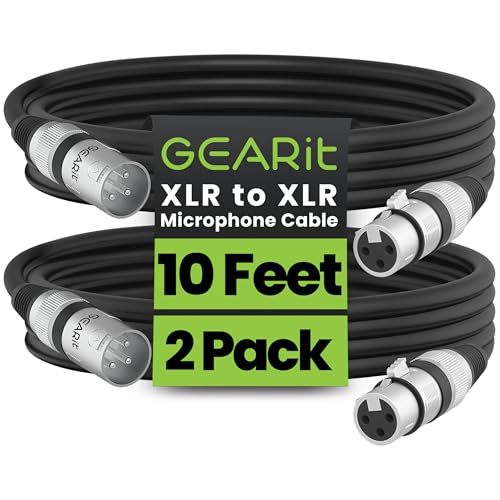
GEARit XLR Cables are an excellent choice for musicians and audio professionals who demand high-quality sound in their recordings. These 10-foot cables come in a convenient 2-pack, featuring 3-pin balanced shielded connections. You’ll appreciate the expertly balanced design that guarantees pristine audio quality, perfect for both studio recordings and live performances. Advanced EMI/RFI shielding effectively eliminates static interference, allowing your sound to shine. With heavy-duty metal housings, these cables promise reliable connections and durability through countless plug-unplug cycles. Plus, their universal compatibility makes them ideal for connecting microphones to mixers, preamps, and more, enhancing your audio setup effortlessly.
Best For: Musicians and audio professionals seeking high-quality, reliable microphone cables for studio and live performances.
Pros:
- Expertly balanced and shielded for pristine audio quality.
- Durable heavy-duty metal housings ensure secure connections.
- Universal compatibility with various audio gear enhances versatility.
Cons:
- Length may be too short for some larger setups.
- No additional features like built-in cable management.
- Some users may prefer premium brands with additional warranty options.
GEARit XLR Cables, 20ft Male to Female Microphone Cable (6 Pack)

When you need a dependable solution for connecting microphones to audio mixers, the GEARit XLR Cables stand out as an excellent choice. This 20ft male to female microphone cable pack includes six cables, perfect for studio recordings or live performances. Designed for pristine audio quality, these balanced and shielded cables minimize static interference and noise, ensuring high-fidelity signals. The heavy-duty connectors feature robust metal housings for secure connections and durability. With universal compatibility, these cables work seamlessly with various audio equipment, making them a versatile addition to your setup—whether you’re podcasting, performing, or recording.
Best For: Audio professionals and enthusiasts seeking reliable and high-quality microphone connections for studio and live performances.
Pros:
- Premium balanced and shielded design ensures minimal interference and noise for clear audio signals.
- Heavy-duty metal connectors provide durability and secure connections, ideal for frequent use.
- Versatile compatibility with various audio equipment, making it suitable for recording, podcasting, and live performances.
Cons:
- The 20ft length may be excessive for small setups or limited spaces.
- Some users may prefer shorter cable options for specific applications.
- The pack includes six cables, which may be more than needed for casual users.
Cable Matters 6.35mm TRS to XLR Cable (6ft, Male to Male)

For those looking to connect audio equipment with precision, the Cable Matters 6.35mm TRS to XLR Cable is an excellent choice. This 6ft male-to-male cable is perfect for interconnecting various audio devices, thanks to its balanced design and oxygen-free copper conductors, which minimize signal loss. You’ll appreciate the copper braided shielding that effectively cancels noise, delivering clear audio. The durable gold-plated connectors and flexible PVC jacket guarantee long-lasting performance, while the 360-degree easy-grip treads make unplugging effortless. Compatible with studio monitors, mixers, and more, this cable enhances your audio setup, making it ideal for both recording and live performances.
Best For: Audio engineers and musicians seeking a reliable cable for connecting professional audio equipment with minimal signal loss.
Pros:
- Balanced design ensures high-quality sound with minimal interference.
- Durable construction with gold-plated connectors and rugged metal housing for long-lasting use.
- Versatile compatibility with various audio devices like mixers, studio monitors, and powered speakers.
Cons:
- Not suitable for microphone use, limiting its application for vocal recordings.
- Length may be too short for larger setups or stage performances.
- Some users may prefer a straight XLR connector instead of the male-to-male design.
Amazon Basics XLR Microphone Cable (10 ft, Black)

The Amazon Basics XLR Microphone Cable, measuring a convenient 10 feet, is an excellent choice for musicians and audio engineers seeking reliable performance in both studio and live sound applications. This cable features XLR male to female connectors, making it compatible with various PA systems and sound equipment. With all-copper conductors and inner spiral shielding, it effectively reduces noise interference, ensuring clear audio transmission. Its durable zinc alloy connectors and protective metal housing add to its longevity, while the flexible PVC jacket allows for easy handling. Whether you’re recording or performing, this cable delivers quality and durability you can trust.
Best For: Musicians and audio engineers looking for a reliable microphone cable for studio recording and live performance.
Pros:
- High-quality all-copper conductors for excellent audio transmission.
- Durable zinc alloy connectors and protective metal housing enhance longevity.
- Flexible PVC jacket allows for easy handling and setup.
Cons:
- Limited length of 10 feet may not be suitable for larger setups.
- Basic design may lack aesthetic appeal compared to premium options.
- No additional features such as built-in noise filters or locking mechanisms.
Mogami Gold Studio 02 XLR to XLR Patch Cable (2 feet)

Engineered for professionals, the Mogami Gold Studio 02 XLR to XLR Patch Cable (2 feet) stands out with its exceptional audio quality, making it an ideal choice for musicians and sound engineers who demand clarity in their recordings. Thanks to Mogami’s Neglex Quad design, you’ll enjoy crystal-clear audio with impressive noise rejection, outperforming traditional twisted pair cables. Its rugged construction, featuring gold-plated connectors, assures durability and reliable signal flow. Plus, the flexible insulation allows for easy integration in tight spaces. Whether in the studio or live, this cable guarantees superior performance for your audio needs.
Best For: Musicians and sound engineers seeking high-quality audio performance and reliable connectivity in studio and live environments.
Pros:
- Exceptional audio quality with Mogami’s Neglex Quad design for crystal-clear sound.
- Superior noise rejection with a quad conductor that outperforms traditional twisted pair cables.
- Durable construction featuring rugged connectors and gold-plated contacts for long-lasting performance.
Cons:
- Short length of 2 feet may limit placement options in larger setups.
- Premium price point compared to standard cables may not fit every budget.
- Limited flexibility for extensive cable runs due to its fixed length.
XLR Cables 10ft 2 Pack with Neutrik REAN Connectors

If you’re a professional audio engineer or a passionate musician looking to enhance your studio setup, the XLR Cables 10ft 2 Pack with Neutrik REAN Connectors is an excellent choice. These cables feature gold-plated connectors and 21AWG 99.99% OFC wires, ensuring durability and superior sound quality. With Kevlar reinforcement and dual shielding, they resist wear and eliminate noise, delivering crystal-clear audio. Their compatibility with various microphones, like Shure and RØDE, makes them versatile for different setups. Plus, with a lifetime warranty and competitive pricing, you’ll get professional-grade performance without breaking the bank.
Best For: Professional audio engineers and passionate musicians seeking high-quality, durable XLR cables for superior sound performance.
Pros:
- High durability due to Kevlar reinforcement, making them 30x stronger than standard cables.
- Noise reduction features with extra aluminum shielding, providing crystal-clear audio without interference.
- Lifetime warranty offering peace of mind and reliable customer support.
Cons:
- Length options may be limited for those needing longer cables beyond 10ft.
- Higher price point compared to lesser-quality cables, though justified by superior materials.
- Weight might be an issue for some users who prefer lighter cables for portability.
Warrky XLR Cables 10ft 2 Pack (Oxygen-Free Copper, Gold-Plated Connector)
![Warrky XLR Cables 10ft 2 Pack [Oxygen-Free Copper (OFC), Gold-Plated Connector] Balanced Microphone Cable Male to Female Professional Hi-Fi XLR Cable](https://m.media-amazon.com/images/I/5100j3VMoJL._SL500_.jpg)
For musicians and audio professionals seeking high-quality performance without breaking the bank, the Warrky XLR Cables 10ft 2 Pack is an excellent choice. These cables feature a 22AWG oxygen-free copper core that minimizes resistance and reduces signal loss by 30%. With a frequency response of 20Hz–20kHz and THD under 0.01%, you’ll enjoy crystal-clear audio. Their six-layer design, including dual-layer shielding, blocks 98% of EMI/RFI noise. Plus, gold-plated connectors enhance durability and conductivity. Ideal for studio recording or live performances, these cables balance affordability with exceptional performance, making them a must-have for your audio setup.
Best For: Musicians and audio professionals looking for high-quality XLR cables that deliver exceptional performance at an affordable price.
Pros:
- Excellent signal fidelity with minimal resistance and reduced signal loss.
- Durable construction with aircraft-grade aluminum connectors and gold plating for enhanced longevity.
- Effective EMI/RFI shielding ensures clear audio quality during recordings and performances.
Cons:
- Limited length of 10ft may not suit all setups.
- May not be as high-end as some premium cables on the market.
- Availability may vary, limiting access for some users.
Factors to Consider When Choosing Balanced XLR Cables for Studio
When you’re choosing balanced XLR cables for your studio, several factors come into play. You’ll want to contemplate cable construction quality, audio performance standards, and noise rejection capability to guarantee ideal sound. Additionally, think about length, flexibility options, and compatibility with your equipment to find the perfect fit for your setup.
Cable Construction Quality
Choosing the right balanced XLR cable for your studio involves understanding the importance of cable construction quality. High-quality materials, like oxygen-free copper (OFC), minimize signal loss and interference, ensuring clearer audio. Look for cables with dual-layer anti-interference shielding, such as aluminum foil and braided copper mesh, to effectively reduce EMI/RFI noise. Heavy-duty metal connectors and reinforced housings enhance durability, making sure your cables withstand frequent use without wear and tear. Gold-plated connectors add corrosion resistance, which helps maintain consistent audio quality over time. Finally, a flexible yet durable outer jacket, made from PVC or nylon braid, protects the internal wiring while allowing easy handling. Prioritizing these features will greatly improve your studio’s sound quality.
Audio Performance Standards
Three key audio performance standards should guide your selection of balanced XLR cables for studio use. First, look for cables with oxygen-free copper (OFC) conductors, as they reduce signal loss and enhance sound fidelity, guaranteeing clarity in your recordings. Second, consider quad conductor designs, which can provide up to 30dB better noise rejection compared to standard twisted pair cables, effectively minimizing interference. Finally, check for advanced shielding techniques, such as braided copper or aluminum layers, that improve noise cancellation and deliver distortion-free audio. Additionally, gold-plated connectors enhance conductivity and resist corrosion, guaranteeing reliable connections over time. By focusing on these standards, you’ll guarantee peak audio performance for your studio setup.
Noise Rejection Capability
Selecting the right balanced XLR cables goes beyond just audio performance standards; noise rejection capability is a critical factor that can greatly impact your recordings. Balanced XLR cables utilize a three-pin configuration that effectively cancels out noise and interference, resulting in a clearer audio signal. If you want superior performance, look for cables with quad conductor technology, which can offer up to 30dB better noise rejection than traditional twisted pair cables. Effective shielding, such as copper braided shielding, considerably reduces electromagnetic and radio frequency interference, ensuring cleaner audio transmission. Additionally, choose cables made with oxygen-free copper (OFC) for enhanced conductivity and minimal signal loss, combined with high-quality insulation materials like XLPE for added protection against external interference.
Length and Flexibility Options
When it comes to balanced XLR cables, length and flexibility play essential roles in optimizing your studio setup. XLR cables typically range from 1.5 feet to over 300 feet, giving you plenty of options. However, longer cables can introduce signal degradation and noise interference, so you need to find a balance between length and your specific application. Look for cables with high-performance XLPE insulation for better audio quality and flexibility, especially in tight spaces. Reinforced construction also guarantees durability, making these cables suitable for both studio and live performance use. Choosing the right length and flexibility can greatly enhance audio fidelity and reliability in critical recording situations, assuring you capture the best sound possible.
Compatibility With Equipment
Finding the right balance in length and flexibility is only part of the equation; ensuring your balanced XLR cables are compatible with your studio equipment is just as important. Start by checking if your devices require male or female connectors, as this can vary. Next, verify the type of audio signals your equipment supports; some only accept balanced signals, while others can handle both. Consider the length of the cable, too—longer cables can cause signal loss or interference. Additionally, confirm that the connectors fit properly and meet any brand-specific requirements. Finally, pay attention to the cable’s shielding and construction, especially in high-signal environments, to minimize electromagnetic interference and maintain ideal audio quality.