When you need high-quality audio without the bulk, compact field recorders are your best bet. These devices pack impressive features into a portable format, making them ideal for capturing everything from interviews to ambient sounds. With various options available, it’s essential to choose one that fits your needs. Let’s explore the top contenders and discover what makes each one a valuable tool for your audio adventures.
Zoom F3 Professional Field Recorder

If you’re a professional audio engineer or a filmmaker on the go, the Zoom F3 Professional Field Recorder is an excellent choice for capturing high-quality sound. This compact, battery-powered 2-channel recorder features 32-bit float recording, ensuring clip-free audio capture without any gain adjustments. With dual AD converters, it delivers a full dynamic range and records up to 192 kHz in WAV format. It also comes equipped with two locking XLR inputs and high-quality mic preamps, boasting an impressive super-low noise floor. Plus, you can store mono or stereo files on SD cards, accommodating up to 512GB for ample recording space.
Best For: Professional audio engineers and filmmakers seeking a portable, high-quality audio recording solution.
Pros:
- High-resolution 32-bit float recording ensures clip-free audio capture without the need for gain adjustments.
- Compact and rugged design makes it suitable for on-the-go recording in various environments.
- Supports SD cards up to 512GB, providing ample storage for extended recording sessions.
Cons:
- Limited to 2 channels, which may not be sufficient for larger recording setups.
- Battery operation may require additional planning for extended use or long shoots.
- The price point may be higher compared to basic recorders, which could be a consideration for budget-conscious users.
TASCAM DR-40X 4-Track Portable Handheld Field Recorder

The TASCAM DR-40X 4-Track Portable Handheld Field Recorder is an ideal choice for musicians, podcasters, and filmmakers seeking high-quality audio in a compact design. With dual adjustable unidirectional stereo condenser microphones, you can record in both A-B and X-Y positions. Its 2 XLR/TRS inputs support +4dBu line level and +48V, allowing for versatile recording modes, including dual recording and nondestructive overdub. Plus, it functions as a 2-in/2-out USB audio interface for seamless integration with your Mac, PC, or iOS device. Weighing only 7.4 ounces, it’s portable yet powerful, making it perfect for any audio project.
Best For: Musicians, podcasters, and filmmakers seeking high-quality audio recording in a portable design.
Pros:
- Dual adjustable unidirectional microphones for versatile recording positions (A-B and X-Y).
- Functions as a USB audio interface for easy integration with various devices.
- Lightweight and compact design, making it highly portable for on-the-go recording.
Cons:
- Battery life may vary depending on usage, requiring extra batteries for extended sessions.
- Limited media format support, only compatible with WAV format.
- Some users may find the interface less intuitive than other recording devices.
Zoom H4 Essential 4-Track Stereo Recorder

For creators looking for a versatile and user-friendly audio solution, the Zoom H4 Essential 4-Track Stereo Recorder stands out with its 32-bit float recording capability. You don’t need to worry about setting gain, making it easy to capture stunning audio at up to 96kHz sample rates. With two XLR/TRS combo inputs and ultra-clean Zoom preamps, your recordings will shine. Plus, you can record to an SD card and USB simultaneously. Its accessible design and audio guidance feature cater to all users, making it perfect for voice, music, and podcasting. Enjoy the included stereo microphones for even more convenience!
Best For: The Zoom H4 Essential 4-Track Stereo Recorder is best for creators seeking a user-friendly and versatile audio recording solution for voice, music, and podcasting.
Pros:
- 32-bit float recording eliminates the need to set gain, simplifying the recording process.
- Simultaneous recording to SD card and USB allows for flexible use in various setups.
- Accessible design with audio guidance caters to a wide range of users, including those with visual impairments.
Cons:
- Limited battery life may require frequent recharging during extended use.
- The included stereo microphones might not meet the expectations of professional users seeking higher-end mic quality.
- Slightly heavier and bulkier compared to other portable recorders on the market.
Zoom H1 Essential Stereo Recorder for Voice, Music, Podcasting & Film

Looking for a reliable audio recorder that delivers exceptional sound quality without the hassle of complicated settings? The Zoom H1 Essential Stereo Recorder is your go-to choice. With 32-bit float recording, you won’t have to worry about setting gain, ensuring perfect audio quality every time. Its high-quality X/Y stereo microphones capture clean audio up to 120 dB SPL, making it ideal for voice, music, podcasting, and film. You can record at a sample rate of up to 96kHz to an SD card. Plus, it easily connects as a USB microphone for your devices. Accessibility features make it user-friendly for everyone.
Best For: Those seeking an easy-to-use audio recorder that provides excellent sound quality for voice, music, podcasting, and film purposes.
Pros:
- 32-bit float recording eliminates the need for gain adjustments, ensuring optimal audio quality.
- High-quality X/Y stereo microphones capture clear audio, even in loud environments, up to 120 dB SPL.
- USB functionality allows for easy connection to PCs, Macs, iOS, or Android devices, enhancing versatility.
Cons:
- Limited onboard editing features may require additional software for advanced audio manipulation.
- Battery life could be a concern for extended recording sessions without access to power.
- The design may not be robust enough for heavy-duty field use, potentially leading to wear and tear.
Zoom H1 Portable Audio Recorder

Packed with features like 32-bit float recording and dual A/D converters, the Zoom H1 Portable Audio Recorder is an ideal choice for musicians, podcasters, and filmmakers who demand high-quality, clip-free audio on the go. Weighing just 6.4 ounces and measuring 5.8 x 3.8 x 1.9 inches, it’s incredibly portable. You’ll appreciate the dual XLR/TRS combo inputs and a 3.5mm stereo mic/line input for versatility. With a USB-C port, you can easily connect to your PC, Mac, iOS, or Android devices. Plus, voice guidance makes it accessible for visually impaired users, ensuring everyone can capture stunning sound effortlessly.
Best For: Musicians, podcasters, filmmakers, and content creators who need a portable and high-quality audio recording solution.
Pros:
- 32-bit float recording ensures high-quality, clip-free audio capture.
- Lightweight and compact design makes it easy to carry for on-the-go recording.
- Versatile input options with dual XLR/TRS combo inputs and a 3.5mm mic/line input.
Cons:
- Limited to WAV media format, which may not be suitable for all users.
- Voice guidance may not be comprehensive enough for all visually impaired users.
- Manufacturer’s warranty is only available upon request, which may be inconvenient for customers.
Sony ICD-UX570 Digital Voice Recorder, ICDUX570BLK, usb

The Sony ICD-UX570 Digital Voice Recorder is an ideal choice for journalists and students who need a reliable, portable device for capturing high-quality audio. Its built-in stereo microphone guarantees enhanced sound quality, while the newly updated slimmer design makes it easy to carry. You can choose from three recording options—wide/stereo, narrow/focus, or normal—tailoring the device to fit your needs. With voice-operated recording, it automatically starts when you speak. Plus, the quick charge functionality offers up to an hour of recording time with just a three-minute charge, making it perfect for on-the-go audio capture.
Best For: Journalists and students seeking a portable device for high-quality audio recording.
Pros:
- Enhanced sound quality with built-in stereo microphone.
- Slimmer design for easy portability.
- Voice-operated recording feature for hands-free use.
Cons:
- Limited battery life may require frequent charging.
- No advanced editing features included.
- USB connectivity may require additional adapters for some devices.
136GB Digital Voice Recorder with Playback

For students, journalists, and music enthusiasts seeking high-quality recordings, the GB Digital Voice Recorder with Playback stands out with its dual noise reduction microphones and impressive 1536 kbps PCM HD audio recording capability. With 136GB of storage, including a complimentary 128GB TF card, you can store up to 9000 hours of audio. Its built-in rechargeable battery offers 68 hours of continuous recording. User-friendly features like one-click recording, voice activation, and fast USB-C file transfer make it a breeze to operate. Lightweight and durable, it’s perfect for on-the-go recording, whether you’re in lectures, at the office, or traveling.
Best For: Students, journalists, and music enthusiasts seeking high-quality audio recordings with extensive storage and user-friendly features.
Pros:
- High recording quality with dual noise reduction microphones and 1536 kbps PCM HD audio support.
- Large storage capacity of 136GB, allowing for up to 9000 hours of recordings.
- User-friendly operation with one-click recording, voice activation, and fast USB-C file transfer.
Cons:
- Limited battery life of 68 hours may require frequent recharging for extensive use.
- Weight of 97 grams might still be considered bulky for some users who prefer ultra-light devices.
- Password protection feature may be seen as unnecessary for casual users.
TASCAM 4-Channel Portable Audio Recorder (DR-60DmkII)

Ideal for videographers, the TASCAM DR-60DmkII offers an impressive ability to record up to four channels simultaneously. Weighing just 1.12 pounds and fitting snugly under your DSLR, it’s a compact powerhouse. With internal SD card recording at up to 96kHz/24-bit WAV files, your audio quality will shine. The upgraded HDDA preamps deliver up to 64dB gain with minimal noise, ensuring crystal-clear sound. You’ll appreciate the versatility of two XLR/TRS mic inputs with 48V phantom power, plus two additional inputs for wireless mics. With rave reviews and a solid design, this recorder is a top choice for capturing stunning audio.
Best For: Videographers seeking a compact and high-quality audio recording solution.
Pros:
- Up to 4 channels of simultaneous recording for versatile audio capture.
- Compact design fits easily under DSLR cameras, enhancing portability.
- Upgraded HDDA preamps provide high gain with low noise for clear sound.
Cons:
- Requires 4 AA batteries, which can add to operational costs.
- The standing screen display size of 1.75 inches may be difficult to read in bright conditions.
- Limited internal storage; relies on external SD cards for recording capacity.
Zoom PodTrak P4 Podcast Recorder

If you’re a podcaster looking for versatility and portability, the Zoom PodTrak P4 Podcast Recorder stands out with its four XLR mic inputs and battery-powered design. You’ll appreciate the four headphone outputs, each with individual volume control, ensuring everyone hears perfectly. The device supports multi-track recording, allowing you to manage all inputs effortlessly. For remote interviews, it features a phone input and USB audio interface mode, complete with automatic mix-minus functionality. With up to 3.5 hours of operation on just two AA batteries, the P4 is your reliable companion for stunning sound quality on the go.
Best For: Podcasters seeking a portable and versatile recording solution with multiple inputs for interviews and sound management.
Pros:
- High-quality microphone inputs with phantom power for professional sound.
- Multi-track recording capability allows for detailed post-production editing.
- Battery-powered operation enhances mobility for on-the-go recording.
Cons:
- Limited battery life of 3.5 hours may require frequent recharging or battery replacements.
- The number of programmable sound pads may not be sufficient for some users.
- Some users may find the interface less intuitive compared to more advanced models.
Zoom H5 4-Track Portable Recorder
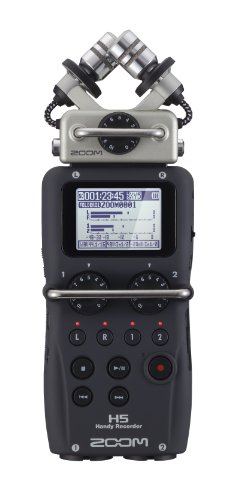
The Zoom H5 4-Track Portable Recorder stands out for its versatility, making it perfect for musicians, podcasters, and videographers who need high-quality audio on the go. With interchangeable input capsules, it’s like having multiple microphones in one device. The detachable X/Y capsule minimizes handling noise and captures clear sound. You can record four tracks simultaneously, with two mic/line inputs supporting phantom power. Plus, it runs on just 2 AA batteries, ensuring portability. Compatible with all Zoom capsules, it also acts as a USB audio interface, making audio management seamless. Whether you’re recording music or podcasts, the H5 delivers stunning sound quality effortlessly.
Best For: Musicians, podcasters, and videographers looking for a high-quality, portable audio recording solution.
Pros:
- Versatile with interchangeable input capsules for varied recording needs.
- Four-track simultaneous recording capabilities for detailed audio capture.
- Lightweight and battery-operated, enhancing portability for on-the-go use.
Cons:
- Limited maximum SD card capacity of 32GB may restrict recording time.
- Requires additional accessories for optimal use, such as extra input capsules.
- Battery operation may not last as long during extended recording sessions compared to AC power.
Factors to Consider When Choosing Compact Audio Field Recorders
When you’re choosing a compact audio field recorder, several key factors come into play. You’ll want to evaluate recording quality, portability, and battery life, as these will impact your overall experience. Don’t forget to look at input/output options and build quality to guarantee your recorder meets your needs in the field.
Recording Quality and Format
Recording quality and format are essential factors in selecting a compact audio field recorder that meets your needs. Look for models that support 32-bit float recording, which captures audio without clipping and minimizes the need for gain adjustments, ensuring clarity in various environments. High sampling rates, like 192 kHz, deliver superior fidelity, especially for music and professional applications. Make sure the recorder can handle high sound pressure levels (SPL), with some capable of capturing up to 130 dB SPL, perfect for loud events. Additionally, choose recorders that save in widely accepted formats like WAV or MP3 for compatibility with editing software. Finally, models with dual AD converters enhance dynamic range and clarity, capturing those subtle sound nuances you don’t want to miss.
Portability and Weight
Choosing a compact audio field recorder goes beyond just recording quality; portability and weight are key considerations too. The weight of these devices can vary considerably, with options like the TASCAM DR-40X at 7.4 ounces and the Zoom H1 at 6.4 ounces, making them easy to carry for long periods. Dimensions matter too; smaller models can measure around 2.76 x 1.38 x 6.1 inches, fitting effortlessly into pockets or bags. Many recorders utilize lightweight materials like durable plastics or stainless steel, ensuring ease of handling without compromising durability. Battery-powered options boost your mobility, allowing for recording in various environments without being tethered to a power source. A compact design can also include features like voice guidance, enhancing usability while remaining portable.
Battery Life and Power
Battery life and power are essential factors to take into account in compact audio field recorders, as they directly impact your recording sessions. The battery life can vary greatly; some models run for hours on a few AA batteries, while others depend on rechargeable lithium batteries for longevity. Look for recorders with power-saving features, like automatic shut-off, to extend battery life. Devices such as the TASCAM DR-40X operate at around 2.5 watts, influencing how long they’ll last based on battery capacity. Additionally, some recorders allow USB power, offering flexibility for extended sessions. Remember, alkaline batteries might not last as long as rechargeable ones, so consider your power source for convenience during field recordings.
Input and Output Options
Input and output options play an important role in the functionality of compact audio field recorders. When you’re choosing a recorder, consider the number and types of inputs available, particularly XLR/TRS combo inputs, which are crucial for connecting professional microphones. Look for models that provide phantom power for condenser microphones, as this enhances audio quality in various environments. Additionally, make sure the recorder has multiple output options, like USB connectivity, to make transferring recordings to your computer smooth and simple. Built-in microphones can also be a significant advantage, giving you flexibility for portable recording without extra gear. Finally, evaluate the recorder’s ability to handle different input levels and formats, making certain it accommodates your diverse audio sources effectively.
Build Quality and Durability
When selecting a compact audio field recorder, you’ll want to prioritize build quality and durability to guarantee it can withstand various recording environments. Look for rugged metal casings that assure longevity, especially when you’re out in the field. Lightweight models are ideal for portability, but make certain they maintain structural integrity. Features like tripod mounts can enhance stability and protect your device from damage during use. Additionally, check for impact resistance and weatherproofing; these qualities are vital for reliable operation in challenging conditions. Finally, consider recorders with locking XLR inputs to prevent accidental disconnections, adding another layer of durability during your recording sessions. Investing in a solid build will pay off in the long run.
User-Friendly Interface
After ensuring your compact audio field recorder is built to last, the next step is to look for a user-friendly interface that makes your recording experience smooth and efficient. Intuitive controls and layouts allow you to access recording functions quickly, minimizing the need to navigate through extensive menus. Features like voice guidance can be especially helpful for visually impaired users, simplifying navigation. One-click recording and saving functionalities let you start and stop recordings effortlessly. A clear, accessible display—like a large LCD screen—enhances visibility in various lighting conditions. Additionally, customizable sound pads and programmable functions can make operating the device more efficient, allowing you to focus on capturing stunning sound without hassle.
Compatibility With Accessories
Compatibility with accessories is vital for maximizing the potential of your compact audio field recorder. First, make sure it has XLR/TRS inputs to connect professional microphones and other audio gear. If you’re using condenser microphones, check for phantom power support, as this is essential for high-quality audio capture. USB connectivity is also important; it allows your device to function as an audio interface, making integration with computers and mobile devices seamless. Additionally, look for mounting options, like tripod mounts, to stabilize recordings in various environments. Finally, verify compatibility with interchangeable input capsules or accessories, enhancing versatility for different audio projects. These factors will help you achieve stunning sound quality wherever you go.
Price and Value Consideration
Choosing the right compact audio field recorder involves more than just checking for accessory compatibility; price and value play a significant role too. When you evaluate options, balance cost with features—higher-priced models often come with advanced capabilities like 32-bit float recording and multiple inputs. Assess the total value by considering build quality, portability, and battery life, as these factors affect usability in various environments. Prioritize excellent audio quality and low noise levels for a superior recording experience, irrespective of price differences. Don’t overlook warranty and customer support; reliable brands can enhance your purchase’s value. Finally, compare user reviews to see if the price aligns with actual performance and reliability, ensuring you make a well-informed decision.