A field recorder with 32-bit float can protect recordings from sudden volume changes, making it easier to capture clean audio in unpredictable locations. The right model depends on your microphone inputs, channel count, timecode needs, portability, and workflow.
We selected 10 standout recorders for different users, from compact pocket units and simple handhelds to multitrack recorders designed for film sets, music, and professional production.
Best 10 Field Recorder with 32 Bit Float Picks for 2026
Best All-Around Choice

- Up to 192kHz/32-bit float recording
- Four locking XLR/TRS inputs
- Detachable A-B/X-Y condenser microphones
Best For: Flexible multitrack field recording and interviews
Best for Filmmakers

- Clip-free 32-bit float recording
- Large 19.4mm X/Y stereo microphones
- Dedicated gain knobs and two XLR/TRS inputs
Best For: Portable film audio and hands-on music recording
Best for Video Timecode

- Built-in timecode generation and IN/OUT
- Dual-ADC 32-bit float recording
- Compact design with two XLR/TRS inputs
Best For: Videographers recording synchronized location audio
Best Accessible Handheld

- Four-track 32-bit float recording
- Two XLR/TRS inputs plus stereo microphones
- Spoken menu guidance and USB-C connectivity
Best For: Accessible recording for podcasts, music, and video
Best Pocket Recorder
Deity PR-2 32-Bit Float Recorder

- 32-bit float WAV recording
- Includes W.Lav Pro lavalier mic
- Bluetooth control and timecode compatibility
Best For: Mobile filmmakers and interview recordists
Best Dual-XLR Option
Zoom F3 Professional Field Recorder

- 32-bit float recording with dual A/D converters
- Two locking XLR/TRS inputs
- Low-noise preamps for location recording
Best For: Professional film, music, and field recording
Best All-in-One Bundle
Zoom H4essential 4-Track Recorder
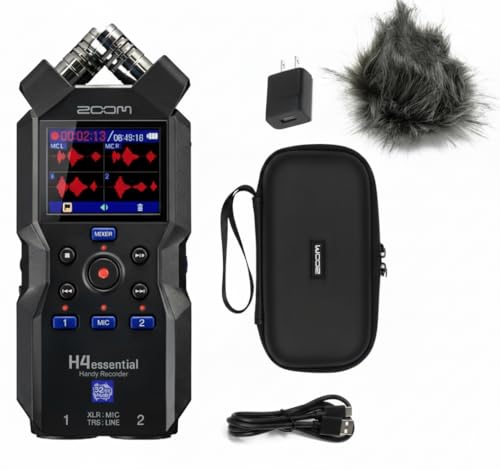
- 32-bit float recording with built-in stereo mics
- XLR/TRS and stereo mini-jack inputs
- Includes case, windscreen, adapter, and USB-C cable
Best For: Creators wanting a versatile starter recording kit
Versatile Pick

- Three microphones with nine recording patterns
- 32-bit float/96kHz clip-free recording
- USB microphone mode with simultaneous SD backup
Best For: Interviews, music, podcasts, filmmaking, and accessible field recording
Compact Stereo Option

- X/Y microphones rated up to 130 dB SPL
- 32-bit float and 96kHz WAV recording
- Auto-record, pre-record, and USB microphone modes
Best For: Portable stereo recording, concerts, speeches, and content creation
External Input Pick

- Two locking XLR/TRS combo inputs
- 32-bit/96kHz recording with waveform display
- 3.5mm stereo input and headphone output
Best For: Filmmakers, musicians, podcasters, and external-mic recording
Best All-Around Choice – Tascam Portacapture X8
The Tascam Portacapture X8 is a versatile field recorder with 32 bit float capability, combining an intuitive 3.5-inch color touchscreen with eight-channel multitrack recording. Its detachable condenser microphones and four locking XLR/TRS inputs make it suitable for everything from interviews and podcasts to music and field work.
Best For: Creators who want flexible multitrack recording, large built-in microphones, and a guided touchscreen workflow.
Pros:
- Records up to 192kHz/32-bit float.
- Four XLR/TRS inputs with individual 24V/48V phantom power.
- Detachable microphones support A-B and X-Y positioning.
- Launcher system simplifies setup for multiple recording applications.
Cons:
- At 1.6 pounds, it is heavier than some compact handheld options.
- Requires the AK-BT1 adapter and is not compatible with the AK-BT2.
The X8 is a strong choice when you need more inputs and recording flexibility than a basic handheld recorder. Its touchscreen and microphone options add convenience, while the multitrack design supports more involved productions.
Best for Filmmakers – Zoom H5 Studio
The Zoom H5 Studio is a portable field recorder with 32 bit float recording designed for filmmakers and musicians. Its large 19.4mm X/Y microphone capsule, dedicated gain knobs, and battery-powered design provide practical control for location recording.
Best For: Filmmakers, musicians, and mobile creators who want clip-free capture with hands-on level adjustment.
Pros:
- 32-bit float recording helps capture audio without clipping.
- Large stereo microphones are designed for detailed, wide-dynamic-range sound.
- Records up to four tracks simultaneously at up to 192kHz WAV.
- Two XLR/TRS inputs and USB audio interface expand connectivity.
Cons:
- Requires four AA batteries.
- Its two-inch screen is smaller than the Portacapture X8’s display.
The H5 Studio emphasizes quick physical control and portable operation. It is particularly appealing for location work where dedicated gain knobs and large stereo microphones matter more than a larger display.
Best for Video Timecode – Tascam FR-AV2
The Tascam FR-AV2 is a compact field recorder with 32 bit float recording built specifically with videographers in mind. Dual ADCs, two XLR/TRS inputs, a 3.5mm input, and built-in timecode generation help streamline synchronized production audio.
Best For: Videographers who need compact no-clip recording and integrated timecode for efficient syncing.
Pros:
- Dual ADCs support 32-bit float recording.
- Built-in timecode generation and timecode IN/OUT support synchronization.
- Two XLR/TRS inputs use Ultra HDDA preamps.
- Supports 48kHz, 96kHz, and 192kHz recording.
Cons:
- It has only two XLR/TRS inputs.
- Wireless monitoring requires the optional AK-BT2 adapter.
- It requires three AA batteries.
The FR-AV2 stands out less as a general-purpose multitrack recorder and more as a focused video-production tool. Its built-in timecode is the key advantage for crews that want to reduce synchronization equipment and setup steps.
Best Accessible Handheld – Zoom H4 Essential
The Zoom H4 Essential is a straightforward handheld field recorder with 32 bit float recording for music, podcasts, interviews, and video audio. Built-in stereo microphones, two XLR/TRS inputs, USB-C connectivity, and spoken menu guidance make it adaptable for both independent recording and streaming workflows.
Best For: Musicians, podcasters, and filmmakers seeking an approachable four-track recorder with accessibility-focused navigation.
Pros:
- 32-bit float recording helps reduce concerns about distorted takes.
- Built-in stereo microphones plus two XLR/TRS inputs support varied sources.
- Records to an SD card while connecting to phones, tablets, or computers over USB-C.
- Spoken menu guidance can improve accessibility and navigation.
Cons:
- It records up to four tracks, fewer than the Portacapture X8.
- Requires two AA batteries.
- The listed digital recording time is approximately 10 hours.
The H4 Essential offers a practical balance of portability, connectivity, and ease of use. It is a sensible pick for creators who need built-in microphones and external-input flexibility without moving to a larger multitrack recorder.
Best Pocket Recorder – Deity PR-2 32-Bit Float Recorder
The Deity PR-2 is a compact field recorder with 32 bit float recording for filmmakers, journalists, and mobile audio work. Its locking 3.5mm input supports lavalier, shotgun, and line-level sources, while Bluetooth control and timecode compatibility add flexibility to production setups.
Best For: Videographers and interview recordists who want a pocket-sized recorder with lavalier support, wireless control, and timecode features.
Pros:
- Supports both 24-bit and 32-bit float WAV recording.
- Includes a W.Lav Pro lavalier microphone.
- Offers up to 30 hours of battery life from two AA batteries.
- Supports Bluetooth control through the Sidus Audio App and works with Deity timecode products.
Cons:
- Uses a 3.5mm stereo mic/line input rather than XLR inputs.
- Its compact design is primarily suited to portable and camera-oriented setups.
The PR-2 stands out when portability, lavalier recording, and production connectivity matter more than multiple professional inputs. The included microphone and timecode compatibility make it a particularly flexible choice for solo filmmakers.
Best Dual-XLR Option – Zoom F3 Professional Field Recorder
The Zoom F3 is a professional field recorder with 32 bit float recording designed for demanding film, music, and location work. Its dual locking XLR/TRS inputs and low-noise preamps make it well suited to microphones and larger recording rigs where secure connections and clean capture are important.
Best For: Filmmakers, musicians, and recordists who need dual locking XLR inputs and clip-resistant recording in unpredictable environments.
Pros:
- Uses 32-bit float recording with dual A/D converters to help prevent clipping.
- Provides two locking XLR/TRS inputs for secure microphone connections.
- Features ultra-low-noise preamps for clean recordings.
- Supports battery-powered, standalone, and USB workflows.
Cons:
- Does not include microphones in the supplied product details.
- Its professional XLR-focused design may be more equipment than basic users need.
Choose the F3 when reliable two-channel microphone recording is the priority. It offers a focused, rugged-style workflow for users who already have compatible microphones and need dependable level handling on location.
Best All-in-One Bundle – Zoom H4essential 4-Track Recorder
The Zoom H4essential is a versatile field recorder with 32 bit float recording, built-in stereo microphones, and inputs for external sources. This bundle adds a hairy windscreen, padded case, AC adapter, and USB-C cable, making it a practical starting point for portable recording and four-track workflows.
Best For: Musicians, creators, and location recordists who want built-in stereo capture plus XLR/TRS and stereo mini-jack connectivity.
Pros:
- Captures audio in 32-bit float without requiring constant gain adjustments.
- Offers XLR/TRS combo inputs and a stereo mini-jack input.
- Includes a windscreen, padded case, AC adapter, and USB-C cable.
- Provides up to 20 hours of continuous recording with lithium batteries.
Cons:
- Its listed battery life is shorter than the Deity PR-2’s 30-hour rating.
- The supplied details specify stereo microphone operation rather than a broader multichannel microphone configuration.
The H4essential bundle is a strong choice for buyers who want one package that covers built-in stereo recording, external microphones, and basic protection. Its accessory pack reduces the need to purchase essential add-ons separately.
Versatile Pick – Zoom H2 Essential
The Zoom H2 Essential is a flexible field recorder with 32 bit float recording for interviews, music, podcasts, and location work. Its three built-in microphones and nine recording patterns cover focused mono capture through wide stereo and surround-style applications, while clip-free recording reduces the need for constant gain adjustment.
Best For: Journalists, podcasters, musicians, filmmakers, and accessible field recording setups.
Pros:
- Three built-in microphones and nine selectable recording patterns.
- Records up to 32-bit float/96kHz for clip-free audio capture.
- Can work as a USB microphone while recording a backup to an SD card.
- Offers audible menu navigation in seven languages and Bluetooth timecode synchronization.
Cons:
- Requires two AA batteries.
- The 1.3-inch screen may feel small for users who prefer large displays.
The H2 Essential stands out when you want one compact recorder for varied microphone patterns and hands-off level management. Its simultaneous USB and SD recording is especially useful when a backup matters.
Compact Stereo Option – Xvive XV1-R
The Xvive XV1-R is a compact stereo field recorder with 32 bit float support and built-in X/Y microphones. It is designed for high-dynamic-range sources, with recording up to 96kHz, automatic recording features, and USB microphone functionality for computers and mobile devices.
Best For: Musicians, concert and speech recording, podcasters, filmmakers, and portable voice capture.
Pros:
- 32-bit float recording avoids the need for constant gain adjustment.
- X/Y microphones capture sources up to 130 dB SPL without distortion according to the supplied specifications.
- Supports WAV at 32-bit float or 24-bit PCM, plus compressed AAC recording.
- Includes auto-record, pre-record, noise reduction, and USB microphone modes.
Cons:
- There is no headphone jack for direct monitoring.
- Battery life is listed at up to 12 hours.
- Long recordings use a 4GB maximum file size before automatic splitting.
The XV1-R is a practical choice when a lightweight stereo recorder needs to handle loud environments and conserve storage through AAC. The missing headphone jack is the main trade-off for monitoring-focused workflows.
External Input Pick – Zoom H1 XLR
The Zoom H1 XLR is a practical field recorder with 32 bit float support for users who need external microphones or instruments. Its two XLR/TRS combo inputs, 3.5mm stereo input, and waveform display make it suited to interviews, podcasts, filmmaking, and other two-channel recording setups.
Best For: Filmmakers, musicians, podcasters, and anyone connecting XLR microphones or line-level sources.
Pros:
- Records at up to 32-bit/96kHz for detailed, clip-free audio.
- Two locking XLR/TRS combo inputs support microphones, instruments, and other sources.
- OLED waveform display provides a quick view of recording levels.
- Includes 3.5mm stereo input and headphone output for added connectivity.
Cons:
- Battery life is listed at up to 10 hours.
- The 0.96-inch screen is smaller than the displays on the other listed models.
- Its two-channel input design is less suited to setups requiring more than two external sources.
The H1 XLR is the strongest fit here when connecting external microphones or instruments matters more than having multiple built-in microphone patterns. Its waveform display and headphone output also support a more hands-on monitoring workflow.
How We Picked the Best Field Recorder with 32 Bit Float
We focused on recording flexibility, input quality, portability, workflow features, and practical value. Each model was considered for how well it handles real-world sound capture, including changing levels, external microphones, interviews, music sessions, video production, and location work. We also looked at channel count, onboard microphones, timecode support, storage and file-format options, battery operation, monitoring, and ease of use.
Because 32-bit float recording is only one part of a complete audio setup, we balanced it against the recorder’s preamps, connectors, controls, and compatibility with the rest of a user’s gear.
Quick Comparison
| Best For | What to Prioritize |
|---|---|
| Run-and-gun video | Compact design, low handling noise, and quick controls |
| Film production | Timecode, dual XLR inputs, reliable monitoring, and rugged construction |
| Music recording | Multiple inputs, quality preamps, overdubbing, and multitrack support |
| Interviews and podcasts | Simple operation, clean microphone inputs, and dependable battery life |
| Hidden or wearable recording | Pocket-size construction, timecode, and discreet operation |
Key Buying Factors for a Field Recorder with 32-Bit Float
Inputs and Channel Count
Choose the number and type of inputs before focusing on resolution. Two XLR or XLR/TRS combo inputs suit many film and music applications, while larger multitrack models are better for several microphones, instruments, or surround and ambient capture. Built-in stereo microphones are useful when speed matters.
Timecode and Video Compatibility
For professional video, timecode can simplify synchronization between separately recorded audio and camera footage. If you regularly work on multicamera shoots or longer productions, a recorder with integrated timecode support may save substantial editing time.
Portability and Controls
A smaller recorder is easier to mount, carry, or conceal, but larger units generally provide more physical controls and connections. Consider whether you will operate the recorder while wearing gloves, moving between locations, or monitoring audio through headphones.
Power, Storage, and Connectivity
Check battery type and expected runtime, memory-card requirements, USB functionality, and whether the recorder can serve as a computer audio interface. Automatic recording, headphone monitoring, limiter behavior, and clear level displays can also make field work more reliable.
Who Should Buy Which Field Recorder with 32 Bit Float?
Choose a compact pocket recorder if portability, discreet placement, or wearable recording matters most. A straightforward handheld model is a good fit for interviews, rehearsals, podcasts, and general-purpose sound gathering. Filmmakers should favor units with dual professional inputs, strong monitoring, and timecode when synchronization is important.
Musicians and producers will benefit from additional channels, multitrack support, and flexible input routing. If you often record unpredictable sources or have limited time to set levels, 32-bit float is particularly useful—but it does not replace proper microphone placement, gain planning, or monitoring. Match the recorder to your microphones, camera workflow, and expected recording conditions for the best results.