Choosing between today’s best polyphonic synthesizers can be surprisingly difficult. Some are built for classic analog warmth, others for deep modulation, portable jamming, or modern hybrid sound design.
This roundup highlights 10 strong options for musicians, producers, and performers who want playable voices, inspiring controls, and the right balance of features for the way they make music.
Best 10 Polyphonic Synthesizers Picks for 2026
Analog Entry Pick
Korg minilogue 37-key Polyphonic Analog Synthesizer

- True analog sound with warm, punchy tones
- Four-voice polyphony and 200 presets
- Built-in polyphonic step and motion sequencer
Best For: Affordable analog polyphony with hands-on editing
Expression-Focused Pick
ASM Hydrasynth Explorer Synthesizer

- 8-voice digital wave morphing synthesis
- PolyTouch aftertouch and MPE compatibility
- Microtuning support in a portable 37-key design
Best For: Expressive digital synthesis and portable performance
Hybrid Starter Pick
Arturia MiniFreak 37 Key Polyphonic 6-Voice Hybrid Synthesizer

- Hybrid digital and analog sound profile
- 6-voice polyphony in a portable 37-key layout
- Includes MiniFreak VST counterpart
Best For: Portable hybrid synthesis for beginners and home studios
Advanced Sound-Design Pick
Korg multipoly Analog Modeling Synthesizer

- 60 voices with four stacked oscillators
- Dual filters plus extensive modulation tools
- Built-in KAOSS Pad and Motion Sequencing 2.0
Best For: Rich layering and expressive sound design
Hybrid Performance Pick
Elektron Digitone II 16-Track Polyphonic Digital Synthesizer

- 16-voice polyphony across 16 tracks
- Four synth machines for varied timbres
- Advanced sequencer with locks and micro-timing
Best For: Producers who want deep sequencing and flexible polyphonic sound design
Voice-Ready Pick
Novation MiniNova Analog Modeling Synthesizer

- Up to 18 voices of polyphony
- Built-in vocoder with included microphone
- 256 presets plus performance controls
Best For: Players who want a compact poly synth with vocoder features and live control
Compact Vintage Module
Roland JX-08 Boutique Synthesizer Module

- Authentic JX-8P sound and PG-800 functions
- Up to 20 voices with two-part multitimbral mode
- USB-C MIDI/audio plus battery power
Best For: Players who want vintage Roland polyphony in a portable module
Analog Flagship
MOOG Muse 8-Voice Analog Polyphonic Synthesizer
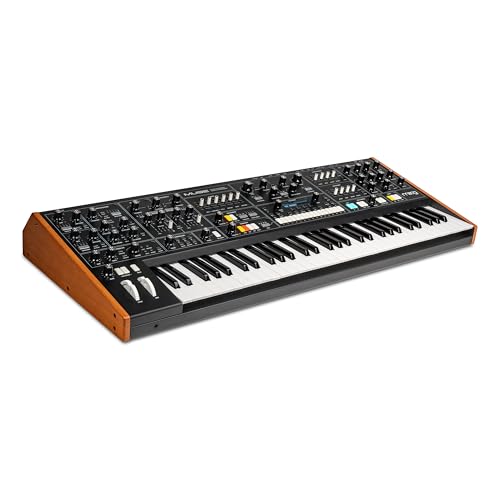
- 8-voice analog polyphony with dual VCOs per voice
- Knob-per-function layout with deeper "More" menus
- Stereo diffusion delay plus arpeggiator and sequencer
Best For: Expressive studio and stage players who want a hands-on analog poly synth
Portable Practice Pick
Yamaha reface CS Portable Analog Modeling Synthesizer

- 8-note polyphony with an analog modeling engine
- Battery powered with built-in speaker for portability
- 37-key mini keyboard plus phrase looper
Best For: Portable jamming, idea sketching, and casual synth practice
Classic Rack-Style Choice
Behringer PRO-800 8-Voice Polyphonic Synthesizer

- 8-voice classic analog synth with pure signal path
- 2 VCOs per voice and unison mode for thicker tones
- 400 program memories with arpeggiator and sequencer
Best For: Rack-friendly buyers who want classic analog polyphony and preset storage
Analog Entry Pick – Korg minilogue 37-key Polyphonic Analog Synthesizer
If you want polyphonic synthesizers with true analog character, the Korg minilogue is built to deliver warm, punchy tones in a compact 37-key format. Its four-voice polyphony, 200 presets, and easy preset editing make it practical for both quick ideas and deeper sound design.
Best For: Players who want affordable analog polyphony, hands-on editing, and a built-in sequencer for studio or live use.
Pros:
- True analog sound with warm, punchy tones
- Four-voice polyphony for layered parts and chords
- 200 preset sounds plus easy sound editing
- Built-in polyphonic step and motion sequencer
Cons:
- 37 slim keys may feel limiting for players wanting a larger board
- Four voices is more limited than higher-polyphony synths
The minilogue stands out as a straightforward, affordable entry into analog polyphonic synthesizers without giving up performance-friendly features like the sequencer and oscilloscope display.
Expression-Focused Pick – ASM Hydrasynth Explorer Synthesizer
The ASM Hydrasynth Explorer is a strong pick among polyphonic synthesizers if you want deep digital sound-shaping in a portable 37-key format. With 8-voice polyphony, polyphonic aftertouch, MPE compatibility, and microtuning support, it is designed for expressive playing and detailed control.
Best For: Players who want expressive performance features, modern digital synthesis, and portability.
Pros:
- 8-voice polyphony for more complex chords and textures
- PolyTouch polyphonic aftertouch and velocity-sensitive keys
- MPE compatible with microtuning support
- Compact, portable design with USB connectivity
Cons:
- Digital workflow may appeal less to players seeking analog tone
- 37-key layout may be compact for larger two-hand parts
For musicians who value expression as much as sound design, the Hydrasynth Explorer offers a flexible and highly playable approach to modern polyphonic synthesis.
Hybrid Starter Pick – Arturia MiniFreak 37 Key Polyphonic 6-Voice Hybrid Synthesizer
Arturia MiniFreak 37 Key Polyphonic 6-Voice Hybrid Synthesizer Keyboard (Standard, 37 Key)
Check Price On AmazonThe Arturia MiniFreak brings a hybrid approach to polyphonic synthesizers, combining digital and analog character in a compact 37-key keyboard. Its 6-voice design and included VST counterpart make it a practical choice for players who want to move between hardware and software workflows.
Best For: Beginners and home-studio users who want a portable hybrid synth with flexible sound options.
Pros:
- Hybrid digital and analog sound profile
- 6-voice polyphony for chords and layered parts
- Portable 37-key format with USB connectivity
- Includes MiniFreak VST counterpart
Cons:
- 37 keys may feel small for players who prefer a wider range
- Hybrid workflow may be less straightforward than simpler synths
The MiniFreak is a good fit if you want a versatile, modern take on polyphonic synthesizers without committing to a purely analog or purely digital path.
Advanced Sound-Design Pick – Korg multipoly Analog Modeling Synthesizer
Korg multipoly Analog Modeling Synthesizer w/Four Oscillators, 60 Voices and built-in KAOSS Pad
Check Price On AmazonThe Korg multipoly is aimed at players who want polyphonic synthesizers with a wide sound palette and lots of modulation options. Its four stacked oscillators, 60 voices, dual filters, and built-in KAOSS Pad make it a powerful choice for evolving textures and hands-on sound shaping.
Best For: Sound designers and performers who want rich layering, experimental routing, and expressive control.
Pros:
- 60 voices with four stacked oscillators for dense sounds
- Flexible x-mod and sync routing for experimental design
- Dual filters, multiple envelopes, LFOs, and mod processors
- KAOSS Pad and Motion Sequencing 2.0 for performance control
Cons:
- More complex feature set may be overkill for simple patch needs
- Larger, heavier build than smaller portable synths
With its stacked oscillators and extensive modulation tools, the multipoly is well suited to players who want a modern analog-modeling instrument that can move from vintage-style tones to highly interactive performance sounds.
Hybrid Performance Pick – Elektron Digitone II 16-Track Polyphonic Digital Synthesizer
If you want a polyphonic synthesizer that goes far beyond basic presets, the Elektron Digitone II is built for deep sound design and sequencing. It combines 16-voice polyphony, four interchangeable synth machines, and a dense 128-step sequencer, making it a strong fit for producers who want one box to handle evolving harmonic parts, MIDI control, and DAW integration.
Best For: Producers and performers who want a highly programmable polyphonic synth with serious sequencing and modulation depth.
Pros:
- Four synth machines: Wavetone, Swarmer, FM Tone, and FM Drum
- 16 voices of polyphony across 16 tracks for layered compositions
- Powerful sequencing tools including parameter locks, trig conditions, Euclidean mode, and micro-timing
- Built-in FX, chord mode, and Overbridge/USB audio support
Cons:
- Feature set is deep, so it may take time to learn
- Compact hardware design may not suit players wanting a traditional keyboard layout
As one of the more capable polyphonic synthesizers here, the Digitone II stands out for flexibility rather than simplicity. If you need layered sounds, advanced sequencing, and tight DAW integration, it offers a very complete modern production workflow.
Voice-Ready Pick – Novation MiniNova Analog Modeling Synthesizer
The Novation MiniNova is a practical choice if you want polyphonic synthesizers that can handle big leads, pads, bass, and vocal processing in one compact unit. With up to 18 voices, built-in effects, a vocoder, and 256 searchable presets, it is geared toward quick results and hands-on performance.
Best For: Players who want an easy-to-use poly synth with vocal effects, presets, and performance controls.
Pros:
- Up to 18 voices of polyphony for wide chords and layered parts
- Built-in vocoder plus gooseneck microphone included
- Animate buttons, pitch/mod wheels, and arpeggiator for live performance
- 256 factory sounds and space to save 128 user presets
Cons:
- 37 mini keys may feel small for some players
- Analog modeling focus may be less appealing if you want a more traditional synth architecture
MiniNova is a strong pick when you want fast access to big sounds and vocal-based creativity. It balances portability with useful performance tools, making it a flexible option for sketching ideas or playing live.
Compact Vintage Module – Roland JX-08 Boutique Synthesizer Module
The Roland JX-08 is a compact module for players who want classic polyphonic synthesizers in a modern, portable format. It recreates JX-8P sound and behavior, adds expanded polyphony up to 20 voices, and includes a two-part polyphonic sequencer, making it a good fit for studio setups and mobile rigs alike.
Best For: Musicians who want a portable module with vintage Roland character and modern sequencing features.
Pros:
- Authentic JX-8P sound and behavior with PG-800 programmer functions
- Up to 20 voices of expanded polyphony
- Two-part multitimbral design with dual and split capabilities
- USB-C audio/MIDI, full-size MIDI I/O, and battery operation
Cons:
- As a module, it does not include a full keyboard
- Best results may depend on pairing it with an external controller or dock
For buyers who prioritize classic Roland textures in a compact format, the JX-08 is a compelling option. Its combination of expanded polyphony, multitimbrality, and portable power makes it especially useful for tight spaces and flexible setups.
Analog Flagship – MOOG Muse 8-Voice Analog Polyphonic Synthesizer
If you want a standout in polyphonic synthesizers with a hands-on analog workflow, the MOOG Muse is built to be both a studio centerpiece and a performance instrument. Its 8 analog voices, dual VCOs per voice, dual transistor ladder filters, and stereo VCAs give it a classic Moog-style foundation, while the diffusion delay, arpeggiator, chord memory, and polyphonic sequencer add plenty of modern range.
Best For: Players, producers, and sound designers who want an expressive analog poly synth with deep control and performance features.
Pros:
- 8 analog voices with two VCOs, a modulation VCO, dual VCFs, and stereo VCA per voice
- Knob-per-function layout with “More” menus for deeper editing
- Stereo Diffusion Delay adds multi-tap, diffusion, and filter behaviors
- Includes arpeggiator, chord memory, and polyphonic sequencer
Cons:
- Large and heavy at 32 pounds, so it is not the most portable option
- Primarily aimed at users who want a fully hands-on analog control surface
- More advanced features may take time to learn
Overall, the Muse is a strong choice if you want a serious analog instrument with classic circuitry inspiration and enough onboard tools to cover both sequencing and sound design.
Portable Practice Pick – Yamaha reface CS Portable Analog Modeling Synthesizer
The Yamaha reface CS is a compact option in polyphonic synthesizers for players who want a portable, easy-to-carry instrument without giving up chord capability. Its analog physical modeling engine, 8-note polyphony, mini keyboard, built-in speaker, and battery power make it useful for sketching ideas, jamming, or traveling with a lightweight setup.
Best For: Mobile musicians and beginners who want a compact poly synth for practice, sketching, and casual performance.
Pros:
- 8-note polyphony for chords, pads, and layered parts
- Portable design with battery power and built-in speaker system
- Integrated phrase looper for capturing ideas quickly
- 37-key HQ mini keyboard for fast performance in a small footprint
Cons:
- Mini keyboard may feel limited for players used to full-size keys
- 8-note polyphony is enough for many parts, but not as deep as larger synths
- Designed more for portability than a full-size studio control surface
If portability matters most, the reface CS delivers a practical way to explore synth sounds and build ideas anywhere without a complicated setup.
Classic Rack-Style Choice – Behringer PRO-800 8-Voice Polyphonic Synthesizer
The Behringer PRO-800 is aimed at buyers who want a straightforward analog entry in polyphonic synthesizers with a classic voice structure and Eurorack-friendly format. It offers 8 voices, 2 VCOs per voice, a pure analog signal path, unison mode, arpeggiator, sequencer, and 400 program memories, making it a practical option for compact studios and modular-oriented setups.
Best For: Players who want a classic analog poly synth with preset storage and a rack-friendly form factor.
Pros:
- Classic 8-voice polyphony with a pure analog signal path
- 2 VCOs per voice for thicker and detuned sounds
- Unison mode for fat lead and bass tones
- 400 program memories plus arpeggiator and sequencer
Cons:
- Rack-style format may not suit players wanting a traditional keyboard synth
- Focuses on classic design rather than a modern hands-on control layout
- Best fit is narrower if you do not need Eurorack-oriented hardware
For users who want a classic analog voice architecture with lots of memory and a compact rack format, the PRO-800 is a sensible and focused pick.
How We Picked These Polyphonic Synthesizers
We focused on instruments that offer real musical flexibility, not just impressive spec sheets. Priority went to voice count, sound quality, modulation depth, onboard controls, sequencing or performance features, and overall value for the intended player. We also considered portability, preset management, and whether each synth is better suited to studio work, live use, or sound design.
Quick Comparison
Broadly speaking, the group breaks into a few categories: compact analog-style keyboards for hands-on play, hybrid and digital instruments for wider sonic range, and desktop or module-style synths for players who already have a controller. If you want immediate chords and classic tones, look toward the simpler voice-rich models. If you want deep programming and evolving textures, the more modern hybrid and digital options stand out.
Key Buying Factors for Polyphonic Synthesizers
Voice Count and Playability
More voices generally means more freedom for chords, pads, and sustained parts without note-stealing. For solo performance and dense arrangements, higher voice counts can make a big difference. For leads and simple chord work, fewer voices may still be enough if the synth sounds right and responds well.
Sound Engine and Character
Some Polyphonic Synthesizers are true analog, while others use analog modeling, wavetable, digital, or hybrid engines. Analog instruments often appeal to players chasing warmth and familiar character, while hybrid and digital designs usually provide broader timbral range and more advanced modulation.
Controls, Workflow, and Performance Features
Knobs, sliders, macros, sequencers, arpeggiators, and performance pads can matter as much as raw sound. A synth that is fast to program will usually stay in rotation longer than one with a powerful but frustrating interface.
Portability and Connectivity
Consider whether you need a full-size keyboard, a compact desktop unit, battery operation, or easy integration with your DAW and MIDI setup. A portable synth can be ideal for writing and travel, while a larger instrument may be better for dedicated studio or stage use.
Who Should Buy Which Polyphonic Synthesizers?
Buy a compact, hands-on model if you want immediate inspiration and a smaller footprint. Choose a deeper hybrid or digital option if sound design is the priority. Pick a classic analog-style poly if you want traditional chordal tones, basses, and pads with a familiar workflow. If you already use an external keyboard, a tabletop module can be the most efficient way to add polyphonic synth colors without taking up more space.
In short, the best choice depends on how you play, how you program, and whether you want classic character or maximum sonic range from your Polyphonic Synthesizers.