When you’re in the market for studio monitor speakers, the right choice can make all the difference in your sound quality. With advancements in Digital Signal Processing (DSP) technology, certain models excel in delivering precise audio tailored to your environment. From the M-AUDIO BX5BT to the compact PreSonus Eris 3.5, each offers unique features that cater to various needs. Let’s explore these options and discover what sets them apart for professional sound.
M-AUDIO BX5BT Pair 5″ Desktop Studio Monitor Speakers
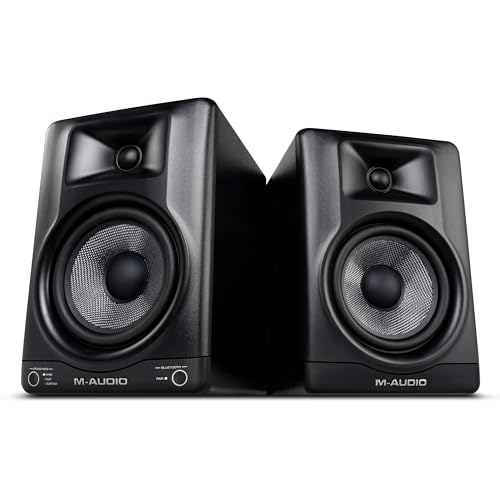
If you’re a music producer, video editor, or content creator looking for studio-quality sound without the complexity of a traditional setup, the M-AUDIO BX5BT Pair 5″ Desktop Studio Monitor Speakers is the perfect choice for you. With 240W bi-amplified power, these monitors deliver clear, full-range audio. The built-in DSP crossover guarantees balanced sound across three reference modes: FLAT, HYPE, and CUSTOM. Plus, you can easily customize your listening experience using the M-Audio Studio Control App. Bluetooth 5.0 connectivity lets you stream wirelessly, while the included accessories make integration seamless. Elevate your projects with the BX5BT’s stunning detail and dynamic range.
Best For: Music producers, video editors, and content creators seeking professional sound quality without complicated setups.
Pros:
- Studio-quality clarity with 240W bi-amplified power for full-range audio.
- Customizable listening experience through the M-Audio Studio Control App with adjustable EQ and presets.
- Bluetooth 5.0 connectivity allows for wireless streaming, enhancing flexibility in setup.
Cons:
- Limited low-end response given the 5” woofer size, which may not satisfy all bass-heavy genres.
- App control required for full customization, which may be a hurdle for users preferring straightforward functionality.
- Rear-panel inputs may be less convenient for some users compared to front-facing connections.
JBL 305P MkII Active Powered Studio Monitors

The JBL 305P MkII Active Powered Studio Monitors are an excellent choice for both budding producers and seasoned audio engineers who seek precise sound reproduction. With a patented Image Control Waveguide, these monitors deliver accurate imaging and a wide sweet spot. Dual 41-Watt Class-D amplifiers power the 5-inch woofer and 1-inch tweeter, providing deep bass and crisp highs. You’ll appreciate the Boundary EQ and HF Trim for customizing your sound to fit any room. Compact yet durable, they’re perfect for desktop setups. With a 4.6-star rating, the JBL 305P MkII proves to be a reliable choice for professional audio work.
Best For: The JBL 305P MkII Active Powered Studio Monitors are best for aspiring producers and experienced audio professionals seeking high-quality sound reproduction in compact setups.
Pros:
- Accurate Sound Imaging: Patented Image Control Waveguide ensures precise sound and a wide sweet spot.
- Powerful Amplification: Dual 41-Watt Class-D amplifiers deliver deep bass and crisp highs for an immersive listening experience.
- Customizable Audio: Boundary EQ and HF Trim allow for tailored sound adjustments to optimize room acoustics.
Cons:
- Limited Size: The 5-inch woofer may not produce the same low-end depth as larger monitors.
- Weight: At 10.43 pounds, they may be heavier than some other compact studio monitor options.
- Price Point: While they offer great performance, they may be considered pricey for entry-level users.
PreSonus Eris 3.5 Studio Monitors (Pair)

Designed for home studios and desktop setups, PreSonus Eris 3.5 studio monitors deliver exceptional sound quality without taking up much space. With a power output of 50 Watts, these active speakers provide accurate audio ideal for music production and multimedia reference. The woven-composite woofers guarantee tight bass, while the silk-dome tweeters enhance high frequencies for a natural response. You’ll appreciate the versatile connectivity options, including TRS and RCA inputs, plus a front-panel aux input for mobile devices. Customize your sound with high- and low-frequency tuning controls, making these monitors perfect for any setup or room size.
Best For: Home studio enthusiasts and desktop users seeking compact, high-quality audio monitoring solutions.
Pros:
- Excellent sound quality with accurate bass and high-frequency response.
- Versatile connectivity options, including TRS, RCA, and aux inputs for various devices.
- Customizable audio output with high- and low-frequency tuning controls.
Cons:
- Limited low-frequency performance without an additional subwoofer.
- Power-saving mode may activate during extended periods of inactivity.
- Smaller size may not be suitable for larger studio environments.
Edifier MR5 2.0 Studio Monitor Bookshelf Speakers

When you’re seeking studio monitor speakers that deliver exceptional sound quality without overwhelming your space, the Edifier MR5 2.0 Studio Monitor Bookshelf Speakers stand out. With a 3-way active crossover system featuring a 5″ woofer, 3.75″ mid driver, and 1″ silk dome tweeter, you’ll experience studio-grade audio. The 110W Class D amplifier guarantees peak performance at 101dB SPL. Plus, you can fine-tune room acoustics using physical knobs or the EDIFIER ConneX App. Bluetooth 6.0 and multiple input options make connectivity easy. Compact and built with MDF cabinets, these speakers are perfect for home studios, delivering consistent sound across all listening areas.
Best For: Audio professionals and enthusiasts seeking high-quality, compact studio monitor speakers for home studio use.
Pros:
- Studio-grade sound with a 3-way active crossover system for enhanced audio clarity.
- User-friendly features like adjustable room tuning and app-based EQ customization for personalized sound control.
- Multiple connectivity options including Bluetooth 6.0 and various input ports for versatile use.
Cons:
- Limited bass response compared to larger speakers, which may not satisfy bass-heavy music genres.
- Rear knobs for acoustic tuning may be less convenient than on-screen adjustments for some users.
- Compact size may not be suitable for larger studio spaces requiring more powerful audio output.
Yamaha HS3 Powered Studio Monitor in Black, Pair (HS3 B)

For budding producers and musicians seeking a compact yet powerful studio monitor, the Yamaha HS3 Powered Studio Monitor in Black stands out. This 2-way bass-reflex speaker features a 3.5-inch woofer and a 0.75-inch tweeter, delivering a frequency response of 70 Hz to 22 kHz. With an output power of 26 W, you’ll enjoy crisp and clear sound. The HS3 offers versatile input options, including XLR/TRS combo and RCA connections, making it easy to integrate into any setup. Included accessories like a stereo mini-RCA cable and anti-slip pads guarantee you’re ready to mix right away.
Best For: Budding producers and musicians seeking a compact yet powerful studio monitor for their mixing and production needs.
Pros:
- High-quality sound with a frequency response of 70 Hz to 22 kHz, ensuring clear audio reproduction.
- Versatile connectivity options including XLR/TRS combo and RCA inputs for easy integration into various setups.
- Included accessories like a stereo mini-RCA cable and anti-slip pads enhance usability right out of the box.
Cons:
- Limited power output of 26 W may not be sufficient for larger studio spaces or louder environments.
- Compact size may not appeal to users looking for larger speaker systems for more robust sound.
- 3.5-inch woofer could limit bass response compared to larger monitors, potentially affecting low-end clarity in mixes.
Edifier MR4 Powered Studio Monitor Speakers (Pair)
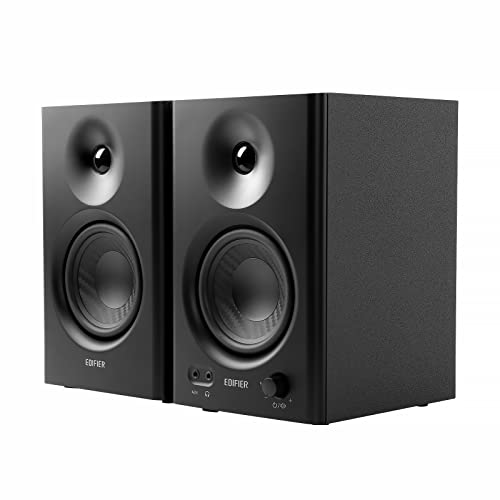
The Edifier MR4 Powered Studio Monitor Speakers are perfect for artists and music creators seeking professional-quality sound without breaking the bank. With a 1″ silk dome tweeter and a 4″ composite woofer, you’ll enjoy clear and smooth audio. The MDF wood texture minimizes resonance, enhancing true sound reproduction. You’ll appreciate the versatile connectivity options, including 1/4″ balanced TRS and unbalanced RCA inputs, making it easy to connect to mixers, computers, or tablets. Plus, the dual mode functionality lets you switch between monitor mode for precise audio and music mode for casual listening. With adjustable high and low frequency knobs, you’re in control!
Best For: The Edifier MR4 Powered Studio Monitor Speakers are best for artists and music creators seeking professional-quality sound at an affordable price.
Pros:
- High-quality audio with a 1″ silk dome tweeter and 4″ composite woofer for clear sound reproduction.
- Versatile connectivity options including balanced TRS, RCA, and AUX inputs for easy integration with various devices.
- Dual mode functionality allows for both accurate audio monitoring and casual listening.
Cons:
- May not provide enough bass response for users who prefer heavier low-end sound.
- Limited to a 4″ woofer, which may be insufficient for larger studio spaces.
- The design may not appeal to everyone aesthetically, as it follows a simple and functional style.
Ortizan C7 Dual-Mode Studio Monitors (Pair, Black)

Offering versatility for both music production and gaming, the Ortizan C7 Dual-Mode Studio Monitors are perfect for anyone seeking high-quality audio in a compact setup. These active speakers boast Bluetooth 5.3, allowing you to connect wirelessly to your devices effortlessly. With multiple input options like RCA and 3.5mm AUX, switching between music and gaming is seamless. The 24-bit DAC minimizes signal loss, while the 3.5-inch carbon fiber speaker and 0.75-inch silk dome tweeter deliver precise sound. Extensive lab tuning guarantees a flat response curve, providing balanced audio across frequencies, making them an ideal choice for your creative needs.
Best For: Audio enthusiasts and content creators seeking high-quality sound in a compact and versatile monitor setup.
Pros:
- Bluetooth 5.3 for easy wireless connectivity with devices.
- Multiple input options (RCA, 3.5mm AUX, and 6.35mm TRS) for seamless switching between audio sources.
- Extensive lab tuning ensures a flat response curve for accurate audio reproduction.
Cons:
- May not be suitable for larger studio environments due to their compact size.
- Limited bass response compared to larger studio monitors.
- The design may not appeal to all aesthetic preferences.
Edifier MR3 Powered Studio Monitor Speakers (Black, Pair)

Designed with audio professionals in mind, the Edifier MR3 Powered Studio Monitor Speakers deliver exceptional sound quality that meets the demands of both music creation and precise monitoring. With Hi-Res Audio Certification, you’ll experience a flat response from 52Hz to 40kHz, ensuring clarity across the spectrum. The 18W*2 RMS output and 92.5dB peak SPL offer robust sound, while Bluetooth V5.4 connectivity lets you connect multiple devices seamlessly. Plus, the EDIFIER ConneX app allows for personalized EQ adjustments, tailoring your audio experience. Whether for production or casual listening, these speakers excel, making them a top choice in studio monitors.
Best For: Audio professionals and enthusiasts seeking high-quality sound performance for music production and casual listening.
Pros:
- Hi-Res Audio Certification ensures precise monitoring and a flat frequency response.
- Multiple Connectivity Options including Bluetooth V5.4 and various input types for versatile use.
- Customization Features via the EDIFIER ConneX app for tailored audio experiences.
Cons:
- Weight and Size may not be ideal for portable setups or small spaces.
- Limited Bass Response below 52Hz may not satisfy bass-heavy music genres.
- App Control may require a learning curve for users unfamiliar with advanced audio settings.
M-AUDIO Forty Eighty Studio Monitor Speaker

For beat-makers, producers, and DJs seeking powerful sound with unmatched clarity, the M-AUDIO Forty Eighty Studio Monitor Speaker stands out as a top choice. With 150W bi-amplified power and an 8-inch Kevlar woofer, it delivers crisp mixes and extended bass response across genres. You’ll appreciate the professional-grade Burr-Brown conversion and DSP processing that guarantee impactful sound. Plus, Bluetooth 5.3 TWS lets you stream audio cable-free, while versatile XLR and TRS inputs connect seamlessly to your gear. The M-AUDIO Forty Series Control App offers customizable presets and a 5-band EQ, catering to your unique production needs with precision.
Best For: The M-AUDIO Forty Eighty Studio Monitor Speaker is best for beat-makers, producers, DJs, mix engineers, and content creators seeking powerful sound and precise audio representation.
Pros:
- Exceptional 150W bi-amplified power ensures clear and impactful sound across all genres.
- Bluetooth 5.3 TWS capability allows for convenient cable-free audio streaming.
- Customizable presets and a 5-band EQ via the M-AUDIO Forty Series Control App enable tailored audio output.
Cons:
- The 8-inch woofer may require ample space for optimal performance in smaller setups.
- Some users may find the learning curve for the control app a bit steep.
- Price point may be higher compared to entry-level studio monitors.
Mackie CR3.5 Powered Studio Monitors

If you’re looking for studio monitor speakers that cater to both music production and casual listening, the Mackie CR3.5 Powered Studio Monitors deliver studio-quality sound in a compact design. With a 3.5″ woven woofer and silk dome tweeter, they provide clean audio with impressive low end. You can easily connect multiple devices through TRS, RCA, or the 3.5 mm input, perfect for your gaming console or PC. The tone control knob lets you customize sound, boosting bass or enhancing highs as needed. Plus, their flexible placement options make them ideal for any setup, whether on your desk or on a bookshelf.
Best For: The Mackie CR3.5 Powered Studio Monitors are best for musicians, gamers, and casual listeners seeking high-quality sound in a versatile and compact design.
Pros:
- Studio-quality sound with a clear audio response and substantial low end.
- Multiple connectivity options including TRS, RCA, and 3.5 mm inputs for easy integration with various devices.
- Customizable sound with a tone control knob that allows for bass and high-end adjustments.
Cons:
- Limited low-frequency response without a subwoofer, which may not satisfy bass-heavy music enthusiasts.
- Size constraints may not deliver the same power and volume as larger studio monitors.
- Potential for interference when used in close proximity to other electronic devices due to their compact design.
Factors to Consider When Choosing Studio Monitor Speakers With DSP
When selecting studio monitor speakers with DSP, you need to take into account several key factors. Sound clarity and detail are essential for accurate mixing, while power output and efficiency can impact your overall experience. Don’t forget to look at room acoustic adjustments, connectivity options, and customization features to guarantee you get the best fit for your setup.
Sound Clarity and Detail
While choosing studio monitor speakers, sound clarity and detail play an essential role in ensuring accurate audio reproduction. High-quality monitors often include specialized drivers, like Kevlar woofers and silk dome tweeters, which enhance clarity across the frequency spectrum. This allows you, as a producer or engineer, to make informed decisions during mixing and mastering. A built-in DSP crossover can greatly improve sound detail by accurately separating frequencies, resulting in balanced audio output. Additionally, pay attention to the signal-to-noise ratio (SNR); higher values indicate less background noise and clearer sound reproduction. Monitors with adjustable EQ settings can help tailor sound clarity to your specific environment, optimizing audio detail for various listening conditions.
Power Output and Efficiency
Sound clarity and detail set the foundation for choosing studio monitor speakers, but power output and efficiency are just as important for achieving the best audio experience. Higher wattage, like 240W, allows your monitors to produce louder sound levels without distortion, vital for dynamic audio production. Efficiency measures how well a speaker converts electrical power into sound, fundamental for maintaining quality in larger spaces. Bi-amplification enhances clarity and efficiency by using separate amplifiers for low and high frequencies. Additionally, a high signal-to-noise ratio (SNR), ideally 75 dB or more, guarantees cleaner audio playback. Understanding the relationship between power output and speaker sensitivity helps you choose monitors that require less power to reach the desired volume, maximizing efficiency in your setup.
Room Acoustic Adjustments
To achieve the best audio experience in your studio, room acoustic adjustments are essential. These adjustments help counteract reflections, standing waves, and frequency imbalances caused by your space’s dimensions and materials. Many studio monitors come with built-in room control features, letting you tailor the frequency response for a balanced sound. Pair these adjustments with acoustic treatment materials like bass traps and diffusers to further enhance clarity and reduce unwanted resonance. Some monitors also offer boundary EQ settings, allowing you to tweak low and high frequencies based on their placement near walls or corners. Regularly evaluating and recalibrating your monitor settings will help maintain ideal audio performance, ensuring your mixing and production results stay accurate and professional.
Connectivity Options Available
When selecting studio monitor speakers, you’ll want to prioritize connectivity options that suit your specific needs. Look for balanced XLR and TRS inputs, which are essential for professional audio devices, helping to minimize noise and interference. Unbalanced RCA inputs add versatility, allowing compatibility with consumer electronics. Many monitors also feature auxiliary inputs (3.5mm) for easy connections to mobile devices, making casual listening a breeze. Consider Bluetooth connectivity as well, as it enables wireless streaming from compatible devices, enhancing your setup’s flexibility. Finally, opt for monitors with multiple inputs to facilitate simultaneous connections, allowing you to switch between different audio sources quickly without unplugging cables. This way, you’ll guarantee a seamless workflow tailored to your preferences.
Customization and Control Features
Choosing the right studio monitor speakers goes beyond connectivity; customization and control features play a significant role in achieving the best audio experience. Look for adjustable equalization settings that let you fine-tune audio to match your preferences and room acoustics. Many models offer app control, allowing you to save custom presets and optimize playback directly from your device, adding convenience. Also, consider speakers with multiple reference modes, like flat or hype, to switch between sound profiles for different scenarios. Physical controls, such as high/low frequency tuning knobs, give you instant access to adjust sound characteristics without needing software. Advanced DSP technology further enhances audio fidelity by managing crossover frequencies, ensuring balanced sound reproduction suited to your environment.
Size and Design Considerations
While selecting studio monitor speakers, size and design factors are essential for achieving ideal audio performance. The size of your speakers can greatly impact sound quality; larger woofers deliver better bass response, while smaller woofers excel in high-frequency clarity. Make sure to take into account your workspace dimensions, as compact designs work best for desktop setups or smaller studios. The enclosure design, especially MDF construction, helps reduce resonance and distortion, enhancing sound reproduction. Portability is another factor; lightweight and compact monitors can be easily moved or adjusted, adapting to changing studio needs. Finally, don’t overlook aesthetic design—color and finish can greatly influence how well your monitors integrate into your studio environment. Choose wisely!
Price and Budget Constraints
Finding the right studio monitor speakers involves balancing performance with your budget. Prices can vary widely, with entry-level models starting around $100 per pair and professional-grade options exceeding $1,000. Don’t forget to account for additional costs like cables and isolation pads, which can add $50 to $200 to your total. Aim for models that strike a good balance between price and features, particularly those with built-in DSP for enhanced sound quality. Research customer reviews to gauge value and performance—higher prices don’t always mean better sound. Remember, investing in quality monitors can lead to improved accuracy and durability, ultimately offering more value for your money in your professional audio endeavors.