If you want sharper detail and a more revealing top end, studio monitors with ribbon tweeters can make a real difference in how you mix and listen. They’re popular for their fast response, airy highs, and precise stereo image.
In this roundup, we focus on the best options for different rooms, budgets, and use cases so you can choose a monitor that fits your workflow instead of just chasing specs.
Best 10 Studio Monitors with Ribbon Tweeters Picks for 2026
Large-Room Reference Pick
ADAM T8V Bundle With Pads & Cables

- ART ribbon tweeter with HPS waveguide
- 35Hz-22kHz response, up to 118dB SPL
- Includes isolation pads and balanced cables
Best For: Bass-heavy production in larger rooms
Compact Desk Option

- 3.5-inch pair sized for desks and small studios
- Tone knob and location switch for quick adjustment
- Includes isolation pads and startup cables
Best For: Small studios and simple desktop monitoring
Single Monitor Pick

- ART ribbon tweeter for detailed highs
- 8-inch nearfield powered monitor
- High- and low-shelf room filters
Best For: Replacement, expansion, or single-monitor setups
Feature-Rich Alternative

- 3-way active design with silk dome tweeter
- XLR, TRS, RCA, AUX, and Bluetooth 6.0
- Room tuning via knobs and app
Best For: Flexible home studios and mixed-use listening
High-output 8-inch pick

- U-ART ribbon tweeter up to 25 kHz
- 33 Hz bass extension for heavier material
- HPS waveguide widens the sweet spot
Best For: Bass-heavy mixing, production, and film scoring
Compact pair for home studios

- U-ART tweeter for detailed highs
- 5-inch nearfield design for smaller rooms
- Includes two monitors and XLR cables
Best For: Desktop and home-studio mixing with limited space
Step-up nearfield monitor
ADAM Audio A7V 7-inch Powered Studio Monitor

- X-ART ribbon tweeter for accurate highs
- DSP-based tuning for room adaptation
- Rotatable waveguide adds placement flexibility
Best For: Producers wanting a configurable 7-inch nearfield
Reference Nearfield Pick
ADAM Audio T7V Active Nearfield Monitor Pair

- U-ART tweeter with HPS waveguide for detailed highs
- 7-inch woofer with 39 Hz frequency response
- DSP filters and multiple analog connections for setup flexibility
Best For: Mixing and mastering in a nearfield home studio
Compact Starter Choice

- U-ART tweeter with HPS waveguide for detailed highs
- Compact 5-inch cabinet for smaller studio spaces
- Multiple analog connections and rear bass reflex design
Best For: Small project studios and desktop mixing
Desktop Ribbon Tweeter Option
ADAM Audio D3V Active Desktop Studio Monitors
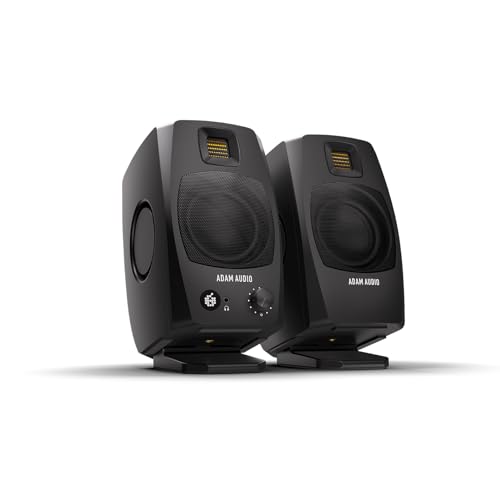
- 1.5-inch D-ART ribbon tweeter for precise highs
- USB-C connectivity with DSP placement controls
- Compact desktop pair with angled stands and mic-stand mounts
Best For: Desktop production and compact listening setups
Large-Room Reference Pick – ADAM T8V Bundle With Pads & Cables
If you’re shopping for studio monitors with ribbon tweeters, this ADAM Audio T8V bundle is aimed at producers who need bigger low-end reach and clear high-frequency detail. The 8.5-inch powered monitors use ADAM’s ART ribbon-derived tweeter with an HPS waveguide, and the bundle adds isolation pads plus balanced cables so you can get set up right away.
Best For: Hip-hop, trap, electronic, and other bass-heavy production in larger mix rooms where sub-bass accuracy matters.
Pros:
- ART ribbon tweeter with HPS waveguide for detailed top end and controlled dispersion
- 35Hz-22kHz response and up to 118dB SPL for strong bass extension and headroom
- Includes Gator isolation pads to reduce desk vibration and bass coloration
- Bundle also includes XLR cables and IEC power cables for faster setup
Cons:
- 8.5-inch monitors are better suited to larger desks or rooms than compact spaces
- Deep bass output may require room correction in untreated environments
The T8V is a practical choice if you want ribbon-style clarity plus serious low-end reach in a ready-to-use package. Its included accessories make it easier to place correctly and hear what the monitors are actually doing.
Compact Desk Option – Mackie CR3.5 Desktop Pair
The Mackie CR3.5 is a compact desktop monitor pair for buyers who want a simple nearfield setup rather than a large studio system. It does not use a ribbon tweeter, but it does focus on practical desktop tuning, with a tone knob, location switch, and included isolation pads for easier placement in small spaces.
Best For: Small desks, home studios, and everyday listening where convenience and space-saving matter more than extended low-end output.
Pros:
- Small 3.5-inch design fits easily on desks and in tight setups
- Tone knob lets you adjust voicing without menus
- Location switch helps correct bass placement near walls or free-standing
- Includes isolation pads and cables in the box
Cons:
- Not a ribbon-tweeter model for shoppers specifically seeking that driver type
- Smaller woofers are not intended for deep bass-heavy monitoring
If your priority is a compact, straightforward monitor pair for a desk-based workflow, the CR3.5 keeps setup easy. It is less about maximum detail or low-end extension and more about usable sound in limited spaces.
Single Monitor Pick – ADAM T8V Nearfield Reference
This single ADAM Audio T8V is a straightforward way to add one of the better-known studio monitors with ribbon tweeters to your setup. It features the brand’s ribbon-style ART tweeter, 8-inch woofer, and rear high- and low-shelf filters, making it a useful reference monitor for mixing and room matching.
Best For: Buyers who want one ADAM T8V monitor for a matching pair setup, replacement, or studio comparison work.
Pros:
- ART ribbon tweeter for detailed high-frequency reproduction
- 8-inch nearfield design suited to studio monitoring
- High-shelf and low-shelf filters help tailor the sound to the room
- Powered design includes separate amplifier power for woofer and tweeter
Cons:
- Sold as a single monitor, not a pair
- Limited product details compared with the full bundle listing
This is a good fit if you already know you want the T8V sound and need only one cabinet. It keeps the core ribbon tweeter and room-adjustment features of the model without extra accessories.
Feature-Rich Alternative – Edifier MR5 Studio Pair
The Edifier MR5 is an active studio monitor pair for buyers who want a versatile desktop or room-friendly speaker system rather than a ribbon-tweeter design. It uses a 3-way active crossover with a silk dome tweeter, plus XLR, TRS, RCA, AUX, and Bluetooth inputs for flexible everyday use.
Best For: Mixed-use studios and home setups that need multiple input options, room tuning, and a compact but powerful speaker pair.
Pros:
- 3-way design with woofer, mid driver, and silk dome tweeter
- Room acoustic tuning controls plus app-based compensation
- Wide connectivity including XLR, TRS, RCA, AUX, and Bluetooth 6.0
- 110W RMS output with up to 101dB peak SPL
Cons:
- Uses a silk dome tweeter instead of a ribbon tweeter
- Large feature set may be more than needed for basic monitoring-only use
The MR5 is a strong all-around option if connectivity and tuning matter more than matching the ribbon-tweeter category exactly. It is especially appealing for users who want one pair to handle studio audio, casual playback, and multiple sources.
High-output 8-inch pick – ADAM Audio T8V Studio Monitor
If you want studio monitors with ribbon tweeters that lean toward bigger bass and longer listening sessions, the ADAM Audio T8V is built for that job. Its U-ART accelerated ribbon tweeter reaches up to 25 kHz, while the 8-inch woofer and 33 Hz low-end extension give you more weight for bass-heavy mixing, production, and film scoring.
Best For: Producers and mixers who want an 8-inch monitor with strong low-end extension and a wide sweet spot.
Pros:
- U-ART ribbon tweeter is designed to reduce ear fatigue and high-frequency distortion.
- 33 Hz bass extension is well suited to EDM, hip hop, and film work.
- HPS waveguide helps create a larger, more controlled sweet spot.
- Flexible studio connectivity with XLR, 1/4″ TRS, and RCA inputs.
Cons:
- The 8-inch size is more space-hungry than smaller nearfield monitors.
- Designed for studio use, so it may be more monitor than some desktop setups need.
The T8V stands out when your priority is clear top-end detail plus stronger bass reach from a ribbon-tweeter design. It’s a practical choice if you want more scale than a compact monitor without giving up the controlled high-frequency response ADAM Audio is known for.
Compact pair for home studios – Adam Audio T5V Pair Bundle
For buyers comparing studio monitors with ribbon tweeters in a smaller room, the ADAM Audio T5V pair is a compact way to get the brand’s U-ART tweeter and detailed imaging. With a 5-inch woofer, 45 Hz to 25 kHz response, and HPS waveguide, this bundle is aimed at accurate nearfield monitoring rather than room-filling output.
Best For: Home studios and desktop setups that need an affordable active monitor pair with ribbon-tweeter detail.
Pros:
- U-ART tweeter delivers detailed, accurate high frequencies.
- 5-inch design fits smaller desks and tighter studio spaces.
- HPS waveguide supports wide, precise stereo imaging.
- Bundle includes a pair of monitors plus XLR cables for quicker setup.
Cons:
- Smaller woofer means less low-end reach than 7- or 8-inch models.
- Best suited to nearfield use, not high-output room coverage.
The T5V is a sensible entry point if you want ADAM’s ribbon-style high-frequency clarity in a compact, practical package. It’s especially appealing when desk space is limited and you still want a monitor pair built for critical mixing decisions.
Step-up nearfield monitor – ADAM Audio A7V 7-inch Powered Studio Monitor
If you’re shopping for studio monitors with ribbon tweeters and want a more advanced nearfield option, the ADAM Audio A7V adds DSP-based tuning, a rotatable X-ART HF driver, and a 7-inch woofer. It’s built for studio use with a 96 kHz sampling rate, 24-bit A/D conversion, and connectivity that includes XLR, RCA, and Ethernet.
Best For: Producers who want a configurable 7-inch monitor with ribbon-tweeter detail and room-tuning flexibility.
Pros:
- X-ART ribbon tweeter delivers ultra-accurate highs with no distortion at high SPLs.
- DSP-based tuning helps adapt the monitor to different rooms.
- Rotatable HPS waveguide adds placement and sonic flexibility.
- 7-inch woofer offers a larger format than compact nearfields.
Cons:
- More advanced feature set may be more than simple plug-and-play users need.
- Single-monitor listing means you’ll need to plan a stereo pair purchase.
The A7V is the most flexible option here if you want more control over how your monitors translate in your room. It combines the clarity of ADAM’s ribbon tweeter design with tuning tools that make sense in serious production spaces.
Reference Nearfield Pick – ADAM Audio T7V Active Nearfield Monitor Pair
If you want studio monitors with ribbon tweeters for mixing and mastering, the ADAM Audio T7V is built for detailed, reliable playback in a nearfield setup. Its HPS waveguide and U-ART tweeter are designed to deliver clear high frequencies, while the 7-inch woofer and rear-firing bass reflex port help it reach deeper low end for more confident mix decisions.
Best For: Home studios, mixing desks, and creators who want an accurate nearfield monitor pair with room-friendly placement options.
Pros:
- U-ART tweeter and HPS waveguide provide detailed high-frequency response.
- 7-inch woofer and 39 Hz low-end extension support fuller monitoring.
- High- and low-shelf DSP filters help adapt the sound to difficult rooms.
- Multiple analog inputs make it easy to connect common studio gear.
Cons:
- Rear bass reflex design may require more careful placement.
- Large footprint may be less convenient on very small desks.
The T7V is a practical step-up choice if you want the clarity ADAM Audio is known for without moving into a larger-format studio monitor. It is especially appealing when you need a balanced pair that can handle recording, mixing, and post-production work.
Compact Starter Choice – ADAM Audio T5V Studio Monitor
For buyers comparing studio monitors with ribbon tweeters, the ADAM Audio T5V offers the same general ADAM Audio monitoring approach in a smaller footprint. The HPS waveguide and U-ART tweeter aim for detailed high-frequency playback, while the 5-inch woofer keeps it compact for smaller desks and room setups.
Best For: Smaller project studios, podcast work, and creators who need a compact monitor with revealing top-end detail.
Pros:
- U-ART tweeter and HPS waveguide support detailed high-frequency monitoring.
- Compact 5-inch design fits tighter desktop or studio spaces.
- Rear-firing bass reflex port can help extend the low end in a small cabinet.
- Multiple analog connections make integration with common devices straightforward.
Cons:
- Smaller woofer means less low-end reach than the T7V.
- Rear port still requires sensible placement for best results.
The T5V is the more space-conscious option in this lineup and suits users who value clear, honest monitoring over big output. It makes the most sense when desk space matters and you still want ADAM Audio’s ribbon-tweeter style detail.
Desktop Ribbon Tweeter Option – ADAM Audio D3V Active Desktop Studio Monitors
If you specifically want studio monitors with ribbon tweeters for a desk setup, the ADAM Audio D3V is the most desktop-focused choice here. Its 1.5-inch D-ART tweeter is designed for precise, unfatiguing highs, and the compact active system adds USB-C connectivity, passive radiators, and DSP controls for practical everyday use.
Best For: Desktop producers, laptop users, and listeners who want a compact monitoring system with ribbon-tweeter detail.
Pros:
- 1.5-inch D-ART ribbon tweeter delivers precise high-frequency reproduction.
- USB-C connection makes it easy to hook up computers and mobile devices.
- Dual passive radiators help extend the system down to 45 Hz.
- Includes angled monitor stands plus mic-stand mounting support.
Cons:
- Small desktop format is not meant for larger room monitoring.
- Uses balanced 1/4-inch inputs rather than broader pro I/O options.
The D3V stands out for users who want ADAM Audio clarity in a compact all-in-one package. It is a strong fit for desk-based production, streaming, and casual listening where space-saving design matters as much as sound quality.
How We Picked the Best Studio Monitors with Ribbon Tweeters
We focused on Studio Monitors with Ribbon Tweeters that offer strong clarity, reliable build quality, and sensible performance for home studios and project rooms. Priority went to models with proven tonal balance, usable frequency response, enough output for real-world monitoring, and a fit for different listening distances.
We also considered value, since the best choice is not always the most expensive one. A monitor that matches your room and job will usually outperform a bigger speaker that is poorly placed or overkill for your space.
Quick Comparison
For small desks and tight rooms, compact 5-inch and desktop models are usually easier to place and less likely to overwhelm the low end. For mixing in larger rooms, 7-inch and 8-inch models can give you more headroom, deeper bass extension, and a fuller picture of your low mids.
If you need reference-level detail for critical editing or mastering, look for the most controlled top end and the widest sweet spot. If you mainly create beats, stream, or work at a desk, convenience and nearfield balance may matter more than maximum output.
Key Buying Factors for Studio Monitors with Ribbon Tweeters
Room Size and Listening Distance
Match the monitor size to your room. Smaller spaces usually benefit from 3.5-inch to 5-inch designs, while 7-inch and 8-inch monitors are better when you have enough distance for the sound to develop properly.
Low-End Extension and Bass Control
Ribbon tweeters are only part of the story. Check the woofer size, low-frequency response, and whether you’ll need a subwoofer. In untreated rooms, too much bass can be more of a problem than not enough.
Connectivity and Workflow
Make sure the inputs fit your interface, controller, or desktop setup. Balanced XLR or TRS connections are usually best for studio use, especially when you want to keep noise low.
Transparency Vs. Listening Comfort
Some monitors are deliberately more revealing, which helps expose flaws in a mix. Others aim for a smoother, more forgiving sound. Decide whether you need maximum accuracy or something more relaxed for long sessions.
Who Should Buy Which Studio Monitors with Ribbon Tweeters?
If you are building a first home studio, compact models are the safest place to start. If you mix regularly and need more depth and headroom, step up to the 5-inch, 7-inch, or 8-inch options. Producers working on vocals, synths, or detailed editing will usually appreciate the extra top-end precision that Studio Monitors with Ribbon Tweeters can provide.
For desktop listening, content creation, and casual music work, choose the smallest pair that still gives you the clarity you want. For mixing and mastering, prioritize room fit, neutrality, and placement flexibility over raw power alone.