Sharing a monitor mix across several performers is easier with the right wireless in-ear monitor system with multiple receivers. These systems can reduce stage clutter while giving singers, musicians, presenters, and production teams more consistent monitoring.
We selected 10 systems spanning UHF and 2.4GHz designs, mono and stereo operation, multi-receiver bundles, rechargeable options, and different range and latency claims. Use the guide below to match the setup to your performers, venue, and workflow.
Best 10 Wireless in Ear Monitor System with Multiple Receivers Picks for 2026
Best Team Pick
Xvive U4R4 Four-Receiver IEM System

- Four receivers included
- Under 5ms latency
- Up to five hours of battery life
Best For: Small bands and four-person performance teams
Best Independent Mixes
Phenyx Pro PTM-33-4B UHF IEM System

- Four standalone monitor mixes
- Four receivers and earphones included
- UHF range up to 164 feet line of sight
Best For: Bands and teams needing separate mono mixes
Best Battery Life
LEKATO MS-20 Two-Receiver Wireless IEM

- Up to 30 hours with charging case
- Supports up to 10 receiver pairs
- OTG and mono/stereo support
Best For: Mobile two-person setups and extended rehearsals
Best Single-Performer Setup
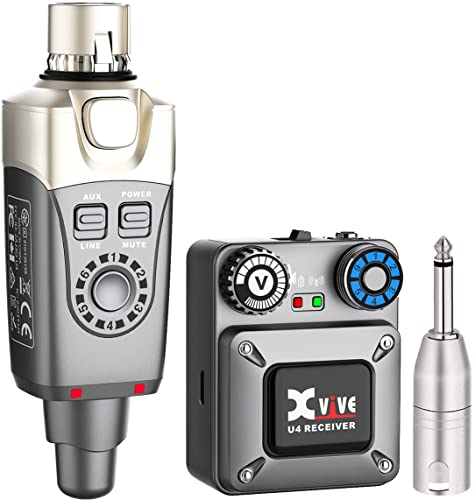
- One transmitter and receiver
- Under 5ms latency
- Over 90-foot stated range
Best For: Solo performers and expandable starter setups
Best Budget Multi-Receiver Pick

- Two receivers included
- Low-latency monitoring
- Automatic pairing
Best For: Bands and group practice
Best High-Resolution Wireless Option

- 5.8 GHz True Diversity
- Less than 5 ms latency
- Up to six channels
Best For: Expandable stage monitoring
Best Long-Range UHF System

- Scales to multiple receivers
- Up to 100-meter coverage
- 85 selectable frequencies
Best For: Stage systems needing flexible UHF coverage
Best Multi-Receiver Value
LEKATO MS-02 Wireless IEM System

- One transmitter supports up to four receiver pairs
- Under 4.5ms mono latency with 24-bit/48kHz audio
- 6–8 hours of battery life and 100-foot open-area range
Best For: Small and medium bands, churches, and rehearsal teams
Best Professional Connectivity

- 1ms latency with 48kHz/24-bit audio
- Seven selectable UHF channels and 164-foot line-of-sight range
- Balanced XLR plus AUX/LINE input options
Best For: Live performers using mixers, interfaces, or stage audio systems
Best for Larger Receiver Groups
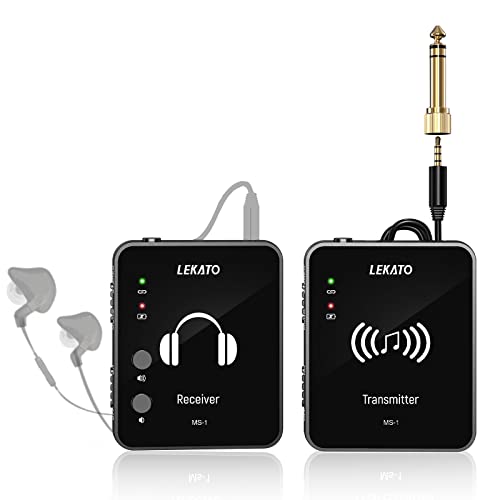
- Supports up to six device sets from one transmitter
- Automatic pairing and mono/stereo switching
- More than five hours of battery life with a 100-foot range
Best For: Bands and teams needing multiple receivers for practice or small gigs
Best Team Pick – Xvive U4R4 Four-Receiver IEM System
The Xvive U4R4 is a practical wireless in ear monitor system with multiple receivers for bands and small production teams. One transmitter sends audio to four receivers, with 2.4GHz transmission, a claimed range of over 90 feet, and latency under 5ms.
Best For: Small bands, worship teams, and live performers who need four individual bodypack receivers from one transmitter.
Pros:
- Includes four receivers and one transmitter.
- Supports six channels with less than 5ms latency.
- Rechargeable transmitter and receivers offer up to five hours of battery life.
- Includes a 1/4-inch-to-XLR adapter and storage bag.
Cons:
- Five-hour battery life may require recharging between longer events.
- The listed operating range is more suited to small venues than large stages.
- No water resistance is specified.
Choose this package when supplying four performers matters more than extended battery life or long-range coverage. Its ready-to-use bundle keeps the setup straightforward for compact live systems.
Best Independent Mixes – Phenyx Pro PTM-33-4B UHF IEM System
The Phenyx Pro PTM-33-4B is a wireless in ear monitor system with multiple receivers designed for four separate monitoring groups. Its transmitter provides four left/right input groups and loop outputs, while UHF transmission supports up to four standalone mixes without audible delay.
Best For: Four-member bands, church teams, stage productions, and sound engineers who need separate monitor mixes.
Pros:
- Provides four independent monitor mixes through one integrated station.
- Includes four UHF bodypack receivers and four in-ear earphones.
- Offers 4 x 25 UHF frequencies and a stated 140-164-foot line-of-sight range.
- Includes IR sync, loop outputs, and a rackmount antenna kit.
Cons:
- It supports mono in-ear monitoring only.
- Thick walls, glass, and metal can reduce operating distance.
- The system requires four auxiliary mixer outputs for its full four-group setup.
This is the stronger fit when performers need distinct mixes rather than a shared feed. Its UHF architecture and rack-oriented design suit more structured stage and worship installations.
Best Battery Life – LEKATO MS-20 Two-Receiver Wireless IEM
The LEKATO MS-20 is a compact wireless in ear monitor system with multiple receivers for rehearsal, studio, and live use. It pairs one transmitter with two receivers, supports automatic pairing and OTG input, and offers up to 30 hours of use with its charging case.
Best For: Two-person bands, mobile performers, and musicians who prioritize rechargeable convenience and phone or USB-C connectivity.
Pros:
- Includes one transmitter and two receivers with a charging case.
- Provides up to 30 hours of usage with the case.
- Supports one transmitter to as many as 10 receiver pairs.
- Offers a 150-foot open-area range and mono/stereo switching.
Cons:
- Earphones are not included.
- The package is limited to two receivers.
- Range performance can vary outside open areas.
The MS-20 stands out for portable setups that need frequent recharging flexibility. It is especially appealing for small groups, though buyers must supply compatible earphones separately.
Best Single-Performer Setup – Xvive U4 Wireless IEM Set
The Xvive U4 is a simple wireless in ear monitor system with multiple receivers capability when additional compatible receivers are added. This package includes one transmitter and one receiver, with 2.4GHz wireless operation, over 90 feet of range, and less than 5ms latency.
Best For: Solo performers, presenters, and buyers starting with one monitor position who may expand later.
Pros:
- Compact one-transmitter, one-receiver configuration.
- Supports simultaneous broadcasts on six channels.
- Claims less than 5ms latency for real-time monitoring.
- Includes a 1/4-inch-to-XLR adapter and storage bag.
Cons:
- Only one receiver is included.
- Battery life is rated for up to five hours.
- No water resistance is specified.
This set is a sensible entry point for one performer or technician. Choose the multi-receiver package instead if several people need monitoring immediately, but this model keeps the initial purchase compact.
Best Budget Multi-Receiver Pick – Depusheng T9-2
If you need a wireless in ear monitor system with multiple receivers for rehearsals, small performances, or group practice, the Depusheng T9-2 is built around a simple one-transmitter, two-receiver setup. Its automatic pairing, low-latency transmission, and claimed range of over 50 meters make it practical for musicians who want straightforward personal monitoring.
Best For: Bands, instrumentalists, DJs, and performers who need two wireless in-ear receivers from one transmitter.
Pros:
- Includes two receivers and one transmitter for group monitoring.
- Ultra-low-latency transmission supports more responsive monitoring.
- Automatic pairing is designed for quick setup.
- Built-in battery provides several hours of use per charge.
Cons:
- Warranty coverage is listed as 90 days.
- It is not water resistant.
- Battery-life details vary between the supplied specifications and product notes.
The T9-2 stands out when multiple receivers and easy pairing matter more than advanced RF configuration. Confirm the input and instrument compatibility of your specific setup before buying.
Best High-Resolution Wireless Option – Xvive U45
The Xvive U45 is a strong choice for shoppers comparing a wireless in ear monitor system with multiple receivers for a growing stage setup. Its 5.8 GHz True Diversity design, dual-antenna receiver, channel scanning, and support for up to six channels are aimed at stable, flexible wireless monitoring.
Best For: Performers and bands that want high-resolution audio, low latency, and room to operate multiple wireless systems.
Pros:
- 24-bit/48 kHz audio and less than 5 ms latency are specified.
- True Diversity reception and dual antennas help support a stable RF connection.
- Smart channel scanning helps identify a suitable local channel.
- Supports up to six channels for multi-system setups.
Cons:
- The supplied product information lists one transmitter and one receiver rather than multiple receivers in the package.
- Battery life is listed at approximately five hours.
- It requires compatible mixer, interface, or line-output connections.
The U45 is best viewed as a scalable wireless monitoring platform rather than a ready-made multi-receiver bundle. Its channel capacity makes it useful when expanding a system over time.
Best Long-Range UHF System – SGPRO SG-40NA
For buyers seeking a wireless in ear monitor system with multiple receivers, the SGPRO SG-40NA offers a UHF-based design that can scale beyond its included single set. Enhanced antenna diversity, 85 selectable frequencies, and a stated range of up to 100 meters give it useful flexibility for stages and larger rehearsal spaces.
Best For: Live performers and bands that need long-range UHF coverage, flexible inputs, and the option to add receivers.
Pros:
- One transmitter can connect to multiple receivers.
- Enhanced antenna diversity is designed to reduce dead spots.
- Offers three inputs, including XLR and 1/4-inch connections.
- Provides 85 selectable frequencies and up to 100 meters of stated coverage.
Cons:
- The supplied package is a single set with one receiver.
- The system is not water resistant.
- Battery life is listed at approximately six hours.
The SG-40NA is a practical foundation for a multi-receiver installation, especially when long coverage and input flexibility are priorities. Additional receivers may be needed to monitor several performers.
Best Multi-Receiver Value – LEKATO MS-02 Wireless IEM System
If you need a wireless in ear monitor system with multiple receivers for rehearsals, church services, or small and medium stages, the LEKATO MS-02 is a flexible 2.4GHz option. It supports one transmitter with up to four receiver pairs, offers mono or stereo operation, and has a rated open-area range of 100 feet.
Best For: Bands, singers, and church teams that need several performers to monitor the same source.
Pros:
- Supports one transmitter with up to four receiver pairs.
- Under 4.5ms latency in mono mode and 24-bit/48kHz audio.
- Up to 6–8 hours of operation with volume and battery-level LEDs.
- Compact clip-on design, mono/stereo switching, and one-key mute.
Cons:
- Earbuds are not included.
- Its 2.4GHz wireless range is specified at 100 feet in open areas.
The MS-02 is a practical pick when multiple receivers and straightforward operation matter more than advanced professional connectivity. Its low latency, useful battery life, and simple pairing make it well suited to smaller performance setups.
Best Professional Connectivity – POGOLAB UHF 7-Channel IEM
For shoppers comparing a wireless in ear monitor system with multiple receivers for live performance, the POGOLAB UHF system emphasizes low delay, channel flexibility, and mixer-friendly inputs. Its transmitter includes balanced XLR and AUX/LINE connectivity, while seven selectable UHF channels help with crowded stage environments.
Best For: Live bands, worship teams, and performers who want UHF transmission and XLR input flexibility.
Pros:
- Claims 1ms latency with 48kHz/24-bit audio.
- Seven selectable UHF channels for interference management.
- Supports balanced XLR and AUX/LINE input sources.
- Rechargeable USB-C transmitter and receiver batteries provide up to five hours.
Cons:
- The supplied notes do not specify a maximum number of receivers.
- Battery life is shorter than some competing systems at up to five hours.
- The 164-foot range is specified for clear line-of-sight use.
This system is especially appealing when your setup relies on a mixer or audio interface with XLR output. The selectable UHF channels and very low stated latency give it a performance-focused edge, though buyers specifically needing several receivers should confirm multi-receiver support before purchasing.
Best for Larger Receiver Groups – LEKATO MS-1 Wireless IEM
The LEKATO MS-1 is worth considering if you want a wireless in ear monitor system with multiple receivers for band practice, church use, or small gigs. It uses 2.4GHz wireless transmission, supports stereo or mono input, and is described as supporting up to six device sets operating simultaneously.
Best For: Groups that need several performers to share one monitor transmission during rehearsals or smaller shows.
Pros:
- Supports up to six device sets with one transmitter.
- Automatic pairing simplifies initial setup.
- True stereo transmission with one-key mono/stereo switching.
- Under 12ms latency, 100-foot open-area range, and more than five hours of battery life.
Cons:
- Its stated latency is higher than the MS-02 and POGOLAB systems.
- Battery life is rated at more than five hours.
- Performance depends on using a stereo source and stereo cable for stereo transmission.
MS-1 stands out for its stated six-device capacity and automatic pairing, making it a convenient choice for multi-member rehearsals. It is less focused on ultra-low latency than newer alternatives, but its stereo support and group capacity remain useful for smaller production setups.
How We Picked the Best Wireless in Ear Monitor System with Multiple Receivers
We compared these systems by receiver capacity, wireless band, audio format, claimed operating range, latency, battery approach, pairing process, connectivity, and practical setup requirements. A system designed for a four-person band has different priorities from a compact kit for rehearsals or a presenter using one receiver.
Specifications such as range, battery life, and latency are manufacturer claims and can vary with obstacles, interference, volume, and connected equipment. We also considered whether each model is positioned for mono or stereo monitoring, since that affects both mix flexibility and receiver compatibility.
Quick Comparison
| What to Compare | Why It Matters |
|---|---|
| Receiver count | Determines how many performers can monitor the same transmitter without extra units. |
| Wireless frequency | UHF and 2.4GHz systems have different interference, range, and venue-planning considerations. |
| Mono or stereo | Mono is often simpler; stereo can preserve more detailed mixes and panning. |
| Power system | Rechargeable receivers reduce disposable batteries, while replaceable batteries may simplify long events. |
| Inputs and outputs | Check compatibility with your mixer, audio interface, instrument outputs, and earphones. |
Key Buying Factors for a Wireless In-Ear Monitor System with Multiple Receivers
Receiver Capacity and Expansion
Confirm how many receivers are included and whether additional compatible receivers can be paired later. For a band, choir, worship team, or theater group, buying enough receivers at the outset can be more economical and easier to manage than combining unrelated kits.
Frequency and Venue Conditions
UHF systems may offer useful range and dedicated channel selection, while 2.4GHz systems are often convenient and simple to deploy. In busy venues, Wi-Fi traffic, nearby wireless microphones, lighting equipment, and physical obstructions can affect reliability. Look for channel options and follow local frequency regulations.
Audio Format, Latency, and Connection
Choose mono if everyone can work from a shared summed mix. Choose stereo when performers need separation or a more natural monitor image. Low latency is especially important for singers and instrumentalists. Before buying, verify the transmitter input type, receiver output, gain controls, and whether the system supports the cables already used by your mixer.
Battery Life and Daily Workflow
Consider the full event schedule, not just the advertised runtime. Charging cases can simplify multi-receiver storage, while removable batteries may be preferable for extended productions. Indicator lights, automatic pairing, belt clips, and sturdy connectors can make a noticeable difference during setup and changeovers.
Who Should Buy Which Wireless in Ear Monitor System with Multiple Receivers?
Choose a multi-receiver bundle when several people need the same monitor feed and you want a coordinated setup. A four-receiver system is a practical starting point for small bands, worship groups, and rehearsal rooms. A two-receiver kit may suit duos, presenters, or compact mobile rigs. For larger or more demanding productions, prioritize channel management, expansion options, diversity reception, and dependable range over the lowest price.
For simple practice and portable use, favor automatic pairing, charging convenience, and low setup complexity. For live venues, focus on interference management, connector compatibility, battery planning, and the ability to test every receiver from the intended performance positions before the event.