Choosing among the best audio mixers for home recording depends on how many sources you need to connect, whether you record directly to a computer, and which controls matter most during a session.
This roundup covers compact analog mixers, USB-equipped consoles, podcast-focused interfaces, and straightforward stereo mixers for creators building or upgrading a home setup.
Best 10 Audio Mixers for Home Recording Picks for 2026
Versatile Podcast Pick

- 48V phantom power for condenser microphones
- 99 DSP effects with USB recording
- PAD and high-pass filter for cleaner inputs
Best For: Podcasters, streamers, and home studios needing effects and flexible connectivity
Streaming Workhorse
Behringer XENYX 802S USB Mixer

- Eight inputs for multi-source setups
- Stereo USB audio interface
- Low-noise analog mixing and EQ
Best For: Streamers and podcasters wanting hands-on controls with USB connectivity
Minimalist Line Mixer
FIFINE N5 4-Channel Mini Mixer
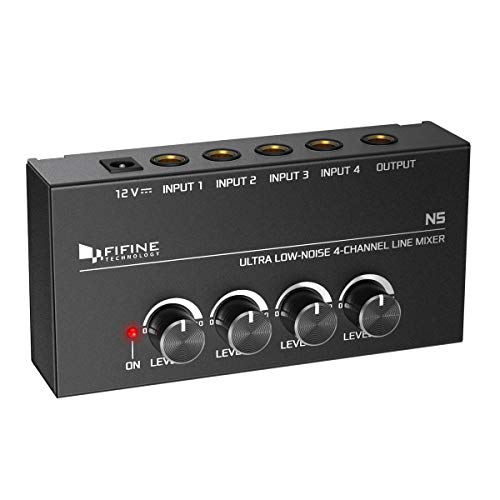
- Four independent line-level volume controls
- Stereo or mono operation
- Compact, low-noise metal enclosure
Best For: Musicians combining keyboards, guitars, or other line-level sources
Compact Analog Classic

- One mic/line input with phantom power
- Two stereo 1/4-inch line inputs
- RCA inputs and outputs for playback or recording
Best For: Small home setups needing simple analog mixing and RCA connectivity
Best Overall
Focusrite Scarlett 2i2 4th Gen

- Two mic and instrument inputs
- 120dB dynamic range and 192kHz support
- Auto Gain, Clip Safe, and Air modes
Best For: Solo musicians recording vocals and guitar at home
Best Multi-Channel Value
8-Channel Bluetooth Audio Mixer

- Eight XLR and 1/4-inch input channels
- Bluetooth and USB audio support
- 48V phantom power, EQ, and onboard effects
Best For: Home studios needing several connected sources
Best for Podcasting

- 11 customizable sound pads
- XLR mic, instrument, USB-C, and smartphone connections
- Reverb, denoise, auto-tune, and loopback features
Best For: Podcasters, streamers, and voice-content creators
Best Compact All-Rounder

- USB interface for PC recording and streaming
- +48V phantom power for compatible microphones
- Compact design with Bluetooth and MP3 input
Best For: Home recording, podcasts, livestreams, and mobile setups
Best Simple RCA Mixer

- Four RCA inputs for line-level audio sources
- Independent controls for each channel
- Passive, compact, and requires no power
Best For: RCA-based home audio systems and simple source mixing
Best for Larger Setups

- Eight channels for microphones and instruments
- USB, Bluetooth, and MP3 audio options
- +48V phantom power with built-in reverb
Best For: Larger home studios, karaoke, bands, and live events
Versatile Podcast Pick – 4-Channel DSP Recording Mixer
For creators comparing audio mixers for home recording, this compact four-channel console combines microphone support, tone shaping, effects, and computer connectivity. Its 48V phantom power, USB recording, Bluetooth streaming, and input controls make it suited to flexible podcasting and home-studio setups.
Best For: Podcasters, streamers, and home recordists who want built-in effects and condenser-microphone support.
Pros:
- 48V phantom power supports condenser microphones.
- 99 DSP effects provide reverb, delay, and other processing options.
- USB recording, OTG support, and Bluetooth 5.0 add flexible connection options.
- PAD and 80Hz high-pass filter help manage loud sources and low-frequency rumble.
Cons:
- Only two inputs are XLR microphone inputs; the other connections are stereo line inputs.
- Bluetooth streaming range is specified at up to 15 feet.
- Software-update support is listed as unknown.
This is the most feature-packed option in the group for users who want effects and modern connectivity in a small console. It is a particularly practical choice when one setup needs to cover recording, streaming, and playback.
Streaming Workhorse – Behringer XENYX 802S USB Mixer
Behringer XENYX 802S Premium Analog 8-Input Mixer with USB Streaming Interface
Check Price On AmazonThe Behringer XENYX 802S is a practical choice among audio mixers for home recording when analog control and computer connectivity are priorities. It provides eight inputs, low-noise analog mixing, and stereo USB audio for streaming, podcasting, and recording workflows.
Best For: Home streamers, podcasters, and musicians who need an analog mixer with USB computer or mobile-device connectivity.
Pros:
- Eight-input layout offers room for multiple sources.
- Stereo USB audio interface connects to a computer or mobile device.
- Analog mixing and equalization provide direct hands-on control.
- Designed for low-noise streaming, podcasting, and recording.
Cons:
- The supplied notes do not specify phantom-power support or built-in effects.
- USB audio is stereo rather than described as multitrack recording.
- Software-update support is listed as unknown.
Choose the 802S if you prefer straightforward analog mixing while still wanting a USB path to a computer or mobile device. Its eight-input format makes it more suitable than a mini line mixer for setups with several connected sources.
Minimalist Line Mixer – FIFINE N5 4-Channel Mini Mixer
For simple signal combining, the FIFINE N5 is a compact option among audio mixers for home recording. It handles four line-level sources with independent volume controls and can operate in stereo or mono, making it useful for keyboards, instruments, monitoring, or submixing.
Best For: Musicians and home recordists mixing multiple line-level instruments into one output.
Pros:
- Four channels with independent volume controls.
- Compact metal enclosure fits easily on a desktop or keyboard.
- Stereo or mono operation supports different routing needs.
- Low-noise design is intended for clean line-level mixing.
Cons:
- It is a line mixer and does not list XLR microphone inputs or phantom power.
- TRS/TS cables are not included.
- It provides a single output rather than a full recording-console feature set.
The N5 makes sense when the goal is uncomplicated submixing rather than microphone processing or USB recording. Its small footprint and separate channel controls are well suited to instrument-heavy desktop or keyboard setups.
Compact Analog Classic – Mackie Mix5 5-Channel Mixer
The Mackie Mix5 is a straightforward analog choice for audio mixers for home recording, playback, and small desktop setups. It combines one mic/line input with phantom power, two stereo 1/4-inch line inputs, and dedicated RCA inputs and outputs for connecting playback or recording equipment.
Best For: Home users wanting a compact analog mixer for one microphone, stereo sources, and RCA playback or recording connections.
Pros:
- Five-channel design includes one mic/line input and two stereo line inputs.
- Phantom power supports studio condenser microphones.
- Two-band EQ offers simple tone shaping on the mic/line channel.
- Dedicated stereo RCA inputs and outputs support playback or recording.
Cons:
- It does not list USB connectivity or built-in digital effects.
- Only one mic/line input is provided.
- The analog layout may be limiting for larger multi-microphone recordings.
The Mix5 is a good fit for users who want familiar analog controls and do not need an integrated USB interface. Its RCA connections and compact form make it especially convenient for basic playback, routing, and small home-recording systems.
Best Overall – Focusrite Scarlett 2i2 4th Gen
The Focusrite Scarlett 2i2 4th Gen is a strong choice among audio mixers for home recording when you want a compact interface focused on high-quality vocals, guitars, and other two-source sessions. Its two inputs, Auto Gain, Clip Safe, and included recording software make it approachable for getting clean takes into your computer.
Best For: Home musicians recording vocals, guitar, or other instruments one or two inputs at a time.
Pros:
- Two mic preamps and Hi-Z instrument inputs support microphones and guitars.
- 120dB dynamic range with 24-bit/192kHz recording capability.
- Auto Gain and Clip Safe help prevent poorly set levels and clipping.
- Includes Ableton Live Lite, Pro Tools Intro+, Cubase LE, and additional plugins.
Cons:
- Two inputs may be limiting for larger ensembles or multi-microphone setups.
- It is an audio interface rather than a multi-channel mixer with onboard channel effects.
Choose the Scarlett 2i2 if recording quality and straightforward computer-based production matter more than having many physical channels. Air mode also provides an option for adding presence and harmonic drive to vocals and guitars.
Best Multi-Channel Value – 8-Channel Bluetooth Audio Mixer
This 8-channel board is a practical pick among audio mixers for home recording if you need several XLR or 1/4-inch sources, hands-on controls, and built-in connectivity. Bluetooth 5.0, USB playback and recording, phantom power, EQ, and effects give it flexibility for home studios, podcasts, karaoke, and live use.
Best For: Users who need multiple microphones or instruments, wireless playback, and physical mixing controls.
Pros:
- Eight XLR and 1/4-inch inputs accommodate microphones, instruments, and other audio devices.
- Bluetooth 5.0 and USB support wireless streaming, playback, and recording.
- 48V phantom power supports condenser microphones.
- Per-channel EQ, gain, FX, volume controls, plus delay and reverb effects.
Cons:
- The supplied notes do not specify recording resolution or maximum sample rate.
- Its broader feature set may be more than needed for a simple two-input setup.
The mixer is a good fit when expandability and real-time control are priorities. PFL monitoring and a headphone output are useful for checking channels during recording, while the slim profile helps it fit into compact workspaces.
Best for Podcasting – MAONO AME2 Podcast Mixer
The MAONO AME2 stands out among audio mixers for home recording when podcasting, streaming, or voice content is the main focus. It combines XLR microphone support, an instrument input, customizable sound pads, reverb, auto-tune, loopback, and smartphone-friendly outputs in a purpose-built console.
Best For: Podcasters, streamers, voice-over creators, and musicians who want effects and sound triggering built in.
Pros:
- Supports XLR condenser and dynamic microphones with up to 60dB gain and 48V phantom power.
- Offers 11 customizable sound pads, including looping audio options.
- Includes denoise, reverb modes, auto-tune, tone controls, pitch changing, and loopback.
- Provides USB-C computer connectivity and outputs for smartphone streaming.
Cons:
- USB microphones are not supported.
- Its podcast-focused effects may be unnecessary for straightforward music recording.
- The supplied notes do not specify a maximum sample rate or detailed channel count for conventional multitrack recording.
Consider the AME2 when live content and audience-facing production are as important as recording. Its separate microphone controls and sound pads make it especially suited to spoken-word workflows, while the instrument input accommodates guitar and bass.
Best Compact All-Rounder – 4-Channel USB Bluetooth Mixer
For shoppers comparing audio mixers for home recording, this compact 4-channel model combines microphone and instrument connectivity with a USB recording interface. Its +48V phantom power, Bluetooth input, and small footprint make it practical for desktop recording, podcasts, livestreams, and small audio setups.
Best For: Home recording, podcasting, livestreaming, karaoke, and mobile audio work.
Pros:
- Supports XLR, 6.35mm, USB, Bluetooth, and MP3 input options.
- +48V phantom power works with compatible condenser microphones.
- Built-in USB interface supports plug-and-play PC recording and streaming.
- Compact design is easy to carry for mobile setups.
Cons:
- Bluetooth supports input only, not wireless output.
- Its four-channel layout may be limiting for larger recording projects.
- Some functions require pressing the MP3 ROUTE control.
This is a versatile choice when you need a small mixer that can handle microphones, instruments, playback, and computer recording without a complicated setup.
Best Simple RCA Mixer – PROZOR 4-Channel Stereo Mixer
Among audio mixers for home recording, the PROZOR is a straightforward option for combining line-level stereo sources. Its passive RCA design requires no power, while independent controls let you balance audio from devices such as TVs, computers, CD players, and compatible instruments.
Best For: Simple RCA source mixing in home audio systems, compact studios, and DJ setups.
Pros:
- Four RCA channels provide flexible line-level source mixing.
- Independent volume controls allow separate level adjustment.
- Passive design needs no external power supply.
- Compact metal housing and gold-plated connectors support portable use.
Cons:
- RCA-only connectivity does not support XLR microphones or USB recording.
- It has no phantom power, Bluetooth, or built-in effects.
- Its passive design is better suited to source routing than full studio mixing.
The PROZOR makes sense if your setup centers on RCA equipment and you want simple, independent level controls without adding another powered device.
Best for Larger Setups – FULUODE 8-Channel Mixer
For home recording projects that need more inputs, this 8-channel FULUODE mixer offers a broader control surface than compact four-channel models. It combines microphone and instrument connectivity with +48V phantom power, USB recording, Bluetooth playback, MP3 input, and reverb for studio, karaoke, live music, and event use.
Best For: Larger home recording setups, karaoke, band performances, conferences, and live music.
Pros:
- Eight channels provide more room for microphones and instruments.
- Includes +48V phantom power for compatible condenser microphones.
- USB recording, MP3 playback, and Bluetooth add flexible source options.
- Built-in reverb supports vocals and live-performance applications.
Cons:
- Larger and heavier than the compact mixers in this roundup.
- The supplied notes specify a 110V American-plug power configuration.
- Its feature set may be more than needed for a basic two-source recording setup.
This mixer is a stronger fit when channel capacity and multiple playback options matter more than portability, especially for users combining recording, karaoke, and live-performance duties.
How We Picked the Best Audio Mixers for Home Recording
We compared these Audio Mixers for Home Recording by looking at input type and count, recording connectivity, monitoring options, control layout, available effects, phantom power, portability, and overall suitability for common home-studio tasks. The selection includes both traditional analog mixers and USB audio interfaces, since they serve different recording needs.
Because specifications and intended uses vary considerably, the right choice depends less on the highest channel count and more on how your microphones, instruments, playback devices, and computer connect to the mixer.
Quick Comparison
- Best for simple computer recording: Focusrite Scarlett 2i2 4th Gen.
- Best for compact podcast setups: MAONO AME2 or a 4-channel podcast mixer with DSP effects.
- Best traditional compact mixer: Mackie Mix5.
- Best budget analog mixer with USB: Behringer XENYX 802S.
- Best for multiple playback sources: an 8-channel model with Bluetooth or the FULUODE CT-80S.
- Best for simple stereo mixing: FIFINE N5 or PROZOR 4-channel mixer.
Key Buying Factors for Audio Mixers for Home Recording
Inputs and Source Compatibility
Count the microphones, instruments, phones, computers, and playback devices you expect to use at the same time. XLR inputs are important for microphones, while 1/4-inch and RCA connections accommodate instruments, media players, and other line-level equipment. Stereo channels can be useful for keyboards and playback devices but may not replace dedicated microphone inputs.
USB Recording and Computer Integration
A USB mixer or audio interface can send audio to recording software, but implementation varies. Check whether USB supports multitrack recording or only a stereo mix. A dedicated interface such as the Scarlett 2i2 may be preferable when clean two-channel recording and low-latency monitoring are the priority.
Phantom Power and Microphone Support
Condenser microphones often require 48V phantom power. Verify that the mixer provides it and understand whether phantom power is global or independently switchable. Dynamic microphones generally do not require phantom power, but gain range still matters, especially with quieter microphones.
Monitoring, Effects, and Controls
Headphone outputs, level meters, independent channel controls, and a clear main mix make recording easier. Built-in DSP effects can help with live podcasts and streaming, while a dry signal is often preferable for editing and mixing music later.
Size and Intended Environment
Compact mixers save desk space and suit mobile recording, but larger consoles provide more routing and hands-on control. Bluetooth and MP3 playback are convenient for background audio or live content, though they are not substitutes for proper recording inputs.
Who Should Buy Which Audio Mixers for Home Recording?
Choose a USB audio interface if you mainly record one or two microphones or instruments into a computer and want straightforward software integration. Choose a podcast mixer if you need multiple microphones, live monitoring, voice effects, and quick control during streams or conversations.
Choose a compact analog mixer for combining several line-level sources, rehearsals, or a simple home studio without computer recording as the central feature. Choose a Bluetooth-equipped multi-channel mixer if playback flexibility and live sound functions matter as much as direct recording.
Before buying, confirm the connector types, channel count, phantom-power requirements, USB workflow, and available desk space. Those details will determine whether a mixer fits your actual recording routine better than a model with more features on paper.