The best car ramps for home garages make routine maintenance easier by providing stable clearance for oil changes, inspections, and underbody work. The right pair should match your vehicle’s weight, ground clearance, tire size, and available garage space.
Our roundup covers lightweight plastic ramps, heavy-duty steel designs, stackable models, and hydraulic ramps with adjustable lift heights. Use the guide below to narrow the choices by capacity, height, traction, and intended use.
Best 10 Car Ramps for Home Garages Picks for 2026
Heavy-Duty Garage Pick
MaxxHaul 50515 6.25-Inch Car Ramps

- 6,500-lb capacity per pair
- 6.25-inch lift height
- Grooved surface and rubber stops
Best For: Routine home-garage maintenance
Highest-Capacity Option

- 12,000-lb capacity per pair
- 12-inch-wide tread surface
- Non-skid tread and rubber feet
Best For: Trucks, SUVs, and vans
Wide-Tire Choice
16,000lb Car Ramps for Oil Changes
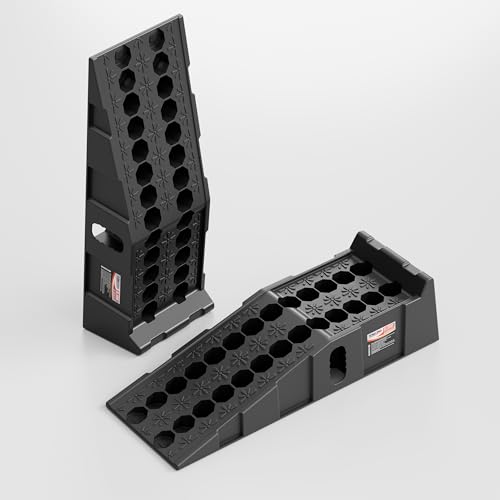
- 16,000-lb capacity per pair
- 7.1-inch maximum lift
- 13-inch-wide ramp dimensions
Best For: Wide-tire SUVs and trucks
Storage-Friendly Pick
MaxxHaul 50947 Stackable Car Ramps

- 6,500-lb capacity per pair
- 6.7-inch lift height
- Stackable design with side handles
Best For: Garages where storage and portability matter
Best Adjustable Lift

- Adjustable 9.84–14.96-inch lift range
- Heavy-duty steel construction
- Designed for cars, trucks, and SUVs
Best For: Home mechanics needing adjustable hydraulic height
Best High-Profile Option
VEVOR Portable Car Service Ramps

- 6.7-inch lift for higher vehicles
- Lightweight, stackable PP construction
- Honeycomb surface supports traction and drainage
Best For: Trucks, SUVs, and Jeeps needing portable maintenance ramps
Best Low-Profile Pick

- 2.6-inch tire-position lift
- 17-degree slope for low-chassis cars
- Lightweight pair with traction and non-slip features
Best For: Sports cars, tuners, and other low-clearance vehicles
Heavy-Duty Garage Ramps

- 16,000-pound total capacity
- 6.7-inch lift and 20-degree incline
- Traction-focused honeycomb plastic design
Best For: High-capacity maintenance on trucks, SUVs, and cars
Low-Profile Garage Ramps

- Designed for low-chassis vehicles
- 10-inch width for wider tires
- Lightweight 5.3-pound pair
Best For: Portable access for sports cars and tuners
Hydraulic Garage Ramps
Adjustable 9-to-14.3-Inch Lift

- 11,065-pound load capacity
- Dual 5-ton hydraulic pumps
- Steel ramps with automatic locks
Best For: High-lift repairs on heavier vehicles
Heavy-Duty Garage Pick – MaxxHaul 50515 6.25-Inch Car Ramps
For car ramps for home garages, the MaxxHaul 50515 offers a 6.25-inch lift and a 6,500-pound paired capacity. Its grooved plastic surface and rubber base stops are designed to help maintain tire traction and ramp stability during routine underside maintenance.
Best For: Home mechanics needing a straightforward, heavy-duty ramp set for cars and compatible vehicles.
Pros:
- Supports up to 3,250 pounds per ramp and 6,500 pounds per pair.
- Provides 6.25 inches of lift for access beneath the vehicle.
- Ribbed surface and rubber base stops help improve traction and reduce movement.
- Heavy-duty plastic construction keeps the pair relatively manageable at 20.1 pounds.
Cons:
- The 6.25-inch lift is lower than some taller ramp options.
- The manufacturer warranty is limited to 90 days.
This is a practical choice when you want dependable load support, traction-focused details, and a moderate lift without switching to heavier steel ramps.
Highest-Capacity Option – Ironton Poly Car Ramp Set
Among car ramps for home garages, the Ironton Poly Car Ramp Set stands out with a 12,000-pound capacity per pair. Its 12-inch width, non-skid tread, and rubber feet are intended to accommodate a broad range of vehicles while helping keep the ramps anchored during loading.
Best For: Owners of trucks, SUVs, vans, and other heavier vehicles who want a high-capacity poly ramp set.
Pros:
- Rated for 6,000 pounds per ramp and 12,000 pounds per pair.
- Wide 12-inch tread supports a broad range of tire widths.
- Non-skid tread pattern helps keep tires firmly positioned.
- Rubber feet help limit forward sliding, while the poly construction resists corrosion.
Cons:
- The set weighs 20.6 pounds, so it is not the lightest option listed.
- The 8.5-inch overall height may not correspond directly to the available working lift.
With the highest stated paired capacity in this roundup and a wide, traction-oriented design, the Ironton is particularly compelling for larger vehicles used in a home garage.
Wide-Tire Choice – 16,000lb Car Ramps for Oil Changes
These wide-path car ramps for home garages are designed for vehicles with larger tires, including SUVs and trucks. The polypropylene pair provides a stated 16,000-pound capacity, a 7.1-inch lift, and a textured surface intended to improve grip while driving onto the ramps.
Best For: Large SUVs and trucks with wider tires that need added clearance for oil changes or inspections.
Pros:
- Offers the highest stated capacity here at 16,000 pounds per pair.
- Provides up to 7.1 inches of lift for routine under-vehicle work.
- Wide 13-inch dimensions and an 11.1-inch path are suited to wider tires.
- A textured surface and 17-degree incline support controlled ramping.
Cons:
- Must be used only on hard, flat, level surfaces.
- The notes specifically caution against dirt, grass, gravel, and sand.
This model is a strong fit when tire width and load rating are top priorities, provided your garage offers a firm, level surface for setup.
Storage-Friendly Pick – MaxxHaul 50947 Stackable Car Ramps
MaxxHaul 50947 Lift Stackable Vehicle Car Ramp 6500 LBS Capacity Per Pair 3250 LBS Per Ramp 2 Pack
Check Price On AmazonFor car ramps for home garages where storage matters, the MaxxHaul 50947 combines a 6,500-pound paired capacity with a stackable design. Built-in side handles support portability, while the ribbed platform is intended to add traction during vehicle loading.
Best For: Home-garage users who need ramps that are easier to store and transport between jobs.
Pros:
- Supports 3,250 pounds per ramp and 6,500 pounds per pair.
- Stackable construction helps simplify storage and transportation.
- Built-in side handles make carrying the ramps easier.
- Offers a 6.7-inch lift and ribbed platform for added clearance and traction.
Cons:
- Its 6,500-pound paired capacity is lower than the Ironton and 16,000-pound options.
- The product notes do not specify a manufacturer warranty.
The 50947 is a sensible choice for compact storage and easy handling, especially for garage owners who do not need the highest load rating available.
Best Adjustable Lift – Hydraulic Car Ramps with Jack
For home garages that need substantial working height, these adjustable car ramps for home garages combine hydraulic lifting with heavy-duty steel construction. The adjustable section rises from 9.84 to 14.96 inches, making the pair suited to under-vehicle maintenance on low-profile cars, trucks, and SUVs.
Best For: Home mechanics who want adjustable hydraulic lift height for oil changes, inspections, and broader vehicle repairs.
Pros:
- Hydraulic height adjusts from 9.84 to 14.96 inches.
- Rated for up to 11,060 pounds according to the product highlights.
- Heavy-duty alloy steel construction with a painted exterior designed to resist rust.
- Suitable for cars, trucks, and SUVs in home garages or professional workshops.
Cons:
- At 83.8 pounds, this pair is considerably heavier than portable polypropylene ramps.
- The long 45.27-inch footprint requires more garage storage space.
- Hydraulic components add installation and maintenance considerations compared with simple drive-on ramps.
This is the most substantial option here for buyers prioritizing adjustable height and steel durability over portability. Confirm the ramp dimensions, vehicle clearance, and stated capacity before use.
Best High-Profile Option – VEVOR Portable Car Service Ramps
These VEVOR car ramps for home garages are designed for higher-chassis vehicles, with a 6.7-inch lift and 17-degree incline. Their impact-resistant PP construction keeps the pair lighter and stackable, while the honeycomb surface and grooved design support traction, drainage, and storage.
Best For: Truck, SUV, and Jeep owners who need portable ramps for oil changes, inspections, and routine maintenance.
Pros:
- 6.7-inch lift and 17-degree incline suit higher-chassis vehicles.
- Each ramp supports up to 4,000 pounds, with the pair rated for an 8,000-pound load in the bullet details.
- Impact-resistant PP resists weather and corrosion while keeping the ramps portable.
- Honeycombed, grooved surfaces provide traction, drainage, and stackable storage.
Cons:
- The high-profile design may not be appropriate for very low vehicles.
- Plastic PP construction may not appeal to buyers specifically seeking steel ramps.
- Capacity information varies between the title/details and bullet specifications, so verify the applicable rating before use.
Choose this set when portability and extra clearance matter more than a compact low-profile design. Its intended fit is higher-chassis vehicles, so check your approach angle and vehicle weight carefully.
Best Low-Profile Pick – HOXWELL Garage Car Ramps
For sports cars, tuners, and other low-chassis vehicles, these car ramps for home garages provide a 2.6-inch lift at the tire position and a 17-degree slope. The lightweight PP pair uses a honeycomb traction surface, drainage channels, and added bottom non-slip pads for a more secure setup during maintenance.
Best For: Owners of low-profile cars who need a lightweight ramp for jack support, inspections, repairs, or replacements.
Pros:
- Low-profile 17-degree slope is designed for low-chassis vehicles.
- Wider 10-inch design accommodates wider tires better than narrower ramps.
- Honeycomb traction, drainage features, curved sides, and bottom non-slip pads support stability.
- Each pair weighs only 5.3 pounds for easy carrying and storage.
Cons:
- The tire-position lift is only 2.6 inches, providing less clearance than taller ramps.
- PP construction may be less appealing to buyers who prefer steel.
- Its low height is less suitable when substantial under-vehicle working room is needed.
This is the practical choice for low-clearance vehicles where a taller ramp could be difficult to approach. It offers easy handling and added traction features, but buyers needing greater working height should consider a higher-lift design.
Heavy-Duty Garage Ramps – 6.7-Inch Vehicle Lifts
For shoppers comparing car ramps for home garages, this two-piece set emphasizes high capacity and a useful 6.7-inch lift. The hardened-plastic honeycomb construction, 20-degree incline, and traction features make it suited to routine maintenance and repair support for cars, SUVs, pickups, and light agricultural vehicles.
Best For: Truck, SUV, and car owners who need high-capacity ramps for oil changes, repairs, or jack support.
Pros:
- Rated for up to 16,000 pounds total, with 4,000 pounds per ramp.
- Provides a 6.7-inch lift with a 20-degree incline.
- Textured surfaces, curved grooves, bumper strips, and drainage help maintain tire grip.
- Wide 12-inch ramps accommodate a range of vehicle types.
Cons:
- The 35.6-inch length and 20-degree incline may require more approach space than low-profile ramps.
- At about 25 pounds per listed product notes, this is less convenient to move than lighter plastic ramps.
This set is a strong fit when capacity and lift matter more than minimal storage weight. Confirm the vehicle’s tire size, approach clearance, and the required working height before use.
Low-Profile Garage Ramps – 2.6-Inch Lift for Low Cars
These car ramps for home garages are designed around low-clearance vehicles, offering a modest 2.6-inch lift and a 17-degree slope. Their 10-inch width, compact footprint, and light 5.3-pound pair weight make them practical for occasional inspections, jack placement, and maintenance on sports cars and tuners.
Best For: Low-chassis cars and owners who want lightweight, portable ramps for limited-height access.
Pros:
- Low 2.6-inch lift is intended for low-profile vehicles.
- 10-inch width helps accommodate wider modified tires.
- Honeycomb PP construction, curved sides, drainage, and bottom non-slip pads support traction and stability.
- At 5.3 pounds per pair, the ramps are easy to carry and store.
Cons:
- The 2.6-inch lift may not provide enough room for every repair or maintenance task.
- Vehicle ground clearance and required working height must be checked before purchase.
This is the most portable option of the three, but its limited lift is also its defining constraint. Choose it when your vehicle is low and your work requires only modest underbody access.
Hydraulic Garage Ramps – Adjustable 9-to-14.3-Inch Lift
For buyers seeking car ramps for home garages with substantially more working height, this steel hydraulic set combines ramps and integrated lifting hardware. Two 5-ton hydraulic pumps support vehicles up to 11,065 pounds, while the adjustable 9-to-14.3-inch range can accommodate tasks from oil changes to undercarriage repairs.
Best For: Home mechanics and workshops needing adjustable, high-lift ramps for heavier vehicles and deeper underbody access.
Pros:
- Reinforced welded steel construction is designed to resist deformation and rust.
- Dual 5-ton hydraulic pumps lift vehicles up to 11,065 pounds.
- Adjustable height ranges from 9 to 14.3 inches for varied repair tasks.
- Anti-slip treads and automatic locking mechanisms support stable operation.
Cons:
- The 45-inch length and steel construction make this a larger, heavier garage solution.
- Use requires level ground, a set parking brake, and centered wheels.
- Hydraulic operation is more involved than simply driving onto fixed ramps.
This is the specialized choice for users who need adjustable height rather than simple drive-on access. Its capacity and lift range are useful for demanding repairs, provided the garage has adequate space and a level operating surface.
How We Picked the Best Car Ramps for Home Garages
We evaluated these ramps by focusing on the factors that matter during real garage maintenance: stated gross vehicle weight capacity, lift height, construction, tire-track width, traction features, portability, and storage. We also considered whether each design is better suited to cars, SUVs, trucks, agricultural equipment, or occasional emergency use.
Capacity claims should always be checked against the manufacturer’s instructions. Never exceed the ramp’s rated load, and remember that the vehicle’s weight distribution may not be perfectly even across the two ramps.
Quick Comparison
| Ramp type | Best for | Main advantage | Potential trade-off |
|---|---|---|---|
| Low-profile ramps | Cars and lowered vehicles | Easier approach angle | Less working height |
| High-capacity ramps | SUVs and trucks | Greater load margin | Bulkier storage |
| Stackable ramps | Compact garages | Space-saving storage | May provide less clearance |
| Hydraulic ramps | Adjustable-height maintenance | Flexible lift range | More moving parts and weight |
Key Buying Factors for Car Ramps for Home Garages
Weight Capacity
Choose a pair rated above your vehicle’s gross weight, not merely its curb weight. SUVs, trucks, vans, and equipment need especially careful capacity checks. A higher rating can provide useful margin, but it does not compensate for damaged ramps or an unstable surface.
Lift Height and Approach Angle
Higher ramps provide more room for access but can be harder to climb and may require a longer approach path. Low-profile ramps are often easier for sports cars and vehicles with limited ground clearance. Confirm that the ramp height is sufficient for the work you plan to do.
Traction and Stability
Look for deep grooves, textured surfaces, raised tire stops, and a broad base. Use ramps only on a flat, hard, level surface. Keep the tires centered, drive on slowly, and verify that the vehicle is fully seated before working underneath it.
Construction and Storage
Steel ramps generally offer substantial strength but may be heavy. Polymer ramps are easier to carry and resist corrosion, while stackable designs simplify storage. Check the product dimensions against your garage shelves, vehicle trunk, and available approach distance.
Safety Equipment
Ramps are not a substitute for proper precautions. Set the parking brake, place the transmission in park or in gear, chock the wheels that remain on the ground, and follow the manufacturer’s instructions. For work requiring removal of wheels or extended time underneath the vehicle, use appropriately rated jack stands as directed.
Who Should Buy Which Car Ramps for Home Garages?
Choose a low-profile model if you mainly service compact cars or a lowered vehicle. A broad, high-capacity ramp is a better fit for SUVs, pickups, and heavier equipment. Stackable ramps suit small home garages where storage space is limited. Hydraulic models make sense when adjustable clearance is more important than portability and simplicity.
For occasional oil changes, prioritize stable traction, a manageable approach angle, and easy storage. For frequent maintenance, spend more attention on build quality, load margin, corrosion resistance, and the amount of working clearance. Whichever model you choose, verify its specifications for your exact vehicle before purchase.