The best compact audio mixers give you practical control over multiple sources without taking over your desk, gig bag, or recording space.
We’ve selected 10 compact audio mixers for different needs, from simple line-level sub-mixing to USB streaming, effects, multitrack recording, and small live performances.
Best 10 Compact Audio Mixers Picks for 2026
Effects-Ready Compact Mixer

- 6 channels with 2 microphone preamps
- Four dedicated stereo line channels
- EQ and digital effects in a compact body
Best For: Small live, rehearsal, and monitoring setups
Clip-Free Recording Hub

- Records 10 tracks plus stereo to SD
- 32-bit float USB interface with simultaneous recording
- Includes effects, MIDI, and assignable sound pads
Best For: Mobile multitrack recording and podcasting
Simple Line Submixer
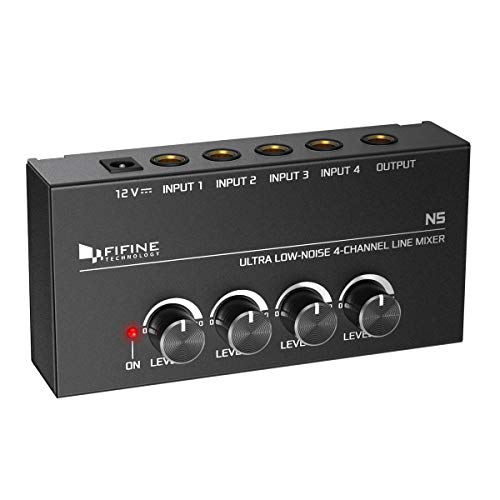
- Four independent line-level volume controls
- Stereo or four-mono operation
- Metal enclosure with low-noise operation
Best For: Keyboard rigs and straightforward line submixing
Streaming-Friendly Analog Mixer

- Eight-input analog mixing layout
- Stereo USB interface for computer or mobile use
- Mixes PC and gaming audio into streaming output
Best For: Streaming, podcasting, and home recording
Broadcast-Ready Compact Pick

- Two Onyx mic preamps with phantom power
- Four line inputs plus 1/4-inch and RCA main outs
- Lightweight 2.5-pound desktop design
Best For: Podcasts, small studios, and broadcast setups
Rugged Analog Choice

- Six analog inputs with D-PRE preamps
- Three-band EQ, high-pass filters, and one-knob compressors
- Impact-resistant powder-coated metal chassis
Best For: Small performances, lectures, and analog recording
Ultra-Compact Line Router

- Combines four line sources into one mono or stereo output
- Supports 3.5mm and 6.35mm TS/TRS connections
- Compact 5.39-by-3.14-by-1.77-inch enclosure
Best For: Sub-mixing instruments, computers, consoles, and other line sources
Simple Control Pick

- Five-channel compact design
- Phantom power and two-band EQ
- RCA inputs and outputs
Best For: Basic home, rehearsal, playback, and recording setups
Instrument-Friendly Upgrade

- Six inputs with two mic channels
- Direct HiZ instrument connections
- Three-band EQ and high-pass filters
Best For: Small musician, live, and recording setups
Ultra-Compact Sub-Mix Value

- Four independent channel controls
- Stereo/mono switching
- Compact 5V-powered design
Best For: Simple line-level sub-mixing in small spaces
Effects-Ready Compact Mixer – Yamaha MG06X
The Yamaha MG06X is a straightforward choice among compact audio mixers when you need microphone inputs, stereo line channels, EQ, and built-in digital effects in a small analog format. Its 6-channel layout and XLR output suit simple live, rehearsal, and monitoring setups.
Best For: Small performances, rehearsals, vocal-and-instrument mixes, and users who want onboard effects without a larger console.
Pros:
- Six-channel analog design with two microphone preamps.
- Four dedicated stereo line channels accommodate keyboards and other stereo sources.
- Includes EQ and digital effects in a compact 5.9-by-7.9-by-2.4-inch enclosure.
Cons:
- It does not offer the multitrack recording features found on recorder-style mixers.
- The supplied notes identify USB connectivity but do not specify a recording workflow or software support.
The MG06X focuses on familiar analog controls and essential effects rather than extensive routing. It is a practical fit for buyers who want a compact, conventional mixer for a small system.
Clip-Free Recording Hub – Zoom LiveTrak L6
The Zoom LiveTrak L6 stands out among compact audio mixers for musicians and podcasters who want mixing plus recording in one portable unit. It records 10 discrete tracks and a stereo mix to SD cards while also working as a 32-bit float USB audio interface.
Best For: Musicians, podcasters, streamers, and mobile recording setups that need multitrack capture, computer connectivity, and flexible channel processing.
Pros:
- Records 10 tracks plus a stereo mix to SD cards up to 1TB.
- Supports simultaneous SD-card and computer recording with 32-bit float audio.
- Provides EQ, AUX sends, pan, effects, MIDI, USB, and four assignable sound pads.
- Compact 8.78-by-4.49-by-1.83-inch design with battery power.
Cons:
- Its broader recording and routing feature set may be more than a basic line-mixing setup requires.
- The unit has only two combo inputs plus four stereo inputs, according to the supplied highlights.
The LiveTrak L6 is the most recording-focused option here. Choose it when clip-free capture, SD recording, and computer integration matter as much as live mixing.
Simple Line Submixer – FIFINE N5
The FIFINE N5 is a highly compact option among compact audio mixers for combining four line-level sources with minimal controls. Its independent volume knobs, metal enclosure, and stereo or mono operation make it useful for keyboards, small setups, and basic submixing.
Best For: Keyboard rigs, four-source line mixing, small-stage monitoring, and routing several instruments into one output.
Pros:
- Four-channel line mixer with separate volume control for each input.
- Supports stereo operation or mixing four mono inputs to one mono output.
- Heavy-duty metal enclosure with a small footprint and low-profile controls.
- Designed for low-noise operation with a supplied AC adapter.
Cons:
- TRS/TS cables are not included.
- It is intended for line-level sources and lacks the microphone preamp, EQ, and effects found on larger mixers.
- Output connectivity is limited to 1/4-inch TRS.
The N5 keeps the job simple: set four channel levels and send the combined signal onward. It is a sensible low-clutter choice for submixing, but not a replacement for a full-featured console.
Streaming-Friendly Analog Mixer – Behringer XENYX 802S
Behringer XENYX 802S Premium Analog 8-Input Mixer with USB Streaming Interface
Check Price On AmazonThe Behringer XENYX 802S combines an 8-input analog mixer with a stereo USB audio interface, making it one of the more practical compact audio mixers for streaming, podcasting, and recording. It also allows direct mixing of computer or gaming audio into the streaming output.
Best For: Streamers, podcasters, and home recording users who need analog mixing plus computer or mobile-device connectivity.
Pros:
- Eight-input analog layout provides more source capacity than smaller mixers.
- Stereo USB interface connects to a computer or mobile device.
- Supports direct mixing of PC or gaming audio into the streaming output.
- Designed for low-noise streaming, podcasting, and recording.
Cons:
- The supplied dimensions list a 19.69-by-19.69-by-11.02-inch package, so verify available desk space.
- The notes do not specify onboard effects or detailed channel-by-channel features.
The 802S is a versatile middle ground for content creators who need both analog source control and USB integration. It offers more inputs than mini line mixers while remaining focused on practical streaming workflows.
Broadcast-Ready Compact Pick – Mackie 402VLZ4
The Mackie 402VLZ4 is one of the more practical compact audio mixers for podcasts, small studios, and broadcast setups. Its two Onyx mic preamps, phantom power, and flexible main outputs keep the desktop design useful without adding much weight.
Best For: Podcasts, small recording setups, and broadcast applications needing two microphone inputs.
Pros:
- Two Onyx mic preamps with phantom power.
- Four line inputs supplement the two microphone inputs.
- Provides 1/4-inch and RCA main outputs.
- Lightweight 2.5-pound desktop design.
Cons:
- Uses an external power adapter rather than a built-in power cord socket.
- Offers four channels, which may be limiting for larger setups.
The 402VLZ4 is a focused choice when clean microphone inputs and a small footprint matter more than extensive channel capacity or built-in digital connectivity.
Rugged Analog Choice – Yamaha MG06
The Yamaha MG06 is a straightforward option among compact audio mixers when you want six analog inputs and hands-on tone control. Its D-PRE preamps, three-band EQ, high-pass filters, and one-knob compressors support recording, lectures, and small performances.
Best For: Analog mixing for small performances, lectures, recording, and guitar or vocal setups.
Pros:
- Six-input layout provides more capacity than a four-channel mixer.
- Studio-grade D-PRE preamps use a discrete Class A design.
- Three-band EQ and high-pass filters help shape and clean up signals.
- Rugged powder-coated metal chassis is impact resistant.
Cons:
- No USB connectivity for direct computer integration.
- Its analog design may require additional equipment for computer recording.
The MG06 makes sense for buyers who value durable construction and accessible analog controls, especially when six inputs are more useful than USB features.
Ultra-Compact Line Router – LZSIG Mini Audio Mixer
The LZSIG Mini Audio Mixer is designed for simple source combining rather than microphone mixing. This compact audio mixer accepts up to four line-level sources, supports 1/8-inch and 1/4-inch connections, and switches between mono and stereo output modes.
Best For: Combining instruments, computers, CD players, gaming consoles, or other line-level sources into one output.
Pros:
- Four inputs combine into a single mono or stereo output.
- Accepts both 3.5mm and 6.35mm TS/TRS cables.
- Extremely small 5.39-by-3.14-by-1.77-inch design.
- Uses a 5V DC power approach and includes a USB-C cable.
Cons:
- Power adapter is sold separately.
- Line mixer design is not intended for microphone preamp use.
- Limited to four inputs and one combined output.
This LZSIG model is best viewed as a compact routing tool for line-level sources. Its small footprint and dual connector support are useful, but buyers should plan for a compatible power supply.
Simple Control Pick – Mackie Mix5
The Mackie Mix5 is a straightforward option among compact audio mixers for small playback, recording, or basic microphone setups. It combines one mic/line input, two stereo 1/4-inch line inputs, RCA connectivity, and a compact 1.4-pound design.
Best For: Small home, rehearsal, playback, and recording setups that need simple analog mixing.
Pros:
- Five-channel layout with two stereo 1/4-inch line inputs.
- Mic/line input includes phantom power for studio condenser microphones.
- Two-band EQ provides clean, simple tone shaping.
- Dedicated stereo RCA inputs and outputs support playback or recording.
Cons:
- Only one mic/line input is provided.
- Two-band EQ offers less control than a three-band design.
The Mix5 favors uncomplicated operation and familiar connections over extensive channel processing. It is a practical fit when a small mixer with basic EQ, phantom power, and RCA support is all you need.
Instrument-Friendly Upgrade – Allen & Heath ZED-6
The Allen & Heath ZED-6 stands out among compact audio mixers when microphone quality, instrument connections, and hands-on tone shaping matter. Its six-input layout includes two mic channels, two line/instrument inputs, and two stereo inputs.
Best For: Musicians and small live or recording setups using microphones, guitars, basses, keyboards, and stereo sources.
Pros:
- Two GS-Pre XLR microphone preamps are designed for low noise and high headroom.
- Two HiZ connections allow direct connection of electric or acoustic-electric instruments without a separate DI box.
- Every mono input includes a 100Hz high-pass filter and three-band MusiQ EQ.
- Neutrik XLR sockets and a 60mm main fader support durable, hands-on control.
Cons:
- At 2.8 pounds, it is heavier than the Mackie Mix5.
- The supplied layout has only two stereo inputs and six total channels.
The ZED-6 offers the most detailed input and tone-control package in this group. Its HiZ inputs and three-band EQ make it especially compelling for instrument-focused setups that still need a compact footprint.
Ultra-Compact Sub-Mix Value – Moukey MAMX1 Mini Mixer
The Moukey MAMX1 is one of the most compact audio mixers for combining four line-level sources into a single output. Its independent channel volume controls, 5V power design, and stereo/mono switching suit keyboards, guitars, basses, drum setups, and other simple sub-mixing tasks.
Best For: Small clubs, bars, keyboard rigs, and quick four-source line-level sub-mixes.
Pros:
- Four channels with independent volume controls.
- Stereo or mono operation supports different routing needs.
- Compact 4.37-by-6.18-by-1.97-inch design is easy to place in tight spaces.
- Designed for low-noise, straightforward mixing of line-level signals.
Cons:
- It is intended for line-level mixing rather than microphone preamp use.
- TRS/TS cables are not included.
- The external 5V power supply should have CE or UL certification and be kept away from interference sources.
The MAMX1 keeps the controls and footprint minimal, making it useful as a dedicated sub-mixer rather than a full-featured console. Choose it when compact size and simple four-source routing matter more than EQ or microphone features.
How We Picked the Best Compact Audio Mixers
We focused on mixers that balance useful connectivity, manageable size, dependable operation, and value. The selection includes analog and USB-enabled models, options with built-in effects, and compact units designed for recording, streaming, rehearsals, or live sound.
We also considered channel count, input flexibility, preamp quality, noise performance, monitoring features, power requirements, and how easily each mixer fits a realistic desktop or portable setup. Because no single mixer suits every user, the list covers both straightforward entry-level designs and more capable recording-focused systems.
Quick Comparison
| Best For | What to Look For |
|---|---|
| Basic sub-mixing | Several stereo line inputs, low noise, simple level controls |
| Home recording | Quality preamps, phantom power, useful monitoring outputs |
| Streaming and podcasting | USB connectivity, direct monitoring, flexible routing |
| Live performance | Rugged construction, clear metering, effects, and accessible controls |
| Multitrack production | Recording functions, independent channels, and reliable file handling |
Key Buying Factors for Compact Audio Mixers
Inputs and Channel Capacity
Count the sources you need today, then leave room for expansion. Microphones usually require XLR inputs and preamps, while keyboards, phones, drum machines, and other devices often use stereo line inputs. Remember that a stereo channel may count as two inputs but offers less independent control than two mono channels.
USB, Recording, and Routing
If you plan to stream or record directly to a computer, choose a model with a USB interface and confirm whether it supports the routing you need. Basic USB mixers may send only a stereo mix, while dedicated mixer-recorders can provide more flexible multitrack workflows. Direct monitoring is valuable for reducing latency.
Features and Sound Control
Look for phantom power if you use condenser microphones, and check whether it is global or individually switchable. Built-in effects can simplify vocals and live presentations, while three-band EQ helps shape sources. A low-noise design matters especially when combining quiet instruments or feeding sensitive recording equipment.
Size, Power, and Build
Compact mixers vary in portability. Some run from standard power adapters, while USB or 5V-powered models may be easier to use with a laptop or portable battery. Metal chassis construction is generally preferable for frequent transport, but a lightweight plastic unit can be perfectly suitable for a fixed desktop setup.
Who Should Buy Which Compact Audio Mixers?
Choose a simple four- or five-channel line mixer if you mainly need to combine keyboards, media players, or other stereo sources. These are affordable and easy to operate, but they are not the best choice for multiple microphones.
For singers, small bands, and home recording, a compact analog mixer with microphone preamps, phantom power, and balanced outputs offers a strong balance of control and portability. Models with onboard effects are particularly useful for small performances and vocal applications.
Streamers and podcasters should prioritize USB connectivity, monitoring, and straightforward computer routing over maximum channel count. If recording live rehearsals or producing music is the priority, consider a mixer-recorder with more advanced channel and file-management features.
Finally, buyers running small venues or frequent gigs should favor sturdy construction, clear controls, dependable power, and enough spare inputs for last-minute additions. The best Compact Audio Mixers are the ones that match your sources and workflow without forcing you to pay for features you will not use.