The best headphone amplifiers with optical input make it easier to connect modern TVs, computers, game consoles, and other digital sources to wired headphones or powered speakers. They can also add useful controls such as volume adjustment, Bluetooth, bass and treble tuning, or microphone support.
This roundup includes compact desktop DAC/amps alongside multifunction stereo receivers. Use the buying guide below to match the right type of amplifier to your headphones, listening setup, and available connections.
Best 10 Headphone Amplifiers with Optical Input Picks for 2026
Best Entry-Level DAC

- USB, optical, and coaxial inputs
- Drives 16Ω–200Ω headphones
- Bass/treble controls and dual outputs
Best For: Compact desktop and TV audio upgrades
Best Desktop Controls

- Optical, coaxial, and USB inputs
- Bass and treble rotary controls
- 160mW RMS output at 32Ω
Best For: Desktop listening, gaming, and active speakers
Best Full-Size Receiver
Pyle PDA99BU Wireless Streaming Amplifier
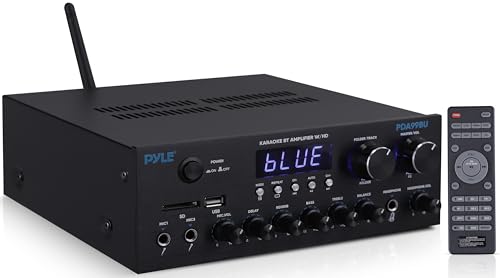
- 24-bit optical and coaxial decoding
- Independent headphone volume control
- HDMI, Bluetooth, USB, SD, FM, AUX, and RCA inputs
Best For: Flexible home theater and speaker systems with private listening
Best Desktop DAC Amp
Fosi Audio K5 Pro Gaming Headphone Amp
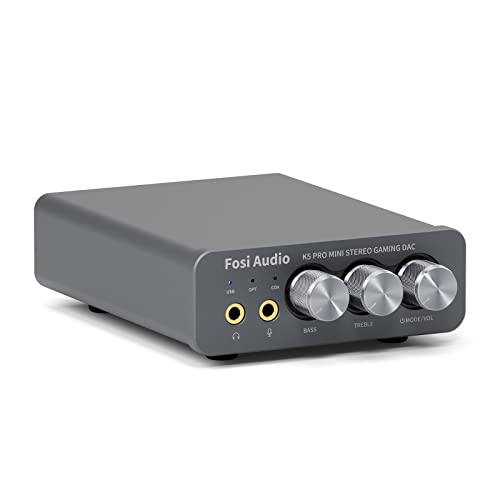
- Optical and coaxial support up to 24-bit/192kHz
- Drives 16–300 ohm headphones
- Bass, treble, microphone, AUX, and RCA connections
Best For: Desktop gaming, computer audio, and versatile headphone listening
Best Speaker System Value
Romicta BT-398A Stereo Amplifier

- Optical and coaxial inputs with broad source support
- Works with passive speakers and active subwoofers
- Includes Bluetooth 5.0, FM radio, tone controls, and remote
Best For: Compact speaker systems needing optical connectivity and flexible inputs
Compact Connectivity Pick
BT-398A Optical-Input Amplifier

- Optical, coaxial, RCA, Bluetooth, USB, and SD inputs
- 60W x2 RMS output with bass and treble controls
- Compact design with remote and LED display
Best For: Small-room audio systems needing flexible source connections
Headphone-Ready Tube Option
Fosi Audio MC331 Optical Tube Amp
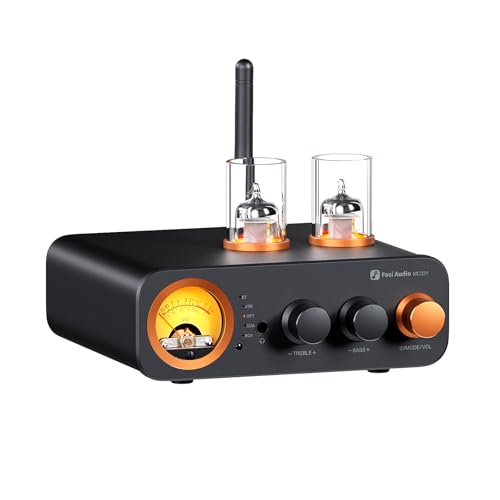
- Integrated DAC and dedicated headphone amplifier
- Optical, USB, coaxial, RCA, and Bluetooth inputs
- 3.5mm headphone output plus replaceable tubes
Best For: Desktop listeners building a flexible headphone-and-speaker system
Karaoke and Subwoofer Choice
Romica AK55 Optical-Input Amplifier

- Optical, coaxial, Bluetooth, RCA, AUX, USB, and SD inputs
- Supports passive speakers and active subwoofers
- Adds microphone input, FM radio, remote, and tone controls
Best For: Karaoke and home theater systems with broad connectivity needs
Best Entry-Level DAC – Fosi Audio Q4
The Fosi Audio Q4 is a practical choice among headphone amplifiers with optical input for desktop, TV, and home stereo use. It accepts USB, optical, and coaxial sources, drives headphones rated from 16Ω to 200Ω, and adds convenient bass and treble controls.
Best For: Buyers seeking a compact, plug-and-play DAC and headphone amp with flexible digital inputs and adjustable sound.
Pros:
- Supports USB, optical, and coaxial inputs.
- Drives headphones from 16Ω to 200Ω.
- Includes bass and treble controls, RCA and 3.5mm outputs.
- Compact metal housing and 24-bit/192kHz support.
Cons:
- No microphone input.
- Requires a 5V power supply.
The Q4 stands out for straightforward setup and broad connectivity in a small enclosure. It is a sensible entry-level option when you want optical headphone amplification plus speaker or amplifier connectivity.
Best Desktop Controls – AIYIMA DAC-A2
The AIYIMA DAC-A2 combines a desktop DAC and headphone amplifier for computers, Macs, TVs, and gaming setups. As one of the more versatile headphone amplifiers with optical input, it converts optical, coaxial, or USB audio to RCA or 3.5mm analog output without requiring drivers.
Best For: Desktop listeners and gamers who want plug-and-play digital conversion, front-panel tone controls, and support for headphones from 16Ω to 200Ω.
Pros:
- Accepts optical, coaxial, and USB digital audio.
- Outputs through RCA or 3.5mm connections.
- Provides independent bass and treble controls.
- Supports up to 24-bit/192kHz audio and delivers 160mW RMS at 32Ω.
Cons:
- Requires a compatible 5V power setup.
- Product details describe the chassis material inconsistently.
With tactile tone controls and multiple digital inputs, the DAC-A2 is designed for convenient desktop integration. Its stated output suits a broad range of everyday headphones, while the RCA output also supports active speaker systems.
Best Speaker Power – MOREGAX M19 BT Amplifier
The MOREGAX M19 BT is primarily a two-channel speaker amplifier, but its optical and coaxial inputs make it a broader option than typical headphone amplifiers with optical input. It also includes a 3.5mm headphone output, Bluetooth 5.3, RCA connectivity, bass and treble controls, and a microphone input.
Best For: Home audio users who need optical connectivity, powerful passive-speaker amplification, and occasional headphone listening from one compact receiver.
Pros:
- Offers optical, coaxial, RCA, Bluetooth, and AUX inputs.
- Includes a 3.5mm headphone output and 6.5mm microphone jack.
- Rated for up to 100W × 2 output under specified conditions.
- Includes remote control and bass/treble adjustment.
Cons:
- Designed mainly for passive speakers rather than dedicated headphone use.
- Active and passive speakers cannot play simultaneously.
- Full rated power requires a separately specified 24V/10A adapter; the package includes a 24V/5A adapter.
The M19 BT makes sense when headphone output is only one part of a larger stereo system. Choose it over a dedicated headphone amp if you also need substantial passive-speaker power and remote-controlled source flexibility.
Best Simple Optical Adapter – eSynic Optical DAC Converter
The eSynic adapter is a focused solution for adding 3.5mm headphone or speaker output to a TV, Blu-ray player, or gaming console. Unlike full-featured headphone amplifiers with optical input, it performs one-way optical-to-3.5mm conversion and supports PCM audio up to 24-bit/192kHz.
Best For: Late-night TV viewing, gaming, and connecting optical sources to 3.5mm headphones, analog speakers, or a wireless headphone transmitter.
Pros:
- Simple optical-to-3.5mm plug-and-play setup.
- Supports 24-bit/192kHz PCM audio.
- Includes a 7-foot cable and metal housing.
- Works with TVs, consoles, Blu-ray players, and analog stereo systems.
Cons:
- Supports PCM 2.0 only, not Dolby or DTS.
- Unidirectional and lacks RCA output.
- Requires a 5V/1A USB power adapter, which is not included.
This eSynic model is best viewed as a straightforward converter rather than a full desktop amplifier. It is useful when your source provides PCM optical audio and you need a basic fixed 3.5mm connection, but volume must be adjusted on the connected equipment.
Best Full-Size Receiver – Pyle PDA99BU Wireless Streaming Amplifier
For shoppers comparing headphone amplifiers with optical input, the Pyle PDA99BU stands out as a versatile home receiver with 24-bit optical and coaxial decoding, a dedicated headphone output, and extensive source support. Its front-panel headphone volume control makes switching to private listening convenient, while the receiver also handles speakers, Bluetooth, HDMI, USB, SD, FM, AUX, and RCA sources.
Best For: Home theaters and flexible entertainment systems that need headphone listening alongside speaker playback.
Pros:
- Optical and coaxial inputs support 24-bit digital decoding.
- Dedicated headphone output has independent volume control.
- Supports Bluetooth, HDMI, USB, SD, FM, AUX, RCA, and dual microphone inputs.
- Metal chassis and compact design suit shelf or entertainment-unit installation.
Cons:
- Its receiver-style design is larger and less headphone-focused than a compact desktop DAC amp.
- The listed power figures vary between peak, rated, and output specifications, so buyers should review their system requirements carefully.
The PDA99BU is a strong choice when optical headphone connectivity is only one part of a broader home-audio setup. Choose it for input flexibility and receiver functionality rather than a minimalist headphone-only system.
Best Desktop DAC Amp – Fosi Audio K5 Pro Gaming Headphone Amp
The Fosi Audio K5 Pro is a focused option for shoppers seeking headphone amplifiers with optical input for gaming, computers, and desktop listening. It converts USB-C, optical, or coaxial signals to 3.5mm AUX and RCA, supports headphones from 16 to 300 ohms, and adds bass, treble, microphone, and master-volume controls.
Best For: Desktop gaming and headphone setups using PS5, PC, Mac, active speakers, or multiple digital inputs.
Pros:
- Optical and coaxial inputs support up to 24-bit/192kHz sampling.
- Provides up to 1000mW at 16 ohms and supports headphones from 16 to 300 ohms.
- Includes 3.5mm headphone, microphone, AUX, and RCA connections.
- Includes an optical cable and USB-A/C-to-USB-C cable.
Cons:
- The USB audio source must connect through the USB-A/C port.
- It is designed primarily for desktop and gaming use, rather than powering passive speakers directly.
With optical, coaxial, and USB-C connectivity in a compact DAC/headphone amplifier format, the K5 Pro is the most purpose-built choice here for personal listening. Its adjustable tone controls and microphone input add practical value for gaming and desk-based use.
Best Speaker System Value – Romicta BT-398A Stereo Amplifier
The Romicta BT-398A is a compact stereo receiver for shoppers considering headphone amplifiers with optical input as part of a broader speaker system. It includes optical and coaxial inputs, Bluetooth 5.0, RCA, AUX, USB, and microphone connectivity, while its controls support bass, treble, and overall volume adjustment.
Best For: Small-room home audio systems that prioritize passive speakers, an active subwoofer, Bluetooth streaming, and multiple source inputs.
Pros:
- Offers optical and coaxial digital inputs alongside Bluetooth, RCA, AUX, USB, and microphone inputs.
- Supports passive speakers and active subwoofers.
- Includes bass, treble, volume controls, FM radio, and a remote.
- Compact design fits bookshelves, offices, bedrooms, and A/V cabinets.
Cons:
- The supplied notes do not identify a dedicated headphone output, so it is not as headphone-focused as the Fosi Audio model.
- Bluetooth range guidance is limited to about 30 feet without walls.
- The listed warranty is only 30 days.
The BT-398A makes sense when optical input is needed alongside substantial speaker-system functionality. However, buyers specifically seeking a headphone amplifier should verify the intended headphone connection, since the supplied specifications emphasize speaker, subwoofer, and line-level outputs.
Compact Connectivity Pick – BT-398A Optical-Input Amplifier
The BT-398A is a practical choice for shoppers comparing headphone amplifiers with optical input and wanting a compact stereo receiver with broad source support. It accepts optical, coaxial, RCA, Bluetooth, USB, and SD inputs, while its front-panel controls and included remote keep operation straightforward.
Best For: Small-room home audio, TV systems, karaoke, and users who want many input options in a compact amplifier.
Pros:
- Includes optical and coaxial inputs alongside RCA, Bluetooth, USB, and SD connectivity.
- Bluetooth 5.0 provides a stated connection range of up to 30 feet/10 meters.
- Offers 60W x2 RMS output, bass and treble controls, a remote, and an LED display.
Cons:
- The supplied details do not specify a dedicated headphone output.
- USB flash-drive support is limited to 64GB.
The BT-398A makes the most sense when versatile inputs and a small footprint matter more than specialized headphone features. Confirm your headphone connection needs before choosing it as a headphone-focused setup.
Headphone-Ready Tube Option – Fosi Audio MC331 Optical Tube Amp
The Fosi Audio MC331 is a strong fit for shoppers seeking headphone amplifiers with optical input in an all-in-one desktop component. It combines a DAC, amplifier, preamplifier, and headphone amplifier, with optical, USB, coaxial, RCA, and Bluetooth inputs for flexible system building.
Best For: Desktop listeners who want a dedicated 3.5mm headphone output plus speaker amplification and tube-inspired styling.
Pros:
- Integrates a DAC, amplifier, preamplifier, and headphone amplifier.
- Provides optical, USB, coaxial, RCA, and Bluetooth inputs.
- Includes a 3.5mm headphone output, remote control, replaceable tubes, and a pre-out.
- Compact design delivers up to 105W x2 at 4 ohms for bookshelf speakers.
Cons:
- Its tube components and VU meter may not suit listeners seeking a minimalist solid-state design.
- The listed headphone connection is 3.5mm, with no other headphone connector specified.
Among these options, the MC331 is the most directly aligned with headphone listening because it explicitly includes a headphone amplifier and output. It is also a versatile choice if you want one compact unit to handle headphones, speakers, and multiple digital sources.
Karaoke and Subwoofer Choice – Romica AK55 Optical-Input Amplifier
The Romica AK55 suits shoppers comparing headphone amplifiers with optical input who also need a full-featured two-channel home audio receiver. Its optical and coaxial inputs are joined by Bluetooth, RCA, AUX, USB, SD, and microphone connections, with support for passive speakers and an active subwoofer.
Best For: Home karaoke, TV audio, small-room theater systems, and setups requiring microphone input or active-subwoofer support.
Pros:
- Offers optical and coaxial inputs plus Bluetooth, RCA, AUX, USB, SD, and microphone connections.
- Supports both passive speakers and active subwoofers.
- Includes bass, treble, and volume controls, remote operation, and FM radio.
- Rated at 50W x2, with a stated peak output of 500W x2.
Cons:
- The supplied details do not list a dedicated headphone output.
- The stated Bluetooth range is dependent on distance and obstructions.
- Its karaoke-focused features may be more than needed for simple headphone listening.
The AK55 is better viewed as a versatile home audio amplifier than a headphone-specific unit. Choose it when optical connectivity is part of a broader system that benefits from microphone input, FM radio, and active-subwoofer compatibility.
How We Picked These Headphone Amplifiers with Optical Input
We focused on models that accept optical digital audio and provide a practical way to drive headphones, powered speakers, passive speakers, or a combination of them. The selection covers compact DAC/headphone amps for desks, portable optical converters, gaming-oriented units, tube-equipped amplifiers, and full stereo receivers.
We also considered connection flexibility, including USB, RCA, coaxial, Bluetooth, 3.5mm, microphone, USB media, and speaker outputs where applicable. Because power ratings and feature sets vary widely, the best choice depends on the equipment you already own rather than on the largest advertised wattage.
Quick Comparison
- For a compact desktop setup: Look first at the Fosi Audio Q4, AIYIMA DAC-A2, or Fosi Audio K5 Pro.
- For optical-to-aux conversion: The eSynic adapter is designed for simple digital-to-analog headphone or powered-speaker connections.
- For passive speakers and headphones: Consider a stereo receiver such as the M19, Romica, BT-398A, or Romica AK55.
- For a tube-style system: The Fosi Audio MC331 combines a tube amplifier design with digital conversion and headphone connectivity.
- For broader home-audio features: The Pyle and Romica receivers add multiple inputs and media-playback functions.
Key Buying Factors for Headphone Amplifiers with Optical Input
Optical Compatibility
Confirm that your TV or source provides a Toslink optical output and that the amplifier accepts the same signal format. Many optical inputs support standard PCM stereo, while surround formats such as Dolby Digital may require conversion or an appropriate output setting on the source. If you hear no sound, set the TV or console audio output to PCM or stereo.
Headphone Output and Power
Check the connector type—typically 3.5mm or 6.35mm—and make sure the amplifier can drive your headphones. Efficient headphones need less power, while high-impedance or less-sensitive models benefit from a stronger dedicated headphone stage. A high wattage figure for speaker output does not automatically indicate strong headphone performance.
Inputs, Outputs, and System Type
Choose a DAC/headphone amp if you mainly use headphones or powered speakers. Choose a stereo receiver if you need to run passive bookshelf speakers. Review whether the unit includes preamp or line outputs, speaker terminals, Bluetooth, USB, coaxial, microphone, or media-card support before buying.
Controls and Everyday Usability
Front-panel volume control, input selection, tone controls, remote control, display visibility, and automatic standby can matter more than extra power in a desktop or living-room setup. Also check dimensions and power requirements so the amplifier fits your available space.
Who Should Buy Which Headphone Amplifiers with Optical Input?
Desktop listeners and PC gamers should favor a compact DAC/headphone amp with USB and optical support. TV viewers need a model with straightforward optical input, a convenient volume control, and compatibility with their headphones or powered speakers. Passive-speaker owners should select a receiver with suitable speaker outputs and enough clean power for the room. Listeners building a flexible stereo system may prefer a receiver with Bluetooth, RCA, coaxial, USB, and microphone inputs. Finally, buyers seeking a particular sound or appearance can consider a tube-equipped model, but should still prioritize connection compatibility, headphone support, and reliable controls.