Traveling musicians need MIDI connectivity that is compact, dependable, and easy to integrate with laptops, keyboards, controllers, and hardware instruments. The right interface can simplify a mobile rig without sacrificing the ports or routing flexibility you actually use.
We selected 10 options spanning USB MIDI adapters, audio/MIDI interfaces, MIDI hosts, wireless routing, and multi-output thru boxes. Use the guide below to match your setup, connection needs, and budget with the most practical choice.
Best 10 Midi Interfaces for Traveling Musicians Picks for 2026
Best All-Around Pick
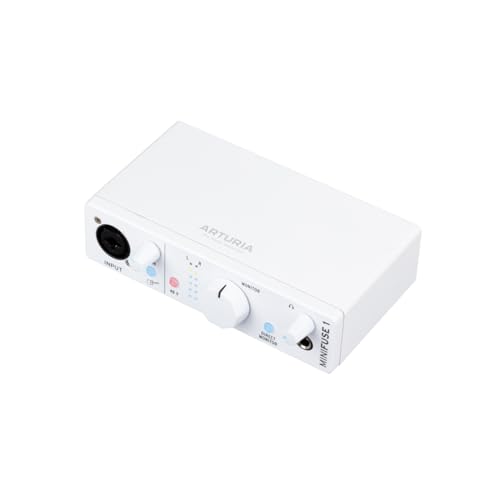
- Compact audio interface with 5-pin MIDI I/O
- Mic, instrument, and line recording support
- Five-year warranty and bundled software
Best For: Mobile musicians recording audio and MIDI
Best Wireless MIDI Router

- Combines Bluetooth and 5-pin MIDI
- Connects up to 10 MIDI devices
- Supports clock, SysEx, MPE, and timecode
Best For: Traveling performers with hybrid MIDI rigs
Best Budget Audio Option
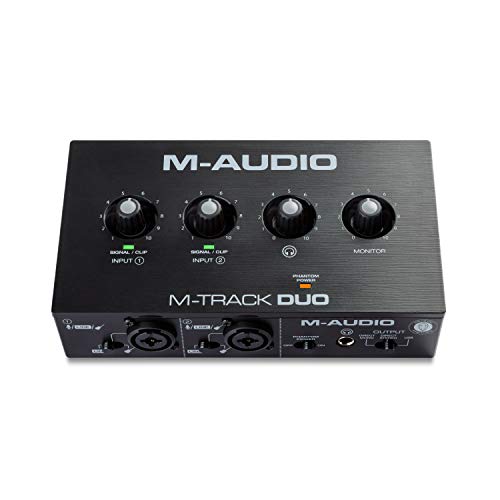
- Two combo inputs for mic, line, and instrument sources
- Zero-latency USB/direct monitoring
- Works with computers and mobile devices
Best For: Affordable two-channel mobile recording
Best USB MIDI Host

- Connects USB MIDI gear to 5-pin hardware
- Supports routing, filtering, mapping, and presets
- Works across major desktop and mobile operating systems
Best For: Compact hybrid hardware MIDI setups
Road-Ready Recording Hub
Behringer UMC404HD 4x4 Interface

- 4x4 USB audio with MIDI I/O
- Four Midas preamps with phantom power
- Metal chassis and 192 kHz support
Best For: Mobile recording rigs needing multiple inputs and MIDI hardware integration
Lightweight MIDI Link
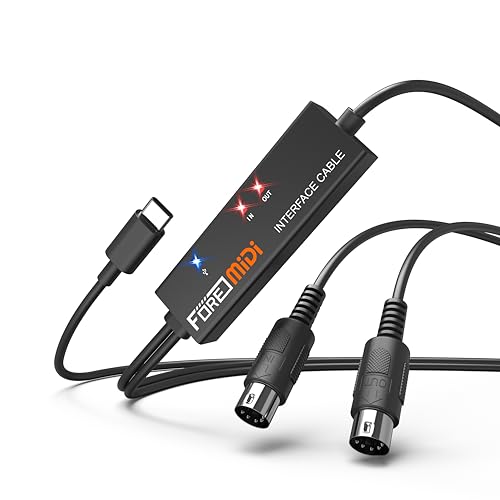
- One-in/one-out five-pin MIDI connectivity
- USB bus-powered and plug-and-play
- Works with USB-C phones, tablets, and computers
Best For: Travel MIDI connections without audio-interface features
Compact MIDI Connectivity
Midiplus 2x2 USB MIDI Interface

- 2 MIDI inputs and 2 MIDI outputs
- USB powered with no external adapter
- Mac and Windows compatible without a driver
Best For: Lightweight computer-based MIDI setups
Portable MIDI Distribution
MIDI Thru 6 Box USB MIDI Interface
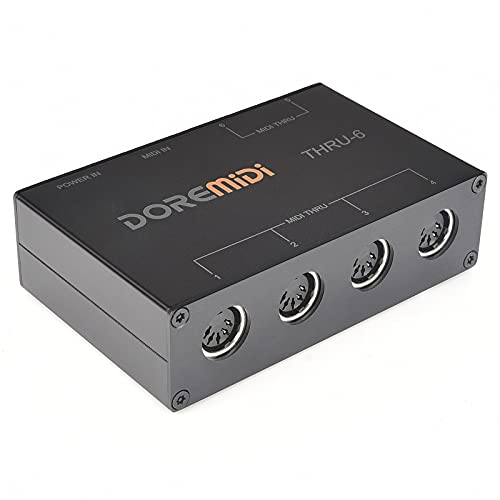
- One MIDI input with six MIDI outputs
- USB-powered 5V operation
- Supports Windows, macOS, and Linux
Best For: Sending one MIDI source to multiple devices
Mobile Audio and MIDI Recording
Mackie Onyx Producer 2X2 USB MIDI Audio Interface

- 2-in/2-out USB audio plus MIDI I/O
- Bus powered for mobile recording
- Mic, line, and Hi-Z inputs with direct monitoring
Best For: Traveling musicians recording audio and MIDI
Best All-Around Pick – Arturia MiniFuse 1
For musicians looking for midi interfaces for traveling musicians, the Arturia MiniFuse 1 combines a compact footprint with audio recording and traditional 5-pin MIDI connectivity. Its plug-and-play workflow, balanced outputs, headphone control, and USB hub make it practical for mobile songwriting and production.
Best For: Traveling guitarists, vocalists, synth players, and creators who want one compact interface for audio and MIDI.
Pros:
- Compact 14.4-ounce design with 5-pin MIDI input and output
- Combo mic/instrument/line input with 48V phantom power
- Includes Ableton Live Lite, Analog Lab Intro, effects, and other creative software
- Backed by a five-year warranty
Cons:
- Only one main input channel is listed
- USB hub provides 250mA, which may limit bus-powered accessories
The MiniFuse 1 is a strong choice when portability, audio quality, and conventional MIDI connections matter more than having multiple simultaneous recording inputs.
Best Wireless MIDI Router – CME WIDI Thru6 BT
The CME WIDI Thru6 BT is a specialized option among midi interfaces for traveling musicians, letting you combine standard 5-pin MIDI cables with Bluetooth MIDI connections. Its small enclosure can distribute MIDI to multiple devices while supporting phones, tablets, computers, and compatible wireless controllers.
Best For: Performers and producers who need flexible wired-and-wireless MIDI routing in a compact travel setup.
Pros:
- Supports wired 5-pin DIN and Bluetooth MIDI connections
- Can connect up to 10 MIDI devices simultaneously
- Handles MIDI channels, clock, SysEx, MPE, and MIDI timecode
- Weighs about 96 grams and measures roughly 2.56 by 3.29 by 1.32 inches
Cons:
- USB-C is for power only, not data
- Windows compatibility requires the Korg BLE MIDI driver
- It is a MIDI-only device rather than an audio interface
Choose the WIDI Thru6 BT when wireless flexibility and multi-device MIDI distribution are your priorities. It is less suitable if you also need microphone or instrument recording.
Best Budget Audio Option – M-Audio M-Track Duo
The M-Audio M-Track Duo is a practical choice for midi interfaces for traveling musicians who need audio recording alongside keyboard or controller work. Its two combo inputs, headphone output, direct monitoring, and bundled MPC Beats software support recording, podcasting, and streaming from a laptop.
Best For: Budget-conscious mobile musicians who need two-input audio recording and straightforward monitoring.
Pros:
- Two combo XLR/line/instrument inputs with phantom power
- USB/direct switch enables zero-latency monitoring
- Compatible with Windows, macOS, iOS, and Android
- Includes MPC Beats and Ableton Live Lite
Cons:
- Maximum sample rate is 48 kHz
- It is larger and heavier than the MiniFuse 1
- The supplied specifications do not list dedicated 5-pin MIDI ports
The M-Track Duo makes sense for travelers who prioritize two-channel audio capture and broad device compatibility. Verify your MIDI connection needs before choosing it as the center of a hardware MIDI rig.
Best USB MIDI Host – CME H2MIDI Pro
For travelers building hybrid hardware setups, the CME H2MIDI Pro stands out among midi interfaces for traveling musicians because it connects USB MIDI gear directly to traditional 5-pin DIN hardware without requiring a computer. It also works as a USB-C computer interface and supports routing, filtering, mapping, and presets.
Best For: Guitarists, producers, and performers combining USB controllers, synths, pedals, and legacy MIDI hardware on the road.
Pros:
- Standalone USB host connects class-compliant MIDI devices without a computer
- USB hub expansion supports up to eight USB MIDI device ports
- Compatible with macOS, Windows, iOS, Android, Linux, and ChromeOS
- Extremely compact 2.08-ounce design with advanced routing tools
Cons:
- Supplied specifications list one MIDI input and one MIDI output via 5-pin DIN
- USB MIDI devices must be class-compliant
- It handles MIDI rather than microphone or instrument audio
The H2MIDI Pro is a particularly capable travel companion for hardware-focused musicians. Its standalone host mode and preset-based routing can simplify setups that would otherwise require a laptop or several adapters.
Road-Ready Recording Hub – Behringer UMC404HD 4×4 Interface
For traveling musicians who need more than basic MIDI connectivity, the Behringer UMC404HD combines 4×4 USB audio with MIDI I/O in a metal, impact-resistant chassis. Its four inputs, four outputs, Midas-designed preamps, and support for major recording software make it suited to mobile recording setups that still require substantial routing flexibility.
Best For: Traveling musicians recording multiple microphones or instruments while integrating MIDI hardware with a Mac or Windows computer.
Pros:
- 4×4 USB audio routing plus dedicated MIDI input and output
- Four Midas-designed mic preamps with +48V phantom power
- 24-bit/192 kHz resolution and compatibility with Pro Tools, Ableton Live, and Cubase
- Impact-resistant metal chassis for easier travel
Cons:
- At 2.7 pounds and 11.5 inches deep, it is less compact than simpler MIDI-only options
- Its four-input design may be more capability than a solo performer needs
The UMC404HD is a strong choice when portability matters but you still need several simultaneous audio inputs and hardware MIDI control. Its larger footprint is the trade-off for that expanded I/O.
Lightweight MIDI Link – FORE T1 USB-C MIDI Interface
The FORE T1 is a compact option for midi interfaces for traveling musicians who primarily need to connect a five-pin MIDI device to a phone, tablet, or computer. Its integrated 6.5-foot cable, USB bus power, plug-and-play setup, and USB-C connection help reduce the accessories needed for mobile MIDI work.
Best For: Musicians connecting a keyboard, synthesizer, drum machine, or other five-pin MIDI device to iOS, Android, Mac, or Windows equipment.
Pros:
- Provides one MIDI input and one MIDI output across 16 MIDI channels
- USB bus-powered with built-in driver and plug-and-play setup
- Compatible with USB-C devices and many common music applications
- Integrated 6.5-foot cable with LED power and signal indicators
Cons:
- USB A-C adapter is not included
- It handles MIDI data only rather than microphone or instrument audio
- Compatibility requires a device with a five-pin DIN MIDI port on the connected hardware
The T1 keeps a travel MIDI kit simple and cable-light, especially for USB-C devices. Choose it when MIDI control is the priority and you do not need audio recording inputs.
Compact Studio Companion – Behringer UMC204HD 2×4 Interface
For traveling musicians who want audio recording and MIDI in a smaller package, the Behringer UMC204HD offers two combination XLR/TRS inputs, four outputs, built-in MIDI I/O, and 24-bit/192 kHz conversion. Its 1.4-pound body is notably easier to pack than larger multi-input interfaces while retaining useful studio connections.
Best For: Solo performers and compact mobile studios recording microphones or instruments while controlling keyboards and other MIDI hardware.
Pros:
- Two combination XLR/TRS inputs cover microphones, instruments, and line-level sources
- Built-in MIDI I/O plus four outputs and analog playback options
- Midas-designed preamps and up to 24-bit/192 kHz resolution
- Weighs 1.4 pounds and supports Pro Tools, Ableton Live, and Cubase
Cons:
- Two inputs provide less simultaneous recording capacity than the UMC404HD
- Its 7.28-inch depth may still be larger than a dedicated MIDI cable interface
- The supplied notes specify Windows operating-system support, so platform requirements should be checked before purchase
The UMC204HD balances travel-friendly size with genuine recording flexibility. It is a practical middle ground for musicians who need both audio inputs and MIDI but rarely record more than two sources at once.
Compact MIDI Connectivity – Midiplus 2×2 USB MIDI Interface
The Midiplus 2×2 is a straightforward choice for musicians seeking MIDI interfaces for traveling musicians. Its USB-powered design eliminates the need for an external power supply, while two MIDI inputs and two MIDI outputs support flexible connections to computers and MIDI hardware.
Best For: Traveling musicians who need a compact, bus-powered MIDI connection for Mac or Windows.
Pros:
- Two MIDI inputs and two MIDI outputs support up to 32 MIDI channels in each direction.
- USB powered, so no external power adapter is required.
- Works with Mac OS X and Windows XP or later without requiring a driver.
- Includes a USB cable and weighs about 5.28 ounces.
Cons:
- Designed for MIDI connectivity rather than audio recording.
- Its listed operating-system support is centered on Mac OS X and Windows.
For portable MIDI setups, the Midiplus keeps the essentials simple: two-in/two-out connectivity, USB power, and broad computer compatibility. It is a practical option when low weight and minimal setup matter more than additional audio features.
Portable MIDI Distribution – MIDI Thru 6 Box USB MIDI Interface
The MIDI Thru 6 Box is aimed at musicians who need to send one MIDI source to several devices while traveling. It provides one MIDI input and six MIDI outputs, with USB power and plug-and-play operation for compact performance or rehearsal rigs.
Best For: Performers and creators who need to distribute one controller’s MIDI data to up to six MIDI devices.
Pros:
- One MIDI input feeds all six MIDI Thru outputs.
- Uses standard 5-pin MIDI and supports standard 16-channel MIDI communication.
- USB-powered from a 5V supply and requires no batteries.
- Supports Windows, macOS, and Linux, with compatibility listed for major music software.
Cons:
- It offers one input, so it is not designed for combining multiple MIDI sources.
- Requires a 5V USB power supply.
- Its primary function is MIDI distribution, not audio interfacing.
For traveling musicians with several synths or other MIDI devices, the six-output layout can reduce the need for multiple splitters. Its compact dimensions and USB power make it easier to include in a portable rig, provided one-input distribution matches your setup.
Mobile Audio and MIDI Recording – Mackie Onyx Producer 2X2 USB MIDI Audio Interface
Mackie Audio Interface, Onyx Producer 2X2 USB Audio Interface with MIDI (Onyx Producer 2-2)
Check Price On AmazonThe Mackie Onyx Producer 2X2 suits traveling musicians who need more than MIDI alone. Alongside MIDI I/O, it offers two-in/two-out USB audio recording, combo inputs for microphones and instruments, bus power, and direct monitoring for a portable recording setup.
Best For: Mobile musicians recording microphones, line sources, or Hi-Z instruments while also needing MIDI connectivity.
Pros:
- Combines MIDI I/O with 2-in/2-out, 24-bit/192kHz USB audio recording.
- Two XLR/TRS combo inputs accept mic, line, and Hi-Z instrument sources.
- Bus-powered USB connectivity removes the need for a power adapter.
- Includes zero-latency direct monitoring, 48V phantom power, and a headphone output.
Cons:
- At 1.3 pounds, it is heavier than a basic MIDI-only interface.
- Its two-channel design may be limiting for larger recording setups.
- The supplied compatibility details emphasize iOS, macOS, and Windows rather than broader platform coverage.
The Onyx Producer 2X2 is the most versatile option here for musicians who record audio as well as MIDI on the road. It adds useful recording and monitoring features while retaining bus-powered portability, though its larger feature set also means more weight than a dedicated MIDI interface.
How We Picked These Midi Interfaces for Traveling Musicians
We focused on portability, connection flexibility, setup simplicity, and practical value for musicians who perform, rehearse, or record away from a permanent studio. The selection includes dedicated MIDI interfaces for straightforward controller-to-computer connections, USB audio interfaces with MIDI I/O, MIDI host devices for connecting gear without a computer, and thru boxes for distributing one MIDI signal to multiple destinations.
We also considered common travel priorities: bus-powered operation, compact designs, USB compatibility, dependable wired transmission, and the number and type of inputs and outputs. Wireless functionality can be useful on stage or in a streamlined setup, but it should not replace a reliable wired connection when timing consistency is critical.
Quick Comparison
Dedicated 1-in/1-out or 2-in/2-out interfaces are usually the smallest and simplest choices for controlling software instruments or recording a keyboard. Audio/MIDI interfaces such as the Arturia, M-Audio, Behringer, and Mackie models are better suited to musicians who also need microphone or instrument inputs. Multi-output MIDI thru boxes are designed for hardware-heavy rigs, while the CME host products help connect USB MIDI devices to traditional MIDI equipment without relying on a computer.
Key Buying Factors
Ports and Routing
Count the MIDI inputs and outputs you need now, then allow a little room for expansion. A single output may be enough for one synthesizer, while a thru box or multi-output interface makes more sense when one controller must feed several devices. Check whether the product uses standard five-pin DIN MIDI, USB MIDI, USB-C, Bluetooth, or a combination.
Audio Requirements
If you only need MIDI data, an audio interface may add unnecessary size and cost. If you record vocals, instruments, or a keyboard’s audio output, a combined USB audio/MIDI interface can reduce the amount of equipment in your travel bag. Review input count, phantom power, headphone monitoring, and included cables before buying.
Power and Compatibility
Bus-powered units are convenient for laptops and mobile workstations, but confirm the host device can supply enough power. USB-C connectors do not automatically guarantee compatibility with every tablet or phone; adapters, hubs, and operating-system support may still be required. For wireless products, verify Bluetooth MIDI support on every device in the signal chain.
Build and Portability
A compact enclosure is useful only if it can withstand frequent packing and unpacking. Look for protected connectors, clear status indicators, and a cable layout that will not place strain on ports. If you perform live, prioritize stable connections and easy troubleshooting over the absolute smallest footprint.
Who Should Buy Which Midi Interfaces for Traveling Musicians?
Choose a compact dedicated MIDI interface if you mainly connect a keyboard, controller, or one hardware instrument to a computer. Choose a USB audio/MIDI interface if your travel setup also includes microphones, guitars, headphones, or monitor speakers. Choose a MIDI host interface if you need to connect USB MIDI gear directly to hardware MIDI equipment without a computer. Choose a thru or splitter box if one MIDI source must control multiple synthesizers or modules. Choose a wireless option when reducing cable clutter is more important than maintaining a fully wired signal path.