The right patch bay can make a home studio easier to reconfigure, troubleshoot, and expand. Instead of reaching behind racks or repeatedly unplugging interface and outboard connections, you can bring key signal paths within easy reach.
This roundup covers balanced TRS and XLR patch bays, compact modules, rack-mounted panels, and compatible patch cables. Use the buying guide below to match connection type, normalled routing, rack space, and cable needs to your setup.
Best 10 Patch Bays for Home Studios Picks for 2026
Flexible Routing Pick

- 48-point fully balanced 1/4-inch patch bay
- Normalled, half-normalled, and thru modes
- 1U rackmount design with front-panel switches
Best For: Growing home studios needing flexible balanced routing
High-Connectivity Choice

- 48-point TRS patchbay
- 96 gold-plated TRS connectors
- Black-anodized stainless-steel construction
Best For: Studios prioritizing dense TRS connectivity
Combo-Connector Pick
ProCraft 12-Channel Patch Panel

- 12 Neutrik combo jacks
- Accepts XLR or 1/4-inch plugs
- 1U flanged aluminum rack panel
Best For: Mixed XLR and 1/4-inch studio connections
Compact Modular Option

- Eight-point 1/4-inch TRS module
- Designed for compatible mixers and outboard gear
- Steel enclosure with limited lifetime warranty
Best For: Small studios needing basic TRS patching
Flexible Rack Connectivity
Procraft 4-Channel Combo Patch Panel

- Four Neutrik combo jacks
- Accepts XLR or 1/4-inch plugs
- Made in the USA
Best For: Home studios needing flexible rack-mounted connections
Organized Studio Routing

- 48 balanced patch points
- 19-inch rack-mountable design
- Fully shielded steel enclosure
Best For: Expanding home studios with multiple rack connections
Color-Coded Patching
AxcessAbles 1/4-Inch TS Cable 6-Pack

- Six 5-foot TS patch cables
- Multiple colors for easy routing
- OFC conductors and shielding
Best For: Unbalanced home-studio patch-bay and effects connections
Rack-Ready XLR Routing

- 16 channels with 32 XLR connectors
- Shielded steel 1U rack enclosure
- Reversible rack ears and 3-year warranty
Best For: Home studios needing rack-mounted XLR routing
Compact Color-Coded Connections
AxcessAbles 1ft TRS Patch Cable 6-Pack

- Six balanced 1-foot TRS cables
- Multi-color design aids connection tracking
- OFC conductors and spiral shielding
Best For: Nearby patchbay and outboard-gear connections
Flexible Patchbay Cabling
AxcessAbles 1.5ft TRS Patch Cable 6-Pack
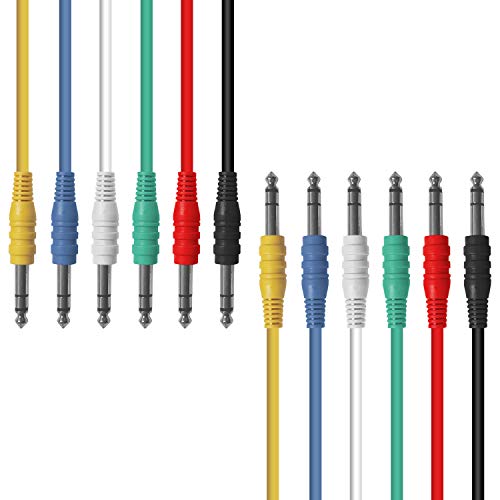
- Six balanced 1.5-foot TRS cables
- Color coding simplifies signal identification
- Suitable for patchbays and outboard effects
Best For: Organized connections between nearby studio processors
Flexible Routing Pick – Samson S-Patch Plus
Samson S-Patch Plus Balanced 48-Point 1/4" Patch Bay | 1/4 Inch Phone Connections
Check Price On AmazonThe Samson S-Patch Plus is a strong choice for patch bays for home studios that need balanced connections and flexible signal routing. Its 48-point, 1U rackmount design keeps connections centralized, while front-panel switches let you choose normalled, half-normalled, or thru operation.
Best For: Home studios that need a versatile, fully balanced patch bay for mixers, microphones, and rack equipment.
Pros:
- Provides 48 front and 48 rear 1/4-inch TRS connections.
- Supports normalled, half-normalled, and thru configurations.
- Fully balanced design helps maintain a clean signal path.
- 1U rackmount construction keeps connections accessible.
Cons:
- Its extensive routing options may be more than a small setup requires.
- Uses 1/4-inch phone connections rather than combo XLR inputs.
With its front-panel configuration switches and high connection count, the S-Patch Plus offers useful flexibility as a home studio grows.
High-Connectivity Choice – Black Lion Audio PBR TRS
The Black Lion Audio PBR TRS is a straightforward option for patch bays for home studios that need a high number of TRS connections. It provides 48 points through 96 gold-plated TRS connectors in a black-anodized enclosure.
Best For: Studios that want a high-density TRS patch bay for connecting compatible audio equipment.
Pros:
- Offers 48 patch points for extensive studio connectivity.
- Includes 96 gold-plated TRS connectors.
- Compatible with all devices according to the supplied product details.
Cons:
- The supplied details do not specify normalled, half-normalled, or thru routing modes.
- Its listed dimensions and 4.31-pound weight may require planning for available rack or workspace.
The PBR TRS focuses on connection density, making it a practical fit when a studio’s main priority is accommodating numerous TRS patch points.
Combo-Connector Pick – ProCraft 12-Channel Patch Panel
The ProCraft 12-channel patch panel is a useful choice among patch bays for home studios that rely on both XLR and 1/4-inch connections. Its 12 Neutrik NCJ6FI-S combo jacks accept either connector type, helping consolidate compatible equipment connections in a 1U rack panel.
Best For: Home studios that need convenient front-panel access to mixed XLR and 1/4-inch connections.
Pros:
- Provides 12 loaded combo jacks.
- Each connector accepts either 1/4-inch or XLR plugs.
- Uses Neutrik NCJ6FI-S combo jacks.
- Made in the USA with a flanged aluminum rack panel.
Cons:
- Offers fewer channels than 48-point patch bays.
- The supplied notes do not specify internal routing modes or balanced operation.
This panel is especially appealing for setups where connector convenience matters more than maximum point count, particularly when XLR and 1/4-inch gear share the same rack area.
Compact Modular Option – Hosa MHB-350
The Hosa MHB-350 is a compact 8-point module for patch bays for home studios with a smaller connection requirement. Its 1/4-inch TRS design is intended for compatible mixers, recorders, and outboard gear, and its steel enclosure offers a practical build for modular setups.
Best For: Small home studios that need a simple 8-point 1/4-inch TRS patchbay module.
Pros:
- Provides eight 1/4-inch TRS patch points.
- Works with compatible mixers, recorders, and outboard gear.
- Uses a steel enclosure.
- Includes a limited lifetime warranty.
Cons:
- Eight points provide less capacity than larger 48-point units.
- Compatibility depends on equipment using compatible connectors.
- The supplied details do not specify selectable routing modes.
For a modest setup, the MHB-350 keeps the patching task focused and avoids paying for a larger connection count than the studio currently needs.
Flexible Rack Connectivity – Procraft 4-Channel Combo Patch Panel
For home studios that need convenient front-panel access, this Procraft rack panel combines four Neutrik combo jacks in a compact 1U format. Each input accepts either an XLR or 1/4-inch plug, making it a practical choice for varied studio connections.
Best For: Home studios needing flexible XLR and 1/4-inch connectivity in a rack-mounted panel.
Pros:
- Four Neutrik NCJ6FI-S combo jacks
- Accepts both XLR and 1/4-inch connections
- Compact 1U rack-panel format
- Made in the USA
Cons:
- Provides four combo connections rather than a larger patch-bay layout
- Additional jack configurations require a request
This is a focused solution for expanding accessible rack connections rather than a full multi-point patch bay. Its combo-jack design is especially useful when your home studio uses both microphone and 1/4-inch equipment.
Organized Studio Routing – ART P48 Balanced Patch Bay
The ART P48 is a 48-point balanced patch bay designed to organize connections in professional or home recording studios. Its 19-inch rack-mountable, fully shielded steel enclosure can help reduce connector wear while keeping studio, PA, AV, and home-theater cabling more accessible.
Best For: Home studios and rack-based setups that need extensive balanced patching and cable organization.
Pros:
- Provides 48 balanced patch points
- Fits a standard 19-inch rack
- Fully shielded steel construction
- Includes a 2-year warranty
Cons:
- Its larger 48-point layout may be more than a small setup needs
- Designed for indoor use
With its high connection count and rack-ready construction, the P48 is suited to studios where routing flexibility and cable organization matter. It is a stronger fit for established or expanding systems than for a minimal desktop rig.
Color-Coded Patching – AxcessAbles 1/4-Inch TS Cable 6-Pack
These AxcessAbles cables are a practical accessory for patch bays for home studios, especially when routing outboard effects and other gear. The six 5-foot, straight-to-straight 1/4-inch TS cables use multiple colors to make signal paths easier to identify.
Best For: Home-studio users patching unbalanced outboard gear, effects, mixers, or amplifiers.
Pros:
- Six 5-foot 1/4-inch TS cables in multiple colors
- Flexible design for patch-bay and outboard-gear routing
- Nickel-plated plugs and OFC conductors
- OFC spiral shielding helps reject EMI and RFI
Cons:
- Unbalanced TS cables are not balanced patch cables
- All cables use 1/4-inch TS connectors
- Five-foot lengths may be excessive for very short connections
This six-pack is a useful complement to a patch bay when you want quick visual identification of multiple unbalanced signal paths. It is best matched with compatible 1/4-inch TS equipment rather than balanced XLR connections.
Rack-Ready XLR Routing – ART P16 XLR Balanced Patchbay
For home studios that use XLR-equipped microphones and outboard gear, the ART P16 provides a centralized patch point in a standard rack format. Its 16-channel layout and balanced XLR connectivity can help keep larger studio setups organized.
Best For: Home studios needing rack-mounted XLR routing and accessible front-panel connections.
Pros:
- Provides 16 XLR channels with 32 total connectors.
- Uses PCB wiring and a fully shielded steel enclosure.
- Fits a 19-inch, 1U rack space and includes reversible rack ears.
- Backed by a 3-year warranty.
Cons:
- Uses XLR connections rather than 1/4-inch TRS.
- Its rack-mounted design may be more than a small setup needs.
The P16 is a focused choice for XLR-based patching, especially when a durable, rack-ready enclosure and multiple channels matter more than a compact desktop format.
Compact Color-Coded Connections – AxcessAbles 1ft TRS Patch Cable 6-Pack
When choosing patch bays for home studios, short cables can make close-together gear easier to connect without excess slack. This six-pack provides 1-foot balanced 1/4-inch TRS-to-TRS cables for patch bays, monitors, mixers, and other studio equipment.
Best For: Short connections between nearby patchbay, mixer, monitor, and outboard-gear jacks.
Pros:
- Includes six 1-foot TRS-to-TRS balanced cables.
- Multi-color cables make connections easier to identify.
- OFC conductors and spiral shields support signal clarity and interference rejection.
- Nickel-plated plugs are designed for durability and signal transfer.
Cons:
- One-foot length may be too short for gear positioned farther apart.
- These are cables rather than a standalone patchbay unit.
This pack is a practical cable add-on for a compact studio, particularly if color coding and minimal cable slack are priorities.
Flexible Patchbay Cabling – AxcessAbles 1.5ft TRS Patch Cable 6-Pack
For patch bays for home studios, a little extra cable length can make outboard routing easier while keeping runs manageable. This six-pack uses 1.5-foot balanced 1/4-inch TRS-to-TRS cables for patchbays, compressors, reverbs, equalizers, preamps, and other effects.
Best For: Home or professional studios linking patchbays with nearby analog or digital outboard gear.
Pros:
- Includes six 1.5-foot balanced TRS patch cables.
- Multi-colored cables help distinguish signal paths.
- Designed for patchbays and a broad range of outboard effects.
- Features nickel-plated plugs, OFC conductors, and OFC spiral shields.
Cons:
- May still be short for equipment placed farther apart.
- Does not replace a patchbay or provide additional routing hardware.
The 1.5-foot length offers a useful middle ground for organized studio wiring, giving compact setups more reach while retaining a manageable patch-cable format.
How We Picked the Best Patch Bays for Home Studios
We selected these products based on connection format, signal compatibility, rack or desktop practicality, routing flexibility, construction, and usefulness in real home-studio workflows. The list includes 48-point patch bays for larger setups, compact modules for smaller rigs, XLR-focused panels, combo connector panels, and patch cables needed to complete a reliable routing system.
Balanced products are prioritized for studio environments because balanced TRS and XLR connections can help reject interference over appropriate cable runs. However, an unbalanced patch cable can still be suitable for compatible synthesizers, pedals, and other equipment designed for TS connections.
Quick Comparison
- Large balanced routing: Samson S-Patch Plus and ART P48 offer high-capacity 48-point formats.
- Flexible TRS routing: Black Lion Audio PBR and Hosa MHB-350 suit balanced line-level connections in different sizes.
- XLR and combo connectivity: ART P16 and Procraft panels help bring microphone, instrument, or line connections to the front of a rack.
- Patch cable additions: AxcessAbles TS and TRS cable packs provide short connections for reducing clutter between nearby jacks.
Key Buying Factors for Patch Bays for Home Studios
Connector Type and Signal Format
Start by listing the connectors on your interface, preamps, compressors, synthesizers, and monitors. TRS patch bays are common for balanced line-level gear, while XLR panels are useful for microphone and balanced audio connections. Combo panels accept more than one connector type, but they may not replace a dedicated patch bay for complex routing.
Normalled Versus Non-Normalled Routing
Normalled connections pass a source to a destination until a plug interrupts the path. This is convenient for default signal chains. Half-normalled and non-normalled configurations offer different tapping and routing behavior, so check the manufacturer’s layout before installation. Label every rear connection and document the default path.
Capacity and Rack Space
A 48-point unit is useful when you expect to add outboard gear, but a compact eight-point module may be more practical for a small desk-based setup. Confirm rack height, front-panel clearance, and rear cable access before buying. Leave room for strain relief and ventilation where required.
Cable Quality and Length
Use balanced TRS cables with balanced patch points, and reserve TS cables for equipment that calls for unbalanced connections. Short, color-coded cables make routing easier to identify and reduce loops behind the rack. Avoid forcing incompatible cable types into a signal chain simply because the plug fits.
Who Should Buy Which Patch Bays for Home Studios?
Choose a 48-point balanced bay if you have several pieces of rack gear, multiple interface outputs, or plans to expand. Choose a compact TRS module for a smaller studio with only a few recurring signal paths. Choose an XLR or combo panel if front-access microphone, instrument, or line connections are your main priority. Add short balanced cable packs for clean line-level routing, or choose TS cables when your instruments and effects specifically require unbalanced connections.
Before purchasing, map your inputs and outputs, decide which connections should remain normalled, and count both present and likely future channels. A slightly larger patch bay can be worthwhile if it prevents another rewiring project as your studio grows.