The best portable DACs with headphone amps can make a noticeable difference when a phone, laptop, or handheld device lacks the output power or audio features your headphones need. The right model can improve drive, add balanced connectivity, support high-resolution formats, or provide wireless convenience without requiring a full-size desktop setup.
This roundup compares 10 compact options, from simple USB-C dongles to Bluetooth amplifiers and high-power models. Use the buying guide below to narrow your choice by headphones, connection type, portability, output power, and useful extras such as equalization.
Best 10 Portable Dacs with Headphone Amp Picks for 2026
Best All-Rounder

- Up to 560mW + 560mW balanced desktop-mode output
- Ten-band lossless PEQ with app and web control
- Color display with support for DSD256 and 768kHz/32-bit
Best For: Customizable wired listening with demanding headphones
Best Wireless Flexibility

- Bluetooth 5.4 with LDAC and aptX Lossless support
- Three modes for PC, Bluetooth, and phone use
- Up to 650mW output with dual ES9069Q DACs
Best For: Switching between wireless and wired listening
Best Compact Magnetic Design

- 50g aluminum design with magnetic leather back panel
- 3.5mm and 4.4mm outputs with 80mW/180mW at 32 ohms
- 1.28-inch display and dual USB-C ports
Best For: Slim phone-based setups and everyday portable listening
Best High-Power Wired Option

- Up to 600mW through the 4.4mm balanced output
- Ten-band parametric EQ saves profiles via PC browser
- 3.5mm and 4.4mm outputs with Eco and Boost modes
Best For: Driving demanding headphones with wired connections
Best Bluetooth Versatility

- LDAC and broad Bluetooth codec support
- PC, Bluetooth, and phone modes
- 3.5mm and 4.4mm outputs in a 28.6g design
Best For: Flexible wireless and wired listening across phones, computers, and headphones
Best DSP Control

- Dual CS43198 DACs with DSD256 support
- Parametric-style DSP adjustments through the app
- 4Vrms output with 3.5mm and 4.4mm ports
Best For: Listeners who want detailed EQ control and high-resolution USB playback
Best High-Power Dongle

- Up to 550mW balanced output in Desktop mode
- Dual CS43131 DACs and dual op-amps
- 3.5mm and 4.4mm outputs with PCM/DSD support
Best For: Driving a wide range of headphones from a compact USB-C dongle
Tube-Tuned Power
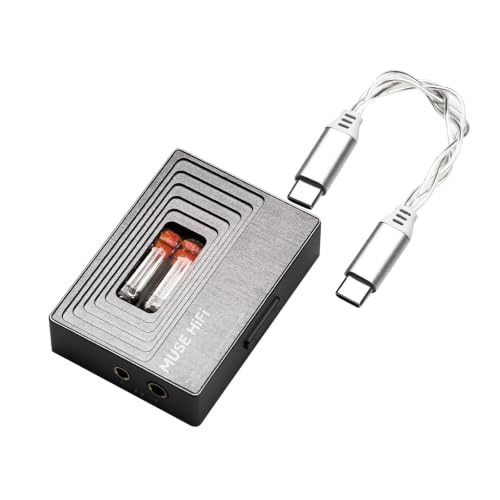
- JAN6418 tube hybrid amplification
- Up to 480mW balanced output
- PCM 384kHz and DSD256 support
Best For: Listeners seeking warm tube character with strong portable output
Feature-Packed Mini Amp

- Dual CS43131 DAC architecture
- 320mW balanced output at 32Ω
- Buttons and Android 8-band EQ
Best For: Portable listening with controls, calls, and balanced output
Clean, Simple Power

- Dual CS43131 DAC chips
- Up to 170mW per channel at 32Ω
- 60-step volume with memory
Best For: High-resolution mobile listening with simple physical controls
Best All-Rounder – FiiO KA15
The FiiO KA15 is a versatile choice among portable DACs with headphone amp functionality, combining a compact design with a display, app control, and strong output options. Its desktop mode and balanced output give it flexibility for both everyday listening and more demanding headphones.
Best For: Listeners who want detailed control, customizable EQ, and broad headphone compatibility in a tiny USB dongle.
Pros:
- Desktop mode provides up to 560mW + 560mW balanced output.
- Ten-band lossless PEQ supports saved, shared, and imported tuning profiles.
- 0.96-inch color display, dual CS43198 DACs, and support for up to 768kHz/32-bit and DSD256.
Cons:
- Some advanced controls require the FiiO Control app or web interface.
- Desktop mode is intended for higher-power operation and may not suit every mobile setup.
The KA15 stands out for packing serious power and extensive customization into a small, user-friendly package. It is a particularly strong fit if you want a wired dongle that can adapt to different headphones and listening preferences.
Best Wireless Flexibility – FiiO BTR17
The FiiO BTR17 is a flexible portable DAC and headphone amp for listeners who want Bluetooth convenience without giving up wired USB operation. Its three-mode switch, high-power desktop mode, and balanced output make it suitable for phones, computers, and a range of headphones.
Best For: Users who want one portable unit for Bluetooth listening, USB DAC use, and high-output headphone amplification.
Pros:
- Bluetooth 5.4 supports LDAC, aptX Adaptive, and aptX Lossless features.
- Three modes support PC soundcard, Bluetooth DAC/amp, and smartphone tail-DAC use.
- Dual ES9069Q DACs, 10-band PEQ, and up to 650mW output in desktop mode.
Cons:
- Its broad feature set may be more than needed for simple wired dongle use.
- Maximum desktop-mode output requires a dedicated power input.
The BTR17 is the most adaptable option here for moving between wireless and wired sources. Choose it if connection flexibility and strong amplification matter as much as portable size.
Best Compact Magnetic Design – Fosi Audio MD3
Fosi Audio MD3 Portable DAC Headphone Amplifier Magnetic USB C Mini Amp HiFi Black
Check Price On AmazonThe Fosi Audio MD3 is a lightweight pick among portable DACs with headphone amp functionality, weighing 50g and measuring 12mm thick. Its magnetic back panel, dual USB-C ports, display, and dual headphone outputs make it practical for phone-based listening.
Best For: Mobile listeners who want a slim DAC amp that can attach to a phone and handle both standard and balanced headphones.
Pros:
- Magnetic leather back panel helps keep the unit attached to a phone.
- 3.5mm and 4.4mm outputs provide 80mW/180mW at 32 ohms.
- 1.28-inch circular display, 100-level volume control, and volume memory.
Cons:
- Output power is lower than the higher-powered options in this roundup.
- Its interactive display features may not matter to buyers seeking a simple dongle.
The MD3 prioritizes portability and phone-friendly ergonomics over maximum amplifier power. It is a sensible choice for IEMs and compatible headphones when a magnetic, easy-to-carry design is the main priority.
Best High-Power Wired Option – Protocol Max
The Protocol Max is a high-output portable DAC amplifier for listeners who need both 3.5mm single-ended and 4.4mm balanced connections. Dual Cirrus Logic DACs, persistent parametric EQ, and selectable power modes give it a practical mix of performance and control.
Best For: Headphone users who want substantial balanced output and adjustable sound profiles without relying on an additional app.
Pros:
- Balanced output delivers up to 600mW of amplification.
- Ten-band parametric EQ profiles can be adjusted and saved through a PC browser.
- Includes both 4.4mm balanced and 3.5mm single-ended outputs with low output impedance.
Cons:
- At 110g, it is heavier than the MD3 and typical ultra-light dongles.
- Its EQ setup is browser-based rather than app-based.
The Protocol Max is aimed at buyers who value output power and persistent EQ more than the smallest possible footprint. Its Eco and Boost modes also let you choose between longer battery life and maximum performance.
Best Bluetooth Versatility – FiiO BTR13
The FiiO BTR13 is a flexible choice among portable DACs with headphone amp capability, combining Bluetooth reception, USB DAC operation, and dedicated phone connectivity in a compact 28.6g design. Its LDAC support, dual CS43131 DACs, and 3.5mm and 4.4mm outputs make it well suited to switching between everyday wireless listening and higher-output wired use.
Best For: Listeners who want one lightweight DAC/amp for phones, computers, Bluetooth devices, and multiple headphone connections.
Pros:
- Three-position PC/BT/PHONE switch simplifies switching between use modes.
- Supports LDAC, aptX Adaptive, aptX HD, AAC, SBC, and other Bluetooth formats.
- Dual CS43131 DACs and 4.4mm balanced output support detailed, lower-crosstalk playback.
- App and web-based EQ tools offer presets plus adjustable frequency, gain, and bandwidth.
Cons:
- It is not water resistant.
- The listed headphone jack configuration requires choosing between 3.5mm and 4.4mm connections.
The BTR13 stands out when wireless convenience and broad device compatibility matter as much as wired output. Its balanced mode and independent amplifier power supply add useful headroom, while the compact build keeps it practical for portable listening.
Best DSP Control – MOONDROP Dawn PRO 2
The MOONDROP Dawn PRO 2 is a USB-focused option among portable DACs with headphone amp, built around dual CS43198 DAC chips and a detailed app-based DSP system. It combines high-resolution PCM and DSD support with independent power regulation, smooth 100-level volume control, and both 3.5mm and 4.4mm outputs.
Best For: Digital listeners who want precise EQ customization, high-resolution playback, and a durable aluminum housing.
Pros:
- Dual CS43198 DACs support up to 32-bit/384kHz PCM and DSD256.
- Interactive DSP allows adjustments to filter type, frequency, gain, and Q value.
- Provides 4Vrms output and 124 + 124mW power for broad headphone compatibility.
- Aluminum alloy construction and vent placement support durability and heat dissipation.
Cons:
- The supplied information describes USB operation rather than Bluetooth connectivity.
- Its advanced DSP controls may be more involved than necessary for plug-and-play users.
The Dawn PRO 2 is a strong fit for listeners who enjoy tailoring their sound rather than relying on fixed tuning. Its output specification and aluminum design add substance, while the separate volume control helps maintain smoother level adjustments.
Best High-Power Dongle – FiiO/JadeAudio KA13
The FiiO/JadeAudio KA13 is a compact USB-C dongle for shoppers seeking portable DACs with headphone amp power beyond typical basic adapters. Its dual CS43131 DACs, dual op-amps, 3.5mm and 4.4mm outputs, and optional Desktop mode deliver a versatile setup for smartphones, computers, music players, and headphones.
Best For: Users who want a tiny USB DAC/amp with unusually high balanced-output power for demanding headphones.
Pros:
- Desktop mode raises balanced output power to a specified 550mW.
- Dual CS43131 DACs and SGM8262 op-amps provide a high-performance internal design.
- Supports PCM up to 32-bit/384kHz and DSD256.
- Includes both 3.5mm and 4.4mm headphone outputs in a compact aluminum body.
Cons:
- The highest stated power requires Desktop mode.
- The supplied details identify it as a USB adapter, not a Bluetooth receiver.
- Its small dongle format may be less convenient for users who prefer a built-in battery and wireless controls.
The KA13 is especially compelling when output power is the priority but pocket-friendly size still matters. App connectivity adds control over lighting, filters, and SPDIF settings, making this more adaptable than a basic passive dongle.
Tube-Tuned Power – MUSEHiFi M3 Ultra
For listeners comparing portable dacs with headphone amp, the MUSEHiFi M3 Ultra stands out with its JAN6418 tube and hybrid amplification design. It combines a warm, natural presentation with substantial output power, dual headphone connections, and high-resolution PCM and DSD support.
Best For: IEM and headphone listeners who want tube-style warmth, balanced output power, and a more engaging portable setup.
Pros:
- JAN6418 tube hybrid design adds smooth vocals and rich harmonics.
- Offers up to 460mW from 3.5mm and 480mW from 4.4mm balanced output.
- Supports PCM up to 32-bit/384kHz and DSD256.
- Noise-reduction measures help control tube microphonics during movement.
Cons:
- Tube-based hardware may be less convenient for rough, highly mobile use.
- It is a wired DAC/amp, so it requires a physical connection to the source.
The M3 Ultra is a strong choice when tonal character matters as much as technical capability. Its balanced output and high power suit demanding wired headphones, while the tube implementation gives the presentation a distinctive flavor.
Feature-Packed Mini Amp – TRN Black Pearl
The TRN Black Pearl is a compact option among portable dacs with headphone amp, pairing dual CS43131 chips with both 3.5mm and 4.4mm outputs. Its buttons, app-based Android EQ, and support for calls and recording make it practical for everyday phone and computer use.
Best For: Everyday listeners who want a lightweight, feature-rich USB-C DAC/amp with balanced output and physical controls.
Pros:
- Dual CS43131 DACs support PCM up to 32-bit/384kHz and DSD256.
- Provides up to 125mW through 3.5mm and 320mW through 4.4mm at 32Ω.
- Physical buttons control volume, playback, and track changes.
- Approximately 25g with a full-metal body and tempered-glass panel.
Cons:
- 3.5mm and 4.4mm outputs are intended for one-at-a-time use.
- Android EQ requires the WALK PLAY app and a compatible wired USB-C connection.
- It is not water resistant.
Black Pearl balances portability and flexibility particularly well. It offers useful controls and connectivity features without giving up a balanced output, making it a convenient choice for mobile listening and computer use.
Clean, Simple Power – Fosi Audio DS2
The Fosi Audio DS2 is a straightforward pick for shoppers seeking portable dacs with headphone amp in a small USB-C design. It uses dual CS43131 chips, offers 3.5mm and 4.4mm connections, and includes independent 60-step volume buttons for easy adjustment across phones, tablets, and computers.
Best For: Listeners who want a compact, easy-to-use DAC/amp with high-resolution support and strong output for varied headphones.
Pros:
- Supports PCM up to 32-bit/384kHz and DSD256.
- Delivers up to 170mW per channel at 32Ω.
- Dual CS43131 chips provide a 1μV noise floor and 0.0001% THD rating.
- 60-step volume control includes volume memory.
Cons:
- Its wired USB-C design requires a compatible cable and source connection.
- The supplied notes do not specify a built-in microphone or call-control feature.
DS2 is a sensible all-rounder for users who prioritize clean specifications, convenient volume control, and broad source compatibility. Its dual outputs also make it easy to match the device to different wired headphones and IEMs.
How We Picked the Best Portable Dacs with Headphone Amp
We evaluated these portable DAC/amp options by looking at the features that matter most in everyday listening: connection flexibility, output options, stated power, codec and file-format support, physical size, controls, and compatibility with phones, computers, IEMs, and full-size headphones. We also considered whether each design is best suited to pocketable wired use, Bluetooth listening, or higher-demand headphones.
Specifications such as balanced outputs, high-resolution PCM or DSD support, PEQ, and amplifier architecture can be useful, but they do not automatically guarantee better sound. The best choice depends on your headphones, source device, listening habits, and tolerance for extra size or battery management.
Quick Comparison
| Type | Best For | What to Look For |
|---|---|---|
| USB-C dongle | Simple phone or laptop upgrades | Low power consumption, plug-and-play compatibility, suitable output |
| Bluetooth DAC/amp | Wireless convenience | Bluetooth codecs, battery life, onboard controls, wired USB mode |
| Balanced-output model | More demanding headphones or compatible cables | 4.4mm output, sufficient power, sensible heat and battery usage |
| High-resolution DAC/amp | Local music libraries and detailed playback | Supported PCM/DSD formats, app or system compatibility, practical value |
Key Buying Factors for Portable Dacs with Headphone Amp
Output Power and Headphone Matching
Check the requirements of your headphones rather than choosing by wattage alone. Sensitive IEMs usually need little power, while high-impedance or low-sensitivity over-ear headphones may benefit from a stronger amplifier. Extra power can also provide more usable volume headroom, but it may increase battery drain and noise with very sensitive earphones.
Single-Ended Versus Balanced Output
A 3.5mm output is the simplest option and works with most headphones. A 4.4mm balanced output can offer more power and is useful if your headphones already have a compatible balanced cable. Do not connect a balanced output to an incompatible cable or adapter without verifying that the wiring is safe.
Wired, Wireless, and Device Compatibility
USB-C dongles are usually the smallest and easiest to carry, but they draw power from the source device. Bluetooth models add a battery and support wireless listening, while still often working as USB DACs. Confirm operating-system support, included cables, connector orientation, and whether controls or PEQ features require a companion app.
Features That Improve Daily Use
Volume buttons, gain settings, display information, digital filters, PEQ, microphone support, and a secure phone connection can matter more than headline resolution numbers. Consider heat, cable strain, pocketability, and whether the device may block adjacent ports.
Who Should Buy Which Portable Dacs with Headphone Amp?
Choose a compact USB-C dongle if you want the simplest, lightest upgrade for a phone, tablet, laptop, or portable music player. A Bluetooth DAC/amp is better for listeners who want to keep their phone in a pocket or use wireless codecs while retaining a wired headphone connection. Select a balanced, higher-power model if your over-ear headphones need more drive or you already own a 4.4mm cable.
For sensitive IEMs, prioritize low noise, careful volume control, and a low-gain mode over maximum output. For desktop-and-mobile flexibility, look for USB operation, physical controls, and broad format support. Finally, buy based on the complete system: source, headphones, cable, battery expectations, and connectivity should all fit your routine.