Fine dust can linger in workshop air long after cutting, sanding, or routing stops. The right air filtration system helps capture airborne particles that ordinary shop vacuums may miss, keeping your workspace cleaner between projects.
We compare 10 shop air filtration systems for fine dust across airflow, controls, filtration features, coverage, and practical workshop use so you can choose a model that fits your shop and dust-producing tools.
Best 10 Shop Air Filtration Systems for Fine Dust Picks for 2026
Compact Choice
WEN 3410 Air Filtration System
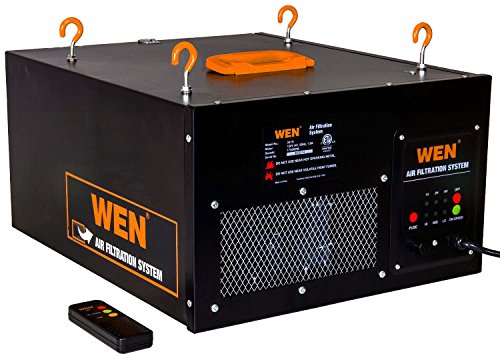
- 1-micron filter plus replaceable pre-filter
- Three speeds up to 400 CFM
- RF remote and programmable timer
Best For: Small workshops and hobby spaces
HEPA Upgrade
DEWALT DWXAF101 Air Filtration System
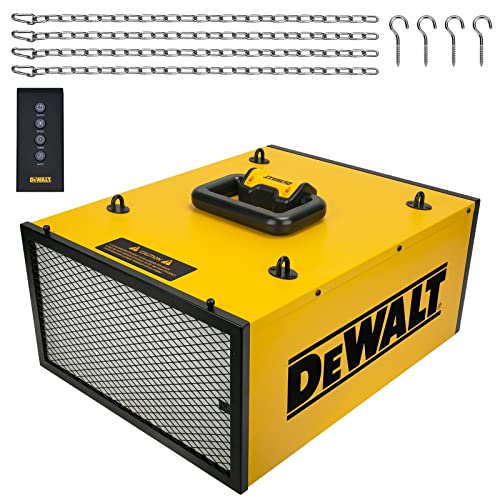
- H11 HEPA two-stage filtration
- Four modes with air-quality sensing
- Ceiling mounting and washable pre-filter
Best For: Woodworking shops needing HEPA filtration
High-Airflow Pick
WEN 3417 Industrial Air Filtration
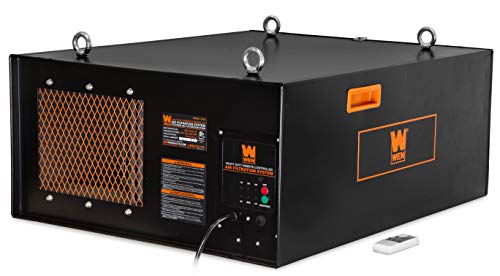
- Airflow up to 1,044 CFM
- Coverage up to 1,000 square feet
- 1-micron filter and RF remote
Best For: Larger workshops needing strong air circulation
Maximum Coverage

- Up to 1,350 CFM and 1,700-square-foot coverage
- 360-degree intake with MERV-11 filtration
- Ceiling, workbench, or direct-ceiling installation
Best For: Large woodworking shops and garages
High-Capacity Choice

- 1,350 CFM airflow with 360° intake
- MERV-11 filter for fine airborne dust
- Remote, timer, and ceiling-mount design
Best For: Large woodshops, garages, and workshops up to 1,700 square feet
Quiet Ionizer Pick

- 580/780 CFM two-speed airflow
- Built-in ionizer for dust and odor control
- Below-50-dBA operation with remote and timer
Best For: Smaller workshops and garages up to about 800 square feet
Portable Filtered Airflow

- 1,080 CFM airflow with 270° intake
- Three removable MERV-11 filters
- 22-pound body with handles and 26-foot remote
Best For: Movable filtration for garages, workshops, and DIY projects
High-Coverage Pick

- 360-degree intake for broad air circulation
- MERV 11 filter targets fine airborne particles
- Covers rooms up to 1,700 square feet
Best For: Large woodworking shops and garages
Versatile Remote Pick

- Three-speed airflow for flexible operation
- Two-stage filtration with replaceable filters
- Remote control works up to 26 feet
Best For: Medium-sized shops needing flexible controls
Compact Shop Pick

- Three speeds from 350 to 500 CFM
- Compact benchtop-friendly design
- Two-stage filtration plus built-in ionizer
Best For: Small shops and work areas up to 500 square feet
Compact Choice – WEN 3410 Air Filtration System
If you want to shop air filtration systems for fine dust in a smaller workshop, the WEN 3410 provides adjustable airflow, remote operation, and layered filtration in a compact housing. Its 300/350/400 CFM settings are suited to rooms up to 400 square feet.
Best For: Small workshops and hobby spaces needing convenient overhead or room air filtration.
Pros:
- Includes a 1-micron filter and a replaceable 5-micron pre-filter.
- Three airflow settings provide 300, 350, or 400 CFM.
- RF remote works from up to 26 feet and does not require direct line of sight.
- Programmable timer supports automatic shutoff.
Cons:
- Its stated coverage is limited to rooms up to 400 square feet.
- Noise is rated from 50 to 60 dB.
The WEN 3410 is a practical, straightforward option when space and budget matter more than maximum airflow. It offers useful controls and fine-particle filtration for smaller shops.
HEPA Upgrade – DEWALT DWXAF101 Air Filtration System
For shoppers comparing air filtration systems for fine dust, the DEWALT DWXAF101 stands out with two-stage filtration that pairs a washable cotton pre-filter with an H11 HEPA filter. Its ceiling-hanging design helps preserve floor space in a woodworking shop or garage.
Best For: Workshops that prioritize HEPA filtration, automatic operation, and ceiling installation.
Pros:
- Two-stage filtration captures over 95% of stated 0.3-micron particles.
- Four modes include high, medium, low, and automatic air-quality sensing.
- Built-in 1-, 2-, 4-, and 8-hour timer settings.
- Includes a washable pre-filter, replacement indicator, remote, hooks, and chains.
Cons:
- Noise is rated at 64 dB.
- Its 105-watt system is designed for air filtration rather than primary source dust collection.
The DWXAF101 is a well-equipped choice for users who want HEPA filtration and hands-off controls. Its included mounting hardware and three-year warranty add practical value for a permanent shop setup.
High-Airflow Pick – WEN 3417 Industrial Air Filtration
WEN 3417 3-Speed Remote-Controlled Industrial-Strength Air Filtration System (556/702/1044 CFM)
Check Price On AmazonWhen you shop air filtration systems for fine dust in a larger workspace, the WEN 3417 offers substantially more airflow than compact units. Its three settings reach 1,044 CFM and are intended for rooms up to 1,000 square feet.
Best For: Larger workshops that need high circulating airflow and remote-controlled operation.
Pros:
- Three airflow levels deliver 556, 702, or 1,044 CFM.
- Rated to cover rooms up to 1,000 square feet.
- Includes a 1-micron filter and replaceable 5-micron pre-filter.
- RF remote works from up to 26 feet, with a programmable timer.
Cons:
- The 55-pound housing is heavier than the smaller WEN unit.
- Noise is rated from 63 to 68 dB.
- Its larger 30.3-by-24-by-12.2-inch footprint requires more installation space.
The WEN 3417 makes the most sense when room size and air circulation are the main priorities. It trades compactness and lower noise for considerably higher airflow capacity.
Maximum Coverage – Abestorm DecDust 1350IG
The Abestorm DecDust 1350IG is a high-capacity option for shoppers looking to shop air filtration systems for fine dust across a broad workspace. It combines 1,050-1,350 CFM airflow, 360-degree intake, a MERV-11 filter, and flexible mounting options.
Best For: Large woodworking shops and garages needing high airflow, flexible placement, and odor treatment.
Pros:
- Provides 1,050-1,350 CFM airflow and stated coverage up to 1,700 square feet.
- 360-degree intake supports broad air circulation.
- Can hang from the ceiling, sit on a workbench, or screw directly into the ceiling.
- Includes touch and remote controls, four replaceable MERV-11 filters, and a built-in ionizer.
Cons:
- It cannot be shipped to California because it does not meet that state’s air-cleaner regulations.
- Noise is rated from 60 to 69 dBA.
- Filters are suggested for replacement every two to four months.
With its broad coverage and adaptable installation, the DecDust 1350IG is aimed at large, active workspaces. Verify regional shipping eligibility and account for its relatively high noise range before choosing it.
High-Capacity Choice – ABESTORM DecDust 1350
If you want to shop air filtration systems for fine dust in a larger woodshop or garage, the ABESTORM DecDust 1350 stands out for its 1,350 CFM airflow and 360° intake. Its MERV-11 filter is designed to capture airborne dust and fine particles, while the two-speed fan, timer, and remote add practical control during woodworking projects.
Best For: Larger woodshops, garages, and workshops up to 1,700 square feet that need strong overhead or workbench air circulation.
Pros:
- High 1,350 CFM airflow with a 360° air intake design.
- MERV-11 filtration targets 3–10 micron particles and particles as small as 1 micron.
- Includes two fan speeds, a 1–9 hour timer, remote control, and ceiling-mount hardware.
Cons:
- Noise is rated at 60–69 dB, so it may be noticeable in quieter spaces.
- The replaceable filter requires ongoing maintenance.
Choose this model when airflow capacity and broad coverage matter most. Its flexible ceiling or workbench placement makes it useful when you want to preserve floor space while reducing suspended woodworking dust.
Quiet Ionizer Pick – ALORAIR Purecare 780IG
For shoppers comparing air filtration systems for fine dust in a compact workshop, the ALORAIR Purecare 780IG combines a two-stage design, MERV-11 filtration, and a built-in ionizer. Its 580/780 CFM operation, 270° intake, and noise rating below 50 dBA make it a practical option for smaller work areas.
Best For: Woodworking shops, garages, and workspaces up to about 800 square feet where lower operating noise and odor-focused features are priorities.
Pros:
- Two-stage 580/780 CFM airflow with a 270° intake.
- Built-in ionizer is designed to help reduce dust and odors.
- Quiet operation below 50 dBA, plus a timer, remote, and hanging or workbench placement.
Cons:
- Its stated coverage is smaller than the larger systems in this roundup.
- It cannot be shipped to California according to the supplied product notes.
This is a good fit when you want a quieter, compact filtration unit with ionization and flexible placement. Verify the shipping restriction before ordering, and replace the MERV-11 filter as needed.
Portable Filtered Airflow – Abestorm DecDust 1080IG
If portability is important while you shop air filtration systems for fine dust, the Abestorm DecDust 1080IG offers 1,080 CFM airflow in a 22-pound design. Its three MERV-11 filters work alongside a built-in ionizer, while the remote control, handles, and removable filters simplify everyday workshop use.
Best For: Woodworkers and DIY users who need a movable filtration unit for garages, workshops, sanding areas, and renovation projects.
Pros:
- 1,080 CFM airflow with a 270° wide intake.
- Three removable MERV-11 filters support fine-dust filtration and maintenance.
- Lightweight 22-pound body, corner handles, hanging design, and 26-foot remote range.
Cons:
- The supplied notes do not state a noise rating.
- Ionization adds a specialized feature that may not be necessary for every user.
This model balances substantial airflow with easier repositioning than heavier shop units. It makes sense for users who move between work areas and want accessible filter and dust-bag maintenance.
High-Coverage Pick – ALORAIR PureCare 1350
If you want to shop air filtration systems for fine dust in a larger garage or woodworking area, the ALORAIR PureCare 1350 emphasizes broad circulation and strong airflow. Its 360-degree intake, two speed settings, and MERV 11 filter are designed for airborne particles from sanding, sawing, carving, and similar work.
Best For: Larger workshops and garages up to 1,700 square feet where ceiling mounting or bench placement is useful.
Pros:
- 360-degree intake and a strong vortex fan provide high circulating airflow.
- MERV 11 filtration is rated to stop 90% of 3–10-micron particles and 85% of 1-micron particles.
- Includes a timer for 1–9 hours, IR remote, hooks, and chains for flexible placement.
- Filter replacement is straightforward.
Cons:
- Not available for shipment to California because it does not meet that state’s regular requirements.
- Noise is listed at 60–69 dB.
- Only two fan speeds are provided.
With its larger stated coverage area and 1,350 CFM class airflow, this model is a practical option when shop size and circulation matter most. Confirm the California shipping restriction and listed noise range before ordering.
Versatile Remote Pick – PuriCare 1100
For shoppers comparing air filtration systems for fine dust, the PuriCare 1100 combines three-speed operation with a two-stage filter setup. It is intended to reduce airborne dust from sanding, turning, sawing, and other shop tasks while offering both hanging and portable benchtop use.
Best For: Workshops up to 1,100 square feet that need flexible placement, remote operation, and adjustable airflow.
Pros:
- Three fan speeds support more adaptable airflow control.
- Two-stage filtration uses an outer filter for larger particles and an inner filter for smaller particles.
- RF remote works from up to 26 feet, including when direct line of sight is obstructed.
- Timer settings from 1–12 hours allow automatic shutoff.
Cons:
- Not available for shipment to California because it does not meet that state’s air-cleaner requirements.
- At 40.9 pounds, it is heavier than the smaller PuriCare 500IG.
- Listed noise level is 66 dB.
The PuriCare 1100 stands out for its combination of three speeds, reusable replaceable filters, and a long timer range. Its up-to-1,100-square-foot rating makes it a sensible middle-ground choice for many home shops.
Compact Shop Pick – PuriCare 500IG
If your workspace is smaller, the PuriCare 500IG is a compact option for shoppers looking at air filtration systems for fine dust. It offers three fan speeds, a two-filter setup, and a built-in ionizer for woodworking tasks such as sanding, turning, sawing, and powder mixing.
Best For: Smaller workshops, garages, and benchtops up to 500 square feet.
Pros:
- Compact design can sit on a benchtop and includes handles for mobility.
- Three airflow settings provide 350, 450, and 500 CFM operation.
- Two replaceable, reusable filters separate larger and smaller particles.
- RF remote works from up to 26 feet, and the timer runs from 1–6 hours.
Cons:
- Not available for shipment to California because it does not meet that state’s air-cleaner requirements.
- Its 500-square-foot coverage is limited compared with larger shop filtration units.
- The built-in ionizer may not suit shoppers seeking filtration without ionization.
The PuriCare 500IG is best matched to a compact workspace where portability and straightforward controls matter more than maximum coverage. Its three speeds and listed 1-micron particle retention make it a capable small-shop supplement to dust collection.
How We Picked These Shop Air Filtration Systems for Fine Dust
We focused on the features that matter most in an active workshop: stated airflow, fan-speed selection, filter design, control options, installation flexibility, and suitability for garages or woodshops. The lineup includes compact units for smaller spaces and high-CFM systems intended to circulate air more aggressively in larger work areas.
Air filtration is not a replacement for source collection. A dust hood, properly sized shop vacuum or dust collector, and appropriate respiratory protection remain important. These machines are best viewed as a second layer that captures suspended dust after it enters the room.
Quick Comparison
- Smaller shops: Look for a compact, lower-CFM unit that can run without taking up much overhead space.
- Medium workshops: Midrange systems with multiple speeds and remote controls offer a useful balance of circulation and convenience.
- Large or especially dusty spaces: High-CFM models can move more air, but they may require stronger mounting points and more frequent filter maintenance.
- Convenience features: Remote controls, timers, ionizers, and multiple intake directions can simplify operation, though they should not replace effective mechanical filtration.
Key Buying Factors for Shop Air Filtration Systems for Fine Dust
Airflow and Room Size
Compare the manufacturer’s CFM rating with your workshop’s volume and typical dust load. Higher CFM can help circulate air faster, but the highest number is not automatically best if the unit is oversized, noisy, or difficult to mount.
Filter Quality and Maintenance
Fine-dust performance depends on the filter media, not just the fan. Check replacement-filter availability and inspect the filter regularly. A clogged filter reduces airflow and can make even a powerful system less effective.
Speed Controls, Noise, and Timers
Multiple speeds let you trade maximum circulation for quieter operation. Remote controls and timer functions are particularly useful when the unit is mounted overhead or when you want filtration to continue after a project ends.
Mounting and Airflow Direction
Confirm the unit’s dimensions, weight, hanging hardware requirements, and intake or exhaust layout before buying. Position it so it circulates room air without interfering with lighting, lumber, doors, or other equipment.
Ionizers and Safety
Some models include ionizers that may help particles settle, but mechanical filtration remains the core feature to evaluate. If you are sensitive to ozone or have specific indoor-air concerns, check the manufacturer’s specifications before using an ionizer.
Who Should Buy Which Shop Air Filtration Systems for Fine Dust?
Choose a compact system for a one-car garage, hobby bench, or smaller woodworking area where space and budget are priorities. Choose a midrange model if you want a practical balance of airflow, remote control, and manageable operating noise. Choose a high-CFM system for larger shops, frequent sanding, or multiple dust-producing tools, provided your mounting setup and electrical capacity are suitable.
Whichever model you choose, place it where it can circulate the room effectively, keep filters clean, and pair it with tool-level dust collection. That combination provides more dependable fine-dust control than relying on an overhead filter alone.