The best stereo wireless in-ear monitor systems give performers a clearer, more controlled stage mix without the restrictions of wired headphone cables. The right system can improve mobility, reduce stage clutter, and make monitoring more consistent for singers, musicians, and production teams.
This roundup compares 10 options across 2.4GHz, 5.8GHz, and UHF designs, including single- and multi-bodypack systems. We focus on latency, range, channel flexibility, battery performance, connectivity, and the practical needs of different performers and venues.
Best 10 Stereo Wireless in Ear Monitor Systems Picks for 2026
Best Stereo Sound
Xvive U45D Stereo Wireless IEM System

- True stereo sound with four monitoring modes
- Sub-5ms latency for responsive performance
- 5.8GHz smart channel scanning
Best For: Performers who prioritize immersive stereo monitoring and low latency
Best Multi-Performer Setup
Phenyx Pro PTM-33-4B UHF IEM System

- Four receivers for simultaneous performers
- Up to four standalone mono mixes
- Rack-mountable transmitter with IR sync
Best For: Bands and worship teams needing individual mono monitoring
Best Simple 2.4GHz Kit
M6S Stereo Wireless IEM System

- Automatic transmitter-receiver pairing
- Selectable mono and stereo input
- Rechargeable battery operation
Best For: Solo performers and small setups seeking straightforward wireless monitoring
Best Full-Band Package
XTUGA SEM200 Stereo Wireless IEM System

- Four-bodypack package for band monitoring
- 200 tunable UHF channels and 230-foot stated range
- Stereo/mono switching plus Bluetooth 5.3
Best For: Bands needing multiple receivers and flexible wireless input options
Best for Bands
LEKATO MS-20 Dual-Receiver IEM

- One transmitter with two receivers
- Up to 30 hours with charging case
- 150-foot open-area range and OTG support
Best For: Band rehearsals, live performances, and shared monitoring
Best for Rackmount Stages

- 25 selectable 905–930MHz frequencies
- Rackmount transmitter with included kit
- Supports unlimited receivers
Best For: Professional stage systems and fixed rack installations
Best Budget Stereo Pick
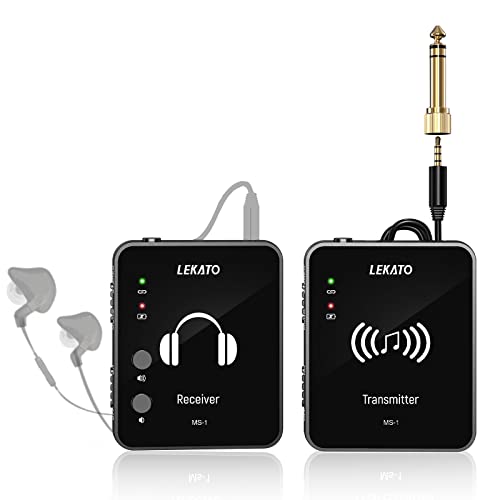
- True stereo with mono/stereo switching
- Up to six device sets simultaneously
- Five-hour battery and 100-foot range
Best For: Small bands, church services, and short rehearsals
Reliable UHF Monitoring

- 900MHz UHF with 89 selectable frequencies
- Stereo/mono, EQ, limiter, and balance controls
- Includes earbuds, rack kit, and carrying case
Best For: Stage, studio, worship, speech, and exhibit use
Talkback-Ready Digital System

- 5.8GHz wireless with four selectable channels
- Cue mic support and stereo/mono switching
- Rechargeable transmitter case and receiver
Best For: Bands and live teams needing cue communication
Compact Multi-Receiver Monitoring

- One transmitter supports up to four receiver pairs
- Under 4.5ms mono latency and 24-bit/48kHz audio
- Six-to-eight-hour battery life with 100-foot range
Best For: Small bands, churches, rehearsals, and mobile monitoring
Best Stereo Sound – Xvive U45D Stereo Wireless IEM System
For performers seeking stereo wireless in ear monitor systems, the Xvive U45D emphasizes immersive monitoring, quick setup, and real-time response. Its 5.8GHz connection, sub-5ms latency, smart channel scan, and four monitoring modes make it adaptable for live stages, rehearsals, and worship settings.
Best For: Musicians, singers, and worship teams that want true stereo monitoring with flexible mono-style options.
Pros:
- True stereo monitoring provides clear separation and a wide soundstage.
- Sub-5ms latency helps keep performance timing closely aligned.
- Smart channel scanning and 5.8GHz wireless connectivity support stable operation.
- Stereo, Left, Right, and Mix modes accommodate different monitoring workflows.
Cons:
- This is a single-transmitter, single-receiver set rather than a multi-performer system.
- The notes do not indicate built-in noise control.
The U45D is a focused choice when stereo imaging and low latency matter more than supplying several bodypacks. Its included adapters and carrying case also make it practical for a straightforward mixer-to-IEM setup.
Best Multi-Performer Setup – Phenyx Pro PTM-33-4B UHF IEM System
The Phenyx Pro PTM-33-4B is a practical option among stereo wireless in ear monitor systems when a band needs multiple monitoring stations. Although its monitoring is mono, the four-channel UHF design supports up to four independent mixes with no stated audio delay.
Best For: Four-member bands, church teams, stage productions, and performers who need individual mono mixes.
Pros:
- Four transmitter channels and four receivers support simultaneous performers.
- Four groups of left/right inputs and loop outputs allow flexible mixer connections.
- UHF operation offers a stated 140–164-foot line-of-sight range.
- IR sync simplifies linking additional receivers, and the transmitter includes rack-mount hardware.
Cons:
- It provides mono monitoring rather than true stereo.
- Range can be affected by thick walls, glass, and metal obstructions.
- The receivers use AA batteries, which require replacements or spares.
This system is better suited to coordinated group monitoring than to stereo listening. Its integrated four-channel design can reduce rack clutter while giving each performer a dedicated mix.
Best Simple 2.4GHz Kit – M6S Stereo Wireless IEM System
The M6S offers a compact entry point to stereo wireless in ear monitor systems, using automatic pairing and a selectable mono/stereo input. Its 24-bit/48kHz processing, rechargeable batteries, and clip-on receiver make it convenient for church services, rehearsals, and live performances.
Best For: Individual performers who want an easy-to-pair wireless monitor with rechargeable operation.
Pros:
- Automatic pairing avoids manual channel setup.
- One-button switching supports mono or stereo input.
- Built-in rechargeable batteries provide up to 10 hours after a full charge.
- One transmitter can pair with multiple receivers, with up to six units working simultaneously.
Cons:
- The kit includes one transmitter and one receiver, so additional receivers may be needed for a group.
- Its 2.4GHz connection may share spectrum with common wireless devices.
- Battery life is listed as up to 10 hours in the product claims, while the detailed specifications state an 8-hour average.
With automatic pairing and a supplied in-ear headphone, the M6S keeps setup simple. It is a sensible fit for users who value portability and convenience over advanced frequency-management features.
Best Full-Band Package – XTUGA SEM200 Stereo Wireless IEM System
The XTUGA SEM200 stands out among stereo wireless in ear monitor systems as a four-bodypack package with UHF transmission, stereo/mono switching, and 200 tunable channels. Bluetooth 5.3 streaming and automatic pairing add flexibility for backing tracks, click tracks, and other performance sources.
Best For: Bands and production teams that want four receivers, extended stated range, and flexible stereo or mono monitoring.
Pros:
- Includes four receivers for whole-band monitoring.
- Offers a stated UHF range of up to 230 feet and 200 tunable channels.
- Switchable stereo and mono modes support different stage preferences.
- Bluetooth 5.3 streaming can handle backing tracks, click, or intermission music from a phone.
Cons:
- The product details contain inconsistent package metadata, so buyers should confirm included accessories.
- Bluetooth streaming and UHF monitoring features may require more setup decisions than a basic single-receiver kit.
- The listed active noise cancellation is not described in detail in the supplied notes.
The SEM200 is aimed at teams that need a complete multi-receiver solution with room to tune around crowded wireless environments. Its LCD status display, low-battery indicator, and preset modes further support live-use convenience.
Best for Bands – LEKATO MS-20 Dual-Receiver IEM
For bands comparing stereo wireless in ear monitor systems, the LEKATO MS-20 stands out as a portable setup with one transmitter and two receivers. It offers automatic pairing, 24-bit/48 kHz audio, a claimed 150-foot open-area range, and a charging case rated for up to 30 hours of use.
Best For: Band rehearsals, live performances, studio monitoring, and situations where two performers need a shared transmitter.
Pros:
- Includes one transmitter and two receivers with support for up to 10 receiver pairs.
- Charging case provides up to 30 hours of usage and uses USB-C charging.
- Supports OTG audio input for compatible smartphones and USB-C devices.
- Offers selectable mono/stereo operation, low latency, and a claimed 150-foot range in open areas.
Cons:
- Earphones are not included.
- Not water resistant.
- Its 2.4GHz band may be less suitable for users specifically seeking a UHF/RF system.
The MS-20 is a practical multi-user option when portability and battery endurance matter. The dual-receiver bundle is especially useful for small bands, while the mono/stereo switch adds flexibility for different monitoring sources.
Best for Rackmount Stages – happymusic HM-10 Wireless IEM
The happymusic HM-10 is a rackmount-oriented choice for shoppers seeking stereo wireless in ear monitor systems for stage use. Its 905–930MHz RF design provides 25 selectable frequencies, a claimed 164-foot range, stereo or single-channel operation, and a transmitter designed for rack installation.
Best For: Private stage performances, professional music setups, and installations needing rackmount hardware with multiple receivers.
Pros:
- Provides 25 selectable frequencies across the 905–930MHz range.
- Supports unlimited receivers according to the supplied product details.
- Rackmount transmitter includes a rack mount kit and metal enclosure.
- Dual-antenna receiver design is intended to improve stability and interference resistance.
Cons:
- Heavier than the portable LEKATO systems at 2.14 kg.
- The supplied details list no warranty.
- Its stage-focused rackmount format is less convenient for highly portable setups.
The HM-10 makes the most sense when a rack-based stage system and broad receiver scalability take priority. Its frequency selection and dual-antenna design are useful features for more complex performance environments.
Best Budget Stereo Pick – LEKATO MS-1 Wireless IEM
The LEKATO MS-1 is a compact option for shoppers comparing stereo wireless in ear monitor systems for rehearsals and smaller gigs. It supports true stereo transmission, automatic pairing, one-key mono/stereo switching, and up to six device sets operating together, with a claimed 100-foot open-area range.
Best For: Small and medium-sized bands, church services, home studios, and musicians who want a simple clip-on monitoring system.
Pros:
- Supports true stereo transmission and mono/stereo switching.
- One transmitter can pair with multiple receivers, with up to six sets working simultaneously.
- Automatic pairing simplifies setup.
- Claims under 12ms latency, 24-bit/48kHz audio, and a 100-foot open-area range.
Cons:
- Battery life is approximately five hours per charge.
- Its 100-foot range is shorter than the MS-20’s stated range.
- Stereo operation requires a stereo audio source and stereo cable.
The MS-1 is a straightforward choice for short rehearsals and smaller performances. Its stereo support and multi-receiver capability offer useful flexibility, but the shorter battery life makes it less suited to extended events without recharging.
Reliable UHF Monitoring – Phenyx Pro PTM-10
The Phenyx Pro PTM-10 is a practical choice for stereo wireless in ear monitor systems when you need selectable UHF frequencies, flexible inputs, and rack-ready hardware. Its stereo/mono modes, limiter, EQ, and up to 160-foot operating range suit a variety of stage, studio, speaking, and rehearsal setups.
Best For: Performers, speakers, worship teams, and studios that want configurable UHF monitoring with professional installation options.
Pros:
- Selectable 900MHz operation with 89 frequencies and support for up to five systems simultaneously.
- Stereo/mono switching, EQ, balance, limiter, PAD, and lock functions provide useful control.
- Includes earbuds, bodypack receiver, carrying case, rackmount kit, and hybrid XLR/6.3mm inputs.
- Metal transmitter construction and a stated range of up to 160 feet support mobile use.
Cons:
- The system uses AA batteries in the supplied bodypack rather than a rechargeable receiver design.
- It is a single-transmitter and single-receiver package, so additional performers require extra compatible units.
Choose this model if dependable UHF coverage and hands-on audio controls matter more than a compact rechargeable format. The rack hardware and included accessories also make it well suited to semi-permanent professional setups.
Talkback-Ready Digital System – SWIFF AUDIO WX520
The SWIFF AUDIO WX520 adds cue communication to stereo wireless in ear monitor systems, making it useful when performers need both monitoring and quick stage coordination. Its 5.8GHz digital transmission, four channels, low-latency operation, and rechargeable charging-case design target live bands, rehearsals, and studio work.
Best For: Bands, worship teams, and performers who need stereo monitoring with a built-in cue talkback option.
Pros:
- Supports stereo/mono switching and a cue mic connection for stage communication.
- Under-9.2ms claimed latency helps support real-time performance monitoring.
- XLR, 1/4-inch, and 3.5mm inputs accommodate mixers, instruments, microphones, and other audio equipment.
- One transmitter can support multiple receivers on the same channel, while the charging case extends operating time.
Cons:
- The receiver is rated for up to five hours of use per charge.
- Only four selectable channels are listed, offering less frequency choice than some UHF alternatives.
The WX520 stands out for teams that value communication as much as monitoring. Its rechargeable format and broad input selection are convenient for mobile setups, while the limited channel count should be considered for larger or crowded wireless environments.
Compact Multi-Receiver Monitoring – LEKATO MS-02
The LEKATO MS-02 is a compact option among stereo wireless in ear monitor systems, with auto-pairing, ultra-low claimed latency in mono mode, and one-transmitter-to-multiple-receiver support. Its clip-on design and rechargeable battery make it convenient for small and medium stages, rehearsals, lessons, and home recording.
Best For: Singers, small bands, church teams, and rehearsal groups that need several receivers from one transmitter.
Pros:
- Supports up to four receiver pairs from one transmitter.
- Claims under 4.5ms mono latency with 24-bit/48kHz transmission.
- Offers stereo/mono switching, one-key mute, five-level volume adjustment, and LED status indicators.
- Rechargeable operation provides a stated six-to-eight hours of use, with a 100-foot open-area range.
Cons:
- Earbuds are not included and must be purchased separately.
- The 2.4GHz wireless band may be less suitable for environments with heavy wireless congestion.
- The system uses compact clip-on components rather than rackmount hardware.
This is a strong fit when portability, multiple receivers, and quick setup are priorities. Budget separately for earbuds, and consider the operating environment before choosing its 2.4GHz wireless platform for a busy professional stage.
How We Picked the Best Stereo Wireless in Ear Monitor Systems
We selected systems that cover the main use cases in wireless monitoring, from personal rehearsals and small stages to multi-performer setups and professional live production. Our comparison emphasizes transmission band, stereo or mono operation, stated range, latency-related features, receiver count, pairing method, power options, and portability.
Specifications can vary by venue, interference, antenna placement, and local wireless conditions. Treat advertised range and battery life as useful benchmarks rather than guarantees, and confirm current details before buying.
Quick Comparison
- 2.4GHz systems: Often offer simple automatic pairing and compact hardware, making them convenient for rehearsals, small performances, and portable rigs.
- 5.8GHz systems: Can provide low-latency digital monitoring and avoid some congestion in crowded 2.4GHz environments, though performance depends on line of sight and venue conditions.
- UHF systems: Frequently suit stage installations that need longer practical coverage, selectable frequencies, or rack-mounted transmitters.
- Multi-receiver systems: Are the better fit when several performers need the same monitor mix, provided the transmitter supports the required number of bodypacks.
Key Buying Factors for Stereo Wireless In-Ear Monitor Systems
Transmission Band and Interference
Consider the wireless equipment already operating at your venue. A system with selectable UHF frequencies may offer more tuning flexibility for installed stage rigs, while 2.4GHz and 5.8GHz models can be easier to deploy. Keep transmitters and receivers within a clear path where possible.
Latency and Monitoring Format
Low latency matters most for singers and musicians who rely on timing and pitch feedback. Confirm whether the system supports true stereo, mono, or both, and check how many separate mixes it can carry. Stereo is useful for music detail, while mono may simplify compatibility and conserve available channels.
Range, Battery, and Charging
Match the operating range to the venue rather than choosing solely by the largest advertised figure. Look for battery life that covers a full rehearsal or performance, plus practical charging options such as USB, a charging case, or replaceable batteries. Extra bodypacks may also require a clear charging plan.
Connections and Setup
Check transmitter inputs, output levels, included cables, mounting hardware, and receiver controls. Automatic pairing saves time, but frequency selection and channel management are valuable when several wireless systems share a stage.
Who Should Buy Which Stereo Wireless in Ear Monitor Systems?
Solo performers and small bands should prioritize compact 2.4GHz or 5.8GHz systems with automatic pairing, low latency, and straightforward stereo operation. Groups with several performers should choose a transmitter and bodypack package designed for multiple receivers rather than adding units that are not officially supported.
Churches, theaters, and installed venues may benefit from rack-mountable UHF systems with selectable frequencies and longer practical coverage. Mobile performers and rehearsal users should favor lightweight receivers, charging cases, strong battery life, and simple controls. Before purchasing, verify connector compatibility, monitor-mix requirements, and local wireless regulations.