The best digital wireless in-ear monitor systems give performers clearer personal mixes, better stage mobility, and more consistent monitoring than traditional floor wedges. The right setup can simplify rehearsals, reduce stage volume, and help musicians stay locked in during live shows.
This roundup compares 10 systems across stereo and mono operation, wireless bands, range, battery design, channel capacity, and multi-bodypack flexibility. Whether you need a compact rig for one performer or a scalable solution for a full band, these options cover the most common buying scenarios.
Best 10 Digital Wireless in Ear Monitor Systems Picks for 2026
Best Low-Latency Pick

- 2.4GHz wireless with less than 5ms latency
- 24-bit/48kHz audio and six channels
- Rechargeable battery lasts up to five hours
Best For: Small bands, studios, and live performers needing simple low-latency monitoring
Best for Four Performers
Phenyx Pro PTM-33-4B 4-Channel IEM

- Four independent mono monitoring channels
- Includes four receivers and four earphones
- UHF operation with IR sync and loop outputs
Best For: Four-member bands, worship teams, and stage productions
Best Compact Touring Kit
- One transmitter and one receiver in a portable kit
- 2.4GHz wireless with under-5ms latency
- Over 90 feet of range and up to five hours of battery life
Best For: Solo performers and small venues needing a compact IEM setup
Best Adjustable-Frequency Option

- 50 selectable UHF frequencies
- Separate inputs and pass-through line outputs
- Up to 164-foot operating range with one receiver
Best For: Churches, presenters, studios, and performers needing frequency flexibility
Best 5.8GHz Pick

- 5.8GHz wireless transmission
- 48kHz/24-bit stereo audio
- Auto-pairs with multiple receivers
Best For: Performers needing stable, low-latency stereo monitoring
Best Multi-Performer System

- Four bodypack receivers included
- Up to 300-foot wireless coverage
- Adjustable UHF frequencies
Best For: Bands and teams monitoring one mix together
Best Compact Option

- Under-4.5ms mono latency
- Six to eight hours of battery life
- Pairs with up to four receiver pairs
Best For: Small stages, churches, rehearsals, and portable setups
Professional Stage Control
Phenyx Pro PTM-10 UHF Stereo IEM

- 900MHz band with 89 selectable frequencies
- Stereo/mono, EQ, limiter, and balance controls
- 160-foot range with rack-mount accessories
Best For: Stage, studio, worship, lectures, and conference monitoring
Portable Band Monitoring

- Includes one transmitter and two receivers
- Charging case provides up to 30 hours of use
- OTG support and up to 150-foot open-area range
Best For: Portable band rehearsals, small gigs, and two-person monitoring
Simple Rehearsal Setup
LEKATO MS-1 Wireless Stereo IEM
- Auto-pairing with support for up to six device sets
- Stereo/mono switching with under-12ms stated latency
- Five-hour battery and 100-foot open-area range
Best For: Band rehearsal, church use, studio work, and small gigs
Best Low-Latency Pick – Xvive U4 Wireless IEM System
The Xvive U4 is a practical choice for musicians seeking digital wireless in ear monitor systems for rehearsals, studios, and live performances. Its 2.4GHz connection, under-5ms latency, and simple transmitter-to-receiver pairing make it easy to add personal monitoring without a complex rack setup.
Best For: Performers and small teams that want clear, low-latency monitoring with rechargeable battery power.
Pros:
- Uncompressed 24-bit/48kHz audio with a 20Hz–20kHz frequency response.
- Less than 5ms latency and six simultaneous channels.
- Metal housing, built-in limiter, and up to five hours of battery life.
- Supports balanced XLR or unbalanced 1/4-inch TS input.
Cons:
- Battery life is limited to about five hours per charge.
- The system provides mono monitoring rather than stereo monitoring.
- Its stated range is better suited to smaller venues than long-distance stages.
The U4 balances portability and straightforward operation well. It is especially appealing when low latency and quick setup matter more than extended battery runtime or advanced multi-mix control.
Best for Four Performers – Phenyx Pro PTM-33-4B 4-Channel IEM
The Phenyx Pro PTM-33-4B is designed for groups comparing digital wireless in ear monitor systems with independent monitoring needs. Its four-channel station provides four left/right input groups and loop outputs, allowing a four-member band to use separate mixes from a single transmitter.
Best For: Four-person bands, worship teams, stage productions, and other setups requiring multiple personal monitor feeds.
Pros:
- Provides four standalone mixes with four bodypack receivers included.
- Uses 4×25 UHF frequencies to help avoid interference.
- Offers IR syncing, loop outputs, and rack-mountable transmitter hardware.
- Includes four in-ear earphones, antennas, power adapter, and AA batteries.
Cons:
- Monitoring is mono only.
- The 140–164-foot range depends on line of sight and can be reduced by walls, glass, or metal.
- The larger multi-channel station is less portable than a single-transmitter system.
This is the strongest fit when several performers need individualized mixes without separate transmitters. Its integrated design can also reduce rack clutter, though it requires more planning and mixer outputs than a basic one-channel kit.
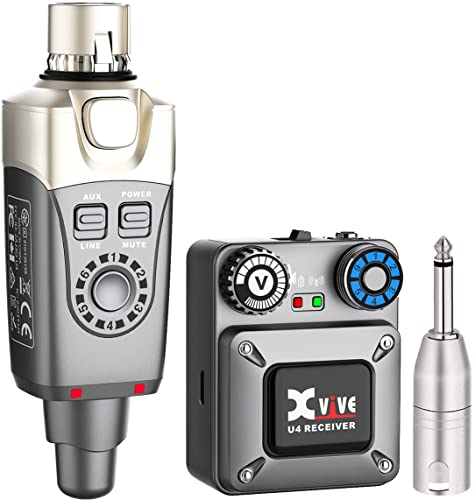
Best Compact Touring Kit – Xvive U4 Set
The Xvive U4 set is a compact option for shoppers comparing digital wireless in ear monitor systems for small venues and mobile use. This package includes one transmitter and one receiver, with 2.4GHz wireless, a working range of over 90 feet, and less than 5ms latency.
Best For: Solo performers or small setups needing a portable transmitter-and-receiver kit for clubs, rehearsals, and stage use.
Pros:
- Compact metal transmitter and receiver design for easy transport.
- Works worldwide on the 2.4GHz band according to the supplied notes.
- Offers six channels and less than 5ms latency.
- Rechargeable transmitter and receiver batteries provide up to five hours of use.
Cons:
- The package includes only one receiver, so additional performers require more equipment.
- The listed range is over 90 feet, making it less suited to large venues.
- No earphones are listed in the supplied package contents.
For a single performer or compact monitoring rig, the U4 set keeps setup and transport simple. It is a sensible choice for smaller stages, but larger groups should account for additional receivers and compatible accessories.
Best Adjustable-Frequency Option – Phenyx Pro PTM-11 UHF IEM
The Phenyx Pro PTM-11 suits buyers who prioritize frequency flexibility when choosing digital wireless in ear monitor systems. Its UHF design offers 50 selectable frequencies, separate left/right inputs and outputs, and an operating range of up to 164 feet for stage, studio, lecture, and broadcast applications.
Best For: Performers, presenters, churches, and studios that need adjustable UHF frequencies and pass-through connections.
Pros:
- Provides 50 selectable UHF frequencies and supports up to five systems working together.
- Separate inputs and line outputs allow the original signal to pass through.
- A built-in PAD switch helps reduce overload and distortion.
- Includes a metal half-rack transmitter, bodypack receiver, earphone, batteries, and rack kit.
Cons:
- It is a mono monitoring system.
- The single-receiver package is intended for one listener.
- UHF range can be affected by thick walls, glass, and metal obstructions.
The PTM-11 is a flexible single-user system with useful signal-routing features and more frequency choices than a basic fixed-channel setup. Its rack-friendly construction makes it a good fit for permanent or semi-permanent installations.
Best 5.8GHz Pick – EMR 1-GRAY Stereo IEM System
For shoppers comparing digital wireless in ear monitor systems, the EMR 1-GRAY stands out with 5.8GHz transmission, 48kHz/24-bit stereo audio, and latency below 5ms. Its rechargeable design and automatic multi-receiver pairing make it practical for rehearsals, live performances, worship teams, and studio sessions.
Best For: Performers who want clean stereo monitoring, low latency, and simple one-to-many pairing.
Pros:
- 5.8GHz wireless technology is designed for stable, interference-resistant operation.
- 48kHz/24-bit digital audio provides detailed stereo monitoring.
- Supports automatic pairing with multiple receivers and offers up to a 100-foot range.
- Rechargeable batteries provide over five hours of continuous use.
Cons:
- The listed battery runtime is shorter than some larger professional systems.
- The package includes the transmitter and receiver but does not list earbuds among the included media.
This is a well-rounded choice when low latency and modern digital clarity matter more than maximum operating range. The 5.8GHz connection and two-year manufacturer warranty add useful reassurance for regular performance use.
Best Multi-Performer System – XTUGA RW2080 UHF IEM Kit
The XTUGA RW2080 is a strong option among digital wireless in ear monitor systems when several performers need the same monitoring setup. Its UHF design, four included bodypack receivers, adjustable frequencies, and claimed range of up to 300 feet make it suited to stages, studios, lectures, and other professional audio applications.
Best For: Bands, production teams, and venues that need four bodypack receivers from one system.
Pros:
- Includes one transmitter and four bodypack receivers for multi-performer monitoring.
- UHF operation uses adjustable frequencies across a 32MHz band and supports multi-set operation.
- Offers up to 300 feet of wireless coverage under suitable conditions.
- Metal transmitter construction, LCD status display, and included rackmount kit support professional use.
Cons:
- The system weighs 4.9 pounds, making it less portable than compact personal kits.
- Its receiver battery charge time and average life are listed as 20 hours, so charging needs careful planning.
- UHF setup may require more frequency coordination than a simple plug-and-play digital kit.
The RW2080 is the most practical choice here for a group that needs multiple receivers immediately. It trades compact simplicity for broader coverage, rugged hardware, and a four-bodypack package.
Best Compact Option – LEKATO MS-02 Wireless IEM
The LEKATO MS-02 is a compact choice for buyers seeking digital wireless in ear monitor systems with quick setup and flexible monitoring modes. It offers under-4.5ms mono latency, 24-bit/48kHz audio, one-to-many pairing for up to four device pairs, and up to six to eight hours of battery life.
Best For: Singers, small bands, churches, and home or studio users who value portability and easy controls.
Pros:
- Ultra-low mono latency below 4.5ms helps keep monitoring responsive.
- Supports mono and stereo modes, five-level volume adjustment, and one-key mute.
- One transmitter can connect with up to four receiver pairs.
- Compact clip-on design, LED status indicators, and a claimed 100-foot open-area range improve usability.
Cons:
- Earbuds are not included and must be purchased separately.
- The 2.4GHz band can be more congested than newer 5.8GHz alternatives.
- The listed range is specified for open areas, so walls and interference may reduce it.
The MS-02 is a sensible everyday monitoring solution when portability, battery life, and straightforward controls matter. Remember to budget for compatible earbuds, since the transmitter and receiver kit does not complete the listening setup by itself.
Professional Stage Control – Phenyx Pro PTM-10 UHF Stereo IEM
The Phenyx Pro PTM-10 is a practical choice for anyone comparing digital wireless in ear monitor systems for stage, studio, worship, lectures, or conferences. Its selectable 900MHz operation, stereo/mono modes, and rack-ready transmitter are geared toward more controlled professional setups.
Best For: Performers, speakers, worship teams, and bands that need adjustable monitoring and up to 160 feet of coverage.
Pros:
- Selectable 89-frequency 900MHz operation supports up to five systems simultaneously.
- Stereo/mono selection, EQ, balance, limiter, PAD, and lock functions provide useful control.
- Includes a bodypack receiver, earbuds, carrying case, batteries, antenna, and rack-mount kit.
- Metal transmitter, hybrid XLR/6.3mm inputs, and removable feet suit professional installations.
Cons:
- Its 160-foot operating range is lower than some larger venue requirements.
- The system includes one transmitter and one bodypack receiver, so additional performers require more units.
Choose this model when interference management, physical durability, and detailed monitor adjustments matter more than an ultra-compact rechargeable design. The included accessories also make it easier to integrate into a rack-based audio setup.
Portable Band Monitoring – LEKATO MS-20 2.4G IEM System
The LEKATO MS-20 stands out among digital wireless in ear monitor systems for portable rehearsals and performances. It includes one transmitter and two receivers, supports auto-pairing, and uses a charging case designed to provide up to 30 hours of use across recharges.
Best For: Small bands, singers, guitarists, and drummers who want a compact two-receiver monitoring setup.
Pros:
- One transmitter can send to multiple receivers, with support for up to 10 pairs.
- Charging case, Type-C charging, and up to 30 hours of stated usage improve portability.
- Supports OTG connection to smartphones and USB-C devices for straightforward playback.
- Offers mono/stereo switching, 24-bit/48kHz audio, and a stated 150-foot open-area range.
Cons:
- Earphones are not included, so compatible in-ear headphones must be supplied separately.
- Its 2.4GHz wireless band may be less suitable for especially crowded wireless environments.
- The stated range applies to open areas and may vary in practical venues.
For musicians who need two receivers without assembling a rack system, the MS-20 offers a convenient balance of battery life, simple pairing, and flexible audio inputs. It is particularly appealing for band practice, church use, and smaller live setups.
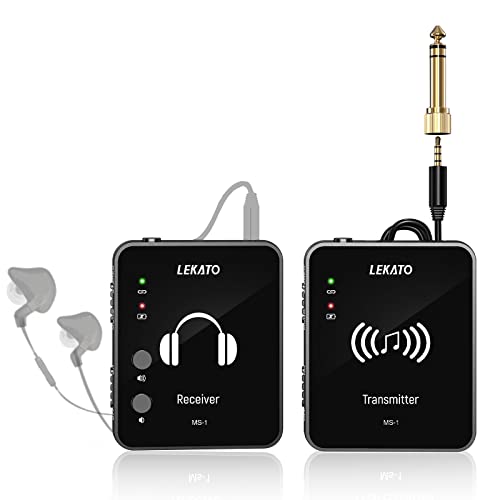
Simple Rehearsal Setup – LEKATO MS-1 Wireless Stereo IEM
The LEKATO MS-1 is a straightforward option among digital wireless in ear monitor systems for rehearsals, churches, studios, and small gigs. Its auto-pairing process, stereo/mono switch, and clip-on design keep setup uncomplicated for musicians who need basic wireless monitoring.
Best For: Small and medium-sized groups seeking easy pairing, stereo transmission, and about five hours of battery life.
Pros:
- One transmitter can pair with multiple receivers, with up to six device sets supported simultaneously.
- Auto-pairing avoids manual channel selection after the devices are powered on.
- Provides stereo/mono switching, stated latency below 12ms, and 24-bit/48kHz transmission.
- Rechargeable battery lasts more than five hours, with a stated 100-foot open-area range.
Cons:
- Five-hour battery life is shorter than the MS-20’s stated usage time.
- The 100-foot range is more limited for larger stages or venues.
- True stereo requires a stereo audio source and stereo cable.
The MS-1 makes sense when ease of use is the priority. It offers useful stereo support and multi-receiver capability at a compact scale, but its shorter range and battery life are better matched to daily practice and smaller performances than extended professional productions.
How We Picked the Best Digital Wireless in Ear Monitor Systems
We focused on systems suited to real rehearsal, studio, worship, theater, and live-performance needs. The comparison considers wireless architecture, mono or stereo monitoring, transmitter and receiver configuration, usable range, battery life, frequency flexibility, latency, construction, and setup convenience.
We also included both simple single-receiver kits and expandable options with multiple bodypacks. That matters because a solo performer has different priorities from a band sharing one transmitter or a production team managing several monitor mixes.
Quick Comparison
| Best For | What to Prioritize | Potential Trade-Off |
|---|---|---|
| Solo performers | Compact transmitter, dependable pairing, low latency | Fewer expansion options |
| Bands and rehearsals | Multiple receivers, frequency flexibility, durable packs | More setup and coordination |
| Live stereo monitoring | Stereo transmission, balanced outputs, stable range | Higher cost and power use |
| Budget setups | Simple controls and included accessories | Less refined RF management |
Key Buying Factors for Digital Wireless In-Ear Monitor Systems
Wireless Band and Interference
Systems in the 2.4GHz and 5.8GHz ranges are generally easy to deploy, but they share spectrum with other wireless devices. UHF systems may offer useful frequency-selection flexibility, though local regulations and venue conditions should be checked before purchase.
Mono Versus Stereo
Mono is often sufficient for speech, basic monitoring, and simple stage mixes. Stereo is preferable when you need spatial separation, panning, or a more natural music mix. Confirm that the transmitter, receiver, and source connections all support the desired format.
Range, Latency, and Reliability
Advertised range is measured in ideal conditions. Walls, people, antennas, and competing signals can reduce performance. For live use, stable connection and low latency are usually more important than maximum distance.
Battery and Receiver Design
Look for realistic operating time, convenient charging, clear battery indicators, and secure belt clips. Charging cases or USB charging can simplify transport, while replaceable or rechargeable packs may suit frequent professional use differently.
Expansion and Connectivity
If several performers need monitoring, verify how many receivers one transmitter can support and whether each performer receives the same mix. Check input and output connectors, rack-mount options, and whether the system integrates cleanly with your mixer or audio interface.
Who Should Buy Which Digital Wireless in Ear Monitor Systems?
Choose a compact 2.4GHz or 5.8GHz kit if you want quick setup for solo practice, small gigs, content production, or home recording.
Choose a UHF system with selectable frequencies if you perform in crowded venues or need more control over channel coordination. These systems are especially useful for bands, houses of worship, and production teams.
Choose a stereo system when your monitor mix depends on panning, backing tracks, or detailed instrument separation. Choose a multi-bodypack package when several performers can share one transmitter and the same monitor mix.
Before ordering, confirm the included number of receivers, connector types, wireless band, local frequency compatibility, and whether your mixer provides the required monitor output. The best digital wireless in-ear monitor systems are the ones that match your stage workflow—not simply the ones with the longest advertised range.