Large rooms need more than a basic bass upgrade. The right subwoofer adds deeper, fuller low frequencies that remain impactful across a wider listening area without overwhelming dialogue or music.
Our 2026 roundup compares 10 powered subwoofers across different sizes, output levels, connection styles, and budgets, so you can match bass performance to your room and audio system.
Best 10 Subwoofers for Large Rooms Picks for 2026
Big-Room Power Pick

- 12-inch front-firing woofer
- 400 watts of dynamic power
- Line/LFE inputs with phase control
Best For: Large-room home theater and music systems
Compact Value Choice
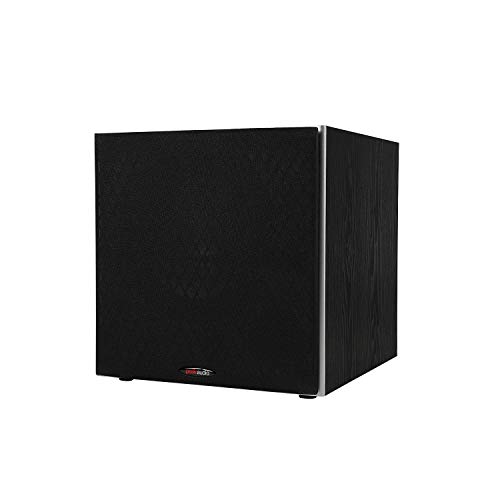
- 10-inch Dynamic Balance woofer
- Up to 100 watts of power
- Adjustable crossover and phase toggle
Best For: Small-to-mid size rooms and budget setups
High-Output Theater Pick

- 12-inch high-excursion woofer
- 400 watts of peak output
- 116 dB maximum acoustic output
Best For: Large home-theater rooms and high-impact bass
Clean-Bass Design Pick

- 10-inch woofer with Advanced YST II
- Twisted flare port
- Stylish floor-standing cabinet
Best For: Home theaters prioritizing clean bass and appearance
Balanced Room-Filling Bass
Klipsch R-100SW 10-Inch Subwoofer

- 10-inch front-firing woofer
- 300 watts peak power
- RCA and LFE inputs
Best For: Wired home-theater and gaming systems
High-Output Home Theater Bass

- 600 watts peak, 300 watts RMS
- Class-D built-in amplifier
- RCA and high-level connections
Best For: Large-room movies, music, and gaming
Simple Wireless Integration

- Wireless Wi-Fi connectivity
- Dual inward-facing 6-inch woofers
- Trueplay room tuning
Best For: Compatible Sonos Beam or Ray systems
Compact Deep-Bass Pick
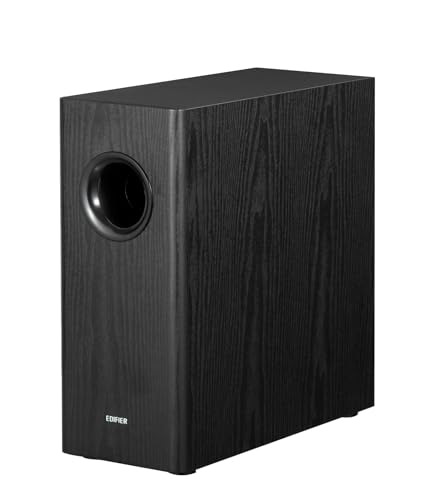
- 8-inch woofer with 70W RMS output
- 35Hz bass and adjustable crossover
- Slim MDF cabinet with auto-standby
Best For: Space-conscious home audio and theater setups
Flexible Connectivity Pick

- 100W RMS and 200W peak power
- RCA and speaker-level connections
- Adjustable crossover and phase controls
Best For: Compact home theater and gaming systems
Balanced Home Theater Pick
Yamaha NS-SW050BL 8-Inch Subwoofer

- 8-inch Yamaha Active Servo woofer
- 100W dynamic power
- Twisted flare port for tight bass
Best For: Simple home theater and music upgrades
Big-Room Power Pick – Klipsch R-12SW
For shoppers comparing subwoofers for large rooms, the Klipsch R-12SW stands out with a 12-inch front-firing woofer and up to 400 watts of dynamic power. Its wired line/LFE inputs, low-pass crossover, and phase control make it practical for home-theater integration.
Best For: Large-room movie and music systems that need strong, room-filling bass.
Pros:
- 12-inch copper-spun front-firing woofer
- 400 watts of dynamic amplifier power
- Line/LFE inputs, low-pass crossover, and phase control
- 29 Hz listed frequency response
Cons:
- Wired rather than wireless connectivity
- Large floor-standing cabinet may require dedicated space
The R-12SW is a compelling choice when output and driver size matter more than a compact footprint. It is especially well suited to listeners who want one substantial subwoofer for both music and movies.
Compact Value Choice – Polk Audio PSW10
The Polk Audio PSW10 is a compact powered subwoofer with a 10-inch Dynamic Balance woofer and up to 100 watts of power. While it is specified for small-to-mid size rooms, its adjustable crossover and flexible inputs make it easy to add bass to an existing system.
Best For: Smaller rooms or budget-conscious setups that want a straightforward bass upgrade.
Pros:
- Compact 10-inch powered design
- Continuously variable 80–160 Hz crossover
- Speaker- and line-level connections
- Phase toggle supports multiple-subwoofer setups
Cons:
- 100 watts is less output than the larger Klipsch models
- Supplied notes position it for small-to-mid size rooms rather than large spaces
The PSW10 is easy to integrate and offers useful adjustment controls, but it may not provide the same headroom as a larger model in a genuinely large room. Consider it when placement flexibility and value are higher priorities than maximum impact.
High-Output Theater Pick – Klipsch R-120SW
The Klipsch R-120SW combines a 12-inch high-excursion spun-copper woofer with 200 watts of amplifier power and 400 watts of peak output. For shoppers seeking subwoofers for large rooms, its 116 dB maximum acoustic output and rear-firing bass-reflex port make it a strong home-entertainment candidate.
Best For: Large home-theater rooms where high output and deep, impactful bass are priorities.
Pros:
- 12-inch high-excursion spun-copper woofer
- 200 watts continuous and 400 watts peak amplifier power
- 116 dB maximum acoustic output
- 29–120 Hz ±3 dB frequency range
Cons:
- Rear-firing port requires thoughtful placement
- RCA wired connectivity may be less flexible than wireless designs
With its high-output specifications and large driver, the R-120SW is aimed at listeners who want a more forceful theater experience. Leave room around the rear port and use the RCA connection to integrate it with compatible equipment.
Clean-Bass Design Pick – Yamaha NS-SW100BL
The Yamaha NS-SW100BL uses a 10-inch cone woofer, Advanced YST II technology, and a twisted flare port designed to contribute to clear, tight bass. It can suit buyers considering subwoofers for large rooms who also want a straightforward floor-standing design with a room-friendly appearance.
Best For: Home-theater users who favor a clean-bass presentation and simple, stylish enclosure.
Pros:
- 10-inch cone woofer with Advanced YST II
- Twisted flare port for clear, tight bass
- Floor-standing design with a stylish appearance
- 100 watts of listed maximum output
Cons:
- 10-inch driver and 100-watt output may offer less large-room headroom
- Supplied notes list wired connectivity despite a Bluetooth specification
The NS-SW100BL emphasizes controlled bass and a visually unobtrusive design rather than maximum output. It is worth considering for moderate listening levels or systems where appearance and bass character are especially important.
Balanced Room-Filling Bass – Klipsch R-100SW 10-Inch Subwoofer
For shoppers comparing subwoofers for large rooms, the Klipsch R-100SW is a practical wired option with a front-firing 10-inch woofer and 300 watts of peak power. Its RCA and LFE inputs make it compatible with many home-theater receivers.
Best For: Home-theater and gaming setups that need adjustable, deep bass from a conventional floor-standing subwoofer.
Pros:
- 10-inch spun-copper IMG woofer provides low-frequency output down to 32Hz.
- 300 watts peak power from an all-digital amplifier.
- Volume, low-pass crossover, and 0/180-degree phase controls support system matching.
- RCA line-level and LFE inputs offer broad receiver compatibility.
Cons:
- Wired connectivity only; it does not support wireless communication.
- Its 26-pound cabinet may require some planning for placement.
The R-100SW is a straightforward choice when you want dedicated bass controls, receiver-friendly inputs, and a compact wood enclosure rather than a wireless ecosystem.
High-Output Home Theater Bass – Rockville Rock Shaker 10-Inch
The Rockville Rock Shaker is one of the more output-focused subwoofers for large rooms, pairing a 10-inch woofer with a built-in Class-D amplifier rated at 300 watts RMS and 600 watts peak. Its multiple connection options suit varied home-theater layouts.
Best For: Movie, music, and gaming setups that prioritize strong bass output and flexible wired connections.
Pros:
- 300 watts RMS and 600 watts peak output deliver substantial low-end capability.
- Adjustable volume, crossover frequency, and phase controls allow tuning.
- RCA line inputs/outputs and high-level speaker inputs/outputs support different setups.
- MDF cabinet with a vinyl finish and detachable foam grille offers a durable design.
Cons:
- It uses wired connectivity rather than wireless pairing.
- The cabinet is relatively large, measuring 18.9 inches deep by 18.3 inches wide.
- The supplied warranty is one year.
With its higher stated power rating and high-level connections, the Rock Shaker is worth considering when a larger room or varied receiver setup calls for a flexible, forceful powered subwoofer.
Simple Wireless Integration – Sonos Sub Mini
The Sonos Sub Mini takes a different approach to subwoofers for large rooms: it uses Wi-Fi and app control instead of traditional receiver wiring. Dual inward-facing 6-inch woofers, force-canceling construction, and Trueplay tuning are designed to integrate with compatible Sonos systems.
Best For: Sonos owners using a Beam or Ray who want compact, wireless bass enhancement with app-based setup.
Pros:
- Wireless Wi-Fi connectivity simplifies compatible Sonos installations.
- Dual inward-facing woofers help reduce distortion through force-canceling design.
- Trueplay tuning adapts bass response to room acoustics; an iOS device is required.
- Compact 8.98-inch-square footprint is easier to place than many conventional subwoofers.
Cons:
- Designed for Sonos surround systems rather than universal RCA receiver setups.
- Its compact 6-inch drivers may not suit buyers seeking the highest output for a very large space.
- Trueplay setup requires a supported iOS device.
The Sub Mini is best viewed as a streamlined Sonos add-on, not a general-purpose wired subwoofer. Its strongest advantages are wireless integration, room tuning, and a space-conscious design.
Compact Deep-Bass Pick – Edifier T5s Powered Subwoofer
The Edifier T5s is a practical choice for shoppers comparing subwoofers for large rooms who also want a slim cabinet. Its 8-inch long-throw woofer, 70W RMS Class-D amplifier, and 35Hz frequency response add low-end weight to home audio and home theater setups.
Best For: Buyers who want adjustable, wired bass extension in a space-saving design.
Pros:
- 8-inch woofer and 70W RMS output deliver deep bass down to 35Hz.
- Adjustable 30Hz–160Hz low-pass filter and 0°/180° phase selector aid system matching.
- Compact MDF cabinet, front-firing driver, and right-firing port are designed for clean, tight bass.
- Auto-standby and included RCA cables simplify setup and everyday use.
Cons:
- It uses wired RCA connectivity and has no wireless communication technology.
- The slim enclosure may offer less output headroom than larger subwoofers for very spacious rooms.
- Series connection requires main speakers with a line input.
The T5s stands out when placement flexibility and straightforward integration matter more than maximum room-filling output. Its controls and connection options make it adaptable, but buyers with especially large spaces may want a higher-powered model.
Flexible Connectivity Pick – Rockville Rock Shaker 6.5
The Rockville Rock Shaker is a compact powered subwoofer for shoppers seeking subwoofers for large rooms with flexible system connections. Its 100W RMS amplifier, adjustable crossover and phase controls, and RCA plus speaker-level inputs and outputs support home theater, music, and gaming setups.
Best For: Users who need versatile wired connections and adjustable integration in a compact enclosure.
Pros:
- 100W RMS and 200W peak power support impactful low-frequency sound.
- RCA and speaker-level inputs and outputs work with receivers, amplifiers, and other audio systems.
- Adjustable crossover and phase controls help tailor bass to the room and main speakers.
- Compact 11-inch × 11.8-inch × 12.6-inch design is easy to place.
Cons:
- The 6.5-inch woofer is smaller than the drivers in the other listed models.
- Connectivity is wired rather than wireless.
- Its compact format may not provide the same scale as a larger subwoofer in a very large room.
The Rock Shaker offers a useful balance of power, adjustability, and connection flexibility. It is a sensible fit for systems that may use either line-level or speaker-level connections, though its smaller driver favors convenience over maximum bass scale.
Balanced Home Theater Pick – Yamaha NS-SW050BL 8-Inch Subwoofer
The Yamaha NS-SW050BL is a straightforward 8-inch powered subwoofer for shoppers comparing subwoofers for large rooms. It combines 100W dynamic power with Yamaha Active Servo Technology II and a twisted flare port intended to produce clear, tight bass for home theater and music playback.
Best For: Home theater and music listeners who want a simple Yamaha-powered bass upgrade.
Pros:
- 8-inch cone woofer provides a substantial driver size for home audio use.
- 100W dynamic power supports stronger low-frequency impact.
- Twisted flare port is designed to reduce port noise and maintain clear, tight bass.
- Stylish black design suits a range of room setups.
Cons:
- The supplied details do not list adjustable crossover or phase controls.
- It uses a wired subwoofer connection despite some inconsistent listing connectivity details.
- Its 28Hz frequency response and 100W rating may be modest for exceptionally large rooms.
The NS-SW050BL is an appealing option for buyers who value a familiar brand, an 8-inch driver, and uncomplicated home theater integration. Its port design focuses on controlled bass, while users wanting extensive tuning controls may prefer a more adjustable model.
How We Picked the Best Subwoofers for Large Rooms
We focused on powered subwoofers with built-in amplification, since they are easier to integrate into home theater and stereo systems. The lineup includes 6.5-inch, 8-inch, 10-inch, and 12-inch models, allowing you to compare compact solutions with options designed for greater output.
We considered driver size, amplifier power, published low-frequency performance, connectivity, enclosure design, brand support, and overall value. Because room size, placement, and listening preferences vary, no single model is ideal for every buyer.
Quick Comparison
| What to Compare | Best For | What It Means |
|---|---|---|
| 12-inch driver | Large rooms and home theater | Typically delivers greater air movement and headroom. |
| 10-inch driver | Balanced performance | A practical choice for medium-to-large spaces. |
| 8-inch or smaller driver | Compact rooms and systems | Uses less space but may provide less deep, room-filling bass. |
| Wireless connectivity | Clean installations | Reduces cable clutter but may require ecosystem compatibility. |
| Higher amplifier power | More demanding listening | Can provide stronger peaks and better headroom when properly designed. |
Key Buying Factors for Subwoofers for Large Rooms
Driver Size and Output
For large rooms, a 10-inch or 12-inch woofer is usually the safest starting point. Larger drivers can move more air, while higher amplifier power helps the subwoofer maintain impact at louder levels. Specifications are useful, but cabinet design and real-world integration also matter.
Room Placement
Placement can affect bass as much as the subwoofer itself. Start near the front of the room, then test corners and wall positions. A corner often increases output, while moving the subwoofer away from boundaries may produce smoother bass. If possible, use room correction or experiment with multiple listening positions before finalizing placement.
Compatibility and Controls
Check that your receiver, amplifier, soundbar, or powered speakers provide a compatible subwoofer output. Adjustable crossover and phase controls make blending easier. Wireless models are convenient, but verify that they work with your existing audio ecosystem rather than assuming universal compatibility.
Size, Budget, and Neighbors
A larger subwoofer is not automatically better if it cannot be positioned correctly. Leave adequate ventilation, account for floor space, and consider vibration transfer in apartments or rooms above other living areas. Spending more on output you cannot use may deliver less value than choosing a well-matched model.
Who Should Buy Which Subwoofers for Large Rooms?
- Choose a 12-inch model if you want the strongest cinematic impact and have room for a larger cabinet.
- Choose a 10-inch model for the best all-around balance of output, size, and price in many large-room systems.
- Choose an 8-inch model if your room is moderately sized, your listening levels are restrained, or space is limited.
- Choose a compact 6.5-inch model for desktop, bedroom, or secondary systems where convenience matters more than maximum depth.
- Choose a wireless subwoofer when a compatible ecosystem and a clean installation are priorities.
Before buying, confirm the subwoofer’s dimensions, input requirements, return policy, and placement options. The best choice is the model that provides sufficient headroom for your room while blending cleanly with your main speakers.