Choosing the right instrument can make or break a set, especially when you need fast access, reliable controls, and sounds that cut through a live mix.
This roundup focuses on the best synthesizers for live performances, from compact travel-friendly options to full-size stage keyboards built for confident hands-on play.
Best 10 Synthesizers for Live Performances Picks for 2026
Gig-Ready Stage Keyboard
Roland JUNO-D6 61-Note Performance Synth

- 3,800+ ZEN-Core sounds
- USB-C battery power support
- 61-note portable synth-action keys
Best For: Live players who want fast access to essential stage sounds and easy transport
Modern Analog Monosynth
MOOG Messenger Portable Bass Synth

- Two VCOs plus sub-oscillator
- 32 full-size keys with aftertouch
- 64-step sequencer and arpeggiator
Best For: Bass and lead players who want hands-on analog control on stage
Portable MIDI Controller
Akai MPK Mini MK3 Compact Performance Pad Controller

- 25 velocity-sensitive mini keys
- 8 MPC-style pads and 8 knobs
- Built-in arpeggiator and NKS support
Best For: Laptop-based performers who need a compact controller for virtual synths
Polyphonic Performance Synth
Korg KingKORG NEO 37-Key Vocoder Keyboard

- 24-voice polyphony for layered parts
- 37 full-size velocity-sensitive keys
- 16-band vocoder with split/layer modes
Best For: Keyboardists who want layered polyphony and vocoder effects on stage
Experimental Hybrid Pick
Arturia MicroFreak Synthesizer Keyboard
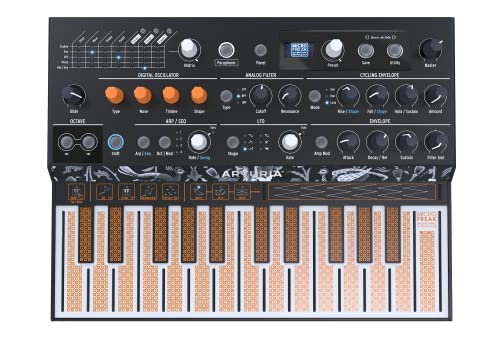
- 17 oscillator modes plus analog filter
- Poly aftertouch touch-plate keyboard
- Spice and Dice sequencing for evolving sets
Best For: Players who want a compact, expressive live synth with deep sound design
Semi-Modular Rhythm Pick
Behringer Grind Hybrid Synthesizer

- 24 digital oscillators and 14 synth engines
- 10 percussion/noise engines for live textures
- 32-step sequencer for rhythmic performance
Best For: Performers who want a semi-modular hybrid synth for rhythmic sequences
Portable FM Pick
M-VAVE Wireless Portable FM Synthesizer

- Battery-powered with built-in speaker
- 6 operators and 32 FM algorithms
- Arpeggiator, 16-step sequencer, and 6 effects
Best For: Mobile players who want a battery-powered FM synth for live use
Stage Novelty Pick

- Full-sized Otamatone with wider neck
- 3.5mm output works with amps and speakers
- Touch stem, squeeze, and vibrato effects
Best For: Performers who want a quirky, amp-friendly live instrument
Compact FM Workhorse

- 6-operator FM engine with 32 algorithms
- USB-C, Bluetooth MIDI, and MIDI IN support
- Arpeggiator, sequencer, and six effects
Best For: Guitarists and mobile performers needing portable FM sounds
Portable Analog Performer

- Battery-powered with built-in speaker
- Analog delay, filter, LFO, and envelope controls
- CV/Gate output for modular rigs
Best For: Performers wanting a portable analog synth with expressive control
Gig-Ready Stage Keyboard – Roland JUNO-D6 61-Note Performance Synth
If you want synthesizers for live performances that cover the essentials without slowing you down, the Roland JUNO-D6 is built around speed, portability, and a broad stage-ready sound set. Its 61-note synth-action keyboard, USB-C mobile battery power support, and over 3,800 ZEN-Core sounds make it an easy fit for gigs, rehearsals, and quick setup changes.
Best For: Players who need a lightweight, performance-focused keyboard with quick access to piano, organ, and synth sounds.
Pros:
- Over 3,800 ready-to-play ZEN-Core sounds for live band coverage.
- USB-C mobile battery power support for flexible gig use.
- Compact 61-note synth-action keyboard for easier transport.
- Built-in eight-track sequencer plus sample import for custom setups.
Cons:
- Only 61 keys, so it is not ideal for players wanting a full-sized piano range.
- Included components are limited to the synthesizer itself.
The JUNO-D6 is a practical pick if you need a portable live keyboard with a fast workflow and a deep preset library. It balances stage-friendly sounds with enough expansion and editing tools to handle more than basic performance duties.
Modern Analog Monosynth – MOOG Messenger Portable Bass Synth
Among synthesizers for live performances, the MOOG Messenger stands out for players who want true analog character in a compact monosynth. It combines two VCOs, a sub-oscillator, a next-gen ladder filter, and knob-per-function controls, making it straightforward to shape bass-heavy lead and low-end parts on stage.
Best For: Performers and producers who want a portable analog monosynth with hands-on control and strong bass presence.
Pros:
- Legendary MOOG analog sound with modern enhancements.
- 32 full-size semi-weighted keys with velocity and aftertouch.
- 64-step sequencer and arpeggiator for pattern-based performance.
- Strong connectivity, including CV, DIN MIDI, and USB-C.
Cons:
- Monophonic design limits it to single-note lines and bass parts.
- Best suited to players who are comfortable with a hands-on synth workflow.
If your live set depends on expressive monosynth tones and immediate control, the Messenger offers a focused, performance-friendly toolset. Its bass compensation, modulation options, and robust connection set make it a flexible stage instrument.
Portable MIDI Controller – Akai MPK Mini MK3 Compact Performance Pad Controller
If you are shopping for synthesizers for live performances but mainly need to control virtual instruments, the Akai MPK Mini MK3 is a compact USB MIDI keyboard built for fast programming and portable use. Its 25 velocity-sensitive keys, arpeggiator, MPC-style pads, and assignable knobs give you a small footprint controller for triggering synths, beats, and effects from a laptop-based rig.
Best For: Laptop performers and beat makers who want a compact controller for virtual synths and samples.
Pros:
- Ultra-portable 25-key design for tight stage or studio spaces.
- 8 MPC-style pads, 8 knobs, and a 4-way thumbstick for control.
- Built-in arpeggiator for simple pattern creation.
- NKS support and included software bundle add value for software-based setups.
Cons:
- Not a standalone synthesizer; it requires a computer or external sound source.
- Mini keys may feel cramped for players used to larger keyboards.
This is a smart pick if your live setup centers on virtual instruments rather than an onboard sound engine. It is lightweight, flexible, and packed with controls for performers who need quick access to software sounds.
Polyphonic Performance Synth – Korg KingKORG NEO 37-Key Vocoder Keyboard
For players comparing synthesizers for live performances, the Korg KingKORG NEO offers a versatile polyphonic approach with expressive keys and a built-in vocoder. Its 37 full-size velocity-sensitive keys, XMT sound engine, 24 voices of polyphony, and split/layer capability make it a strong option when you want classic-style synth shaping on stage.
Best For: Keyboardists who want a flexible performance synth with polyphony, vocoder features, and layered sounds.
Pros:
- 24-voice polyphony supports richer layered and sustained parts.
- XMT sound engine models classic analog synth behavior.
- 16-band vocoder and formant shift/hold add performance character.
- Split/layer functionality and 300 programs expand stage flexibility.
Cons:
- 37 keys may feel limited for players who want a larger performance range.
- Its deeper synthesis features may take more time to learn than a preset-focused board.
The KingKORG NEO is a strong live synth if you want more than basic presets and need tools for shaping sounds in real time. It balances expressive control, versatile sound design, and vocal-style effects in a stage-friendly format.
Experimental Hybrid Pick – Arturia MicroFreak Synthesizer Keyboard
If you want synthesizers for live performances that can jump from wild textures to tight rhythmic parts, the Arturia MicroFreak is built for expressive hands-on control. Its hybrid engine blends multiple digital oscillator modes with an analog filter, while the touch-plate keybed and per-note pressure help keep performances dynamic and immediate.
Best For: Players who want a compact, experimental live synth with deep sound design and expressive control.
Pros:
- 17 oscillator modes, including physical modeling, wavetable, and other experimental engines
- Poly aftertouch touch-plate keyboard for expressive live playing
- Spice and Dice sequencing plus automation for evolving performance patterns
- CV, USB, and MIDI connectivity for pairing with DAWs or modular gear
Cons:
- 25-key layout is compact if you need a larger performance range
- Touch-plate design may not suit players who prefer traditional keys
The MicroFreak stands out when your set needs unusual tones and fast sound-shaping tools rather than a conventional keyboard feel. It is a strong choice for performers who want plenty of sonic variety in a small footprint.
Semi-Modular Rhythm Pick – Behringer Grind Hybrid Synthesizer
For synthesizers for live performances that lean into sequencing and percussive sound design, the Behringer Grind offers a semi-modular hybrid approach with plenty of digital engine variety. Its 24 digital oscillators, percussion/noise engines, analog ladder filter, and 32-step sequencer make it a practical option for building driving patterns on stage.
Best For: Performers who want a semi-modular hybrid synth focused on rhythmic sequences and sound design.
Pros:
- 24 digital oscillators and 14 synth engines for broad timbral options
- 10 percussion/noise engines for punchy live textures
- Analog ladder filter adds character to the hybrid sound
- 32-step sequencer supports pattern-based performance work
Cons:
- More specialized for experimental and rhythmic use than traditional keyboard playing
- Connector details are limited in the supplied notes
The Grind is a good fit if your live set benefits from evolving sequences, industrial textures, and hands-on hybrid synthesis. It looks especially useful for players who want a compact semi-modular instrument with a strong rhythmic focus.
Portable FM Pick – M-VAVE Wireless Portable FM Synthesizer
If portability matters in synthesizers for live performances, the M-VAVE Wireless Portable FM Synthesizer is built for playing anywhere with battery power and a built-in speaker. Its FM engine, preset library, arpeggiator, and 16-step sequencer make it a flexible travel-friendly option for sketching ideas or performing compact sets.
Best For: Mobile players who want a battery-powered FM synth with built-in playback tools.
Pros:
- Battery operation and built-in speaker support truly portable use
- 6 operators, 32 algorithms, and 128 presets cover classic FM sounds
- 6 built-in effects plus arpeggiator and 16-step sequencer expand performance options
- USB MIDI, wireless Bluetooth MIDI, and 3.5mm MIDI IN offer flexible connectivity
Cons:
- 27-key silicone layout is compact and may feel limiting for some players
- Small form factor prioritizes portability over a full performance keyboard experience
This is the most travel-ready option in the group, especially if you want a synth you can power up and use without extra gear. It is best for quick musical ideas, portable jams, and lightweight live setups.
Stage Novelty Pick – Otamatone Deluxe Black
If you want synthesizers for live performances that lean more playful than traditional, the Otamatone Deluxe brings a distinctive sound and stage presence. Its full-size body, touch-sensitive stem, and amp-ready 3.5mm output make it easy to plug into a live setup for simple melody lines, effects, or crowd-pleasing novelty moments.
Best For: Players who want a fun, portable performance synth that can connect to speakers or amps and stand out visually on stage.
Pros:
- Deluxe, full-sized version with a wider neck for more precise playing
- Compatible with headphones, amps, and speakers via 3.5mm stereo jack
- Touch-sensitive stem plus squeeze and vibrato effects for expressive performance
- Portable design with strap included for easy carrying
Cons:
- More of a novelty-performance instrument than a conventional keyboard synth
- Limited to the unique Otamatone playing style
The Otamatone Deluxe is a practical pick if your live rig needs something unusual, compact, and easy to amplify. It is not the most traditional choice, but it can add an unmistakable character to a performance.
Compact FM Workhorse – M-VAVE FM-1 Black
For players shopping synthesizers for live performances, the M-VAVE FM-1 is built around a compact FM engine with enough connectivity and onboard tools to handle stage use. Its 128 presets, arpeggiator, sequencer, and multiple MIDI options make it a flexible choice for portable performances and quick sound changes.
Best For: Guitarists and performers who want a pocket-sized FM synth that can integrate with pedals, DAWs, and MIDI gear.
Pros:
- 6-operator FM engine with 32 algorithms for classic FM sounds
- 128 factory presets plus FM SYSEX import
- USB-C, Bluetooth BLE MIDI, and 3.5mm MIDI IN connectivity
- Built-in arpeggiator, 16-step sequencer, and six effects
Cons:
- 27-key silicone keyboard is compact and not ideal for full-size playing
- Small form factor may suit sound modules better than hands-on keyboardists
The FM-1 stands out if you need a tiny synth that can travel anywhere and still offer real sound-design depth. It is especially appealing for live players who want easy integration with existing gear.
Portable Analog Performer – Stylophone GENX-2
If you are comparing synthesizers for live performances, the Stylophone GENX-2 is a compact analogue option with real hands-on control. Its built-in speaker, battery power, filter, LFO, delay, and CV/Gate outputs make it suitable for quick stage setups, portable jams, and hardware-based rigs.
Best For: Live players who want a portable analogue synth with expressive controls and modular connectivity.
Pros:
- Portable, battery-powered design with built-in speaker
- Analog tools including LFO, resonant low-pass filter, envelope, and delay
- CV and Gate outputs for controlling modular and semi-modular gear
- Stylus keyboard and expression strip support pitch bends and filter sweeps
Cons:
- Stylus-style playing may not suit everyone on stage
- More specialized than a full-size performance keyboard
The GENX-2 is a strong fit if you value portability but still want real sound-shaping controls for live use. It offers enough connectivity and expression features to work as a creative performance tool rather than just a small novelty synth.
How We Picked These Synthesizers for Live Performances
We prioritized instruments that make sense on stage: dependable sound engines, responsive controls, quick patch access, and form factors that fit real gig setups. We also looked at portability, power options, and whether the synth encourages performance rather than menu diving.
Quick Comparison
For live use, the big tradeoff is usually between immediacy and flexibility. Full-size boards like the Roland JUNO-D6 and Korg KingKORG NEO suit players who want broad coverage and comfortable keys. Compact choices such as the Arturia MicroFreak, Akai MPK Mini MK3, and M-VAVE portable models favor minimal footprint and easy transport. More experimental or niche instruments, including the MOOG Messenger, Behringer Grind, and Stylophone GENX-2, appeal to players who want character and hands-on sound shaping.
Key Buying Factors for Synthesizers for Live Performances
Keyboard feel and size: Choose 61 keys if you need both hands, layered parts, or more range. Smaller keyboards are better when space is tight or you already travel with other gear.
Sound variety and recall: Live players benefit from presets that load quickly and cover essentials like pads, leads, basses, and keys without extensive setup.
Hands-on controls: Faders, knobs, arpeggiators, filters, and modulation controls make it easier to adapt in real time. The best Synthesizers for Live Performances let you shape sound without stopping the song.
Connectivity and power: Check MIDI, audio output, USB, CV/Gate, and battery options if you play different venues or integrate with external gear.
Durability and portability: A rugged shell and practical weight matter as much as sound quality if you gig often or commute with your instrument.
Who Should Buy Which Synthesizers for Live Performances?
Gigging keyboardists: Look first at full-size stage synths for stable keybeds, easy split/layer use, and broad preset coverage.
Electronic performers and sound designers: Choose semi-modular or hybrid instruments if you want deeper tweaking and more distinctive textures.
Traveling musicians and minimal setups: Compact synths and controller-style options are best when space, weight, and speed matter most.
Beginners and casual performers: Simpler portable models can be a smart entry point, especially if you want immediate fun and low setup friction.
In the end, the right choice depends on whether you value keyboard range, sound design depth, or maximum portability. If you match the instrument to your performance style, you will get far more from your rig on stage.