If you want more control over your recordings, two channel microphone preamps can be a major upgrade. They give you flexible gain staging, cleaner capture, and better options for stereo miking or tracking two sources at once.
Below, we’ve rounded up standout choices for home studios, project rooms, and pro setups, with a focus on sound quality, features, and real-world value.
Best 10 Two Channel Microphone Preamps Picks for 2026
Tube Character Two-Channel Preamp
ART ProMPAII Two Channel Class A Preamp

- Variable input impedance for mic voicing
- Selectable plate voltage adds flexibility
- Low noise and very low distortion
Best For: Users wanting adjustable tube-style dual-channel preamp control
Clean Gain Booster
StudioMan CL-200 Dual-Channel Mic Booster

- Dual-channel +25dB clean gain boost
- Low-noise design with very low distortion
- Runs on 48V phantom power
Best For: Dynamic and ribbon mic users needing transparent dual-channel gain
Studio Control Rack Preamp
Focusrite ISA Two Dual Mono Mic Preamp

- Lundahl LL1538 transformer input stage
- Variable impedance and up to 80dB gain
- Per-channel HPF and balanced inserts
Best For: Studio engineers needing a configurable dual-mono rack preamp
Classic 2-Channel Mic Preamp
Warm Audio WA273 Dual-Channel Preamp

- Two-channel mic/line/instrument preamp
- XLR connectivity for recording setups
- Works with interfaces, mixers, and computers
Best For: General-purpose dual-channel recording setups
Dual-Channel Character Preamp
Behringer 1273 2-Channel Microphone Preamplifier and Equalizer

- 2-channel mic, line, and instrument preamp
- 3-band EQ, highpass filter, and tone switch
- XLR and 1/4-inch TRS connectivity
Best For: Recording setups that want dual-channel tone shaping and flexible front-end control
Hybrid Tone-Blending Preamp
Universal Audio 710 Twin-Finity Microphone Preamp

- Tone-blends tube and solid-state paths
- Dual gain stages for clean-to-driven sounds
- Discrete JFET DI with ultra hi-Z input
Best For: Players and engineers who want a character-rich single-channel preamp and DI
Classic Studio Dual Preamp
Neve 1073DPX 2-Channel Microphone Preamp & EQ

- 2-channel mic, line, and DI preamp/EQ
- Up to 80dB of gain with highpass filters
- Rear inserts, polarity reverse, and headphone amp
Best For: Engineers needing a premium dual-channel studio preamp with flexible routing
Desktop Dual-Channel Preamp
Black Lion Audio Auteur mkIII 2-Channel Mic Preamp and DI Bundle

- Two balanced XLR mic inputs and two Hi-Z instrument/line inputs
- 62 dB gain, 48V phantom power, pad, and phase inversion
- Cinemag transformers with desktop or rackmount use
Best For: Home studios and users needing a flexible dual-channel preamp with DI inputs
Portable Dual-Channel Mixer Preamp
Rolls MP213 Two-Channel Microphone Preamp

- Dual mic preamp channels in a small portable chassis
- XLR inputs up to 60 dB gain with 48V phantom power
- 3.5mm output can work for camera mixing or monitoring
Best For: Portable setups and camera microphone mixing
Budget USB-Powered Dual Preamp
2 Channel Microphone Preamp, Dual Input USB Powered with 48V Phantom Power
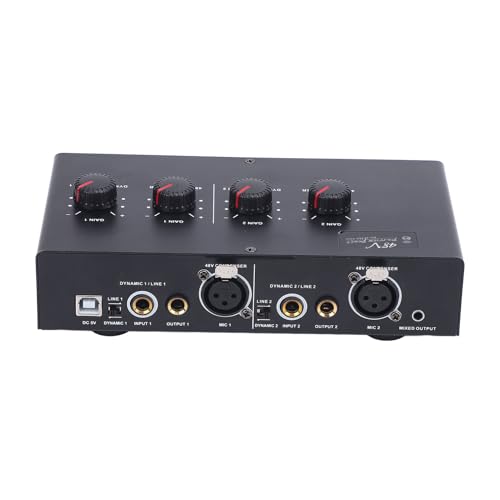
- USB-powered dual-input design with 48V phantom power
- Works with mics, guitars, and other common inputs
- Bluetooth accompaniment playback adds convenience
Best For: Podcasters and home users wanting a simple dual preamp with broad compatibility
Tube Character Two-Channel Preamp – ART ProMPAII Two Channel Class A Preamp
The ART ProMPAII is a two channel microphone preamp built for users who want more control over mic voicing than a basic interface preamp can offer. Its variable input impedance, selectable plate voltage, and discrete Class-A input stage make it a flexible option when you want to shape how microphones respond while keeping noise and distortion low.
Best For: Recording setups that need dual-channel tube-style preamp flexibility and adjustable mic voicing.
Pros:
- Variable input impedance helps match different microphones
- Selectable plate voltage adds voicing flexibility
- Discrete Class-A input design with low noise at lower gain settings
- Extremely low total harmonic distortion
Cons:
- Heavier rack-style unit than compact inline options
- Designed as a fuller preamp solution, not a simple gain booster
Overall, the ProMPAII stands out if you want a two channel microphone preamp with more tonal control than a stripped-down clean boost unit. It is a strong fit for studios that want flexible mic matching and tube-based character in a dedicated hardware preamp.
Clean Gain Booster – StudioMan CL-200 Dual-Channel Mic Booster
The StudioMan CL-200 is a two channel microphone preamp designed as a clean gain boost for dynamic and passive ribbon microphones. It delivers up to +25dB of ultra-clean gain from 48V phantom power, which can help reduce how hard you need to push your mixer or interface gain while keeping hiss and noise down.
Best For: Dynamic and passive ribbon mic users who need a compact dual-channel gain booster.
Pros:
- Dual-channel design supports two microphones at once
- Provides a +25dB clean gain boost
- Very low THD+N and high EIN specification
- Compact metal housing with XLR I/O
Cons:
- Not compatible with condenser microphones
- Requires 48V phantom power to operate
If you need a practical inline solution for weak dynamic mic output, the CL-200 is focused and easy to understand. It is best viewed as a clean signal booster rather than a coloration preamp, making it especially useful when transparency matters.
Studio Control Rack Preamp – Focusrite ISA Two Dual Mono Mic Preamp
The Focusrite ISA Two is a rackmount two channel microphone preamp built around classic ISA topology and a Lundahl LL1538 transformer. With variable input impedance, up to 80dB of gain, and per-channel high-pass filtering, it is aimed at users who want precise control and a highly configurable front end for studio recording.
Best For: Engineers who want a flexible dual-mono rack preamp with transformer-based input options.
Pros:
- Two independent mic preamps in a rackmount format
- Variable input impedance for better mic matching
- Up to 80dB maximum gain on microphone input
- Per-channel high-pass filter and balanced inserts
Cons:
- Larger studio rack unit, not a compact desktop box
- More feature-rich than a simple plug-and-play preamp
The ISA Two is a strong choice when the goal is professional control rather than minimal setup. Its combination of variable impedance, transformer input, and channel-by-channel utilities makes it one of the most versatile two channel microphone preamps in this group.
Classic 2-Channel Mic Preamp – Warm Audio WA273 Dual-Channel Preamp
The Warm Audio WA273 is a two channel microphone preamp designed as a 2-channel mic, line, and instrument preamp. If you want a straightforward dual-channel hardware unit for a recording setup, its wide compatibility with PCs, laptops, audio interfaces, and mixing consoles makes it a practical option to compare in the two channel microphone preamps category.
Best For: Users needing a simple dual-channel preamp for mic, line, or instrument sources.
Pros:
- 2-channel mic/line/instrument preamp design
- Compatible with computers, audio interfaces, and mixers
- Uses XLR connectivity
- Rack-style metal and alloy steel enclosure
Cons:
- Supplied notes do not list detailed gain or noise specifications
- Basic product information is less detailed than some rivals
The WA273 is best treated as a versatile dual-channel preamp for general recording duties. It covers the core use case well and fits cleanly into systems that need a two channel microphone preamp with broader source support.
Dual-Channel Character Preamp – Behringer 1273 2-Channel Microphone Preamplifier and Equalizer
If you want two channel microphone preamps with built-in tone shaping, the Behringer 1273 is aimed at recording setups that need more than clean gain. Its 2-channel mic, line, and instrument path pairs with a 3-band EQ, highpass filter, and tone switch, so you can shape sound at the source instead of fixing it later.
Best For: Engineers and home studios that want a dual-channel preamp with EQ and flexible XLR/1/4-inch connectivity.
Pros:
- Two channels for dual mic, line, or instrument recording
- Built-in 3-band EQ plus highpass filter and tone switch
- Custom Midas transformers for character-focused front-end shaping
- XLR and 1/4-inch TRS connectivity for studio integration
Cons:
- Large and heavy at 14.3 pounds
- More of a rack-style studio unit than a portable preamp
Overall, this is a practical choice if you want a two-channel preamp that also acts like a tone box. The feature set is strongest when you need flexible front-end control during tracking.
Hybrid Tone-Blending Preamp – Universal Audio 710 Twin-Finity Microphone Preamp
The Universal Audio 710 Twin-Finity is a single-channel option in the two channel microphone preamps space only if you are comparing it against larger studio front ends, but its main appeal is the hybrid sound design. It blends tube and solid-state paths with dual gain stages, giving you a way to move from clean to creamy to crunchy without changing hardware.
Best For: Players and engineers who want a character preamp/DI with variable tube-and-solid-state blending.
Pros:
- Twin-Finity tone blending between tube and solid-state sounds
- Dual gain stages for a wide range of drive and coloration
- Discrete JFET DI with 2.2M ohm ultra hi-Z input
- Mic/line preamp and instrument DI in one unit
Cons:
- Only one output channel, so it is not a true dual-channel unit
- Less suited to multi-mic tracking than a dedicated 2-channel preamp
This is a good fit when tonal flexibility matters more than channel count. If you mainly need one premium-sounding front end for vocals or guitar, its hybrid design is the key advantage.
Classic Studio Dual Preamp – Neve 1073DPX 2-Channel Microphone Preamp & EQ
The Neve 1073DPX is a straightforward choice if you are shopping two channel microphone preamps for high-end tracking and classic studio workflow. It combines 2-channel mic, line, and DI preamp/EQ functionality with 80dB of gain, rear-panel inserts, highpass filters, polarity reverse, and a headphone amp for monitoring.
Best For: Engineers who want a dual-channel mic preamp and EQ with studio-grade monitoring and routing features.
Pros:
- Two-channel mic, line, and DI preamp/EQ design
- Up to 80dB of gain for demanding sources
- Rear-panel inserts and highpass filters expand routing options
- Includes polarity reverse and a headphone amp
Cons:
- Heavy unit at 26.5 pounds
- Rack-style setup is best suited to fixed studio use
For studios that want a premium dual-channel front end with practical monitoring tools, this model is built for the job. Its feature set favors serious recording spaces where routing flexibility and gain headroom matter.
Desktop Dual-Channel Preamp – Black Lion Audio Auteur mkIII 2-Channel Mic Preamp and DI Bundle
Black Lion Audio Auteur mkIII 2-Channel Mic Preamp and DI Bundle with 2x XLR- XLR Cable
Check Price On AmazonIf you’re comparing two channel microphone preamps for a compact studio setup, the Black Lion Audio Auteur mkIII stands out as a flexible 2-channel option with mic, line, and instrument inputs. It gives you balanced XLR mic inputs, Hi-Z 1/4″ instrument inputs, and dual TRS balanced outputs, so it can cover recording, DI, and line-level tasks from one box.
Best For: Home studios, desktop rigs, and users who want a dual-channel preamp with DI input options.
Pros:
- Two balanced XLR microphone inputs plus two 1/4″ Hi-Z instrument/line inputs
- Up to 62 dB of gain with 48V phantom power for condenser mics
- Low distortion and noise with a 10 dBu pad and phase inversion option
- Cinemag output transformers and removable rack ears for desktop or rack use
Cons:
- May be more feature-heavy than needed if you only want a basic mic preamp
- Requires more physical space than ultra-compact portable units
Overall, this is a strong pick if you want two channel microphone preamps with extra routing flexibility and a more studio-oriented feature set. It’s especially appealing when you need both mic and instrument inputs in the same unit.
Portable Dual-Channel Mixer Preamp – Rolls MP213 Two-Channel Microphone Preamp
The Rolls MP213 is a practical choice if you want two channel microphone preamps in a small, straightforward chassis. It combines dual mic preamp channels with 3.5mm and XLR inputs and outputs, plus individual gain controls and clip indicators, making it useful for simple recording, camera, or monitoring setups.
Best For: Portable rigs, camera microphone mixing, and users who want simple dual-channel operation.
Pros:
- Dual-channel design with servo-balanced instrumentation amplifier
- XLR inputs provide up to 60 dB of gain, with 3.5mm inputs up to 54 dB
- Includes 48V phantom power for condenser microphones
- 3.5mm output can serve as a camera mixer or monitoring output
Cons:
- Limited to a simple feature set compared with more studio-focused units
- 3.5mm connectivity may not suit every professional workflow
This model makes sense when portability and ease of use matter more than advanced controls. For basic dual-channel recording or camera audio needs, it offers a compact way to handle two microphones cleanly.
Budget USB-Powered Dual Preamp – 2 Channel Microphone Preamp, Dual Input USB Powered with 48V Phantom Power
If you’re looking for an affordable way to add two channel microphone preamps to a home studio or streaming setup, this USB-powered dual-input unit is built around broad compatibility and simple operation. It supports dynamic and condenser microphones, guitars, and other inputs, and it also includes Bluetooth connectivity for accompaniment playback.
Best For: Podcasters, streamers, and home users who want a simple USB-powered dual preamp with wide input compatibility.
Pros:
- Dual input and output design for microphones, guitars, and other sources
- USB powered with 48V phantom power for condenser mics
- Bluetooth support for accompaniment playback
- Designed for broad compatibility with computer, sound card, mixer, stereo, and headphones
Cons:
- Product information emphasizes compatibility more than detailed audio specs
- May be less appealing to buyers who want a more established studio-grade brand
This is a practical pick if you want a versatile, easy-to-power preamp for mixed-use recording. It’s most attractive when you need a simple dual-channel solution that can handle microphones and instruments without much setup.
How We Picked the Best Two Channel Microphone Preamps
We looked for models that balance clean gain, useful tone options, dependable build quality, and practical connectivity. Since Two Channel Microphone Preamps are often used for vocals, stereo instruments, podcasting, and direct recording, versatility mattered as much as pure sonic character.
Quick Comparison: What Matters Most
Some units are designed for transparency and low noise, while others aim for transformer warmth, saturation, or classic console-style color. A few also add EQ, DI inputs, or phantom power, which can make them more useful in a smaller studio. The best choice depends on whether you want a neutral front end or a more musical, colored sound.
Clean Vs. Colored Sound
If you record voiceovers, acoustic instruments, or capture sources that need accuracy, a cleaner preamp may be the better fit. If you want thickness, harmonic character, or a more vintage tone, choose a model known for coloration.
Feature Set
Look for independent gain control per channel, phantom power, phase reverse, high-pass filtering, and impedance switching if you plan to work with multiple mic types. These features make Two Channel Microphone Preamps much more flexible in daily use.
Key Buying Factors for Two Channel Microphone Preamps
Gain range: Make sure the preamp can properly drive low-output dynamic and ribbon microphones without adding excessive noise.
Headroom and noise floor: Better units stay open and clean when pushed, which matters for drums, guitars, and expressive vocals.
Channel matching: For stereo recording, consistent response between channels is important for imaging and phase accuracy.
Connectivity: Confirm XLR, line, and DI support matches your interface or recording chain.
Workflow extras: EQ, filters, or USB power may be useful, but only if they fit how you actually record.
Who Should Buy Which Two Channel Microphone Preamps?
Choose a transparent dual preamp if you need reliable, everyday tracking for spoken word, stereo pairs, or source capture. Go with a colored design if you want your front end to shape tone before the signal hits your interface. For content creators and musicians on simpler setups, compact and USB-powered options can be the easiest entry point into Two Channel Microphone Preamps. For more advanced studios, rackmount units with impedance control, EQ, and stronger analog character offer the most long-term flexibility.
In the end, the best pick is the one that fits your microphones, your room, and the kind of sound you want before mixing even begins.