Choosing the right direct box can make instruments, keyboards, playback devices, and USB sources easier to integrate into a church sound system. The best options provide clean balanced signals, dependable noise control, and the connections your stage setup actually requires.
This roundup compares 10 DI boxes across passive, active, stereo, multi-media, and USB designs so you can find a practical fit for worship teams, smaller venues, and installed audio systems.
Best 10 Di Boxes for Church Sound Systems Picks for 2026
Best Stereo Pick
Radial ProD2 Passive 2 Channel Direct Box

- Passive two-channel stereo design
- Isolation transformer with ground lift
- 15dB pad for stronger signals
Best For: Churches needing a durable passive stereo DI for keyboards, playback, or other two-channel sources.
Best for Larger Setups
Behringer DI800 V2 Signal Direct Box

- Eight-channel DI configuration
- Mains or phantom-powered operation
- XLR, TRS, and TS connectivity
Best For: Churches and live-event setups that need multiple DI channels in one unit.
Best USB Option
OnStage DB2150 Passive Stereo USB DI Box
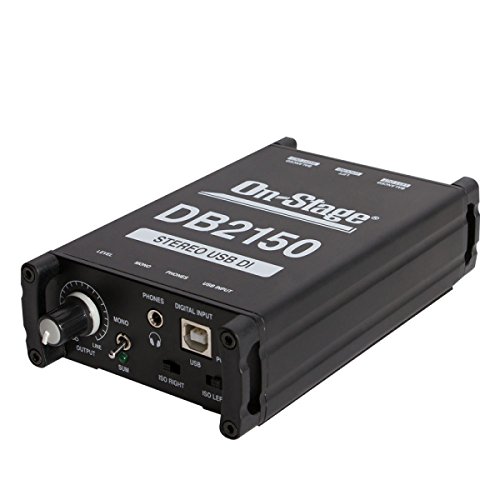
- USB connectivity for computer sources
- Stereo output with mono-sum switch
- Ground lift and dual isolation switches
Best For: Churches connecting a Windows computer or computer-based playback source to stereo audio.
Best Budget Utility
Pyle Premium Direct Injection Audio Box

- Compact passive DI and hum eliminator
- Supports instruments and consumer sources
- Input attenuator for connection flexibility
Best For: Churches needing an affordable, compact DI for individual instruments, keyboards, or consumer audio sources.
Versatile Passive Pick

- Accepts stereo 1/4-inch, 3.5mm, RCA, and XLR inputs
- Needs no batteries or phantom power
- Includes 15dB pad and ground lift
Best For: Church media and playback connections
Connected Active Solution

- Adds USB-C and Bluetooth audio connectivity
- Offers dual balanced XLR outputs
- Includes volume, mono/stereo, and ground-lift controls
Best For: Churches using phones and computers in worship audio
Simple Instrument Interface

- Connects 1/4-inch instruments to XLR equipment
- Includes a through jack for signal routing
- Uses a pad and ground-lift switch without power
Best For: Basic guitar and keyboard connections
Compact Stereo Flexibility

- Passive design needs no power
- Stereo 1/8-inch TRS and RCA inputs
- Summed mono output with MIDAS transformer
Best For: Church playback and stereo-source connections
Rugged Dual-Channel Control
Bolanle D2 Premium Passive Stereo DI Box

- Dual channels include -15 dB pads
- Ground lift and polarity reversal switches
- Thru outputs support stage monitoring
Best For: Church stages with stereo keyboards and hot signals
Premium Stereo Signal Path
Radial JDI Stereo Premium Passive DI

- Stereo DI design for pro audio
- Listed 10 Hz to 40 kHz response
- Emphasis on workmanship and selected materials
Best For: Churches seeking a premium stereo DI solution
Best Stereo Pick – Radial ProD2 Passive 2 Channel Direct Box
For church sound systems needing two-channel instrument or stereo connectivity, the Radial ProD2 is a practical passive DI option. Its isolation transformer, ground-lift switch, and 15dB pad help adapt connected sources for a mixer or PA setup.
Best For: Churches needing a durable passive stereo DI for keyboards, playback, or other two-channel sources.
Pros:
- Two-channel passive stereo design
- Isolation transformer and ground-lift switch
- 15dB pad for handling stronger signals
- Compact stainless-steel construction
Cons:
- Passive design does not provide the eight channels of a rack-style DI
- At 1.2 pounds, it may be more substantial than basic compact DI units
The ProD2 is a focused choice when a church needs reliable stereo signal handling and hum-isolation features rather than a high channel count.
Best for Larger Setups – Behringer DI800 V2 Signal Direct Box
For church sound systems with several instruments or signal sources, the Behringer DI800 V2 offers eight channels in one unit. It supports optional mains or phantom-powered operation, with XLR, TRS, and TS connectivity for flexible installation and live-use workflows.
Best For: Churches and live-event setups that need multiple DI channels in a single unit.
Pros:
- Eight-channel configuration
- Optional mains or phantom-powered operation
- XLR, TRS, and TS connectivity
- Servo-balanced operation for an ultra-flat frequency response
Cons:
- Its 5-pound size and corded-electric power option may be less convenient for small portable setups
- Eight channels may be more capacity than a small worship rig requires
The DI800 V2 is a strong capacity-focused solution for churches that want to organize several direct signals without using multiple small boxes.
Best USB Option – OnStage DB2150 Passive Stereo USB DI Box
The OnStage DB2150 brings USB connectivity to a passive stereo DI format, making it useful for church sound systems that incorporate a personal computer. Its mono-sum, ground-lift, isolation, and headphone-output features provide practical monitoring and signal-routing flexibility.
Best For: Churches connecting a Windows computer or other computer-based playback source to a stereo sound system.
Pros:
- USB hardware connectivity
- Stereo output with a mono-sum switch
- Ground lift and separate ISO right/ISO left switches
- 3.5mm headphone output for monitoring
Cons:
- Its listed computer compatibility is focused on Windows and personal computers
- Designed for stereo USB use rather than a large multi-channel installation
Choose the DB2150 when computer playback is central to the church setup and convenient stereo routing, isolation, and headphone monitoring are priorities.
Best Budget Utility – Pyle Premium Direct Injection Audio Box
For straightforward church sound systems, the Pyle Premium Direct Injection Audio Box provides a compact passive way to connect guitars, basses, keyboards, and other unbalanced sources to balanced or unbalanced equipment. Its impedance transformer, input attenuator, and hum-cancellation function target common live-sound connection problems.
Best For: Churches needing an affordable, compact DI for individual instruments, submixers, keyboards, or consumer audio sources.
Pros:
- Supports guitar, bass, keyboards, and outboard processors
- Connects unbalanced sources to balanced or unbalanced XLR equipment
- Includes input attenuation and hum-cancellation capability
- Compact 1.8 x 3.3 x 5-inch design
Cons:
- Single passive DI unit is less suited to multi-channel systems
- Its 1/4-inch device connector may require additional adapters for other source types
The Pyle is a flexible utility DI for churches that need basic instrument and playback connections with practical hum-reduction features in a small enclosure.
Versatile Passive Pick – On-Stage DB1050
For church sound systems that need to connect varied playback sources without adding another powered device, the OnStage DB1050 is a practical passive DI option. It accepts stereo 1/4-inch, 3.5mm, and stereo RCA inputs, with a mono XLR low-impedance output for routing audio to a mixer or PA.
Best For: Churches connecting media players, phones, keyboards, or other line-level sources to a sound system.
Pros:
- Supports stereo 1/4-inch, 3.5mm, stereo RCA, and XLR line inputs.
- Requires no batteries or phantom power.
- Includes a 15dB pad and ground-lift switch.
- Compact 16-ounce design with analog signal format.
Cons:
- The mono XLR low-Z output may not suit setups requiring separate stereo outputs.
- Passive operation provides no onboard volume control.
The DB1050 is a flexible choice when a church needs one compact box for multiple consumer and pro audio connections. Its passive design simplifies installation, while the pad and ground lift help accommodate hotter sources and potential grounding noise.
Connected Active Solution – StudioMan MOB-2 USB DI
The StudioMan MOB-2 brings USB and Bluetooth connectivity to the category, making it a useful option for church sound systems that mix computers, smartphones, and traditional instruments. Its active stereo design provides dual balanced XLR outputs, plus volume control and a mono/stereo switch.
Best For: Churches integrating computers, mobile devices, Bluetooth playback, or stereo sources with a PA or mixer.
Pros:
- Plug-and-play USB-C connection with no driver installation required.
- Supports Bluetooth pairing for wireless phone audio.
- Provides balanced left and right XLR outputs and a ground-lift switch.
- Offers volume control, mono/stereo switching, and a 20Hz–20kHz frequency response.
Cons:
- As an active unit, it is more dependent on its electronic and USB-based features than a passive DI.
- Its 1.54-pound size and added connectivity may be more than needed for a simple instrument connection.
The MOB-2 stands out for modern church setups where digital playback and wireless audio are part of the workflow. Dual XLR outputs and ground lift support direct connection to professional audio equipment, while the USB-C and Bluetooth features add installation flexibility.
Simple Instrument Interface – Yovus DB-1 Passive DI
For straightforward instrument connections in church sound systems, the Yovus DB-1 provides a compact passive path from a 1/4-inch source to balanced or unbalanced XLR equipment. Its through jack allows the original signal to continue to an amplifier or other device while the XLR output feeds the mixer.
Best For: Churches connecting a guitar or keyboard to a mixer while retaining a through connection.
Pros:
- Passive design requires no power.
- Includes 1/4-inch input and through jacks.
- Features a pad switch for hot sources and a ground lift for grounding-related buzz.
- Metal enclosure supports a compact, stage-ready format.
Cons:
- Provides one output channel rather than stereo operation.
- Its listed compatible devices are limited to guitar and keyboard.
The DB-1 is a focused, no-frills choice for basic instrument-to-mixer routing. It is especially useful when a church needs a passive DI with a through connection, source padding, and ground-lift control without adding power requirements.
Compact Stereo Flexibility – Klark Teknik PRO DI DI 10P
For church sound systems that need to connect stereo playback devices or other compact sources, the Klark Teknik PRO DI DI 10P offers a practical passive solution. Its stereo inputs can be summed to mono, while the MIDAS transformer and high-headroom design are intended to preserve signal quality without requiring power.
Best For: Churches connecting stereo consumer sources, keyboards, or playback devices to a mixer through a compact DI box.
Pros:
- Passive operation requires no power supply.
- Stereo input supports 1/8-inch TRS and RCA connectors.
- Can provide stereo input with summed mono output.
- MIDAS transformer and high-headroom design support clean signal handling.
Cons:
- Its passive design may offer fewer control features than active DI boxes.
- The supplied notes do not list a channel-specific pad, ground lift, or thru output.
The DI 10P is a straightforward choice when a church needs flexible stereo connectivity and simple, maintenance-free operation rather than extensive switching or routing controls.
Rugged Dual-Channel Control – Bolanle D2 Premium Passive Stereo DI Box
The Bolanle D2 is a useful option for church sound systems handling stereo keyboards, synths, or multiple instruments. It combines two passive channels with independent -15 dB pads, thru outputs, ground lift, and polarity reversal, giving sound teams practical ways to manage hot signals, hum, phase issues, and stage monitoring.
Best For: Church stages using stereo keyboards or two instruments that need attenuation, direct mixer feeds, and local amplifier monitoring.
Pros:
- Two independent channels support stereo or dual-instrument setups.
- Independent -15 dB pads help manage hot signals from keyboards, active bass, and line-level synths.
- Ground lift can help address ground-loop hum.
- Each channel includes a 1/4-inch thru output for amplifier or stage monitoring.
Cons:
- The supplied notes identify a single ground-lift switch rather than separate ground lift per channel.
- At 1.94 pounds, it is heavier than some compact passive DI options.
With its metal enclosure and unusually broad set of signal-management controls, the D2 is well suited to churches that need more routing and troubleshooting flexibility than a basic passive DI box provides.
Premium Stereo Signal Path – Radial JDI Stereo Premium Passive DI
For church sound systems seeking a premium stereo DI option, the Radial JDI Stereo is positioned as a carefully built pro-audio device. The supplied information highlights selected materials, stereo operation, and a flat 10 Hz to 40 kHz frequency response, though it provides fewer detailed control specifications than the other options here.
Best For: Churches prioritizing a premium stereo DI solution for professional audio setups.
Pros:
- Designed as a stereo DI box for pro-audio use.
- Listed frequency response extends from 10 Hz to 40 kHz.
- Radial Engineering branding and emphasis on workmanship may appeal to buyers seeking premium construction.
Cons:
- The supplied notes do not specify pad, ground-lift, polarity, or thru-output controls.
- Its listed dimensions of 3 x 8 x 10 inches suggest a less compact format than some alternatives.
The JDI Stereo makes the most sense when stereo operation and premium pro-audio positioning matter more than a long list of documented routing controls or compact dimensions.
How We Picked the Best Di Boxes for Church Sound Systems
We focused on features that matter in real worship environments: signal quality, balanced XLR outputs, input and output flexibility, stereo or mono operation, grounding and hum management, durability, and ease of use. The selection includes established professional models alongside budget-friendly options, giving churches choices for instruments, keyboards, playback gear, and multimedia sources.
Because no single DI suits every stage, we also considered whether each design is passive, active, USB-equipped, single-channel, or stereo. Passive boxes are often simple and reliable, while active models can better accommodate lower-output sources or provide additional routing features.
Quick Comparison
| Best For | Recommended Type | What to Look For |
|---|---|---|
| Guitars, bass, and keyboards | Passive or active DI | Instrument input, XLR output, ground lift |
| Stereo keyboards and playback | Stereo DI | Two channels, stereo linking, summed mono option |
| Phones, computers, and USB sources | USB or multimedia DI | USB compatibility, level control, isolation |
| Large worship stages | Rugged professional DI | Strong enclosure, quality transformers, reliable connectors |
Key Buying Factors for Di Boxes for Church Sound Systems
Passive Vs. Active Design
Passive DI boxes do not require batteries or phantom power and are often a dependable choice for keyboards, basses with strong output, and playback devices. Active models may offer more headroom or better impedance matching for passive pickups and quieter sources, but they require an appropriate power source.
Channel Count and Stereo Routing
A mono DI is sufficient for many guitars and basses. Stereo models are more suitable for keyboards, digital pianos, backing tracks, and media players. If your mixer sometimes receives only one available input, a summed-mono feature can be especially useful.
Noise Control and Signal Compatibility
Look for a ground-lift switch, transformer isolation, and suitable attenuation when connecting consumer or high-output equipment. These features can reduce hum and prevent overloaded mixer inputs. Confirm that the box accepts your source connection, such as 1/4-inch instrument, RCA, USB, or other multimedia inputs.
Build Quality and Stage Practicality
Church stages often involve frequent setup, teardown, and volunteer operation. Metal housings, secure jacks, clearly labeled switches, and straightforward controls are valuable. Also check whether the box can fit comfortably in your stage rack, pedalboard, or cable layout.
Who Should Buy Which Di Boxes for Church Sound Systems?
Choose a rugged professional passive DI when reliability and long-term stage use are the priorities. A stereo DI is the better choice for keyboards, playback, or any source where preserving left and right channels matters. Budget passive models work well for churches adding several instrument inputs at once, provided their connectors and attenuation options match the system. For computers, phones, or USB-based playback, choose a multimedia or USB DI with level control and isolation rather than relying on improvised adapters.