The best field recorders with external microphone input give you more control than a phone or basic handheld recorder, whether you are capturing dialogue, music, ambience, or live events.
This roundup compares 10 practical options, from compact stereo recorders to multi-input professional units, with attention to audio quality, connectivity, portability, and recording reliability.
Best 10 Field Recorders with External Microphone Input Picks for 2026
Video Timecode Specialist

- Dual XLR/TRS inputs plus a 3.5 mm input
- 32-bit float recording with dual ADCs
- Built-in timecode generation and sync
Best For: Videographers needing external mics and timecode
Accessible All-Rounder

- Two XLR/TRS inputs for mics and instruments
- Built-in stereo mics and four-track recording
- USB-C recording or streaming with SD backup
Best For: Creators recording music, podcasts, interviews, or video
Flexible Four-Channel Recorder
- Two XLR/TRS inputs for external sources
- Adjustable A-B or X-Y stereo microphones
- Four-channel recording and USB-C interface
Best For: Creators combining internal and external microphones
Professional Dual-XLR Recorder

- Dual locking XLR inputs for secure connections
- 32-bit float recording for unpredictable levels
- Ultra-low-noise preamps and flexible power options
Best For: Filmmakers and musicians using external XLR microphones
Reliable Starter
- Stereo condenser microphones capture subtle and loud sounds
- Up to 17.5 hours on two AA batteries
- USB audio interface mode for streaming and voice work
Best For: Beginners and creators wanting simple stereo recording
Compact XLR Pick

- Two XLR/TRS combo inputs for mics and instruments
- 32-bit float recording with 96kHz support
- OLED waveform display and 3.5mm connectivity
Best For: Portable two-source filmmaking, music, and podcasting
Production Powerhouse
- Eight inputs and 10-track recording for complex setups
- 32-bit float capture with high-gain, low-noise preamps
- Dual SD slots, timecode, and USB interface operation
Best For: Professional film and multi-microphone location audio
Best Compact 32-Bit Float Option
Xvive XV1-R Portable Stereo Recorder

- 32-bit float and 96 kHz recording
- X/Y microphones rated to 130 dB SPL
- USB microphone mode for multiple devices
Best For: Portable stereo recording and USB audio use
Best New XLR Pick

- Two XLR/TRS combo inputs
- 32-bit float recording up to 96 kHz
- Includes 64GB microSD card and adapter
Best For: Interviews, podcasts, and external-microphone recording
Best Expandable Multitrack Recorder
Zoom H5 4-Track Handheld Recorder
- Two XLR/TRS inputs with phantom power
- Four-track simultaneous recording
- Interchangeable input capsule system
Best For: Filmmaking, music production, and multitrack capture
Video Timecode Specialist – TASCAM FR-AV2
For videographers seeking field recorders with external microphone input, the TASCAM FR-AV2 combines two XLR/TRS combo inputs, 32-bit float recording, and built-in timecode generation in a compact body. Its dual ADCs are designed for worry-free capture, while the 3.5 mm input adds another connection option.
Best For: Videographers who need external mic connectivity and timecode synchronization in a small recorder.
Pros:
- Dual XLR/TRS inputs with Ultra HDDA preamps.
- 32-bit float recording with dual ADCs helps support fast setup and no-clip capture.
- Built-in timecode generation, sync, and timecode IN/OUT.
- Supports 48, 96, and 192 kHz recording.
Cons:
- Bluetooth monitoring requires the optional AK-BT2 adapter.
- Uses three AA batteries.
The FR-AV2 is especially compelling when timecode is central to a video workflow. It offers substantial connectivity and recording flexibility without requiring a separate timecode device.
Accessible All-Rounder – Zoom H4 Essential
The Zoom H4 Essential is a versatile choice among field recorders with external microphone input, pairing built-in stereo microphones with two XLR/TRS inputs. It supports four-track recording, USB-C connection to compatible devices, and 32-bit float capture for music, interviews, podcasts, and video audio.
Best For: Musicians, podcasters, filmmakers, and interviewers who want built-in mics plus external input flexibility.
Pros:
- Two XLR/TRS inputs accommodate external microphones, instruments, mixers, or soundboards.
- 32-bit float recording supports clip-free audio capture.
- Four-track recording expands workflow flexibility.
- USB-C supports recording or streaming while also saving to an SD card.
Cons:
- Requires two AA batteries.
- Its built-in microphone form factor is stereo, which may not suit every specialized setup.
With both built-in stereo mics and external connections, the H4 Essential covers a broad range of recording situations. Spoken menu guidance is an added convenience for users who prefer a more guided interface.
Flexible Four-Channel Recorder – TASCAM DR-40XP
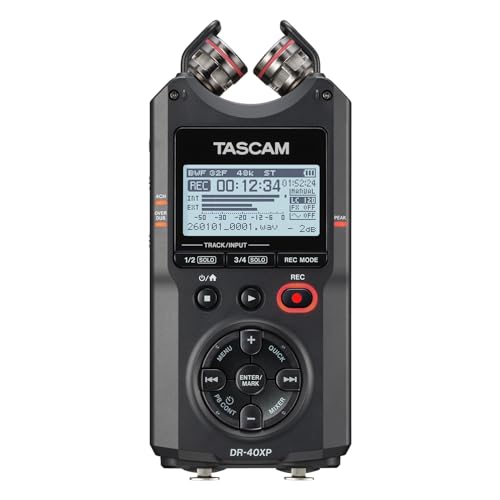
The TASCAM DR-40XP is a practical option for shoppers comparing field recorders with external microphone input. It combines two XLR/TRS inputs with adjustable built-in stereo microphones, allowing four-channel recording from internal and external sources at the same time.
Best For: Musicians and creators who need simultaneous built-in and external microphone recording.
Pros:
- Two XLR/TRS inputs support external microphones and other gear.
- Adjustable A-B or X-Y condenser microphones provide flexible stereo recording.
- Four-channel recording can combine built-in mics and external inputs.
- Functions as a 2-in/2-out USB-C audio interface.
Cons:
- microSD card and batteries are not included.
- Built-in microphones are rated for up to 125 dB SPL, which may limit especially loud sources.
The DR-40XP stands out for flexible source management: use the adjustable stereo microphones, external inputs, or both together. Its USB-C interface also makes it useful beyond standalone field recording.
Professional Dual-XLR Recorder – Zoom F3
The Zoom F3 is a focused professional option among field recorders with external microphone input. Its two locking XLR inputs, 32-bit float recording, and ultra-low-noise preamps are suited to filmmakers and musicians working with external microphones in unpredictable conditions.
Best For: Filmmakers and recordists who prioritize secure XLR connections and reliable recording in the field.
Pros:
- Two locking XLR inputs help keep microphone connections secure.
- 32-bit float recording handles quiet dialogue and sudden peaks without constant level adjustment.
- Ultra-low-noise preamps support clean, consistent audio.
- Flexible battery, standalone, and USB workflows support extended sessions.
Cons:
- It provides two external XLR inputs rather than the four-channel configuration found on some alternatives.
- Requires two AA batteries for battery-powered operation.
The F3 is a strong fit for streamlined professional rigs where dependable XLR connections matter more than built-in microphone versatility. Its compact design and clip-free recording approach suit run-and-gun work.
Reliable Starter – Tascam DR-05X
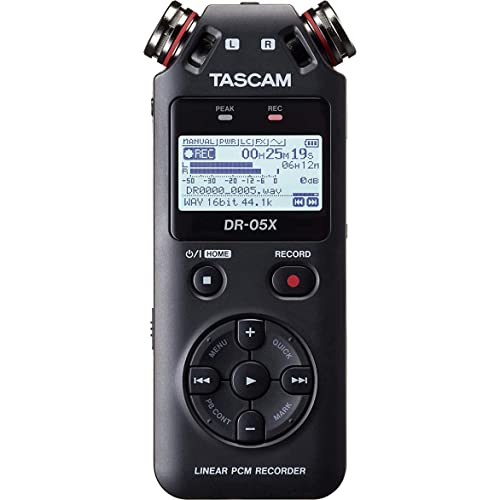
If you need field recorders with external microphone input for everyday interviews, music, or voice work, the Tascam DR-05X is a straightforward portable option. Its built-in stereo condenser microphones capture everything from subtle sounds to louder sources, while USB Audio Interface Mode adds flexibility for podcasting, streaming, and voiceovers.
Best For: Beginners, interviewers, musicians, and creators who want a simple stereo recorder with USB connectivity.
Pros:
- Sensitive built-in stereo microphones handle quiet and loud sources.
- Simple controls make recording, level adjustment, take deletion, and marker placement easy.
- Up to 17.5 hours of operation from two AA batteries, with USB battery power supported.
- Works as a USB audio interface for voiceovers, livestreams, podcasts, and songwriting.
Cons:
- Uses built-in microphones rather than the multi-input setup found on more advanced recorders.
- Its 2.5mm headphone jack is less common than a 3.5mm connection.
The DR-05X is a practical choice when portability, easy operation, and long battery life matter more than extensive routing or multiple external inputs.
Compact XLR Pick – Zoom H1 XLR
The Zoom H1 XLR is a compact choice among field recorders with external microphone input, pairing two XLR/TRS combo inputs with 32-bit/96kHz recording. It also includes a 3.5mm stereo input and headphone output, making it useful for filmmakers, musicians, podcasters, and other mobile recording setups.
Best For: Filmmakers, musicians, and podcasters who need two external mic or instrument inputs in a small recorder.
Pros:
- Two XLR/TRS combo inputs accept microphones, instruments, and other sources.
- 32-bit float recording helps provide clip-free audio across changing levels.
- OLED waveform display provides a quick view of recording levels.
- Supports SDXC cards up to 1TB and includes 3.5mm input and headphone output.
Cons:
- Battery life is listed at about 10 hours.
- It has two external combo inputs, rather than the larger input count of production recorders.
With its compact 6.4-ounce design, flexible connections, and 32-bit float recording, the H1 XLR is well suited to small crews and portable two-source sessions.
Production Powerhouse – Zoom F8n Pro Field Recorder
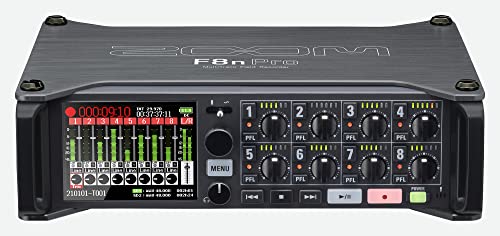
For professional productions that need field recorders with external microphone input, the Zoom F8n Pro offers an expansive eight-channel, 10-track workflow. Its 32-bit float recording, high-gain preamps, accurate timecode, dual SD slots, and simultaneous USB interface operation are designed for demanding film and field work.
Best For: Film crews, location sound professionals, and multi-microphone productions requiring extensive inputs and track management.
Pros:
- Eight-channel, 10-track recording supports complex field setups.
- 32-bit float recording and dual AD converters help capture a wide dynamic range without clipping.
- 75dB gain and -127dBu EIN preamps support quiet dialogue and dynamic sources.
- Dual SD slots enable redundant recording, while timecode accuracy reaches 0.2ppm.
Cons:
- At 1.8kg, it is substantially less lightweight than compact handheld recorders.
- Battery life is listed at about 8.5 hours.
- Its professional feature set may be more than needed for simple stereo recording.
The F8n Pro is the strongest fit for serious location audio, especially when multiple microphones, backup recording, timecode, and simultaneous USB production are priorities.
Best Compact 32-Bit Float Option – Xvive XV1-R Portable Stereo Recorder
For shoppers comparing field recorders with external microphone input, the Xvive XV1-R is a compact, versatile option with built-in X/Y microphones and USB microphone functionality. Its 32-bit float recording, 96 kHz support, and auto-record features suit musicians, podcasters, filmmakers, and general-purpose recording.
Best For: Portable stereo recording, USB audio use, and high-dynamic-range sources such as concerts or speeches.
Pros:
- 32-bit float recording helps reduce problems from incorrect gain settings.
- Built-in X/Y microphones capture sound up to 130 dB SPL without distortion.
- Works as a USB microphone with PC, Mac, iOS, and Android devices.
- Supports WAV and space-saving AAC recording, plus auto-record and pre-record features.
Cons:
- Its microphone form factor is built-in, so the supplied notes do not specify a dedicated external microphone input.
- No headphone jack is listed for direct monitoring.
- Uses two AA batteries and limits individual files to 4GB before automatically splitting extended recordings.
The XV1-R is appealing when portability, simple operation, and flexible file formats matter most. However, buyers specifically needing a recorder for plugging in external microphones should verify connectivity requirements before choosing it.
Best New XLR Pick – Zoom H1 XLR Recorder Bundle
The Zoom H1 XLR is a strong fit for shoppers seeking field recorders with external microphone input. It combines two XLR/TRS combo inputs, 32-bit float recording up to 96 kHz, waveform display, and a 3.5mm stereo connection, while this bundle adds a 64GB microSD card and adapter.
Best For: Interviews, podcasts, location recording, and users connecting external microphones or line-level sources.
Pros:
- Two XLR/TRS inputs support external microphones and compatible line-level sources.
- 32-bit float recording is available at up to 96 kHz.
- OLED waveform display provides a quick view of recording levels.
- Includes a 64GB microSD card and SD adapter, with support for cards up to 1TB.
Cons:
- External microphones are not included.
- The supplied notes do not specify phantom-power availability for the combo inputs.
- The bundle’s warranty coverage does not extend Zoom’s warranty to the memory card or adapter.
With two combo inputs and 32-bit float recording, the H1 XLR is the most directly aligned choice here for external-microphone workflows. The included storage also makes it easier to start recording without purchasing a card separately.
Best Expandable Multitrack Recorder – Zoom H5 4-Track Handheld Recorder
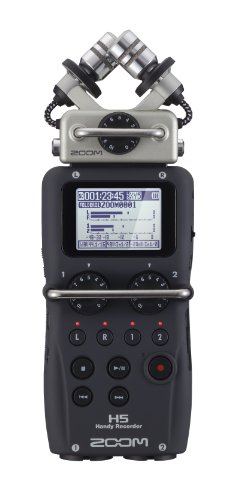
The Zoom H5 is a flexible choice among field recorders with external microphone input, pairing a detachable X/Y capsule with two XLR/TRS mic/line inputs. Its four-track recording, selectable phantom power, input pads, and interchangeable capsule system make it well suited to filmmaking and music production.
Best For: Filmmakers and musicians who need multiple inputs, four-track recording, and an expandable microphone setup.
Pros:
- Two XLR/TRS combo inputs accept microphones or line-level sources.
- Selectable phantom power and -20dB pads add input flexibility.
- Records up to four tracks simultaneously and includes a detachable shock-mounted X/Y capsule.
- Functions as a multichannel or stereo USB audio interface for PC, Mac, and iPad.
Cons:
- Records to SD/SDHC cards up to 32GB, a lower stated capacity than the H1 XLR’s support for cards up to 1TB.
- Its supplied notes list WAV format but do not mention 32-bit float recording.
- The recorder requires two batteries, and the listed battery details are inconsistent across the supplied specifications.
The H5 stands out for hands-on input control and expansion rather than maximum card capacity or newer float-recording features. It is a practical pick when four-track capture, phantom power, and interchangeable capsules are priorities.
How We Picked the Best Field Recorders with External Microphone Input
We focused on recorders that accept an external microphone through dedicated XLR, TRS, or compatible microphone inputs. The selection covers several use cases and budgets, including compact handheld models, 32-bit float recorders, multi-track units, and recorders that can double as USB audio interfaces.
We also considered input count, phantom-power support, monitoring, storage, battery practicality, physical controls, portability, and features that reduce the risk of unusable recordings. Because the right recorder depends heavily on the job, the list includes both simple stereo tools and advanced field mixers.
Quick Comparison
| Best For | What to Look For |
|---|---|
| Interviews and basic location work | Simple controls, built-in microphones, headphone monitoring, and one or two external inputs |
| Filmmaking and dialogue | XLR inputs, low-noise preamps, phantom power, safety recording, and compact mounting options |
| Music and live recording | Clean preamps, adjustable input levels, stereo linking, and sufficient storage |
| Professional multi-mic production | Multiple XLR inputs, timecode or sync features, multitrack recording, and reliable power options |
| Fast, mistake-resistant capture | 32-bit float recording, limiters or safety tracks, and clear level monitoring |
Key Buying Factors for Field Recorders with External Microphone Input
Input Type and Count
Check whether the recorder uses XLR, 1/4-inch TRS, 3.5mm, or combination inputs. XLR inputs are generally the most flexible for professional microphones and often support balanced connections and phantom power. Two inputs work well for interviews, stereo sources, or a camera-mounted microphone; larger productions may need four or more.
Recording Format and Level Protection
32-bit float can make level-setting more forgiving, particularly for unpredictable dialogue and location sound, but it does not replace good microphone placement. Standard 24-bit recording remains fully capable when levels are set carefully. Look for safety tracks, limiters, or dual recording if you regularly capture loud or rapidly changing sources.
Power, Storage, and Monitoring
Confirm battery type and expected runtime before buying. Phantom-powered microphones can reduce battery life, while USB power may be useful for long sessions. Headphone monitoring, lockable or accessible controls, removable storage, and straightforward file transfer all matter when recording away from a desk.
Workflow and Connectivity
A USB audio interface mode can make one recorder useful for podcasts, voiceover, or computer-based music. Filmmakers should also consider timecode, camera connectivity, mounting, and whether the recorder can provide a clean feed while recording internally.
Who Should Buy Which Field Recorders with External Microphone Input?
Choose a compact handheld recorder if portability, quick setup, and built-in microphones matter most. These models suit interviews, rehearsals, lectures, travel, and everyday documentary work. A two-input 32-bit float recorder is a strong choice for solo filmmakers, musicians, and creators who want external microphones without carrying a larger mixer.
Step up to a recorder with more XLR inputs if you routinely use several microphones, record ensembles, or need isolated tracks for post-production. Professional location-sound users should prioritize reliable preamps, timecode or synchronization features, durable controls, and flexible power. Finally, choose a bundle only when its included memory card and accessories match your workflow; otherwise, compare the recorder itself and buy storage or cables separately.