Clear, dependable audio helps worship leaders, pastors, musicians, and event speakers stay connected with the congregation. The right wireless microphone system can reduce cable clutter while providing the range and channel capacity a church needs.
We compared 10 wireless microphone systems across handheld, headset, and lavalier configurations, focusing on channel count, operating range, signal reliability, setup, and value for common church sound environments.
Best 10 Wireless Microphones for Church Picks for 2026
Best Rack-Ready Setup
Phenyx Pro PTU-5000-2H2B 4-Channel System

- Two handheld and two bodypack microphones
- Four XLR outputs with individual volume controls
- Up to 260-foot range and included AA batteries
Best For: Fixed church venues wanting durable, quick wireless setup
Best Long-Range Handheld Value
GTDaudio 4-Handheld Wireless System
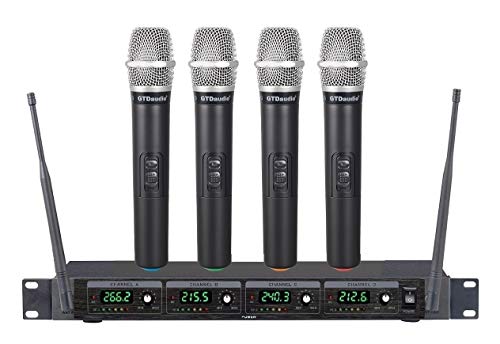
- Four handheld mics for simultaneous operation
- Up to 300 feet of wireless range
- Four XLR outputs plus mixed 1/4-inch output
Best For: Churches that primarily use multiple handheld microphones
Best for Six Speakers
PRORECK MX66 6-Channel UHF System

- Six handheld microphones and six channels
- Six XLR outputs plus a mixed 1/4-inch output
- 200-foot range with separate volume controls
Best For: Larger services and events with up to six handheld users
Flexible Dual-Mic Pick

- Two handheld UHF microphones with sturdy metal construction
- 30 tunable frequency groups and automatic pairing
- XLR and 1/4-inch outputs for common PA setups
Best For: Churches needing two adjustable wireless microphones
Large-Service Value
MicrocKing MK240-1 Four-Mic System

- Four handheld UHF microphones with a four-channel receiver
- Individual volume controls and LCD frequency display
- Four XLR outputs plus a 1/4-inch audio output
Best For: Churches needing four independently controlled handheld mics
Modern Four-Mic Setup

- Four handheld microphones with 24-bit/48kHz digital transmission
- 4x10 frequency groups support up to eight systems
- Portable receiver with built-in antennas and included batteries
Best For: Churches wanting a portable, expandable four-mic system
Best Multi-Mic Flexibility

- Four UHF handheld channels
- Auto Scan and selectable frequencies
- 290–328 ft line-of-sight range
Best For: Churches needing four coordinated handheld microphones
Best Simple Four-Mic Setup

- Four handheld microphones
- Individual volume controls
- Two XLR and one mixed output
Best For: Small churches using one fixed-frequency system
Best Hands-Free Church Setup

- Includes lavalier, headset, and handheld mics
- 100 selectable frequencies per channel
- 180–240 ft line-of-sight range
Best For: Sermons and presentations requiring hands-free movement
Best Multi-User Flexibility – TONOR 4-Mic Headset/Lavalier System
For churches needing several presenters or singers on wireless microphones, the TONOR system combines four bodypack channels with headset and lapel options. Its 200-foot range, automatic pairing, and compatibility with mixers, amplifiers, and powered speakers make it practical for services, meetings, and performances.
Best For: Churches that need hands-free headset and lapel microphones for multiple users.
Pros:
- Includes four bodypacks, two headset mics, and two lapel mics.
- Offers up to 200 feet of wireless range and 10 channels per bodypack.
- Automatic pairing and bodypack mute buttons simplify operation.
- Connects through the included 1/4-inch audio cable.
Cons:
- AA batteries are required but not included.
- The receiver uses a 1/4-inch audio connection rather than listed individual XLR outputs.
This is a flexible choice for churches prioritizing hands-free movement and multiple microphone formats. The included mix of headset and lapel microphones is especially useful when different speakers share one service.
Best Rack-Ready Setup – Phenyx Pro PTU-5000-2H2B 4-Channel System
The Phenyx Pro is a strong option for churches seeking a durable wireless microphone system with flexible microphone types and precise channel control. Its four fixed UHF frequencies, LCD receiver, individual volume controls, and up to 260-foot range support repeatable setups in fixed venues.
Best For: Churches that want a sturdy, plug-and-go system with both handheld and hands-free microphones.
Pros:
- Includes two handheld microphones plus two bodypacks with headset and lapel mics.
- Provides four XLR outputs and individual volume controls.
- Fixed UHF frequencies, memory settings, and LCD frequency display support quick setup.
- Metal receiver and microphones are designed for heavy-duty use.
Cons:
- Fixed-frequency operation may offer less flexibility than a selectable-frequency system.
- It is not intended for multiset operation.
- An amplifier or speaker is required for sound output.
With included batteries and a broad selection of microphone styles, this system is convenient for churches that regularly host services, meetings, or performances. Its individual XLR outputs are useful when the sound team needs separate channel routing.
Best Long-Range Handheld Value – GTDaudio 4-Handheld Wireless System
For church teams that prefer handheld microphones, the GTDaudio 4 Handheld System provides four simultaneous channels and a stated range of up to 300 feet. Individual volume controls and separate XLR outputs allow the sound operator to balance each microphone and route channels independently.
Best For: Churches using several handheld microphones for services, singing, or events.
Pros:
- Includes four handheld wireless microphones for simultaneous users.
- Offers up to 300 feet of wireless operating range.
- Provides individual volume controls, four XLR outputs, and a mixed 1/4-inch output.
- Metal enclosure and SMT construction are intended for professional reliability.
Cons:
- Includes handheld microphones only, with no headset or lapel option listed.
- Battery information in the supplied specifications is limited and should be checked before use.
This system makes the most sense when a church’s speakers and singers are comfortable using handheld microphones. Its long stated range and flexible outputs give the audio operator useful control for larger rooms and event layouts.
Best for Six Speakers – PRORECK MX66 6-Channel UHF System
The PRORECK MX66 is designed for churches and event spaces that need six handheld microphones at once. It offers six channels, separate volume controls, six XLR outputs, a mixed 1/4-inch output, and a 200-foot line-of-sight range for coordinating multiple speakers or singers.
Best For: Larger church services, conferences, and events with up to six handheld microphone users.
Pros:
- Includes six handheld UHF microphones and a six-channel receiver.
- Provides separate volume controls and six individual XLR outputs.
- Offers a 200-foot line-of-sight operating range.
- Includes eight EQ modes and an LCD display for venue adjustment and monitoring.
Cons:
- Each microphone requires two AA batteries, which are not included.
- Two sets cannot be used together.
- The system is limited to handheld microphones.
Among these wireless microphones for church, the MX66 stands out when capacity is the priority. Its six-channel design can reduce the need to share microphones, while the separate outputs give a mixer greater control over each user.
Flexible Dual-Mic Pick – Phenyx Pro PTU-52-2H
For churches looking for wireless microphones for church services, the Phenyx Pro PTU-52-2H is a practical two-microphone setup with tunable UHF frequencies, automatic pairing, and outputs suited to common PA equipment. Its cardioid capsules and up to 200 feet of open-space range make it a flexible choice for worship, speaking, and events.
Best For: Churches needing two handheld microphones with adjustable frequencies and straightforward mixer or speaker connectivity.
Pros:
- Includes two wireless handheld microphones with a metal receiver and microphone construction.
- Offers 30 tunable frequency groups and frequency hopping for flexible operation.
- Provides two XLR outputs and one mixed 1/4-inch output for PA and mixer connections.
- Includes AA batteries, windscreens, anti-rolling rings, and connection accessories.
Cons:
- The stated 200-foot range applies to open-space, line-of-sight conditions.
- It supports two microphones, so larger services may need additional systems.
Choose this system when your church needs a durable, adjustable two-mic package rather than a larger multi-microphone rack. The selectable frequencies and broad output options are especially useful when adapting to an existing sound setup.
Large-Service Value – MicrocKing MK240-1 Four-Mic System
For churches that need several speakers or vocalists at once, the MicrocKing MK240-1 provides four handheld UHF microphones and a receiver with individual volume controls. Its four XLR outputs, 1/4-inch output, LCD display, and claimed 400-foot range make it geared toward larger services and events.
Best For: Churches, conferences, and weddings requiring four independently controlled handheld microphones.
Pros:
- Includes four handheld microphones and a four-channel receiver.
- Individual volume controls help balance each microphone at the receiver.
- Provides four XLR outputs plus a 1/4-inch audio output for flexible connections.
- Cardioid moving-coil pickups are designed to reduce feedback and unwanted interference.
Cons:
- Batteries are not included; the system requires eight AA batteries.
- The fixed-frequency design offers less frequency adjustment than tunable systems.
- The stated 400-foot range may depend on the venue and signal conditions.
This is a strong fit when a worship team or event program needs four handheld channels without adding separate microphone receivers. Plan for your own AA batteries and confirm that the fixed frequencies suit your venue before installation.
Modern Four-Mic Setup – MELONARE 4×10 UHF System
The MELONARE system is a convenient option for wireless microphones for church use when you need four handheld channels and a compact receiver. It combines 24-bit/48kHz digital transmission, 200-foot coverage, frequency hopping, and color-coded controls to simplify setup for worship services and other church events.
Best For: Churches wanting a portable four-microphone system with included batteries and multiple frequency-group options.
Pros:
- Includes four handheld transmitters, eight AA batteries, and connection cables.
- Offers 24-bit/48kHz sampling and cardioid pickup for detailed, focused audio.
- Provides 4×10 frequency groups and supports simultaneous use of up to eight systems.
- Built-in receiver antennas and color-coded controls simplify transport and channel identification.
Cons:
- The stated 200-foot coverage can vary with walls, interference, and venue layout.
- Its four-channel receiver may be more equipment than a small church needs.
- The listed frequency range is 530–580 MHz, which may require checking local compatibility requirements.
This system stands out for churches that value portability and quick identification of multiple microphones. Its included batteries and built-in antennas reduce setup friction, while the frequency-group options provide room to expand a larger wireless arrangement.
Best Multi-Mic Flexibility – Phenyx Pro PTU-7000-4H
For churches needing several handheld microphones, the Phenyx Pro PTU-7000-4H is a feature-rich wireless microphones for church option. Its four-channel UHF design, auto scanning, selectable frequencies, and long line-of-sight range are suited to services, events, and larger presentations.
Best For: Churches that need four handheld microphones with frequency flexibility and long-range operation.
Pros:
- Auto Scan helps identify lower-interference frequencies, while 40 selectable frequencies per channel support multiset operation.
- Four handheld microphones use IR synchronization and offer a stated 290–328-foot line-of-sight range.
- Cardioid pickup, tuned EQ, metal construction, mute functions, and replaceable microphone heads add practical versatility.
- Includes individual XLR and mixed 1/4-inch connection options, antennas, batteries, and setup accessories.
Cons:
- Its four-handheld configuration may be more equipment than a small church needs.
- Frequency setup and multiset operation may require more planning than a fixed-frequency system.
Choose this model when dependable channel coordination and four simultaneous handheld users matter more than keeping the setup minimal. The selectable UHF architecture makes it particularly adaptable for changing venues and expanded systems.
Best Simple Four-Mic Setup – innopow WM-400
The innopow WM-400 is a straightforward choice for churches seeking wireless microphones for church use without selectable-frequency complexity. It supplies four handheld microphones, individual channel volume controls, and multiple output options for a small church sound system.
Best For: Small churches, worship teams, conferences, and events that need four fixed-frequency handheld microphones.
Pros:
- Includes four handheld microphones with individual volume control for each channel.
- Metal construction and unidirectional neodymium dynamic cartridges support durability, clear vocals, and feedback rejection.
- Offers two individual XLR outputs plus a mixed 1/4-inch output for flexible connection to audio equipment.
- Provides approximately 14–17 hours of battery life and a stated 150–200-foot open-area range.
Cons:
- Fixed-frequency operation cannot be used simultaneously with multiple units.
- The stated operating range is shorter than some systems designed for larger spaces.
This system makes sense when you want a complete four-microphone package with simple controls and conventional outputs. Its fixed-frequency design is best suited to a single-system installation rather than a growing, multi-system church audio setup.
Best Hands-Free Church Setup – innopow 333HB Lavalier System
For sermons, presentations, and worship roles where hands-free movement matters, the innopow 333HB offers a versatile wireless microphones for church configuration. Its receiver supports a lavalier, headset, and handheld microphone, with auto scanning and 100 selectable frequencies on each channel.
Best For: Churches needing a hands-free lavalier or headset option alongside a handheld microphone.
Pros:
- Includes a lavalier microphone, headset microphone, and handheld microphone for flexible speaker use.
- Provides 100 selectable frequencies per channel, with automatic scanning and manual pairing for interference management.
- Offers a stated 180–240-foot line-of-sight range and approximately 14–17 hours of battery life.
- Supplies two individual XLR outputs and one mixed 1/4-inch output.
Cons:
- Only one receiver and microphone set are included, so additional systems may be needed for multiple simultaneous speakers.
- The notes recommend a power amplifier for achieving a good effect, adding a possible equipment requirement.
This is the most practical pick when a pastor, presenter, or worship leader needs to move freely while speaking. Its frequency options also make it more adaptable than a basic fixed-frequency kit, while the included handheld provides a backup or alternate speaking style.
How We Picked the Best Wireless Microphones for Church
We focused on systems that match the practical demands of worship services, sermons, conferences, classrooms, and community events. Key considerations included the number and type of microphones included, UHF operation, stated transmission range, channel availability, receiver design, and ease of setup.
Multi-microphone packages received particular attention because churches often need several speakers or performers active during the same service. We also considered whether a system uses handheld microphones, bodypack transmitters with lavalier or headset microphones, or a combination of both.
Quick Comparison
| System type | Best suited for | Main advantage |
|---|---|---|
| Single or dual handheld | Small services and speakers | Simple setup and familiar operation |
| Four-channel handheld | Worship teams and larger services | Multiple simultaneous performers |
| Six-channel handheld | Large events and flexible programs | Highest microphone capacity |
| Headset or lavalier system | Pastors, presenters, and active speakers | Hands-free movement |
| Auto-scan or tunable system | Venues with interference concerns | More frequency-management flexibility |
Key Buying Factors for Wireless Microphones for Church
Microphone Type
Handheld microphones work well for singers, guest speakers, and announcements. Headsets and lavaliers are better for pastors or presenters who need both hands free. Before buying, consider whether the system includes the microphone style your volunteers will actually use.
Channel Count
Choose enough channels for microphones used at the same time, not merely the total number of people who may speak during an event. Four channels cover many worship teams, while six-channel systems provide extra flexibility for larger programs.
Range and Signal Stability
Published range is usually measured in open conditions. Walls, people, stage equipment, and nearby wireless devices can reduce usable distance. Prioritize stable operation and antenna placement over the highest advertised number.
Frequency Options
Fixed-frequency systems can be straightforward when the venue has little interference. Tunable or auto-scan models are more adaptable for churches that use several wireless systems or host events in different locations.
Receiver Connections and Power
Confirm that the receiver offers outputs compatible with the church mixer, powered speaker, or audio interface. Also check battery type, battery life, rack or tabletop placement, and whether spare transmitters or microphones can be added later.
Who Should Buy Which Wireless Microphones for Church?
Small churches and occasional speakers: A dual handheld or basic bodypack system is typically easier to manage and avoids paying for unused channels.
Worship teams and medium-sized congregations: A four-channel handheld system offers a useful balance of capacity, convenience, and value.
Pastors and presenters: Choose a headset or lavalier package when hands-free delivery and consistent microphone distance matter most.
Large churches and event programs: A six-channel system or an expandable multi-channel setup provides room for singers, speakers, and guests.
Venues with wireless interference: Look for auto-scan or tunable frequency controls, then coordinate frequencies before the service and test every microphone from the stage and seating area.