Choosing the right equalizer can make a bigger difference than adding more power or volume. The best parametric hardware equalizers help you shape tone, reduce problem frequencies, and get a cleaner, more controlled sound.
This roundup covers 10 options across car audio, pedalboard, studio, and live sound use cases, so you can quickly narrow down the right fit for your setup and budget.
Best 10 Parametric Hardware Equalizers Picks for 2026
1/2-Din Car Audio Tune-Up
CT-7EQ 7 Band Parametric Car Audio Equalizer
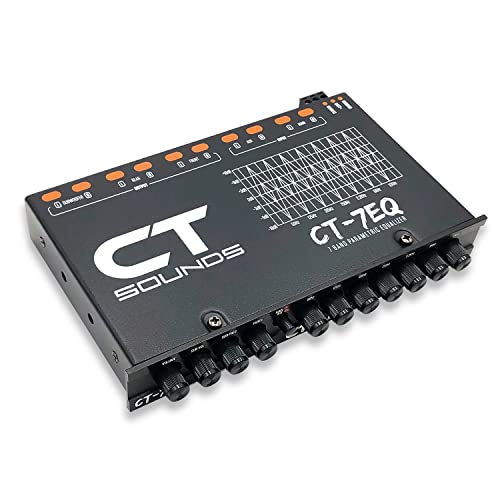
- 7 bands across 20Hz to 20kHz
- Bass, mid, and treble each offer ±10dB
- Includes installation brackets and hardware
Best For: Car audio buyers who want a compact 1/2-DIN equalizer with simple tuning controls
Studio Rack Classic
dbx 530 Compact Professional Parametric EQ

- Classic 3-band design based on the dbx 905
- Selectable bell or shelf filters on low and high bands
- Adjustable Q on each band
Best For: Engineers and producers building a 500-series rack who want compact professional EQ control
4-Way Car Bass Control
Gravity GR-EQP11 Digital Bass Machine EQ

- 4-band parametric EQ with 12dB boost/cut
- Front, rear, and sub output support
- Subwoofer level control with frequency selectors
Best For: Car audio systems that need front, rear, and sub output control in a 1/2-DIN unit
Pedalboard Tone Shaper
Ibanez PTEQ Pentatone 5-Band Parametric EQ Pedal

- 5-band parametric EQ with level faders and Q controls
- 30Hz to 14.5kHz frequency range
- Master volume and bypass switch included
Best For: Players who want a 5-band parametric EQ pedal for hands-on tone shaping
Ultra-Fast Automatic Feedback Control
Behringer FBQ2496 Feedback Destroyer Pro

- 40 FBQ filters for feedback control
- Single-shot mode locks feedback until reset
- Set-and-forget default with Panic button
Best For: Live sound and venues needing automatic feedback suppression
Car Audio Tone Shaping
Soundstream MPQ-5V 5-Band Equalizer

- Five bands with +/- 18 dB boost/cut
- Front, rear, and subwoofer RCA outputs
- Independent sub level and low-pass filter
Best For: In-car tuning with subwoofer and source controls
Simple Analog Parametric Control

- Compact 5 x 5 x 5 inch size
- Simple hardware approach to EQ
- Stainless steel material listed
Best For: Buyers who want a compact, basic hardware EQ
Car Audio Upgrade Pick
Crunch CREQ7B 7-Band Parametric EQ with Line Driver

- 7-band EQ with -12dB to +12dB adjustment
- Built-in 9-volt line driver for cleaner signal output
- Dual inputs, 3 RCA outputs, and dedicated sub control
Best For: Car audio users who want a dash-mounted EQ with flexible routing and bass control
Studio Rack Choice
E-EQ 500 Series Parametric Equalizer

- 500 series rack module format
- Part of the E-Series EQ and Dynamics family
- Aimed at classic SSL sound
Best For: 500 series users looking for an SSL-style modular EQ
Budget Car Audio Option
Power Acoustik PWM-20 Four-Band EQ

- Four-band parametric equalizer
- Two selectable balanced inputs with variable sensitivity
- Subwoofer volume control and 8-volt max output
Best For: Car audio buyers wanting balanced inputs and simple bass control
1/2-Din Car Audio Tune-Up – CT-7EQ 7 Band Parametric Car Audio Equalizer
If you want a straightforward way to shape a car system, this parametric hardware equalizer gives you seven fixed bands across the audio range plus bass, mid, and treble adjustment. The CT Sounds CT-7EQ is built for car audio setups that need practical control, with a wide frequency response and included mounting hardware for installation.
Best For: Car audio buyers who want a compact 1/2-DIN equalizer with simple, useful tuning controls.
Pros:
- 7-band layout divides 20Hz to 20kHz into manageable tuning segments
- Parametric EQ points include 50Hz, 125Hz, 315Hz, 750Hz, 2.2kHz, and 12kHz
- Bass, mid, and treble controls each offer ±10dB adjustment
- Includes installation brackets and hardware
Cons:
- Designed for car audio use, not home audio applications
- Adjustments are geared toward practical tuning rather than deep, surgical control
- 1/2-DIN format may not fit every dash opening without planning
This is a solid pick if you want a compact car EQ that focuses on usable control rather than complexity. Its higher output level, strong separation, and broad response make it a functional center piece for basic system tuning.
Studio Rack Classic – dbx 530 Compact Professional Parametric EQ
For rack systems that need flexible tone shaping, this parametric hardware equalizer follows the classic dbx 905 3-band design with modern convenience. The dbx 530 is a compact 500-series module with selectable bell or shelf filters on the low and high bands, plus adjustable Q on each band for more targeted control.
Best For: Engineers and producers building a 500-series rack who want a compact, professional parametric EQ.
Pros:
- Classic 3-band parametric EQ design based on the dbx 905
- Selectable bell or shelf filter types on low and high bands
- Adjustable Q on each band for more precise shaping
- Compact 500-series format for rack workflows
Cons:
- Requires a 500-series rack setup
- Only three bands, so it is less extensive than multi-band options
- More suited to professional environments than casual use
The dbx 530 is a practical choice when you want proven parametric control in a compact studio format. It favors precision and flexibility over extra features, which makes it a strong fit for focused mix or processing chains.
4-Way Car Bass Control – Gravity GR-EQP11 Digital Bass Machine EQ
If you need more control over a car system’s front, rear, and sub outputs, this parametric hardware equalizer is built for that kind of setup. The Gravity GR-EQP11 combines a 4-band parametric EQ with a master volume control up to 9 volts RMS, subwoofer level control, and selectable subwoofer frequencies.
Best For: Car audio systems that need front, rear, and sub output control in a 1/2-DIN unit.
Pros:
- 4-band parametric EQ with 12dB boost/cut
- Front, rear, and sub output support
- Master volume control up to 9 volts RMS
- Subwoofer level control with frequency selectors
Cons:
- More specialized for car audio than general listening setups
- Feature set is centered on bass and output management
- May be more complex than a basic equalizer
This model is best for systems where output routing and bass management matter as much as EQ adjustment. The night illumination and 1/2-DIN design make it a practical match for automotive installs that need active control at the dash.
Pedalboard Tone Shaper – Ibanez PTEQ Pentatone 5-Band Parametric EQ Pedal
For guitar or signal-chain tone shaping, this parametric hardware equalizer pedal offers five bands, level faders, and Q controls in a compact stompbox format. The Ibanez PTEQ covers a 30Hz to 14.5kHz frequency range and adds master volume plus bypass switching for straightforward on-board control.
Best For: Players who want a 5-band parametric EQ pedal for hands-on tone shaping on a pedalboard.
Pros:
- 5-band parametric EQ with level faders and Q controls
- Wide 30Hz to 14.5kHz frequency range
- Master volume and bypass switch included
- Compact pedal format with 1/4-inch audio connectivity
Cons:
- Requires a 9V battery or external 9V DC adapter
- Single pedal format offers less routing flexibility than rack gear
- Best suited to signal processing rather than full-system control
The PTEQ is a strong fit if you want parametric control in a musician-friendly format. It keeps the interface simple while still giving you frequency shaping, level management, and Q adjustment for more deliberate tonal changes.
Ultra-Fast Automatic Feedback Control – Behringer FBQ2496 Feedback Destroyer Pro
If you need a practical parametric hardware equalizer for live sound, the Behringer FBQ2496 is built around speed and automation. Its ultra-fast response, single-shot mode, and 40 FBQ filters make it a strong fit when feedback needs to be detected and reduced quickly, while the set-and-forget default and Panic button keep operation simple.
Best For: Live performers, venues, and sound setups that need fast automatic feedback suppression with simple controls.
Pros:
- 40 FBQ filters for flexible feedback control
- Single-shot mode detects and locks feedback automatically until reset
- Set-and-forget default setting plus Panic button for quick operation
- 96 kHz audio performance with XLR and 1/4″ TRS connectivity
Cons:
- Designed more for feedback suppression than hands-on tone shaping
- Rack-style unit may be more than some small setups need
For buyers comparing parametric hardware equalizers, this model stands out when the priority is fast, reliable feedback management rather than broad studio-style tweaking. The included control options make it approachable, but its real strength is automatic protection during live use.
Car Audio Tone Shaping – Soundstream MPQ-5V 5-Band Equalizer
The Soundstream MPQ-5V is a car-focused parametric hardware equalizer for systems that need flexible tuning and easy source management. It offers five frequency bands, selectable balanced RCA inputs, and front, rear, and subwoofer outputs, giving you a straightforward way to shape in-car sound and manage multiple channels.
Best For: Car audio systems that need a 5-band parametric EQ with subwoofer and source controls.
Pros:
- Five frequency bands with +/- 18 dB boost/cut
- 2 selectable balanced RCA inputs and multiple RCA outputs
- Independent subwoofer level control and selectable low-pass filter
- Blue backlit control knobs and voltage level indicator
Cons:
- Built specifically for car audio rather than general studio or live use
- Equalization range is listed separately as +/- 12 dB
If you’re shopping for parametric hardware equalizers in a vehicle setup, the MPQ-5V gives you the controls most owners actually use: band shaping, sub control, and source switching. It is especially practical when you want one unit to manage front, rear, and subwoofer outputs in a compact format.
Simple Analog Parametric Control – rolls RPQ160B Parametric EQ
The rolls RPQ160B is a straightforward parametric hardware equalizer for users who want a compact analog EQ solution without extra complexity. With a small footprint and passive speaker amplification type listed in the supplied details, it fits best as a simple hardware option when basic parametric control is the main goal.
Best For: Users who want a compact, no-frills parametric EQ in a hardware setup.
Pros:
- Compact 5 x 5 x 5 inch product dimensions
- Simple hardware approach for basic parametric equalization
- Stainless steel material type listed in the details
Cons:
- Limited feature detail provided in the supplied notes
- No advanced control set or connectivity specifics listed
Among parametric hardware equalizers, this rolls model is the most stripped-down choice in the group. That makes it appealing if you value simplicity and a smaller physical footprint more than a long list of features or processing modes.
Car Audio Upgrade Pick – Crunch CREQ7B 7-Band Parametric EQ with Line Driver
If you want parametric hardware equalizers for a vehicle system, the Crunch CREQ7B focuses on practical tuning tools rather than flashy extras. Its 7-band EQ, 9-volt line driver, subwoofer control, and multiple RCA inputs/outputs make it a straightforward way to refine signal routing and bass management in a car audio setup.
Best For: Drivers who want a dash-mounted equalizer with flexible tuning, sub control, and dual-source connectivity.
Pros:
- 7-band parametric equalization with -12dB to +12dB adjustment.
- Built-in 9-volt line driver to help deliver a cleaner, higher-voltage signal.
- Dedicated subwoofer volume control with an 18dB-per-octave crossover fixed at 80Hz or 120Hz.
- Three stereo RCA outputs plus dual inputs for main and aux sources.
Cons:
- Designed specifically for vehicle audio, not home or studio use.
- Fixed crossover points limit tuning choices to 80Hz or 120Hz.
This is a strong fit if your priority is organizing a car audio system with accessible controls and cleaner signal routing. The 1/2 DIN ISO mount chassis also makes it appealing for a more integrated dashboard installation.
Studio Rack Choice – E-EQ 500 Series Parametric Equalizer
The E-EQ 500 Series Parametric Equalizer is aimed at the 500 series rack format, making it a compact option for users building out a modular signal chain. For buyers comparing parametric hardware equalizers in a studio context, its main appeal is straightforward: it brings the classic SSL sound into a rackable module format.
Best For: Engineers or producers using a 500 series rack who want an SSL-style EQ module.
Pros:
- Built for the 500 series rack format.
- Part of the E-Series EQ and Dynamics module family.
- Designed to bring classic SSL sound into a modular setup.
Cons:
- Sold as a rack module, so it requires a compatible 500 series system.
- No detailed control list is provided in the supplied notes.
This is the most specialized option in the group, and it makes sense if your workflow already centers on a 500 series rack. If you want a compact module with a familiar SSL-inspired character, it fits that brief well.
Budget Car Audio Option – Power Acoustik PWM-20 Four-Band EQ
The Power Acoustik PWM-20 is a practical pick for shoppers comparing parametric hardware equalizers in a car audio system. It offers four bands of parametric equalization, adjustable stereo input sensitivity, balanced inputs, and a subwoofer volume control, plus an 8-volt max output for system integration.
Best For: Car audio users who want a feature-packed EQ with balanced inputs and simple subwoofer control.
Pros:
- Four-band parametric equalizer for basic tone shaping.
- Two selectable balanced inputs and variable stereo input sensitivity.
- Subwoofer volume control for easier low-end adjustment.
- 8-volt max out and CD input for flexible signal connections.
Cons:
- Only four bands, so it offers less shaping than 7-band alternatives.
- Specific crossover details are not listed in the supplied notes.
Overall, the PWM-20 looks like a straightforward car audio control piece with enough connection options to work in a variety of systems. It suits buyers who want practical adjustment features without moving into a more complex setup.
How We Picked These Parametric Hardware Equalizers
We focused on units that offer useful frequency control, dependable build quality, and features that matter in real-world setups. That includes the number of bands, adjustment range, output options, ease of installation or integration, and whether the unit is better suited to music production, car audio, or live performance.
We also favored products that solve a clear buyer need: dialing in bass response, taming feedback, fine-tuning a stereo system, or adding flexible tone shaping without unnecessary complexity.
Quick Comparison
Not all Parametric Hardware Equalizers are designed for the same job. Car audio models often emphasize line drivers, subwoofer control, and compact mounting. Pedal and rack units typically prioritize instrument or studio tone shaping. Feedback-control models are built for live sound stability rather than broad musical EQ sweetening.
Best Use Cases by Type
Choose a compact car EQ if you want system tuning and sub control, a pedal EQ if you need on-stage tone shaping, a rack or studio unit for precise audio control, and an automatic feedback destroyer when your main goal is live sound protection.
Key Buying Factors for Parametric Hardware Equalizers
Bands and control range: More bands can provide finer tuning, but only if the center frequencies and boost/cut range match your needs. For many users, a smaller number of well-placed bands is enough.
Application: Make sure the unit fits the environment. Car audio equalizers should match your head unit and amplifier setup. Instrument and studio units should match your signal chain and level requirements. Live sound units should support feedback management and fast response.
Connectivity and mounting: Check input and output formats, voltage compatibility, and whether the form factor is 1/2 DIN, pedal, rack, or 500 series. These details matter as much as the EQ layout itself.
Noise and headroom: A good equalizer should improve control without adding hiss, distortion, or unwanted level loss. If you run hot signals, confirm the unit can handle them cleanly.
Ease of use: Some Parametric Hardware Equalizers are built for quick adjustment, while others reward careful tuning. Pick the balance that fits how often you plan to adjust the sound.
Who Should Buy Which Parametric Hardware Equalizers?
Car audio enthusiasts: Look for units with line driver features, subwoofer control, and front/rear output flexibility.
Guitarists and bassists: A pedal EQ can be the most practical choice for shaping tone and solving frequency issues on a pedalboard.
Studio and recording users: Rack and 500 series options are usually the best fit when you need precise, repeatable control in a studio workflow.
Live sound teams: If feedback suppression is a priority, choose a model built for that job rather than a general-purpose EQ.
In short, the best choice depends on where you need control most: in the car, on stage, in the studio, or in a live mix. Match the form factor, connectivity, and feature set to your system first, and the right equalizer becomes much easier to identify.