Choosing powered studio monitors is easier when you know what to prioritize: accuracy, room size, and useful connectivity.
This roundup highlights ten strong options for beginners, home-recording creators, and mixing-focused setups, so you can match the right pair to your desk and workflow.
Best 10 Powered Studio Monitors Picks for 2026
Compact Desktop Pick
PreSonus Eris 3.5 for clear near-field listening

- 50W stereo pair with 3.5-inch woofers
- High/low tuning controls for room adjustment
- TRS, RCA, aux, and headphone jack inputs
Best For: Desktop users who want flexible, compact near-field monitors
Room-Filling Monitor
KRK Classic 7 for bigger studio sound

- 73W self-powered design with bi-amped amps
- 7-inch driver and front-firing port
- Low/high level controls for room matching
Best For: Mixers and producers who want a larger, more powerful monitor
Budget Desktop Pair
M-AUDIO BX3 for wired near-field use

- Zero-latency wired stereo pair
- 3.5-inch Kevlar woofers with silk dome tweeters
- RCA, TRS, and aux inputs plus headphone jack
Best For: Budget desktop setups for gaming, streaming, and music work
Hi-Res Feature Pick
Edifier MR3 with app tuning and Bluetooth

- Hi-Res certified with 52Hz-40kHz response
- TRS, RCA, AUX, Bluetooth, and headphone output
- Music, Monitor, and Custom modes with app EQ
Best For: Home studios and mixed-use setups that want modern controls
Desk-Friendly Pair
Mackie CR3.5 3.5" powered studio monitors

- Sold as a pair for desktop and small studio use
- Tone knob and location switch help tailor placement and voicing
- Includes pads and cables for quick setup
Best For: Compact home studios and near-field desk monitoring
Neutral Desktop Monitor
Edifier MR4 4" active near-field monitors
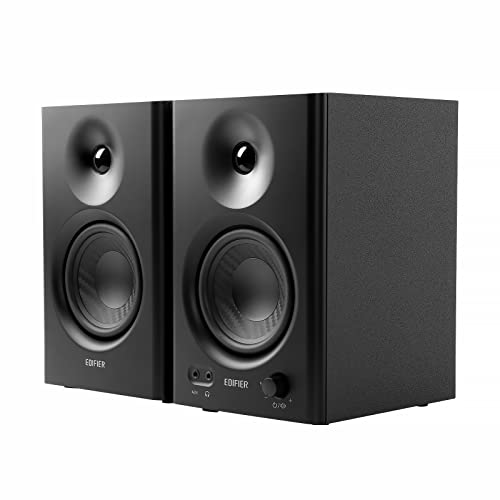
- Almost flat tuning aimed at artists and music creators
- TRS, RCA, AUX, and headphone output for flexible hookups
- Dual mode design plus bass/treble controls
Best For: Creators who want a balanced desktop monitor with flexible inputs
Wireless-Flexible Pair
Ortizan C7 powered studio monitors with Bluetooth

- Bluetooth 5.3 plus RCA, AUX, USB, and TRS inputs
- Built-in 24-bit DAC for USB playback
- 3.5-inch drivers with silk dome tweeters and balanced tuning
Best For: Small setups that need both studio-style inputs and wireless convenience
Accuracy-first nearfield
Yamaha HS5 Powered Studio Monitor Pair

- 5-inch bi-amped 2-way design
- 54 Hz to 30 kHz frequency response
- XLR and TRS input support
Best For: Mixing and monitoring when accuracy matters most
Small-space desktop choice
Yamaha HS3 White Powered Studio Monitor Pair

- 3.5-inch woofer with 26W + 26W output
- RCA, USB, and XLR connectivity
- Room control and high trim adjustments
Best For: Small desks, computer editing, and compact setups
Full-range studio monitor pair
Yamaha HS8 8-Inch Powered Studio Monitor Pair

- 8-inch woofer with 120W bi-amp power
- 38 Hz to 30 kHz frequency response
- Stereo pair for studio recording
Best For: Larger studios that want stronger output and deeper bass
Compact Desktop Pick – PreSonus Eris 3.5 for clear near-field listening
If you want powered studio monitors that fit easily on a desk but still aim for honest, detailed sound, the PreSonus Eris 3.5 is a practical entry point. This pair combines 50 watts of built-in amplification with 3.5-inch woven-composite woofers and 1-inch silk-dome tweeters for balanced listening across music, gaming, streaming, and basic production.
Best For: Desktop setups, casual producers, and anyone who wants a compact stereo pair with flexible input options.
Pros:
- 50 watts of built-in power for clear, room-filling desktop sound
- High- and low-frequency tuning controls help tailor the response to your space
- Balanced TRS, RCA, and front-panel aux inputs cover common gear
- Front headphone jack adds convenient private listening
Cons:
- 3.5-inch drivers are better suited to near-field use than deep bass playback
- Best results will still depend on placement and room setup
The Eris 3.5 is a straightforward choice if you need compact powered studio monitors with useful tuning controls and broad connectivity. It is built for desk-friendly flexibility rather than maximum output, which makes it a strong fit for small rooms and close listening.
Room-Filling Monitor – KRK Classic 7 for bigger studio sound
The KRK Classic 7 is a more substantial option among powered studio monitors, built around a 7-inch driver and 73 watts of self-powered, bi-amped output. Its front-firing port and level controls make it a sensible pick when you want more output and placement flexibility for studio recording or mixing.
Best For: Producers and mixers who want a larger monitor with strong output and front-port placement convenience.
Pros:
- 73 watts of self-powered, bi-amped output with matched amps
- 7-inch driver delivers a bigger monitoring footprint than compact desktop models
- Front-firing port allows easier placement near walls
- Low- and high-frequency controls help match the room and your taste
Cons:
- Single monitor listing means you must pay attention to buying a pair if needed
- Larger size is less desk-friendly than smaller near-field speakers
If you need powered studio monitors with more scale than entry-level desktop speakers, the Classic 7 offers a strong balance of output and control. It is especially appealing for users who want to mix or record with a larger, more assertive monitor.
Budget Desktop Pair – M-AUDIO BX3 for wired near-field use
The M-AUDIO BX3 pair is aimed at users who want powered studio monitors for desktop work without giving up flexibility. With wired, zero-latency monitoring, 3.5-inch Kevlar woofers, silk dome tweeters, and multiple rear inputs, it is built for gaming, podcasting, streaming, and music production on a compact setup.
Best For: Budget-conscious desktop users who need a wired stereo pair for creative work and multimedia.
Pros:
- Zero-latency wired monitoring for studio and live-use cases
- 3.5-inch Kevlar woofers and silk dome tweeters for clear imaging
- Rear 1/4-inch, 1/8-inch, and RCA inputs offer broad compatibility
- Front headphone and aux access is handy for quick listening changes
Cons:
- Small drivers limit low-end output compared with larger monitors
- Best suited to desktop and near-field use rather than bigger rooms
The BX3 is a flexible all-rounder if you want powered studio monitors that can handle both everyday audio and creative tasks. Its strength is convenience and connectivity, making it a good fit for a compact workstation.
Hi-Res Feature Pick – Edifier MR3 with app tuning and Bluetooth
The Edifier MR3 brings a more modern feature set to powered studio monitors, pairing Hi-Res Audio certification with balanced TRS, RCA, AUX, Bluetooth, and headphone output. Its 3.5-inch mid-low drivers, 1-inch tweeters, and app-based EQ control make it a versatile choice for home studios and everyday listening.
Best For: Users who want monitor-style sound with app control, Bluetooth, and plenty of input options.
Pros:
- Hi-Res Audio certification with a wide 52Hz to 40kHz response
- Balanced TRS, RCA, AUX, Bluetooth, and headphone output support
- Music, Monitor, and Custom modes plus EDIFIER ConneX app tuning
- MDF cabinet helps reduce distortion for production and casual use
Cons:
- Wireless features may be more than some buyers need in a studio monitor
- Single-unit listing requires checking the package details carefully
The MR3 is a strong option if you want powered studio monitors with modern convenience features alongside monitoring flexibility. It is especially appealing for mixed-use setups where Bluetooth, app tuning, and multiple inputs all matter.
Desk-Friendly Pair – Mackie CR3.5 3.5" powered studio monitors
If you want powered studio monitors that fit a desk or small studio without giving up a practical monitoring setup, the Mackie CR3.5 is built for that role. Sold as a pair, they use 3.5-inch woofers, RCA/TRS connectivity, and a tone knob plus location switch to help you adapt the sound to your space.
Best For: Desktop creators, small home studios, and casual listening where space is limited.
Pros:
- Sold as a pair and sized for desks and small studios
- Tone knob lets you adjust voicing without menus
- Location switch helps correct bass placement near a wall or in free space
- Includes isolation pads and cables to get started
Cons:
- 3.5-inch drivers are better suited to compact setups than larger rooms
- Wired-only design may not suit wireless-first users
- Single-item listing can be easy to misread since the speakers are sold as a pair
The CR3.5 is a straightforward option if you want a compact powered studio monitor pair with easy setup and simple sound-shaping tools. It is geared more toward near-field use than big-room playback, which is exactly what many desk-based buyers need.
Neutral Desktop Monitor – Edifier MR4 4" active near-field monitors
The Edifier MR4 is a practical choice if you want powered studio monitors tuned for a more neutral listening experience. With a 4-inch woofer, 1-inch silk dome tweeter, and both monitor and music modes, it is set up for creators who need useful desktop monitoring plus everyday playback flexibility.
Best For: Music creators, home recording, and PC users who want a responsive near-field monitor.
Pros:
- Professionally tuned to an almost flat curve for studio-style use
- Flexible inputs include TRS, RCA, AUX, and front headphone out
- Dual mode design switches between monitor and music listening
- Separate high and low frequency controls make adjustments simple
Cons:
- Wired connections only, so no built-in wireless playback
- 4-inch size is compact rather than full-range for larger rooms
- Tabletop layout may still require careful placement for best results
The MR4 stands out as one of the more studio-minded powered studio monitors in this group, especially if you value input flexibility and basic tonal control. It is a good fit when you want a speaker that can handle both critical listening and casual use without overcomplicating the setup.
Wireless-Flexible Pair – Ortizan C7 powered studio monitors with Bluetooth
The Ortizan C7 is a versatile powered studio monitors pair if you want wired monitoring with the convenience of Bluetooth 5.3. It combines RCA, 3.5mm AUX, USB with a built-in 24-bit DAC, and TRS input, making it useful for a small creative setup that also needs easy wireless playback.
Best For: Small music production spaces, mixed-use desks, and users who want both wired and Bluetooth playback.
Pros:
- Bluetooth 5.3 adds quick wireless pairing for phones and tablets
- Built-in 24-bit DAC over USB is designed to reduce signal loss
- TRS balanced input works with mixers and other pro gear
- 3.5-inch drivers and silk dome tweeters are tuned for balanced, detailed sound
Cons:
- 3.5-inch woofer size limits low-end scale compared with larger monitors
- Wireless convenience may not matter if you only want a pure wired studio setup
- More feature-rich than basic monitors, which may be more than some buyers need
For buyers comparing powered studio monitors on flexibility, the C7 offers an appealing mix of pro-style inputs and easy wireless use. It makes sense if you want one compact pair that can handle music production, TV audio, and casual listening without constant cable changes.
Accuracy-first nearfield – Yamaha HS5 Powered Studio Monitor Pair
If you want powered studio monitors that focus on accuracy over hype, the Yamaha HS5 pair is built for that job. With a 5-inch woofer, 1-inch dome tweeter, and a bi-amped design, these monitors are aimed at music production and studio monitoring where hearing the mix clearly matters more than boosted lows.
Best For: Producers and engineers who want a compact, neutral nearfield monitor for critical listening.
Pros:
- 2-way bass reflex design with 5-inch woofer and 1-inch dome tweeter
- Bi-amplified 70W system with 45W LF and 25W HF power
- Wide 54 Hz to 30 kHz frequency response for detailed monitoring
- XLR and TRS inputs support balanced or unbalanced connections
Cons:
- 5-inch size may not deliver the deepest bass on its own
- Sold as a pair, which may be more than casual desktop users need
The HS5 is a straightforward choice if you value sonic purity and a compact footprint. It is best suited to mixing spaces where accuracy is more important than extra low-end emphasis.
Small-space desktop choice – Yamaha HS3 White Powered Studio Monitor Pair
The Yamaha HS3 pair is a compact option in powered studio monitors for small desks and computer-based setups. It uses a 3.5-inch woofer, 0.75-inch dome tweeter, and 26W + 26W output, making it a practical fit for editing, desktop listening, and lighter studio work.
Best For: Desktop creators who need a smaller studio monitor pair for computer work and video editing.
Pros:
- Compact tabletop design fits smaller workspaces
- 3-way connectivity including RCA, USB, and XLR
- Room control and high trim controls help tailor the response
- Compatible with desktops, laptops, smartphones, tablets, and TVs
Cons:
- 3.5-inch woofer limits low-end reach compared with larger monitors
- 26W output is modest for bigger rooms
For a small-room setup, the HS3 keeps things simple and flexible. It is a sensible pick if you want powered studio monitors that can connect easily to modern devices without taking up much space.
Full-range studio monitor pair – Yamaha HS8 8-Inch Powered Studio Monitor Pair
The Yamaha HS8 pair is the largest option here and a strong fit when you want powered studio monitors with more reach and headroom. Its 8-inch woofer, 1-inch dome tweeter, and 120W bi-amped system make it suitable for studio recording and fuller-range monitoring.
Best For: Studio users who want a larger nearfield monitor pair with stronger output and deeper low-end reach.
Pros:
- 8-inch woofer and 1-inch tweeter for larger monitoring duties
- 120W total amplification with 75W LF and 45W HF bi-amp design
- 38 Hz to 30 kHz frequency response for broad coverage
- Pair includes two monitors for stereo studio use
Cons:
- Larger cabinets take more space than smaller monitors
- Heavier build may be less convenient for portable setups
- XLR cables are not included in the box
If your room can handle the size, the HS8 offers the most substantial monitoring option in this group. It is the best match for buyers who want a more powerful powered studio monitor pair for serious studio work.
How We Picked the Best Powered Studio Monitors
We focused on models that make sense for real-world studio use: honest sound balance, practical inputs, reliable build quality, and sizing that fits common desks and small rooms. We also favored options that cover a range of budgets, from compact near-field speakers to larger monitors for more demanding setups.
Quick Comparison
Smaller monitors in the 3.5-inch to 4-inch range are usually best for compact desks, casual production, and multimedia work. Five-inch models often strike the best balance for most home studios, while 7-inch and 8-inch speakers can deliver more low-end output and headroom when your room can support them.
Key Buying Factors for Powered Studio Monitors
Driver Size and Room Size
Driver size affects bass extension and how much air the monitor can move. In smaller rooms, oversized speakers can exaggerate low frequencies and make mixing harder. Match the speaker size to your space, not just your preferences.
Accuracy Vs. Flavor
Some Powered Studio Monitors are tuned to sound more exciting, while others aim for a flatter response. If you plan to mix or edit audio, a more neutral presentation is usually the better choice.
Connectivity
Check for the inputs you actually need. Balanced TRS or XLR connections are ideal for studio gear, while Bluetooth or unbalanced inputs can be convenient for casual listening or desktop use.
Controls and Placement
Volume knobs, tone controls, and room compensation features can help you adapt the speakers to your setup. Even great monitors sound better when placed at ear level and away from walls if possible.
Who Should Buy Which Powered Studio Monitors?
If you want the most compact option for a small desk, look at the smallest pairs first. If you are building a serious home studio and need better bass and more headroom, move up to larger 5-inch, 7-inch, or 8-inch Powered Studio Monitors. For mixed-use setups, consider models with Bluetooth or simple desktop-friendly controls. The best choice is the one that fits your room, your budget, and how you actually work.