Hybrid synthesizers blend familiar analog-style workflow with modern digital sound engines, giving you a wide palette for basses, leads, textures, and evolving pads.
In this roundup, we focus on the best options for players who want hands-on control, flexible sound design, and the right balance of portability, polyphony, and performance features.
Best 10 Hybrid Synthesizers Picks for 2026
Compact Hybrid Poly Synth

- 37-key portable hybrid synth
- Includes MiniFreak VST counterpart
- Beginner-friendly digital/analog blend
Best For: Beginners and compact studio setups
Performance Hybrid Workstation

- Wavetable plus virtual analog engine
- Full-size keys with hands-on controls
- Motional Pad and sequencer onboard
Best For: Performers and sound designers wanting immediate control
Experimental Hybrid Mini Synth
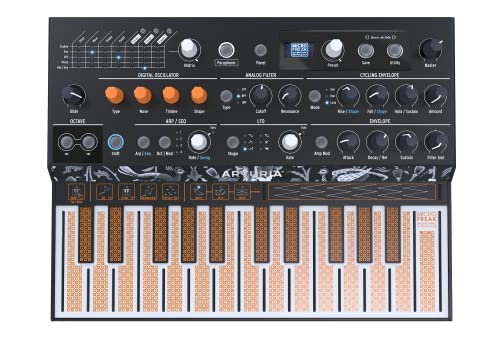
- 17 oscillator modes and analog filter
- Poly aftertouch touch-plate keyboard
- CV, USB, and MIDI connectivity
Best For: Advanced users seeking compact experimental sound design
Ultra-Portable Vector Hybrid

- Tiny hybrid synth with vector oscillators
- Analog low-pass filter and sequencer
- Battery or USB-C powered
Best For: Portable sequencing and quick sound sketches
Portable Performance Pick
Arturia MicroFreak Vocoder Edition Hybrid Synthesizer

- 25-key paraphonic hybrid synth with poly-aftertouch
- Digital oscillators, modulation matrix, and analog filters
- Lightweight desktop build with vocoder-oriented design
Best For: compact expressive performance and experimental sound design
Studio Power Pick
Novation Peak 8-Voice Desktop Polyphonic Synthesizer

- 8-voice desktop hybrid synth with Oxford Oscillators
- 60 wavetables, analog filter, and onboard effects
- 16-slot modulation matrix with polyphonic aftertouch
Best For: deep studio sound design and expressive desktop performance
White Vocoder Hybrid
Arturia MiniFreak 37 Key Polyphonic 6-Voice Hybrid Synthesizer Keyboard

- Two sound engines with 31 modes each
- 37-note keyboard with velocity and aftertouch
- Dual vocoder FX engines and SEM filters
Best For: Intermediate to professional players who want expressive hybrid synthesis and vocoder features
Compact Vector Bundle
Behringer Pro VS MINI Hybrid Vector Synthesizer Bundle

- 4-voice polyphony with 16 vector oscillators
- Includes closed-back studio monitor headphones
- USB-C MIDI plus sequencer and arpeggiator
Best For: Players who want a compact hybrid vector synth bundle for immediate studio use
Black Cable Bundle
Arturia MiniFreak 37-Key Hybrid Synthesizer Bundle

- Dual engines with 6 voices and 22 oscillator modes
- Includes patch cables, MIDI cable, USB cable, and power supply
- Works with Ableton Live, Pro Tools, and FL Studio
Best For: Creators who want the MiniFreak with accessories for a complete starter setup
Compact Hybrid Poly Synth – Arturia MiniFreak 37 Key
Arturia MiniFreak 37 Key Polyphonic 6-Voice Hybrid Synthesizer Keyboard (Standard, 37 Key)
Check Price On AmazonThe Arturia MiniFreak belongs on a shortlist of hybrid synthesizers if you want a compact keyboard that mixes digital and analog character without feeling intimidating. Its 37-key layout, portable design, and included VST counterpart make it a practical pick for learning sound design at home or building ideas in a small setup.
Best For: Beginners and adult players who want an approachable 37-key hybrid synth with software support.
Pros:
- Hybrid sound profile combines digital and analog elements.
- 37-key portable format is easy to fit into smaller spaces.
- Includes MiniFreak VST counterpart for hardware-software workflow.
- USB connectivity keeps setup straightforward.
Cons:
- 37 keys may feel limited for more extended playing.
- Best suited to users comfortable exploring synth parameters.
Overall, the MiniFreak is a strong practical option if you want a compact hybrid synth that encourages experimentation while staying manageable. It balances portability, playability, and software integration well for a first serious synth or a space-saving second keyboard.
Performance Hybrid Workstation – Roland GAIA 2
The Roland GAIA 2 is a practical choice among hybrid synthesizers if you want a performance-ready instrument with a clear workflow. Its wavetable and virtual analog engine, full-size keys, aluminum panel, and hands-on controls make it easy to move from basic sounds into more advanced sound design.
Best For: Players who want a full-size hybrid synth with immediate control and performance features.
Pros:
- Hybrid engine combines wavetable and virtual analog synthesis.
- Full-size keys and logical panel layout support playing and learning.
- Hands-on controls include knobs, sliders, and a Motional Pad.
- Sequencer and multi-effect section add useful sound-shaping tools.
Cons:
- Larger and heavier than compact desktop synths.
- May be more instrument than a casual beginner needs.
In practice, the GAIA 2 stands out for users who want a guided but capable path into deeper synthesis. It offers a solid balance of playability, motion control, and onboard effects for live use or focused studio work.
Experimental Hybrid Mini Synth – Arturia MicroFreak
The Arturia MicroFreak is one of the most distinctive hybrid synthesizers for players who want compact size and unusual sound sources. Its digital oscillator section, resonant analog filter, and touch-plate keybed make it a practical tool for experimental patches, sequencing, and modular-style control in a tiny footprint.
Best For: Advanced users who want a compact experimental synth with deep modulation and CV connectivity.
Pros:
- 17 oscillator modes cover a wide range of digital textures.
- Analog filter adds hybrid character to the sound.
- Touch-plate keyboard supports poly aftertouch.
- CV, USB, and MIDI connectivity expand integration options.
Cons:
- 25-key touch-plate format is unconventional.
- Designed more for exploration than traditional keyboard playing.
The MicroFreak is best viewed as a creative sound-design instrument first and a traditional keyboard second. If your priority is experimentation, randomization, and flexible routing in a very small package, it offers a lot of capability for the size.
Ultra-Portable Vector Hybrid – Behringer Pro VS Mini
The Behringer Pro VS Mini is aimed at players who want hybrid synthesizers in a very small, battery- or USB-powered format. With vector morphing oscillators, an analog low-pass filter, and onboard sequencer and arpeggiator, it is built for fast idea capture and portable sound creation.
Best For: Mobile musicians and budget-minded buyers who want a tiny hybrid synth with sequencing tools.
Pros:
- Very compact, portable design works well for mobile use.
- Hybrid engine uses vector morphing oscillators and an analog low-pass filter.
- Sequencer and arpeggiator add quick pattern-building options.
- USB-C power or battery operation improves flexibility.
Cons:
- Small form factor limits hands-on control space.
- 2.5mm jack connectivity is less standard than full-size ports.
For the size, the Pro VS Mini packs in a lot of practical features for sketching sounds and patterns on the go. It makes the most sense if portability and hybrid synthesis matter more than a full keyboard experience.
Portable Performance Pick – Arturia MicroFreak Vocoder Edition Hybrid Synthesizer
If you want one of the most compact hybrid synthesizers for hands-on experimentation, the Arturia MicroFreak Vocoder Edition stands out with its 25-key paraphonic layout, poly-aftertouch flat keyboard, and digital oscillators paired with analog filters. It’s built for players who like fast modulation changes, unusual textures, and performance features in a small desktop-friendly format.
Best For: Players who want a compact hybrid synth with expressive control and vocoder-ready sound design.
Pros:
- 25-key paraphonic hybrid hardware synth design with poly-aftertouch
- Digital oscillators and modulation matrix for flexible sound shaping
- Analog filters plus arpeggiator for performance and movement
- Small, lightweight build with USB and 3.5mm connectivity
Cons:
- Flat keyboard layout may not suit every player
- Plastic body may feel less premium than metal desktop synths
Overall, this is a strong choice if you want hybrid synthesizers that prioritize expression, modulation, and portability over a traditional keybed feel. The Vocoder Edition keeps the focus on creative play in a very manageable footprint.
Studio Power Pick – Novation Peak 8-Voice Desktop Polyphonic Synthesizer
The Novation Peak is a desktop hybrid synthesizer aimed at players who want deep sound-shaping and a polished performance platform. Its New Oxford Oscillators combine analog-sounding numerically controlled oscillators with 60 customizable wavetables, while the analog filter, onboard effects, and extensive modulation options give it a wide sonic range.
Best For: Synth players who want a powerful desktop polyphonic instrument with deep modulation and performance controls.
Pros:
- 8-voice polyphony with New Oxford Oscillators and 60 wavetables
- Analog filter plus reverb, delay, chorus, and three distortion stages per voice
- 16-slot modulation matrix and 16 direct assignments for detailed control
- Polyphonic aftertouch, two pedal inputs, and animate buttons for expressive playing
Cons:
- Desktop module format may require external keys or controller setup
- Metal desktop design is compact, but not the smallest option here
For hybrid synthesizers that lean toward studio depth and performance flexibility, Peak offers a very capable feature set. It is especially appealing if you want a compact desktop unit with broad tonal options and strong modulation control.
Rhythm-and-Texture Pick – Behringer Grind Semi-modular Hybrid Multi-engine Synthesizer
The Behringer Grind is a semi-modular hybrid synthesizer built for players who want a multi-engine approach to rhythm, percussion, and experimental sound creation. With 24 digital oscillators, 10 percussion/noise engines, an analog ladder filter, and a 32-step sequencer, it is set up for hands-on pattern building and aggressive sound design.
Best For: Sound designers and sequencer-focused players who want a hybrid synth with percussion and noise engines.
Pros:
- Semi-modular hybrid design with 14 synth engines
- 24 digital oscillators plus 10 percussion/noise engines
- Analog ladder filter for shaping and color
- 32-step sequencer for pattern-based workflow
Cons:
- Semi-modular layout may be less straightforward than simple desktop synths
- MIDI-focused connectivity may not suit users wanting broader onboard options
Among hybrid synthesizers, Grind is the most obviously geared toward rhythmic and textural experimentation. It makes the most sense if you want a synth that can cover percussion-like parts, sequenced patterns, and noisy timbres in one unit.
White Vocoder Hybrid – Arturia MiniFreak 37 Key Polyphonic 6-Voice Hybrid Synthesizer Keyboard
Arturia MiniFreak 37 Key Polyphonic 6-Voice Hybrid Synthesizer Keyboard (White, MiniFreak Vocoder)
Check Price On AmazonThe Arturia MiniFreak is a standout choice in hybrid synthesizers for players who want deep sound design without feeling locked into one lane. Its dual sound engines, polyphonic state-variable SEM filters, and two advanced vocoder FX engines make it a versatile keyboard for exploring evolving textures, expressive leads, and experimental tones.
Best For: Intermediate to professional synth players who want a feature-rich hybrid keyboard with vocoder tools and expressive controls.
Pros:
- Two sound engines with 31 modes each for broad tonal range
- 37-note keyboard with velocity and aftertouch for expressive playing
- Polyphonic state-variable SEM filters plus dual vocoder FX engines
- Includes MiniFreak V software support for added workflow options
Cons:
- May be more complex than a beginner-focused synth
- 37 keys may feel compact for some keyboard players
The MiniFreak leans hard into creative exploration, making it a strong pick if you want a hybrid synthesizer that rewards hands-on experimentation. If you value performance features and flexible sound shaping, this one offers a lot of range in a relatively compact footprint.
Compact Vector Bundle – Behringer Pro VS MINI Hybrid Vector Synthesizer Bundle
The Behringer Pro VS MINI is a compact entry in hybrid synthesizers that focuses on vector-based sound shaping and practical studio integration. With 4-voice polyphony, 16 vector oscillators, built-in chorus, and included studio monitor headphones, it offers a straightforward way to start building layered textures and rhythmic ideas.
Best For: Players who want a small hybrid vector synth bundle with headphones for immediate studio use.
Pros:
- 4-voice polyphony with 16 vector oscillators for evolving sounds
- Includes closed-back studio monitor headphones in the bundle
- USB-C MIDI, 5-pin DIN MIDI, and sync I/O for flexible connectivity
- 3-pattern arpeggiator and 16-step, 16-pattern sequencer for pattern work
Cons:
- Only 4-voice polyphony, which limits chord density
- Compact mini format may feel limiting for hands-on control
This bundle makes sense if you want an affordable, compact hybrid synthesizer setup that is ready to use right away. It is especially appealing for producers who care about simple integration and sequenced ideas more than a large keyboard surface.
Black Cable Bundle – Arturia MiniFreak 37-Key Hybrid Synthesizer Bundle
The Arturia MiniFreak bundle is a practical way to get into hybrid synthesizers with the accessories needed to start making music right away. It combines dual digital sound engines, analog filters, rich stereo effects, and flexible modulation, while the included patch cables, MIDI cable, USB cable, power supply, and cloth add immediate value for studio setup.
Best For: Creators who want the MiniFreak plus useful accessories for a more complete starter setup.
Pros:
- Dual-engine hybrid architecture with 6 voices and 22 oscillator modes
- Analog filters, playful modulation, and stereo effects for broad sound design
- Includes patch cables, MIDI cable, USB cable, power supply, and cleaning cloth
- Compatible with Ableton Live, Avid Pro Tools, and FL Studio
Cons:
- Accessory bundle may be more than some buyers need
- 37-key layout is compact compared with larger keyboards
If you want a hybrid synthesizer package that goes beyond the keyboard itself, this bundle is a smart fit. It is aimed at users who want immediate experimentation, strong modulation options, and a more complete out-of-box setup.
How We Picked These Hybrid Synthesizers
We focused on instruments that combine useful digital synthesis engines with practical hardware design. Priority went to models with strong sound-shaping controls, reliable keybeds or compact portability, and enough voice count or modulation depth to support real music production.
We also considered the needs of different buyers: desktop producers, live performers, first-time synth owners, and sound designers who want more than a basic preset machine.
Quick Comparison
If you want the most playable all-around option, look at the 37-key polyphonic models. If your priority is compact experimentation, smaller mini-key and desktop units make more sense. For deeper studio work, the desktop polyphonic synth stands out, while portable vector and semi-modular designs are better for travel or more experimental patching.
Key Buying Factors for Hybrid Synthesizers
Voice Count and Polyphony
More voices usually mean smoother chords, longer pads, and fewer note dropouts. Monophonic and lower-voice designs can still be excellent for bass and leads, but polyphony matters if you want layered harmonies or more cinematic sounds.
Sound Engine and Modulation
Look at the synthesis methods under the hood. Wavetable, virtual analog, vector morphing, and multi-engine setups each offer different strengths. The best Hybrid Synthesizers usually give you enough modulation to move beyond static presets and shape sounds over time.
Hands-On Controls
Knobs, sliders, matrix controls, and performance pads make a big difference. A good interface speeds up learning and makes sound design less frustrating, especially if you plan to program your own patches rather than rely on presets.
Form Factor and Workflow
Choose a keyboard model if you want a self-contained performance instrument. Pick a desktop unit if you already have a controller or prefer studio integration. Mini-key and portable designs suit limited spaces, mobile setups, and sketching ideas quickly.
Who Should Buy Which Hybrid Synthesizers?
Beginners should look for straightforward layouts and compact designs that encourage experimentation without overwhelming menus. Live players may prefer keyboard versions with immediate controls and performance-friendly features. Producers and sound designers will usually get the most value from models with deeper modulation, more voices, and richer engine combinations. If you want a flexible, modern instrument that can cover classic tones and futuristic textures, Hybrid Synthesizers are a smart place to start.