Great stage monitoring can make or break a live performance. The right speaker helps singers hear pitch, gives guitarists and keyboard players clearer timing, and keeps the whole band locked in.
In this roundup, we focused on stage monitors for music that balance volume, vocal clarity, feedback control, and practical setup for rehearsal spaces, clubs, churches, and mobile rigs.
Best 10 Stage Monitors for Music Picks for 2026
Matched Pair Wedge Monitors
Dual 10-Inch Seismic Audio Floor Monitors
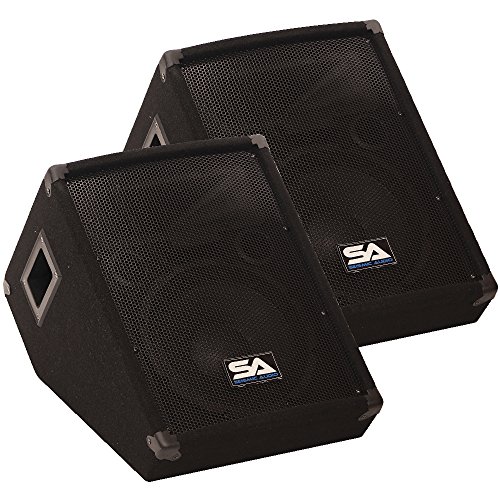
- Pair of 10-inch floor wedges
- 150W RMS / 300W peak each
- Titanium horn with XLR and aux inputs
Best For: Bands and rehearsal spaces needing a matched pair
Feedback-Control Powered Monitor
Feedback-Control Behringer Stage Monitor

- Adjustable feedback filter and limiter
- 12-inch woofer with 250W max output
- XLR, TRS/TS, RCA, and Speakon inputs
Best For: Live setups that need feedback control
Compact Near-Field Pair
Compact PreSonus Desk Monitors

- 3.5-inch powered stereo pair
- Tone controls for high and low frequencies
- TRS, RCA, aux, and headphone jack
Best For: Desktop music and personal near-field listening
Single Wedge Monitor
Single Seismic Audio 10-Inch Stage Wedge

- Single 10-inch floor wedge
- 150W RMS / 300W peak
- Titanium horn with XLR and Speakon support
Best For: Solo performers and small stages
Ultra-Compact PA/Monitor Pick

- 50-watt Class-D monitor in a compact enclosure
- 3-channel mixer with 3-band EQ for basic control
- Bluetooth streaming and USB MP3 playback included
Best For: Small vocal and keyboard monitoring setups with media playback
Desktop Studio Monitor Pair

- Wired pair with zero-latency monitoring
- 3.5-inch Kevlar woofers and silk dome tweeters
- Rear EQ and multiple input options for flexibility
Best For: Near-field music production and desktop monitoring
Heavy-Duty Stage Wedge

- 15-inch passive wedge with 1400 watts peak power
- 70 degree x 50 degree coverage for wider dispersion
- Dual 1/4-inch and Speakon inputs/outputs
Best For: Louder live music and DJ stage monitoring
Compact Powered Wedge
Sound Town METIS-10MPW 10-inch Powered Stage Monitor

- 300W powered wedge with 10-inch woofer and titanium compression driver
- XLR, 1/4-inch, and 1/8-inch inputs with daisy-chain output
- Onboard 3-band EQ for quick tonal adjustment
Best For: small stages, churches, bars, and rehearsals
Matched Monitor Pair
Seismic Audio SA-10MT-PW-Pair 10-inch Powered Wedges

- Pair of powered 2-way 10-inch floor monitors
- XLR combo, 1/4-inch, 3.5 mm, and Speakon inputs
- 3-band EQ, gain, and volume controls for live sound
Best For: bands and venues needing a matched pair of wedge monitors
Lightweight Monitor
Gemini AS-2108P 8-inch Powered Floor Monitor

- 300W powered speaker with 8-inch woofer and piezo HF driver
- 11-pound cabinet for easy transport
- XLR, 1/4-inch, RCA, and AUX wired inputs
Best For: small gigs, rehearsal spaces, and portable monitoring
Matched Pair Wedge Monitors – Dual 10-Inch Seismic Audio Floor Monitors
Seismic Audio - SA-10MT - Pair of 10" Floor / Stage Monitors Wedge Style with Titanium Horn
Check Price On AmazonIf you want stage monitors for music that can cover a small live setup without a lot of fuss, this Seismic Audio pair is built for floor-mounted monitoring with a 2-way design and titanium compression horn. The 10-inch woofer and 300-watt peak rating give it enough presence for rehearsals, gigs, and general stage monitoring where you need clear directional sound.
Best For: Bands, rehearsal rooms, and live performers who want a matched pair of wedge-style stage monitors.
Pros:
- Sold as a pair for left/right or multiple monitor positions
- 2-way 10-inch design with titanium compression horn for stage use
- 150 watts RMS and 300 watts peak per monitor
- Wired XLR and auxiliary connectivity for flexible hookup options
Cons:
- Not waterproof or weather-resistant
- Heavier than compact desktop-style options at 44 pounds for the set
For players who need straightforward, floor-based stage monitoring, this model focuses on utility over extras. It is a practical option when you want a basic powered-style monitor setup without moving into smaller studio-monitor territory.
Feedback-Control Powered Monitor – Feedback-Control Behringer Stage Monitor
For stage monitors for music that need more control on louder stages, this Behringer EUROLIVE monitor includes an adjustable feedback filter and integrated limiter to help manage output. Its 12-inch woofer, 250-watt power rating, and bi-amped Class-D design make it a solid pick for live performance and music playback where feedback control matters.
Best For: Performers and venues that want a powered monitor with built-in feedback management.
Pros:
- Adjustable feedback filter helps reduce unwanted stage howl
- Integrated limiter adds speaker protection and control
- 12-inch woofer with 250 watts maximum output
- Multiple wired inputs including XLR, 1/4-inch TRS/TS, RCA, and Speakon
Cons:
- Mono output only
- Not water resistant
This is a useful choice if your priority is control on stage rather than a compact footprint. The mix of feedback management and broad input compatibility makes it easy to fit into many live sound setups.
Compact Near-Field Pair – Compact PreSonus Desk Monitors
These PreSonus Eris 3.5 speakers are not traditional stage monitors for music, but they can still be a useful compact option when you need accurate near-field sound on a desk or in a small practice space. The 50-watt powered stereo pair, 3.5-inch woofers, and tuning controls are aimed at clear, balanced listening rather than live wedge monitoring.
Best For: Desktop music work, gaming, and small personal listening setups where compact accuracy matters.
Pros:
- Sold as a stereo pair with built-in amplification
- High- and low-frequency tuning controls help tailor the sound
- Front aux input and headphone jack add everyday convenience
- Multiple connection options including TRS and RCA
Cons:
- Designed for desktop/bookshelf use, not floor-mounted stage monitoring
- 3.5-inch drivers are smaller than typical live stage monitor drivers
If your search for stage monitors for music is really about compact, close-up monitoring at a desk, these are a practical fit. For actual live wedges, though, their intended use is more studio and multimedia than stage performance.
Single Wedge Monitor – Single Seismic Audio 10-Inch Stage Wedge
Seismic Audio - SA-10MTSingle - 10" Floor / Stage Monitor Wedge Style with Titanium Horn
Check Price On AmazonIf you need a single stage monitor for music rather than a pair, this Seismic Audio wedge gives you a simple floor-monitor option with a 10-inch woofer and titanium horn driver. Its 300-watt peak rating and 2-way design make it suitable for live performances, practice spaces, and monitor setups where one dedicated wedge is enough.
Best For: Solo performers, small stages, and users who only need one floor monitor.
Pros:
- Single wedge-style monitor keeps the setup compact
- 2-way 10-inch speaker with titanium horn driver
- 150 watts RMS and 300 watts peak output
- XLR and Speakon-compatible wired connectivity
Cons:
- Only one monitor is included
- Not waterproof or weather-resistant
This model makes sense when you want a straightforward monitor without buying a full pair. It stays focused on stage use, with the kind of output and connector options that fit basic live sound needs.
Ultra-Compact PA/Monitor Pick – Behringer EUROLIVE B105D
If you want a compact option for stage monitors for music, the Behringer EUROLIVE B105D is built for basic vocal and keyboard monitoring without taking up much space. Its 50-watt Class-D design, 3-channel mixer, 3-band EQ, Bluetooth streaming, and USB MP3 playback make it a flexible pick for small setups, practice spaces, and simple live-use applications.
Best For: Vocal and keyboard monitoring, plus small rooms, rehearsal spaces, and casual live playback.
Pros:
- 50-watt monitor with Class-D amplification for a lightweight, compact build
- 3-channel mixer with 3-band EQ for basic tone shaping
- Bluetooth audio streaming and built-in MP3 playback via USB
- Works for vocal monitoring, keyboards, home recording, and multimedia use
Cons:
- Single 5-inch design limits low-end output compared with larger stage monitors
- Best suited to smaller monitoring jobs rather than high-volume stage use
- Corded power means it is not a portable battery-powered monitor
Overall, the B105D is a practical entry-level monitor if you need simple monitoring and media playback in one compact speaker. It is less about brute stage output and more about convenience, portability, and everyday flexibility.
Desktop Studio Monitor Pair – M-AUDIO BX3
For stage monitors for music in a desktop or near-field setup, the M-AUDIO BX3 is a wired pair focused on clean, zero-latency monitoring. The 3.5-inch Kevlar woofers, silk dome tweeters, MDF cabinet, and rear EQ controls make them a solid choice when you want studio-style clarity for streaming, podcasting, music production, or casual mixing.
Best For: Desktop monitoring, music production, live streaming, podcasting, and general studio use.
Pros:
- Wired, zero-latency monitoring for uninterrupted audio
- 3.5-inch Kevlar woofers with silk dome tweeters for clear stereo imaging
- MDF cabinet and bass reflex design to reduce vibration and improve depth
- Rear and front inputs offer flexible hookup options for studio gear and headphones
Cons:
- Small 3.5-inch drivers are better for near-field use than larger-room monitoring
- Designed as desktop speakers, not rugged stage wedges
- Requires wired connections, so it is less convenient for quick portable setups
The BX3 makes sense if your priority is accurate, compact monitoring at a desk rather than high-output stage coverage. It offers useful connection options and tuning controls, but its size keeps it firmly in the desktop studio category.
Heavy-Duty Stage Wedge – Rockville RSM15P
If you need stage monitors for music with more power and coverage, the Rockville RSM15P is built as a 15-inch passive floor wedge for live performance and DJ use. Its 1400-watt peak rating, titanium compression driver, 70 degree x 50 degree dispersion, and rugged road-ready cabinet make it a straightforward option for bigger stage applications.
Best For: Live music, DJ monitoring, and larger stage setups that need strong projection.
Pros:
- 15-inch woofer with 1400 watts peak power for high-output monitoring
- 70 degree x 50 degree horn coverage for wider sound dispersion
- Angled wedge enclosure is made for floor monitoring on stage
- Dual 1/4-inch and Speakon connections fit pro audio setups
Cons:
- Passive design requires an external amplifier
- At 54.9 pounds, it is heavier than compact monitor options
- Larger cabinet may be more than needed for small rehearsal rooms
For players and DJs who want a more traditional powered-by-an-amp monitor wedge, the RSM15P offers the kind of output and build quality that suits demanding live environments. It is less portable than smaller monitors, but it brings the scale and coverage that bigger stages often need.
Compact Powered Wedge – Sound Town METIS-10MPW 10-inch Powered Stage Monitor
If you need stage monitors for music that are simple to deploy and focused on live vocals or instrument monitoring, the Sound Town METIS-10MPW is built for that job. Its 10-inch woofer, 1-inch titanium compression driver, and onboard 3-band EQ make it easy to adapt to rehearsal rooms, churches, bars, and other small-venue setups.
Best For: Players, churches, and small venues that want a powered wedge with basic tone shaping and flexible wired inputs.
Pros:
- 300W integrated amplification in a compact powered wedge design
- 10-inch woofer plus 1-inch titanium compression driver for clear monitor sound
- XLR line in/out, 1/4-inch aux, and 1/8-inch MP3 input for flexible connectivity
- 3-band bass, mid, and treble controls for quick room adjustments
Cons:
- Wired-only setup with no wireless option
- Single unit included, so larger stages will need multiple monitors
- Carpet-covered cabinet is sturdy but not water resistant
This is a practical choice if you want an affordable powered stage monitor that stays focused on the essentials. It offers the core inputs and EQ you need for straightforward live sound use without extra complexity.
Matched Monitor Pair – Seismic Audio SA-10MT-PW-Pair 10-inch Powered Wedges
For stage monitors for music where you need two powered wedges in one package, the Seismic Audio SA-10MT-PW-Pair is a straightforward live-sound option. Each 10-inch floor monitor includes a titanium horn, XLR combo inputs, a 3-band EQ, and the wired connections needed for PA, studio, or rehearsal use.
Best For: Bands, studios, and live sound setups that need a matched pair of powered wedge monitors.
Pros:
- Includes a pair of powered 2-way 10-inch stage monitor wedges
- 3-band EQ and gain/volume controls for basic tuning
- XLR combo inputs plus 1/4-inch, 3.5 mm, and Speakon connections
- Recessed handles and metal grille for road-ready handling
Cons:
- Heavy pair at 70 pounds total
- No wireless connectivity
- Basic powered monitor design without advanced features
This pair makes sense if you want matched monitors without buying separate units. It is a utility-first option that prioritizes wired flexibility and simple control over extras.
Lightweight Monitor – Gemini AS-2108P 8-inch Powered Floor Monitor
If you want stage monitors for music in a small, portable format, the Gemini AS-2108P keeps things lightweight and easy to move. With 300 watts of power, an 8-inch woofer, and wired inputs including XLR, 1/4-inch, RCA, and AUX, it covers monitoring duties for rehearsals, parties, and smaller live gigs.
Best For: Portable monitoring and small venues where a light, wired-only powered speaker is easier to manage.
Pros:
- 300W powered design in an 11-pound cabinet
- 8-inch woofer with piezo HF driver for clear, compact monitoring
- Multiple wired inputs: XLR/1/4-inch, RCA, and AUX
- Onboard bass and treble controls for quick adjustment
Cons:
- 8-inch design may be less full than larger stage monitors
- No Bluetooth or wireless option
- Best suited to smaller spaces rather than larger stages
This is a good fit when portability matters as much as monitoring clarity. It is a simple, wired speaker that works well when you want one compact unit for practice or small-event sound.
How We Picked These Stage Monitors for Music
We looked for models that make sense for real-world live use: usable output, stage-friendly dispersion, practical connectivity, and features that support clean monitoring at performance volume. We also considered whether each option is better suited to vocals, general band monitoring, or dual-use as a small PA speaker.
Because Stage Monitors for Music are used in different environments, we included a range of powered and passive designs, compact and larger cabinets, and options that fit everything from small rehearsal rooms to louder stage setups.
Quick Comparison
For the fastest decision, think in terms of room size and use case. Compact monitors are usually best for vocals, practice, and tighter stages. Larger 10- to 15-inch models can deliver more low-end and headroom for full-band monitoring. Powered monitors simplify setup, while passive monitors can be a better match if you already own an amp or want to build a modular system.
Key Buying Factors for Stage Monitors for Music
Power and Headroom
Choose enough output for the room so the monitor can stay clear without being pushed to its limit. More headroom generally means less distortion and better vocal intelligibility.
Driver Size and Sound Character
Smaller drivers tend to sound tighter and more focused, while 10-inch and 12-inch monitors often provide a stronger full-range sound. If bass response matters for keys or playback-heavy sets, a larger cabinet may be worth it.
Powered Vs. Passive
Powered monitors are convenient because the amp is built in, which reduces gear and wiring. Passive models can be more flexible in existing PA systems, but they require an external amplifier and matching power carefully.
Feedback Control and Dispersion
Good Stage Monitors for Music should aim sound where performers need it without spilling too much into microphones. Features like horn design, wedge angle, and feedback-friendly voicing can make a noticeable difference on a busy stage.
Portability and Placement
Weight, cabinet shape, and handle layout matter if you move gear often. A monitor that is easy to place and reposition will save time during setup and soundcheck.
Who Should Buy Which Stage Monitors for Music?
Singers and smaller bands should usually lean toward compact powered wedges for simple setup and clear vocals. Churches, venues, and louder cover bands may benefit from 10-inch or 12-inch options with more output and broader coverage. If you already have an amp rack or want a lower-cost expansion, a passive monitor can be the smarter fit. For rehearsal rooms, practice rigs, and multi-use spaces, smaller monitors may offer the best balance of clarity, cost, and convenience.
Ultimately, the best choice depends on how loud you play, how many performers need monitoring, and whether you want a plug-and-play solution or a more customizable system.